Published on: 2026-01-29
Updated on: 2026-01-29
Major forex pairs are entering 2026 amid a highly volatile environment. The Federal Reserve has paused rate cuts, maintaining a policy rate of 3.50% -3.75%. Japan's 0.75% policy rate no longer suppresses yen volatility, and tariff policy has evolved from negotiation to a persistent macroeconomic shock. When rate differentials become unstable and political factors drive prices, foreign exchange markets shift rapidly rather than drift.
These developments are unfolding as the global economic cycle remains intact but fragile. The International Monetary Fund projects global growth of 3.3% in 2026 and 3.2% in 2027. This growth rate may coincide with significant foreign exchange volatility, primarily driven by frequent regime shifts between risk-on carry trades and risk-off deleveraging.
Furthermore, commodity markets are shaped by continued production increases projected by the U.S. Energy Information Administration, while geopolitical risks can trigger abrupt price spikes. This environment creates conditions favorable for trend bursts, stop runs, and pronounced mean reversion.
Policy divergence remains wide and unstable: rate spreads still matter, but political shocks can quickly dominate price action.
The yen has regained two-way risk: crowded funding trades can unwind fast when Japan rates or risk appetite shifts.
Tariffs are a major volatility source: headline-driven USD liquidity bids can trigger sudden risk-off moves.
Commodity FX is not only about China: bearish fundamentals can be interrupted by geopolitics and supply-route risks.
Cross-currency pairs matter more: relative-value crosses (e.g., EUR/GBP) can offer cleaner signals when USD absorbs most headline volatility.
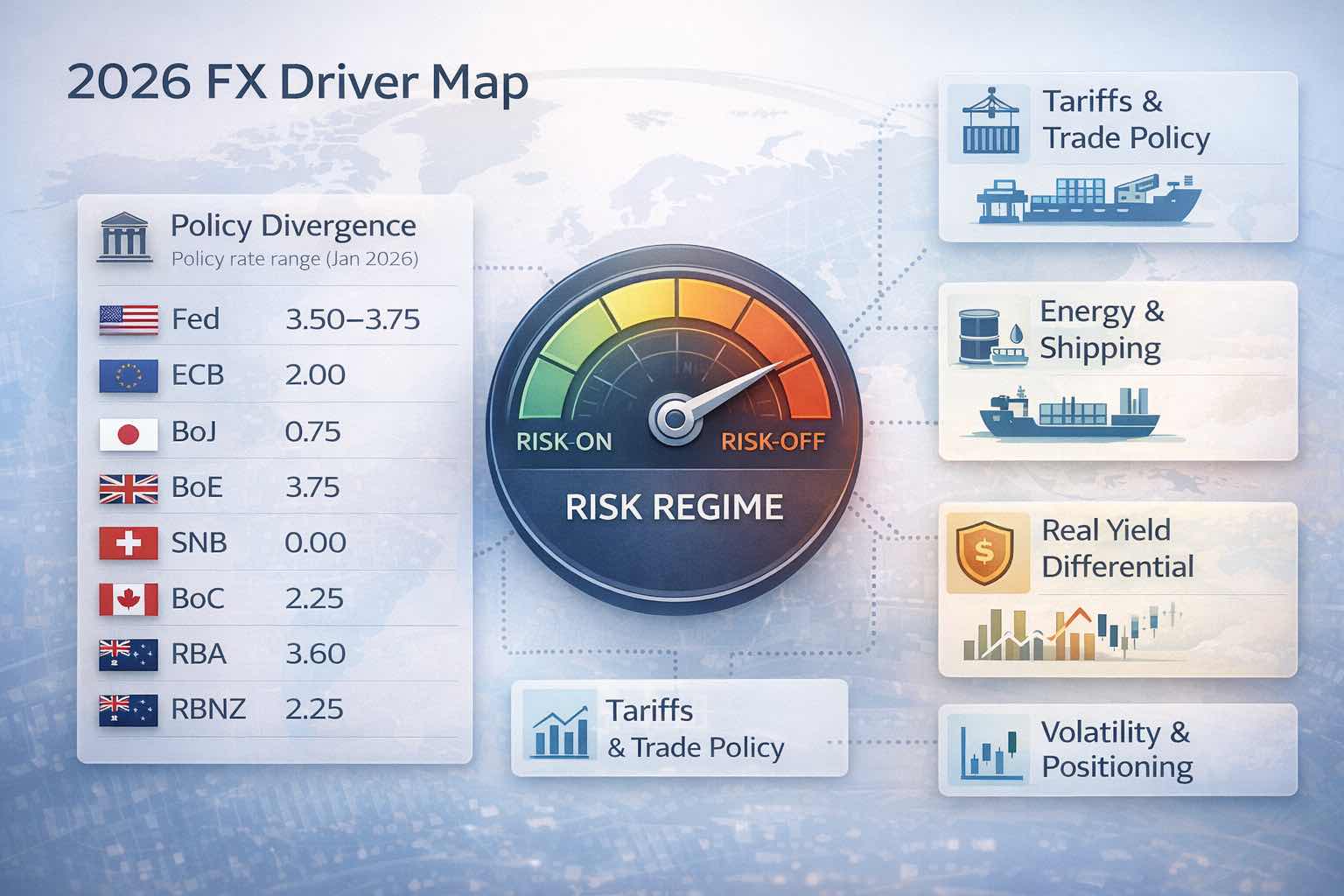
| Central bank | Policy setting (latest) | What it means for FX in 2026 |
|---|---|---|
| Federal Reserve | 3.50%–3.75% | USD carry remains relevant, but the pause increases sensitivity to data surprises |
| ECB (deposit) | 2.00% | EUR reacts more to growth and trade shocks than to incremental rate tweaks |
| Bank of Japan | ~0.75% | JPY volatility is back, and carry trades are less “free” |
| Bank of England | 3.75% | GBP becomes a rates-repricing and fiscal-confidence trade again |
| Swiss National Bank | 0% | CHF retains haven convexity, with intervention tail risk |
| Bank of Canada | 2.25% | CAD trades as oil + North America policy risk, not just rates |
| RBA | 3.60% | AUD is a risk-regime proxy with enough carry to attract positioning |
| RBNZ | 2.25% | NZD remains high beta to global growth and risk sentiment |
| Pair | 2026 move potential | Reason |
|---|---|---|
| EUR/USD | High | Clean expression of US growth, tariff shocks, and shifting Fed path expectations |
| USD/JPY | Very High | BoJ policy reintroduces convexity; small yield repricing can drive outsized moves |
| GBP/USD | Medium-High | GBP becomes highly sensitive to rates repricing and confidence shocks |
| USD/CHF | Very High | Haven flows plus intervention risk can produce fast moves and abrupt reversals |
| USD/CAD | High | CAD is a conduit for oil volatility and North American trade/tariff risk |
| AUD/USD | Medium-High | Carry attracts positioning, but AUD de-rates sharply in risk-off regimes |
| NZD/USD | Medium | Higher beta and thinner liquidity can create overshoots and mean reversion |
| EUR/JPY | Very High | Europe growth sensitivity combined with revived JPY volatility |
| AUD/JPY | Very High | Pure risk-on carry versus risk-off unwind cross |
| EUR/GBP | Medium-High | Cleaner relative-value cross when USD is dominated by headline volatility |
Rate-path repricing and shifts in risk regimes can dominate. During risk-off episodes, demand for USD liquidity can pressure EUR/USD quickly; in risk-on conditions it may appreciate more gradually.
US inflation and labor surprises that alter Fed expectations
Euro area growth surprises that shift ECB easing assumptions
Trade and tariff headlines that compress global risk appetite
Sharp downside in stress; slower, steadier upside when carry and valuation reassert.
More volatility-sensitive than a slow carry trade. Repricing of Japan rates and global risk swings can trigger rapid reversals.
BoJ communication and policy-normalization signals
US yield swings on growth or inflation surprises
Equity drawdowns that unwind carry
Trends in calm markets; sharp reversals when volatility rises. Disproportionate yield moves can precede FX acceleration.
Rate differentials and confidence. Sterling can swing around inflation persistence, growth weakness, and fiscal credibility headlines.
UK services inflation, wages, and retail activity
BoE guidance on the pace of easing
Broad USD risk swings that overwhelm UK idiosyncrasies
Rallies can be fragile during broad USD strength; when USD weakens, GBP can rise quickly if rates expectations reprice.
Risk premia and policy response. CHF often appreciates during stress; intervention risk can shape speed and persistence.
Geopolitical escalation or risk sentiment deterioration
Credit events or banking stress narratives
Signals that reprice intervention probability
Sharp, directional moves in stress, followed by abrupt reversals when conditions stabilize.
Oil prices and North American macro risk, with trade uncertainty amplifying otherwise oil-driven moves.
Oil shocks from geopolitics and supply routes
US trade policy headlines repricing cross-border growth
Canadian growth prints shifting the domestic rate path
Strongest trends when oil and risk sentiment align; volatility rises when oil signals diverge from rate spreads.
Barometer for global growth and risk regimes, with enough yield sensitivity to attract positioning when volatility is low.
Global PMI momentum and risk appetite
Trade-policy developments affecting Asia-linked demand expectations
Shifts in the US rate path changing USD carry attractiveness
Fast drawdowns during volatility spikes; slower recoveries. Failure to rally on risk-on days can signal fragility.
Higher-beta cousin to AUD with thinner liquidity, making overshoots and frequent breaks more common.
Broad risk sentiment shifts
Global rate volatility, especially the US curve
Commodity and Asia-growth narrative changes
Breaks technical levels more often and then mean-reverts; cleaner trends reflect sustained risk regimes.
Blends carry conditions with Japanese volatility. Calm periods behave like carry; stress periods turn it into a deleveraging instrument.
BoJ-driven yield volatility
European growth surprises and political risk premia
Equity drawdowns and volatility spikes
Declines often occur faster than rallies; failure to recover quickly after a volatility spike can signal a longer unwind.
A clean risk-on carry versus risk-off unwind gauge, often capturing regime changes early when trade and geopolitics are unstable.
Volatility spikes and equity drawdowns
BoJ surprises that reprice JPY funding costs
Asia-linked growth narrative shifts
Crowded carry positioning can produce steep unwinds; lighter positioning tends to stabilize faster after shocks.
Relative-value cross for policy divergence within Europe without USD headline interference; reacts to which economy weakens faster and which central bank is expected to ease more.
UK inflation and wages versus euro area growth momentum
Fiscal credibility headlines
Surprises that reprice the relative easing path
Often ranges quietly, then moves sharply when expectations shift; rewards patience and clear thesis positioning.
Major forex pairs are the most actively traded currency pairs, typically involving the U.S. dollar, euro, yen, pound, Swiss franc, Canadian dollar, Australian dollar, and New Zealand dollar. These pairs tend to have tighter spreads and deeper liquidity.
Pairs linked to Japanese normalization and haven flows are expected to show significant volatility, including USD/JPY, EUR/JPY, AUD/JPY, and USD/CHF.
Tariffs can shift growth expectations, inflation pass-through, and risk sentiment, increasing the frequency of abrupt risk-off moves where USD and CHF can strengthen quickly.
A balanced watchlist can include a global risk barometer (EUR/USD), a Japan volatility anchor (USD/JPY), a haven pair (USD/CHF), an oil-and-trade conduit (USD/CAD), and a relative-value cross (EUR/GBP).
Both can work: baseline growth can sustain ranges, but regime shifts can decisively break them. Traders often benefit from focusing on catalysts, invalidation levels, and volatility conditions rather than static patterns.
2026 is likely to feature persistent policy divergence, renewed yen volatility, and recurring tariff risks. The FX environment may alternate between carry-friendly conditions and shock-driven repricing. Building a watchlist around the ten pairs above concentrates attention on the currencies most likely to reflect these dominant forces.
Disclaimer: This material is for general information purposes only and is not intended as (and should not be considered to be) financial, investment, or other advice on which reliance should be placed. No opinion given in the material constitutes a recommendation by EBC or the author that any particular investment, security, transaction, or investment strategy is suitable for any specific person.