Published on: 2026-03-13
Updated on: 2026-03-13
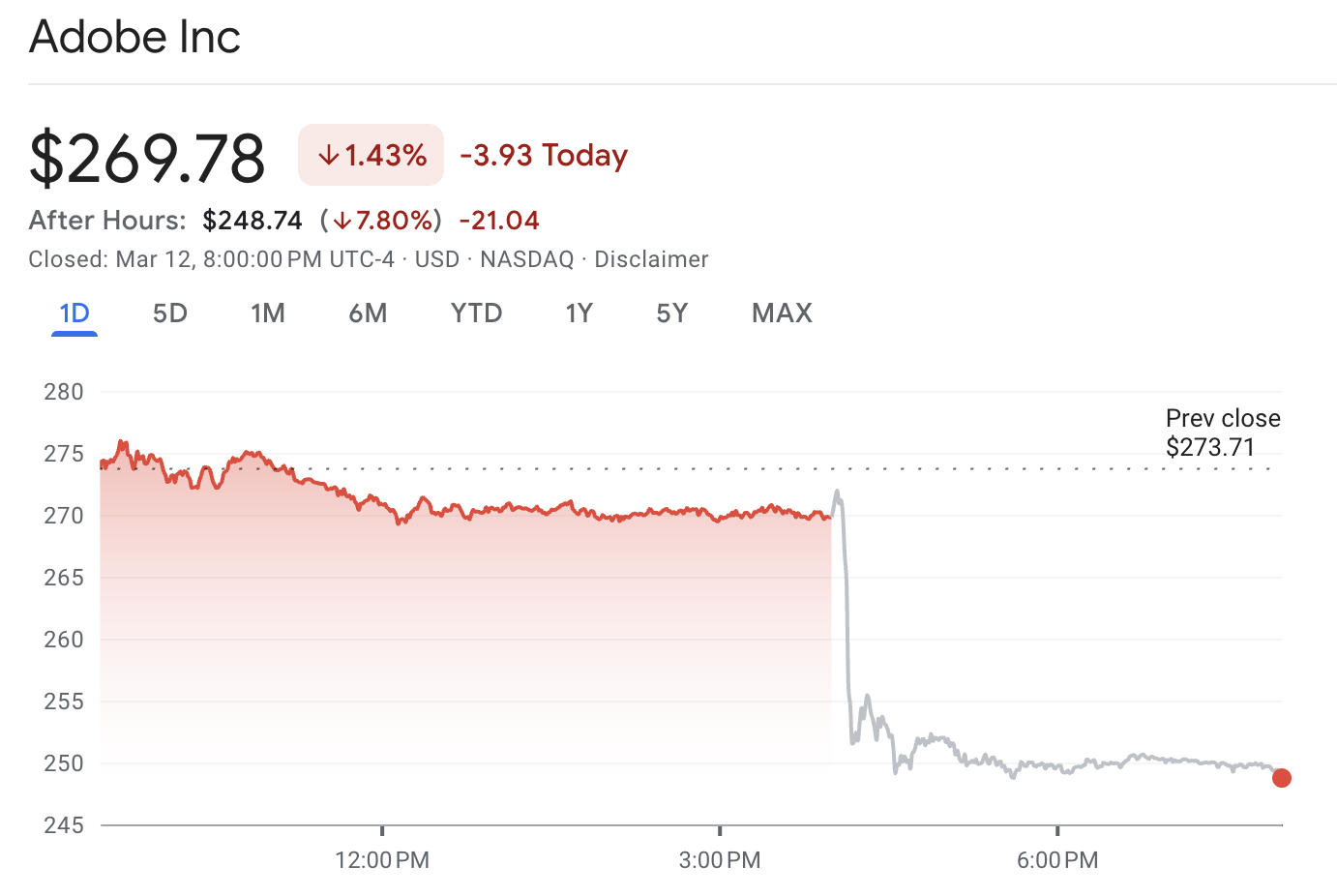
Adobe reported strong earnings results; however, the stock price fell. On March 12, 2026, ADBE stock closed at $269.78, down 1.44%, and then dropped to $248.74 in after-hours trading, reflecting a further 7.80% decline. The market did not question the results themselves, but rather what they indicate for future growth.
In its fiscal first quarter of 2026, Adobe reported record revenue of $6.40 billion, non-GAAP earnings per share of $6.06, total ARR of $26.06 billion, and record operating cash flow of $2.96 billion. Adobe also guided second-quarter revenue to $6.43 billion to $6.48 billion and said AI-first ARR more than tripled YoY.
However, Wall Street quickly shifted attention to concerns beyond the numbers. Investors are more concerned about slower recurring revenue growth, ongoing anxiety regarding AI competition, and a new leadership uncertainty after Adobe announced that Shantanu Narayen will step down as CEO once a successor is appointed.
Hard Catalyst: Earnings beat, but not a reacceleration beat.
Hard Catalyst: Guidance was positive, but not exciting enough.
Hard Catalyst: A CEO transition was announced, which added uncertainty.
Soft Catalyst: Investors remain uneasy about AI monetization and the potential for competition.
Soft Catalyst: Heavy volume amplified the move.
Soft Catalyst: The stock remains below major moving averages.
Adobe's quarter was objectively good. Revenue rose 12% to $6.40 billion, non-GAAP EPS came in at $6.06, and operating cash flow reached a record $2.96 billion.
Subscription revenue grew 13%, Business Professionals and Consumers revenue rose 16%, and Creative and Marketing Professionals revenue climbed 12%. Those are healthy numbers for a company of Adobe's size.
The problem is that Adobe isn't valued like an ordinary software company. Investors want proof that AI can meaningfully and quickly boost growth. A simple beat is no longer enough.
Adobe guided second-quarter revenue to $6.43 billion to $6.48 billion and non-GAAP EPS to $5.80 to $5.85, while reaffirming its previously issued full-year fiscal 2026 targets.
That is supportive, but it does not suggest a sharp acceleration in growth. Traders were hoping for stronger evidence that Adobe's AI push is about to change the revenue curve.
That gap between "good" and "great" matters. In a nervous market, stocks often fall when they fail to exceed already high expectations.
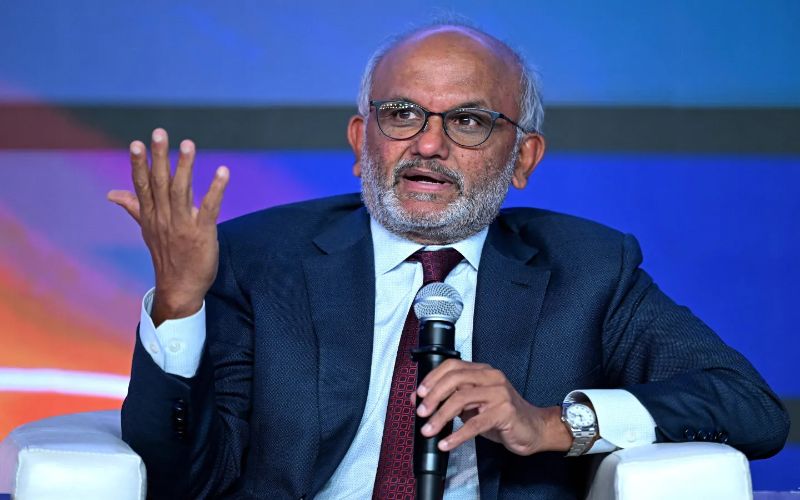
The biggest hard negative catalyst was the timing of the CEO transition. Adobe said Shantanu Narayen, CEO for 18 years, will step down once a successor is named, but will remain board chair.
Even if the transition is orderly, the announcement adds uncertainty at a time when Adobe is already trying to convince investors that its AI strategy can defend and expand its moat.
Markets dislike added uncertainty, especially when it arrives on earnings day.
Adobe is a leader in AI. The company is rapidly advancing AI across creativity, productivity, and customer experience tools, and management demonstrates strong AI-first ARR growth.
Despite these advancements, investor concerns persist. Discussions following the release highlighted ongoing fears that AI-native competitors will challenge parts of Adobe's business, and that Adobe must demonstrate its new AI offerings will drive faster, more sustainable revenue growth across the company.
These concerns have weighed on the stock for months and remain despite the company exceeding expectations this quarter.
| Metric | Current (FY2026 / March 2026) | Historical Comparison / Notes |
|---|---|---|
| Revenue (Q1 FY2026) | $6.40B (+12% YoY) | Q1 FY2025 revenue was $5.71B, acceleration evident |
| Operating Cash Flow (Q1) | $2.96B (record) | Good YoY Improvement |
| GAAP Net Income (Q1 FY2026) | $1.89B ($4.60/share) | Q1 FY2025 GAAP net income was $1.81B and diluted GAAP EPS was $4.14. |
| Non-GAAP EPS (Q1 FY2026) | $6.06 | Recent coverage put consensus near $5.87, so the beat was about 3.2%. |
| Gross Margin (TTM) | 89.27% | Among the highest in enterprise software |
| EBITDA (TTM) | $9.24B (38.88% margin) | Structurally excellent; improving |
| Trailing P/E | About 15–16x | Current market-data pages show trailing P/E around 16.15, while Macrotrends recently showed 15.33. |
| Forward P/E | 11.48x | - |
| P/FCF (TTM) | 11.16x | Suggest Deep Value |
| EV/Sales | 4.63x current EV/Sales; 4.14x forward P/S | Significant Discount |
| 52-week range | Roughly $244.28–$453.26 | Stock trading near multi-year lows |
| Analyst average price target | About $383–$395 | MarketBeat shows $383.08 and Stock Analysis shows $395.45, implying about 42%–47% upside from $269.78. |
| ROE (TTM) | 55.43% | Exceptional capital efficiency |
Adobe's Q1 FY2026 results were unequivocally strong. The valuation is even more compelling. Adobe currently trades at approximately 16.15x trailing earnings and 11.48x forward earnings, with $9.85 billion in trailing free cash flow, an outstanding 89.27% gross margin, and a highly attractive P/FCF multiple of 11.16x.
On an EV/Sales basis, the stock trades at just 4.63 times current sales and 4.14 times forward sales, a striking discount for a software franchise with Adobe's profitability, recurring revenue, and robust cash generation. This combination of robust fundamentals and attractive valuation positions Adobe as a standout opportunity in the sector.
The post-earnings weakness was not a verdict on the quarter itself. The selloff reflects concerns about CEO changes, slowing ARR growth, and doubts about Adobe's ability to quickly translate its AI product cycle into significant revenue.
In other words, the market is discounting uncertainty around the next leg of growth rather than signaling a deterioration in the core business.
From a technical analysis perspective, Adobe remains in a medium-term downtrend. ADBE stock is currently trading below its 50-day moving average of $288.41 and its 200-day moving average of $340.29, while the RSI is near 45.66.
That is weak momentum, but not yet a deeply oversold reading. Short interest is only about 3.52% of float, so this is not a squeeze story. It is a plain, sentimental, and chart-structured story.
| Level | Type | Why It Matters |
|---|---|---|
| $248.50 to $249.00 | Immediate support | March 13 intraday low and after-hours print |
| $244.30 to $245.00 | Stronger support | February 24 swing low and current 52-week low area |
| $257.00 to $260.00 | First rebound resistance | Recent pivot zone from late February and early March |
| $269.80 to $273.40 | Near-term resistance | March 12 close and regular-session opening zone |
| $276.00 to $281.80 | Major resistance | March 12 intraday high and March 10 close area |
For bulls, the first goal is simple: Hold above the $248.50 to $249.00 area and reclaim the $257 to $260 band.
For bears, a clean break below $248 opens the door to a test of the $244 zone. If Adobe cannot recover the $269.80 to $273.40 area quickly, sellers are likely to stay in control through the next two sessions.
Adobe beat on revenue and profit, but the market focused on modest growth guidance, slower enthusiasm around ARR momentum, and the surprise CEO transition. Those concerns outweighed the headline beat.
Yes. Adobe posted record Q1 revenue of $6.40 billion, non-GAAP EPS of $6.06, and record operating cash flow of $2.96 billion. The business is continuing to perform well.
Relative to its own recent history, it is cheaper than it was. Adobe's current price-to-sales and price-to-book multiples are both below their year-end averages for 2022 to 2025.
Not really. Short interest is low at about 3.52% of float, which suggests this is not a squeeze unwind or meme-style move. It looks more like a broad institutional repricing after earnings.
In conclusion, Adobe's earnings beat was unmistakable. Revenue, EPS, subscription growth, cash flow, and AI-first ARR all advanced decisively.
ADBE stock declined because investors evaluated the report with higher expectations: full-year guidance remained unchanged, ARR momentum did not meet ambitious targets, and new uncertainty emerged around the CEO succession plan.
This does not mean the quarter was weak. The market demanded more than a solid quarter. Investors sought a compelling reason to believe that Adobe is entering a high-growth phase, and this report did not fully deliver.
Disclaimer: This material is for general information purposes only and is not intended as (and should not be considered to be) financial, investment or other advice on which reliance should be placed. No opinion given in the material constitutes a recommendation by EBC or the author that any particular investment, security, transaction or investment strategy is suitable for any specific person.