Published on: 2026-06-01
Updated on: 2026-06-01
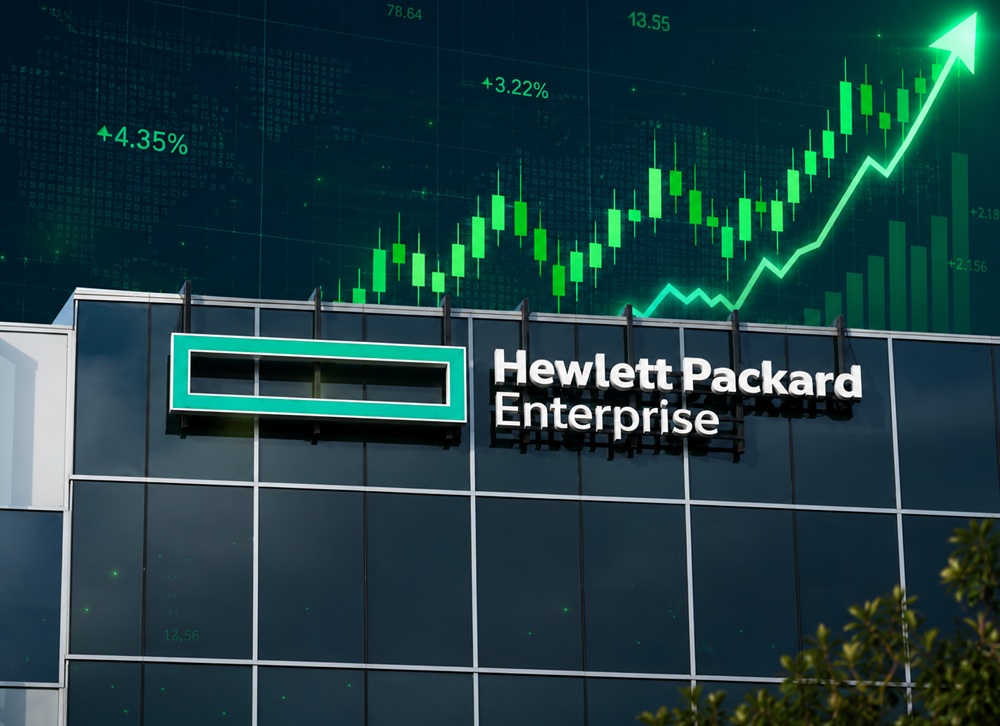
Something fascinating is happening on Wall Street right now. Investors are quietly shifting their money into practical tech infrastructure, and Hewlett Packard stock has found itself right in the sweet spot. In a striking move, shares of both Hewlett Packard Enterprise (NYSE: HPE) and HP Inc. (NYSE: HPQ) have climbed out of their old trading ranges to hit fresh, all-time highs. This sudden surge comes at a fascinating time, with traders aggressively piling into positions just days before both companies release their latest quarterly numbers.
For the last couple of years, the market's obsession with artificial intelligence was almost entirely focused on chipmakers. But over the last few months, a lot of large institutional funds have realized something obvious: all those powerful new chips need to actually live inside real, physical servers. That realization has turned Hewlett Packard stock into an unexpected market darling.
This isn't just random market noise or a standard pre-earnings pump. The run-up reflects a genuine shift in how corporations are spending money on technology this year. Businesses are moving past the experimental phase and are now spending real cash to upgrade their core data systems.
A few key factors have come together to trigger this rally:
The Industry-Wide Domino Effect: Excellent financial results from direct competitors have given investors a ton of confidence. For example, when Lenovo recently posted its fastest revenue growth in five years—driven largely by corporate server demand—it proved to everyone that the hardware upgrade cycle is very real.
Massive Order Backlogs: Demand for high-performance enterprise servers, especially the advanced systems that require specialized liquid cooling, is completely outpacing supply. Companies are rushing to modernize their infrastructure, creating thick backlogs that guarantee steady revenue for quarters to come.
Wall Street Changes Its Mind: Analysts have been forced to tear up their old, conservative models and quickly adjust. Over the past few weeks, major investment banks like Citi, Morgan Stanley, and JPMorgan have all raised their price targets on Hewlett Packard entities, which naturally brought in a wave of new buyers.
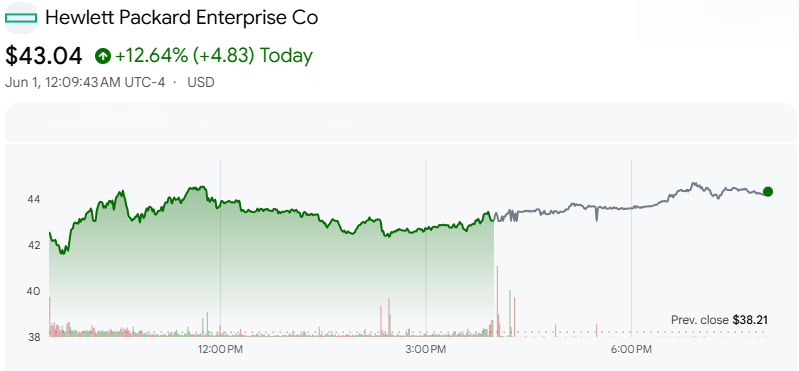
The numbers under the hood explain why everyone is suddenly so bullish. Hewlett Packard Enterprise (HPE) recently closed at an all-time high of $43.04, with some intraday trading stretching up to $44.58. That is a massive 117% jump from where it sat a year ago, pushing the company's total market value well past $57 billion.
On the corporate and personal computer side of things, HP Inc. (HPQ) has been enjoying a remarkably similar ride. Trading right around $27.04 per share, HPQ recently put out a second-quarter financial update that completely silenced the skeptics. The company brought in $14.4 billion in revenue for the quarter—a 9% increase year-over-year—and posted adjusted earnings per share (EPS) of $0.86. beating consensus expectations by roughly 20%.
Because business has been so brisk, management felt confident enough to bump up their full-year guidance. HP Inc. now expects full-year earnings to land between $2.90 and $3.10 per share, while reassuring investors that they are easily on track to generate a very healthy $2.8 billion to $3.0 billion in free cash flow.
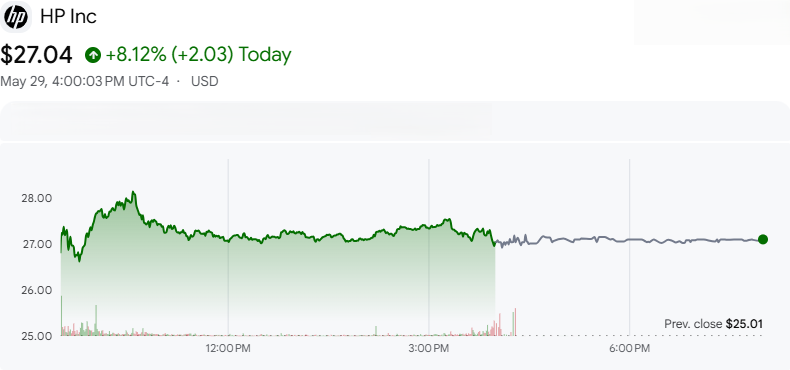
If you like looking at stock charts, the current setup for Hewlett Packard stock looks incredibly strong. Heavy institutional buying has pushed both HPE and HPQ well above their long-term moving averages, confirming a classic structural breakout.
| Chart Metric | Hewlett Packard Enterprise (HPE) | HP Inc. (HPQ) | What It Means for Traders |
| Current Stock Price | $44.32 | $27.04 | Sitting right near all-time highs |
| Relative Strength Index (RSI) | 76.21 | 74.50 | Deep in overbought territory / high speed |
| MACD (12. 26. 9) | +2.24 (Bullish Cross) | +1.45 (Bullish Cross) | Heavy, steady buying pressure |
| 52-Week Range | $17.02 – $44.58 | $17.56 – $28.17 | Breakout after a long period of flat trading |
| Forward P/E Ratio | ~17.5x | ~9.7x | Surprisingly cheap compared to Big Tech |
HPE's 14-day Relative Strength Index (RSI) is currently sitting at 76.21. In traditional technical analysis, any reading over 70 means a stock is technically "overbought" and might be due for a quick pullback. However, when an entire industry undergoes a major shift, these momentum indicators can stay hot for weeks as big funds slowly build out their long-term positions.
The MACD indicator is also looking highly constructive at +2.24, showing that short-term buying speed is leaving historical baselines behind. If we see some quick profit-taking after the actual earnings numbers cross the wire, traders will be keeping a close eye on old breakout points for support—specifically around $38.00 for HPE and $24.50 for HPQ. On the flip side, if the reports beat expectations, the next big psychological targets are $50.00 and $32.00.
The ongoing re-rating of Hewlett Packard stock isn't just about riding a temporary wave of market enthusiasm. It's tied to some very real, strategic corporate chess moves that are finally starting to pay off.
For HPE, the pending multi-billion-dollar acquisition of Juniper Networks is a massive deal. By bringing Juniper's high-performance networking technology into the mix, Hewlett Packard Enterprise can directly take on legacy heavyweights like Cisco. Being able to sell fully unified data center packages—combining servers, advanced cooling, and high-speed networking fabric—makes them incredibly attractive to large corporate clients who want a one-stop shop.
Meanwhile, HP Inc. is perfectly positioned to benefit from a massive corporate computer refresh cycle. A huge percentage of the laptops and desktops currently used in corporate offices were bought during the work-from-home rush of 2020 and 2021. Simply put, those machines are getting old and slow.
The arrival of new "AI PCs"—laptops with built-in processors designed to handle complex tasks locally without constantly lagging on the cloud—is giving companies a great excuse to upgrade their hardware. You can already see this starting to show up in the financials, with HP's Personal Systems division posting a healthy 13% jump in revenue last quarter.
The massive run-up in Hewlett Packard stock shows just how quickly Wall Street sentiment can flip when underlying fundamentals change. At the start of the year, many analysts were cautious, handing out lukewarm "Hold" ratings because they viewed these as boring, legacy tech companies.
But investors who looked a little closer recognized that these firms are capturing real, tangible profits from the current infrastructure boom. Trading at just under 10 times trailing earnings on the PC side, and showing accelerating growth in data centers, the Hewlett Packard ecosystem offers a rare mix of value and real growth. The real test comes when the official quarterly earnings cross the wire. If the actual financial execution matches the immense hype of this pre-earnings rally, these current record highs might just be the baseline for the next major leg up.