Published on: 2026-05-13
The BSE Sensex shed 1,456.04 points on May 12, 2026, closing at 74,559.24, a drop of 1.92% in a single session. The sell-off was broad-based, sweeping across IT, banking, aviation, realty, and consumer sectors.
For investors trying to make sense of the decline, the causes were multiple and interconnected: surging crude oil prices, a rupee record low, aggressive FPI selling, and rising geopolitical risk all converged on the same trading day.
Here is a breakdown of what drove the BSE Sensex decline, which sectors bore the brunt, and what technical levels traders are now watching.
The BSE Sensex finished May 12 at 74,559.24, down 1,456.04 points from the previous close, one of the sharpest single-session declines in recent months. The broader Nifty 50 mirrored the weakness, falling 436.30 points, or 1.83%, to close at 23,379.55.
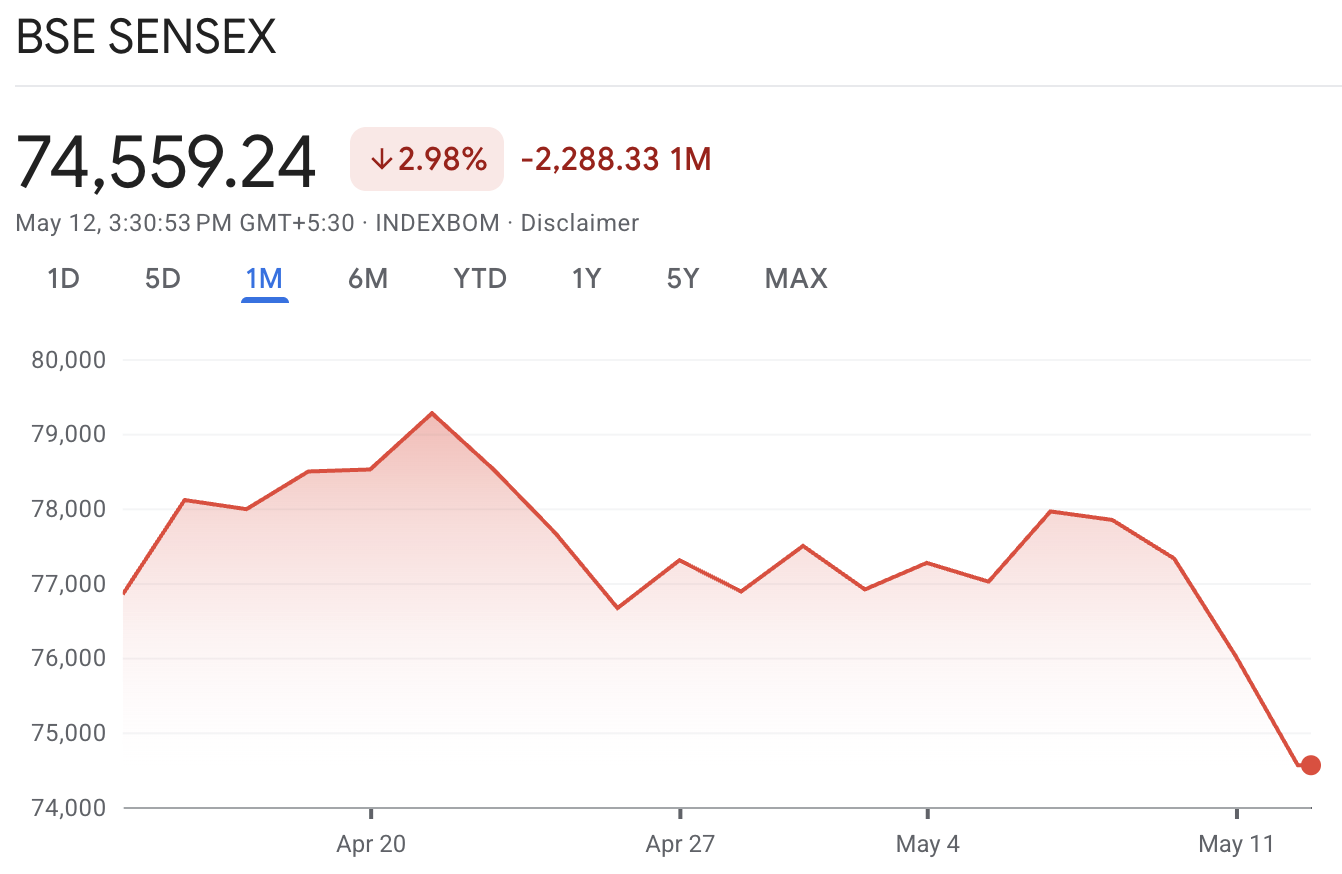
Market breadth was decisively negative. On the NSE, 2,726 shares declined against 590 advances, signalling that selling pressure was not concentrated in a handful of heavyweights but spread across mid- and small-cap counters as well. Nifty Smallcap 100 and Nifty Midcap 100 also fell sharply, confirming a broader risk-off move.
The scale of the drop pushed the Sensex below the psychological 75,000 level, raising questions over whether a deeper technical correction was underway or whether the move reflected a short-term overreaction to macro headwinds.
One of the most immediate triggers for Sensex today’s weakness was a renewed surge in Brent crude oil prices, which climbed above $107 per barrel as concerns over the Middle East conflict and the Strait of Hormuz intensified. For India, a net energy importer, higher oil is a direct macro risk rather than a narrow commodity shock.
Higher crude prices have a cascading effect on the Indian economy:
Inflation pressure: Petrol, diesel, logistics, and input costs can feed into headline CPI.
Current account deficit risk: A higher oil import bill increases external financing pressure.
Fiscal strain: Fuel-related subsidies and tax adjustments can reduce budget flexibility.
Corporate margin compression: Aviation, paints, chemicals, logistics, and consumer companies face higher costs.
Aviation shares fell as investors revised fuel cost assumptions upward, while other oil-sensitive sectors also came under scrutiny.
The Indian rupee fell to a fresh lifetime low near 95.63 against the US Dollar, adding another layer of anxiety for institutional investors. A weaker rupee amplifies the cost of dollar-denominated oil imports, creating a double hit from both higher crude and a weaker currency.
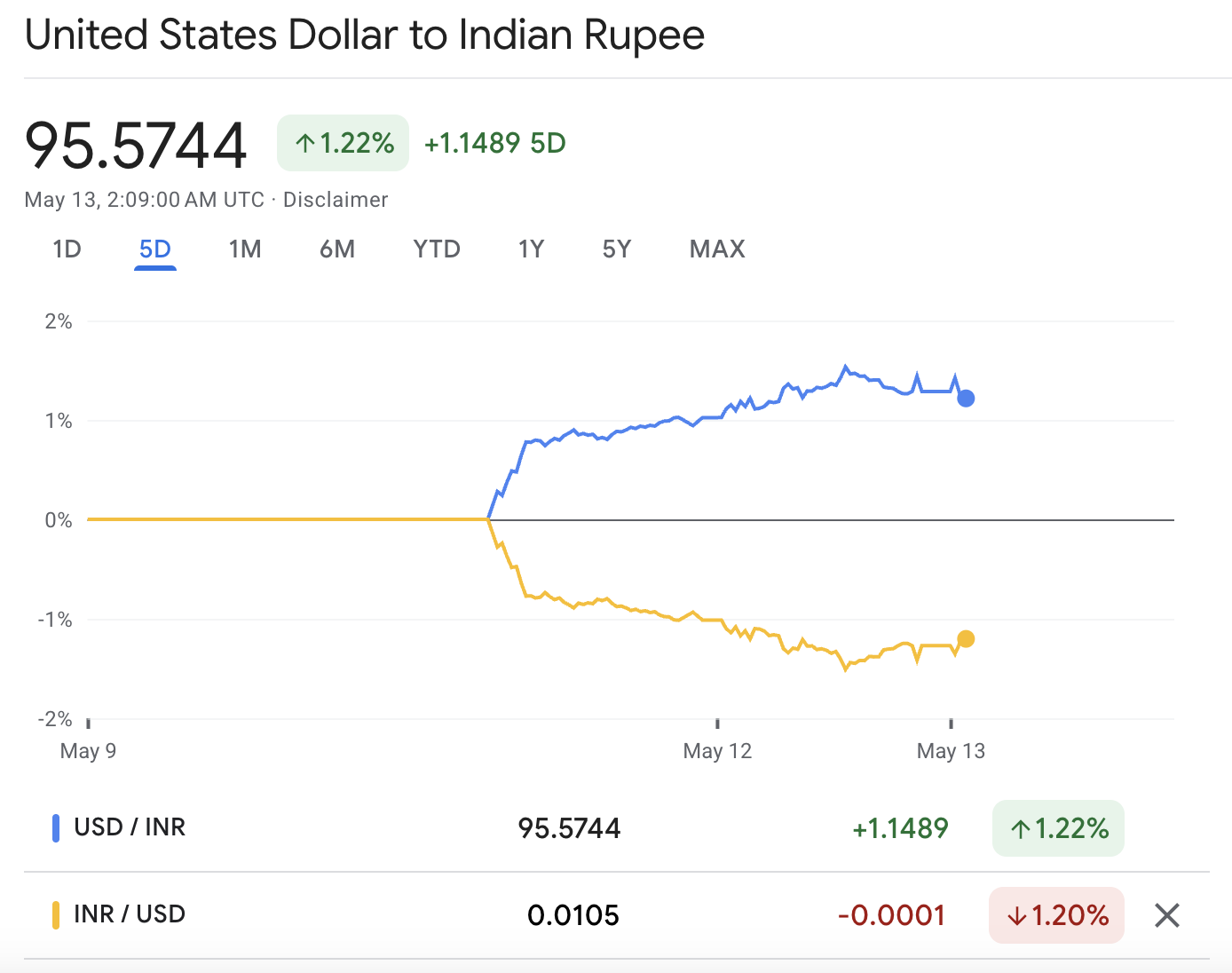
For equity markets, rupee record low levels tend to spook foreign investors, who see their Indian holdings erode in dollar terms even if local prices hold steady. This dynamic can accelerate FPI selling, which in turn puts further pressure on the currency.
FPI selling was among the most cited causes by institutional desks. NSDL data showed foreign portfolio investors sold ₹14,231 crore of Indian equities in May through May 8, taking total 2026 equity outflows to ₹2.06 lakh crore.
Several factors are driving FPI outflows from Indian markets:
A stronger US Dollar attracting capital back to dollar assets
Concerns over India’s premium valuations relative to emerging market peers
Higher global bond yields making risk-free returns more attractive
Geopolitical uncertainty affecting global risk sentiment
FPI activity is closely watched because foreign investors hold significant stakes in large-cap Indian companies, and their selling tends to disproportionately affect index-level moves.
Elevated geopolitical tensions, especially around the Middle East and energy supply routes, kept risk sentiment subdued. Geopolitical shocks tend to compress equity valuations by raising the risk premium investors demand to hold equities, even when the direct economic impact is still unfolding.
For India, the transmission channel is clear: geopolitical stress lifts crude, crude pressures the rupee, and rupee weakness amplifies foreign-flow risk.
The Indian share market fall on May 12 was not uniform. Sectors with crude oil, currency, technology, or foreign-flow exposure suffered the most, while defensives held up relatively better.
| Level | Type | Significance |
|---|---|---|
| 76,015 | Resistance | Previous close before the latest sell-off |
| 75,000 | Resistance | Psychological level bulls need to reclaim |
| 74,449 | Support | May 12 intraday low |
| 74,000 | Support | Psychological downside checkpoint |
| 71,546 | Strong Support | 52-week low and major demand reference |
IT shares deserve special mention. While a weaker rupee is theoretically positive for IT exporters because dollar revenues translate into more rupees, the sector sold off due to broader concerns about AI-driven disruption and slower discretionary technology spending by US and European clients.
The Nifty IT index fell around 3.7% to 28,234.90, its lowest closing level in three years, after renewed concerns over traditional IT services demand intensified selling in large-cap technology names.
For traders navigating the near term, the following support and resistance levels are considered key:
| Level | Type | Significance |
|---|---|---|
| 76,015 | Resistance | Previous close before the latest sell-off |
| 75,000 | Resistance | Psychological level bulls need to reclaim |
| 74,449 | Support | May 12 intraday low |
| 74,000 | Support | Psychological downside checkpoint |
| 71,546 | Strong Support | 52-week low and major demand reference |
A sustained close below 74,449 would keep the medium-term structure under pressure and open the door for a move toward the 71,500- 72,000 demand zone. A recovery above 75,000 would signal short-covering, but the Sensex needs to reclaim 76,015 to repair the immediate breakdown.
The Sensex fell on May 12, 2026, due to a combination of rising crude oil prices, a rupee record low, sustained FPI outflows, geopolitical risk, and sector-specific selling in IT, banking, aviation, and jewellery shares.
As of May 12, 2026, the BSE Sensex closed at 74,559.24, down 1,456.04 points, or 1.92%. Its intraday low was 74,449.50.
The correction can deepen if crude oil prices remain above $100, FPI selling continues, and the rupee stays under pressure. A break below 74,449 would expose the 71,500–72,000 support zone.
The Nifty 50 followed the Sensex lower, closing at 23,379.55, down 436.30 points, or 1.83%. Near-term downside risk remains toward the 23,200–23,150 zone, with resistance around 23,600.
IT, banking, aviation, jewellery, realty, and consumer shares were among the hardest hit. Defensive areas showed relative resilience, but the broader market tone remained weak.
The latest Sensex fall was a macro-driven correction, not a single-headline reaction. Crude oil prices above $107, a rupee record low, sustained FPI selling, and AI-led pressure on IT stocks combined to push Indian equities into a defensive phase.
The next signal is technical as much as macro: the Sensex must reclaim 75,000 to stabilise sentiment, while a break below 74,449 would confirm that sellers still control the tape.