Published on: 2026-03-30
Updated on: 2026-03-30
The answer is simple: Unity excelled not only in revenue but also in profitability and overall business quality.
The Unity stock buy case rests on five points:
Revenue beat came in above guidance by about 4.4% at the midpoint.
Adjusted EBITDA beat came in above guidance by about 23.3% at the midpoint.
Strategic revenue growth significantly outpaced overall company growth.
Having free cash flow and cash reserves allows the company to continue improving its operations.
The stock price has already reset hard, which leaves more upside if execution stays on track.
The market also responded positively to management's choice to exit slower, less strategic operations, allowing the company to concentrate on the areas of the business that are growing more rapidly and yielding better margins.
At the midpoint, Unity's new Q1 revenue outlook of $506.5 million is about 4.4% above the midpoint of its original guide. The midpoint for adjusted EBITDA is $132.5 million, approximately 23.3% higher than the previous guidance.
That kind of gap matters because it suggests the business did not simply scrape past expectations. It moved well ahead of them.
Unity announced that strategic growth revenue is expected to reach approximately $279 million in Q1, a 48% year-over-year increase. Meanwhile, strategic Create revenue is projected at around $152 million, a 14% increase.
Total strategic revenue should be about $431 million, which means roughly 85% of expected Q1 revenue is now coming from the parts of the business management sees as core.
This points to better revenue quality, not just higher revenue.
The company announced it will close its legacy ad network by April 30 and seek to sell its game publishing unit. Based on the Q1 numbers, non-strategic revenue is about $75.5 million, or around 15% of total expected Q1 revenue.
Walking away from that revenue can look painful at first, but it also means future growth should reflect more of the core business and less of the drag from slower assets.
Unity's fourth quarter of 2025 already showed better operating discipline. Revenue was $503 million, adjusted EBITDA was $125 million, and free cash flow was $119 million.
In the full year of 2025, revenue totaled $1.85 billion, with operating cash flow of approximately $423 million and free cash flow of around $404 million.
At the end of the year, cash and cash equivalents were about $2.06 billion, compared to roughly $2.24 billion in convertible notes. This positions the balance sheet close to neutral on a net debt basis.
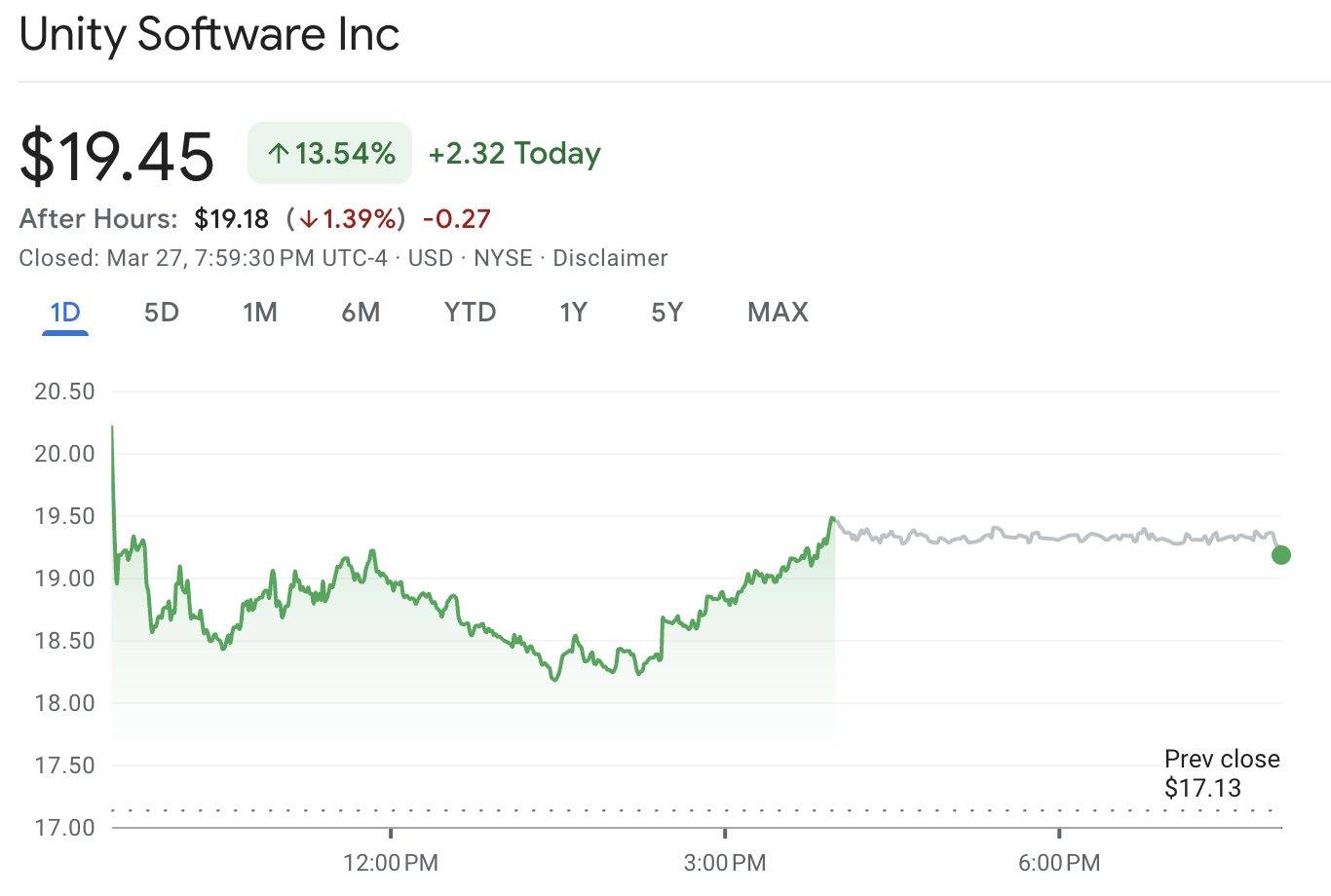
Unity stock remains a recovery story, not a clean breakout story. The shares closed at $19.45 on March 27, 2026, after a 13.54% daily jump. Even after that move, the stock remained down 55.81% year to date and well below its 52-week high of $52.15.
| Period | Price/Move | Comment |
|---|---|---|
| Last close | $19.45 | Strong post-update reaction |
| 1 week | +5.76% | Bounce from March 20 close of $18.39 |
| 1 month | +6.69% | Recovery from February 27 close of $18.23 |
| YTD | -55.81% | Damage from earlier 2026 selloff still large |
| 1 year | -5.09% | Longer-term picture is still mixed |
| 52-week range | $15.33 to $52.15 | Very wide range, which shows high volatility |
In short, Unity stock has bounced, but the market is still pricing in significant doubt.
The total expected revenue growth for Q1 is 17% YoY, while strategic revenue growth is 34%.
This difference is important because it indicates that the stronger segments of Unity are growing at nearly twice the rate of the company as a whole, while weaker parts of the business are being phased out.
For a stock that has been punished for poor quality and uneven execution, that shift is a real change in the story.
Adjusted EBITDA margin is expected at 26% in Q1, up from 22% in the original guide. Q4 2025 adjusted EBITDA margin was already 25%. Free cash flow margin for full-year 2025 was about 21.8%, and operating cash flow margin was about 22.9%.
Those are not the numbers of a business that is running out of room, but a company that is getting better at turning revenue into cash.
As of the close on March 27, Unity's equity value, based on approximately 432.99 million shares outstanding, is around $8.42 billion. When you adjust for cash and convertible debt, enterprise value is about $8.60 billion. That works out to roughly 4.65 times 2025 revenue, or about 4.25 times a simple annualized run rate based on the new Q1 midpoint.
While the stock may not be cheap in absolute terms, it indicates that the valuation is significantly more realistic than when the shares were priced considerably higher.
It is one of the clearest reasons why Unity stock is a buy candidate now, rather than a stock to avoid on valuation alone.
Unity's recent collapse highlighted genuine concerns, including low confidence, inconsistent guidance, and new anxieties among software companies about the impact of AI on traditional business models.
Those concerns have not disappeared. But the latest quarter shows Unity is not standing still. It is cutting weaker pieces, protecting margins, and showing that growth in the core engine and monetisation business can still matter.
From a technical perspective, Unity stock has shown significant short-term improvement, but the chart remains incomplete. The big one-day move pushed the stock back above several key moving averages and turned momentum positive.
| Indicator | Value | Read |
|---|---|---|
| Close | $19.45 | Strong daily gain |
| RSI (14) | 65.08 | Bullish, but not extreme |
| MACD (12,26) | 0.16 | Positive momentum |
| ATR (14) | 0.616 | Volatility remains high |
| SMA 20 | 17.95 | Price is above short-term trend |
| SMA 50 | 18.38 | Near-term trend has improved |
| SMA 100 | 19.22 | Price reclaimed this level |
| SMA 200 | 19.07 | Price is just above long-term average |
| Average 30-day volume | 16.12M | Normal trading pace |
| March 27 volume | 53.77M to 53.95M | Breakout day had heavy participation |
Still, the stock remains far below the highs seen earlier this year, so traders should treat this as an early recovery phase rather than a finished uptrend.
| Key levels | Price zone | Why it matters |
|---|---|---|
| Immediate support | $18.65 | Near current pivot area |
| Stronger support | $18.15 to $18.23 | March 27 intraday low and late-February base |
| Lower support | $17.13 | March 26 close and recent rebound point |
| Major support | $15.33 | 52-week low |
| Near-term resistance | $20.33 | March 27 high |
| Next resistance | $21.35 to $21.37 | Early March swing highs |
| Major upside test | $22.10 | February post-earnings area |
For bulls, the clearest signal would be a hold above $18.65, followed by a push through $20.33. If that happens, the next test is the $21.35 to $22.10 zone.
For bears, the level to watch is $18.15. If the stock breaks that level and volume decreases on rebounds, the movement begins to resemble a short squeeze rather than a genuine trend change.
This is not a no-risk buy. The first risk is that the Q1 numbers are preliminary and unaudited.
The second is that despite improving margins and cash flow, Unity is still operating at a loss on a GAAP basis.
The third is that sentiment in software remains fragile, especially when investors start worrying that AI could pressure older tools and pricing power. A better quarter helps, but it does not erase all of those risks overnight.
The market reacted to a better-than-guided Q1 outlook and the decision to simplify the business. Investors saw higher expected revenue, higher expected EBITDA, and a cleaner growth mix, which helped the stock reprice higher in one session.
The biggest reason is that the stronger part of Unity's business is now growing much faster than the company as a whole. If that continues, the market may start to value Unity more on its core earnings power and less on its old mistakes.
Yes. The stock remains volatile, the business is still in recovery mode, and the latest Q1 figures are still preliminary.
In conclusion, the buy case for Unity stock is stronger today than it was a week ago. The company delivered a clear Q1 revenue beat, lifted expected profitability, showed faster growth in the core business, and took steps to remove slower assets from the story.
The balance sheet is not perfect, but cash flow is improving, and the valuation reset has already happened.
That does not mean the stock will move in a straight line. It does mean the market now has fresh evidence that Unity may be turning a corner.
Disclaimer: This material is for general information purposes only and is not intended as (and should not be considered to be) financial, investment or other advice on which reliance should be placed. No opinion given in the material constitutes a recommendation by EBC or the author that any particular investment, security, transaction or investment strategy is suitable for any specific person.