Published on: 2026-03-25
When a commodity ETF underperforms the raw price of oil, gold, or natural gas, contango is often the underlying cause. Although contango may appear technical, it has tangible and measurable effects on trading outcomes.
Understanding contango, its causes, and its effects on trading positions is essential for both experienced futures traders and newcomers to commodity markets. This knowledge can distinguish between a successful strategy and one that consistently incurs losses.
The following sections provide a comprehensive overview of contango and its implications.
Contango is a normal and well-documented market condition in futures trading, not a signal that something has gone wrong.
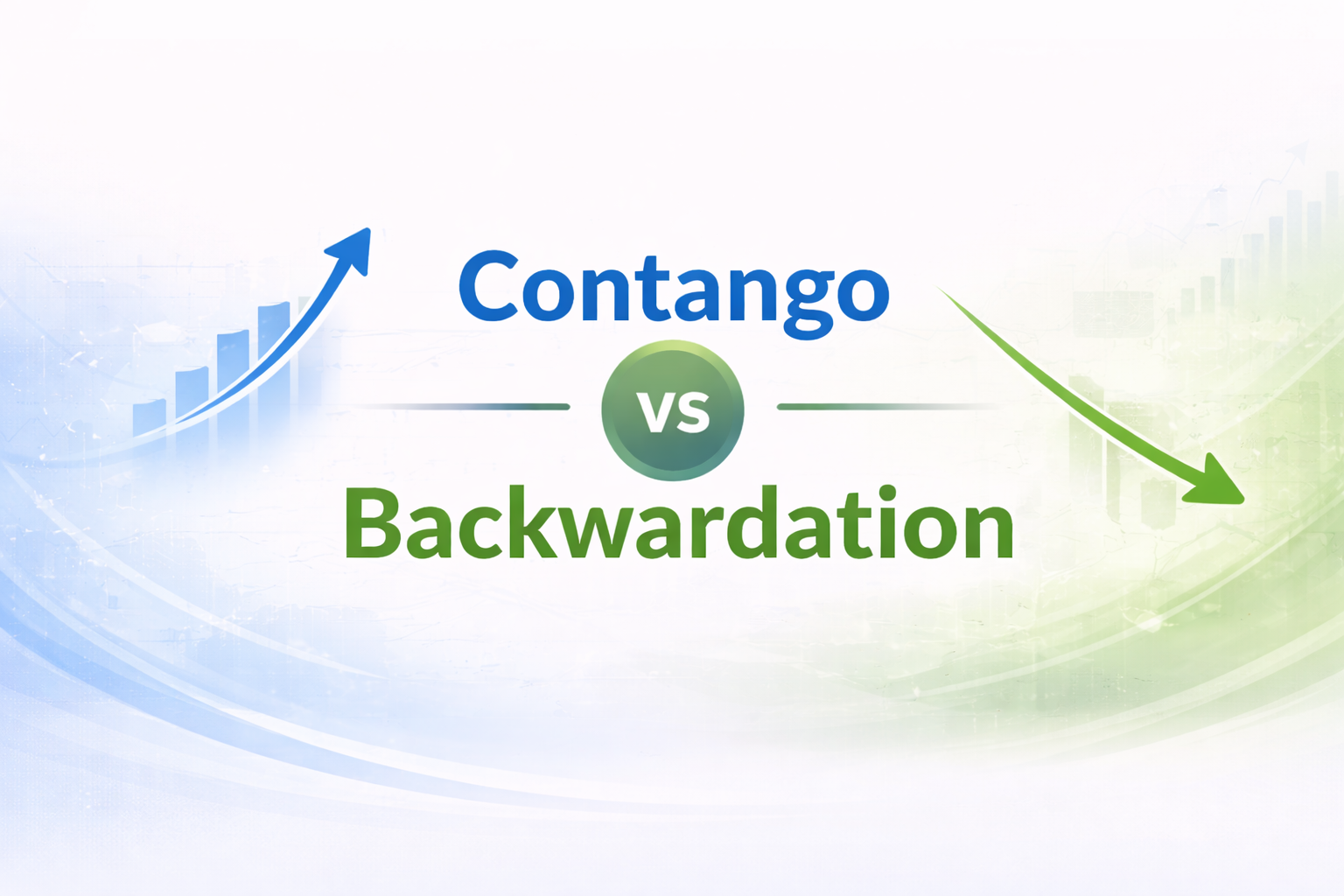
It occurs when futures prices are higher than spot prices, creating an upward-sloping futures curve.
Storage costs, financing charges, and market expectations are the primary drivers behind contango.
It can quietly erode returns for futures-based ETF investors through a process known as negative roll yield.
Understanding contango is essential for anyone trading commodities, energy contracts, or futures-linked investment products.
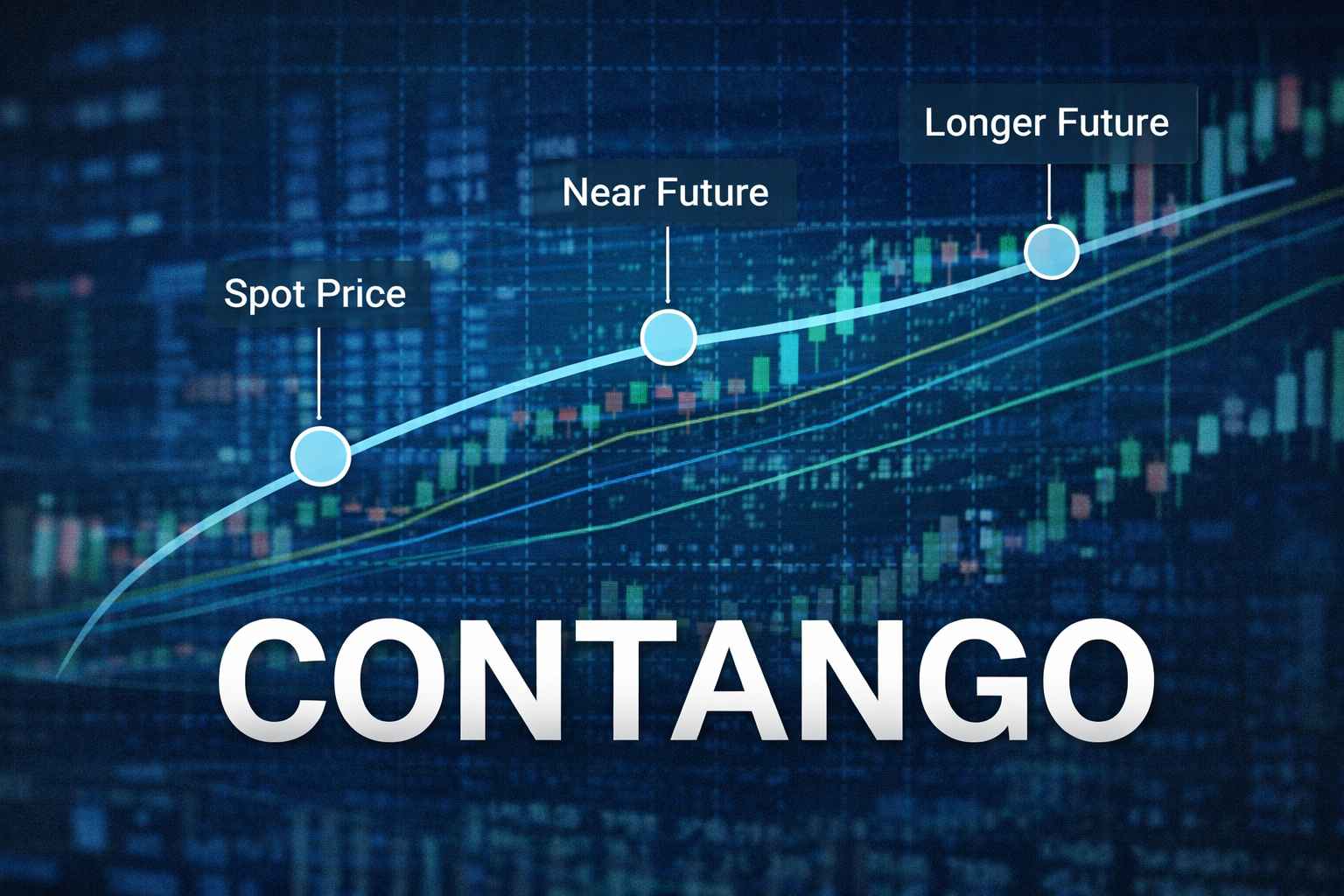
In the futures market, contango occurs when longer-dated futures prices are higher than near-dated futures and typically above spot prices.
It is the normal state for most commodity markets, reflecting the real costs associated with holding physical commodities over time, and it persists as long as those costs exceed any convenience yield that physical holders might enjoy.
Put simply, you pay more to buy a commodity at a future date than you would pay to buy it right now.
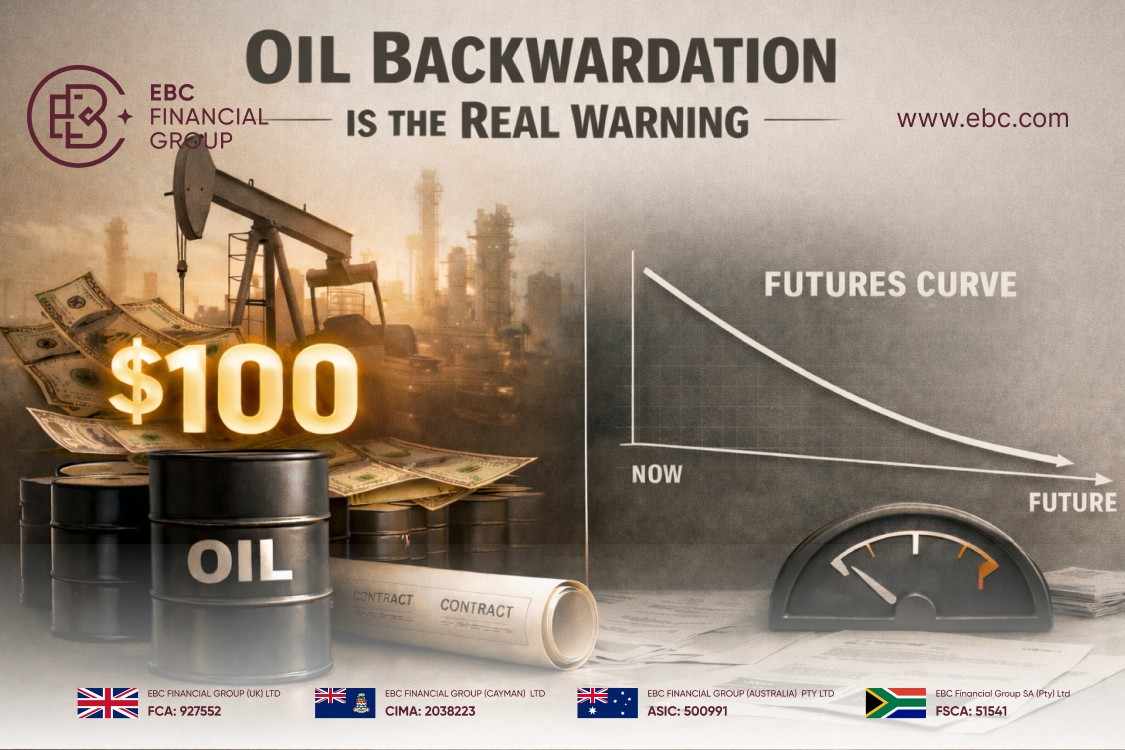
The futures curve is the most effective tool for identifying contango. Observing a commodity’s futures curve reveals whether the futures price is positioned above or below the current spot price.
In a contango market, the futures price is higher than the spot price, and traders pay a premium to lock in delivery at a later date.
For example, if gold trades at a specific spot price per ounce, the one-month futures contract may trade at a slightly higher price, the three-month contract higher still, and the six-month contract even higher.
Each successive contract includes a premium, and this upward slope visually represents contango.
| Market Condition | Futures vs. Spot | Curve Shape | Common Cause |
|---|---|---|---|
| Contango | Futures > Spot | Upward sloping | Oversupply, storage costs |
| Backwardation | Futures | Downward sloping | Supply shortage, high demand |
| Flat | Futures = Spot | Flat | Market uncertainty |
Contango does not appear out of nowhere. It reflects real-world costs and beliefs about future supply and demand. Several distinct factors push futures prices above spot prices:
Contango can result from the cost of carry. Buyers may pay a higher price for a product scheduled for future delivery because they cannot store it themselves. The seller of the contract is compensated for storing the goods until delivery.
Carrying costs typically include:
Storage and warehousing fees
Insurance on physical inventory
Financing or interest charges
Handling and logistics costs
When near-term demand is soft, spot prices tend to drop. If market participants expect demand to recover, longer-dated futures may remain higher, contributing to contango.
Expectations of future price increases can push longer-term futures prices higher, even if current supply and demand are balanced. Traders anticipating higher prices effectively price this bullish outlook into the futures market.
When the market holds more of an asset than buyers need, it can push down spot prices as producers cut prices to move inventory. This leads spot prices to trade lower than futures prices.
The oil market is the most instructive classroom for contango. In 2020, during the global pandemic, oil demand collapsed. Storage tanks filled quickly, and the cost of holding physical crude skyrocketed. Futures contracts traded far above spot prices, resulting in an extreme contango.
A crude oil contango also occurred in January 2009, with arbitrageurs storing millions of barrels on tankers to profit from it. But by the summer, that price curve had flattened considerably.
These episodes illustrate a core principle: a market that is deeply in contango may indicate a perception of a current supply surplus in the commodity.
In this context, contango acts as a hidden cost for ordinary investors. Commodity ETFs that track futures contracts often experience losses in contango markets. The process of rolling contracts,selling expiring futures and purchasing new ones, results in negative roll yield.
Because the normal course of a futures contract in a contango market is to decline in price, a fund composed of such contracts buys contracts at the high price and closes them out later at the usually lower spot price.
Steep contango indicates high roll costs for futures-based ETFs. Shallow contango means modest carrying costs and smaller performance drag. Monitoring steepness helps investors estimate the true cost of futures exposure through market cycles.
In summary, a commodity ETF may display flat or even positive performance at the spot level while investor account values decline, solely due to the mechanics of rolling contracts in a contango environment.
Contango creates a negative roll yield, whereas backwardation generates a positive roll yield.
In backwardation, near-term futures trade at higher prices than longer-dated contracts, creating a downward-sloping curve.
It typically occurs when immediate supply is tight, and buyers pay a premium for near-term delivery during supply disruptions, geopolitical crises, or sudden demand spikes.
For futures-based ETF investors, backwardation is favourable. Rolling contracts means selling expensive near-term contracts and buying cheaper later ones, generating positive roll yield, which is the mirror image of contango’s drag.
Yes, and sophisticated market participants do it regularly. A cash-and-carry trade locks in that spread by buying the physical commodity at the spot price and simultaneously selling the corresponding futures contract at the higher price.
The position is held until the futures contract expires, and the difference is collected as profit.
At the expiration of a contract, the contract price must equal the spot price of the underlying asset. If not, an opportunity to profit from the price difference of the same asset in different markets, known as an arbitrage opportunity, exists.
For most retail traders, the practical implication is straightforward: holding a long position in a commodity ETF during a steep contango market results in negative roll yield, which consistently erodes returns as contracts are rolled forward.
Contango is when futures prices are higher than the current spot price of a commodity. It means it costs more to buy an asset for future delivery than to buy it today, typically because of storage, insurance, and financing costs built into the contract.
It depends on your position. For long-term commodity ETF holders, contango is generally negative because of roll yield drag. For traders running cash-and-carry strategies or shorting futures, it can create profitable opportunities.
Contango in oil markets is typically driven by oversupply, full storage capacity, and rising costs of holding physical crude. Weak near-term demand is another key driver, as seen most sharply during the pandemic in 2020.
In contango, the futures price is higher than the spot price, creating a negative roll yield. In backwardation, futures trade below the spot price, generating positive roll yield. Backwardation usually signals a near-term supply shortage.
Contango is not a market anomaly. It is a normal and well-understood condition driven by the real costs of holding physical commodities over time, including storage, insurance, and financing.
It appears most prominently in energy and metals markets, and it becomes most impactful during periods of oversupply or weak near-term demand.
For traders and investors, the key lessons are clear. Futures-based ETF investors face a structural headwind in contango markets through negative roll yield. Active traders can exploit the spread through cash-and-carry strategies.
Any trader monitoring commodity futures needs to read the curve, because whether it slopes up or down tells a story about supply, demand, and market sentiment that no headline can fully capture.
Disclaimer: This material is for general information purposes only and is not intended as (and should not be considered to be) financial, investment or other advice on which reliance should be placed. No opinion given in the material constitutes a recommendation by EBC or the author that any particular investment, security, transaction or investment strategy is suitable for any specific person.