Published on: 2026-03-25
Updated on: 2026-07-21
Flag and pennant patterns are short pauses on a price chart that usually appear in the middle of a strong trend and often end with the trend continuing in its original direction. Both patterns start with a sharp, near-vertical move called the flagpole. Price then rests inside a small consolidation area for a short time. When price breaks out of that area, the earlier trend tends to resume.
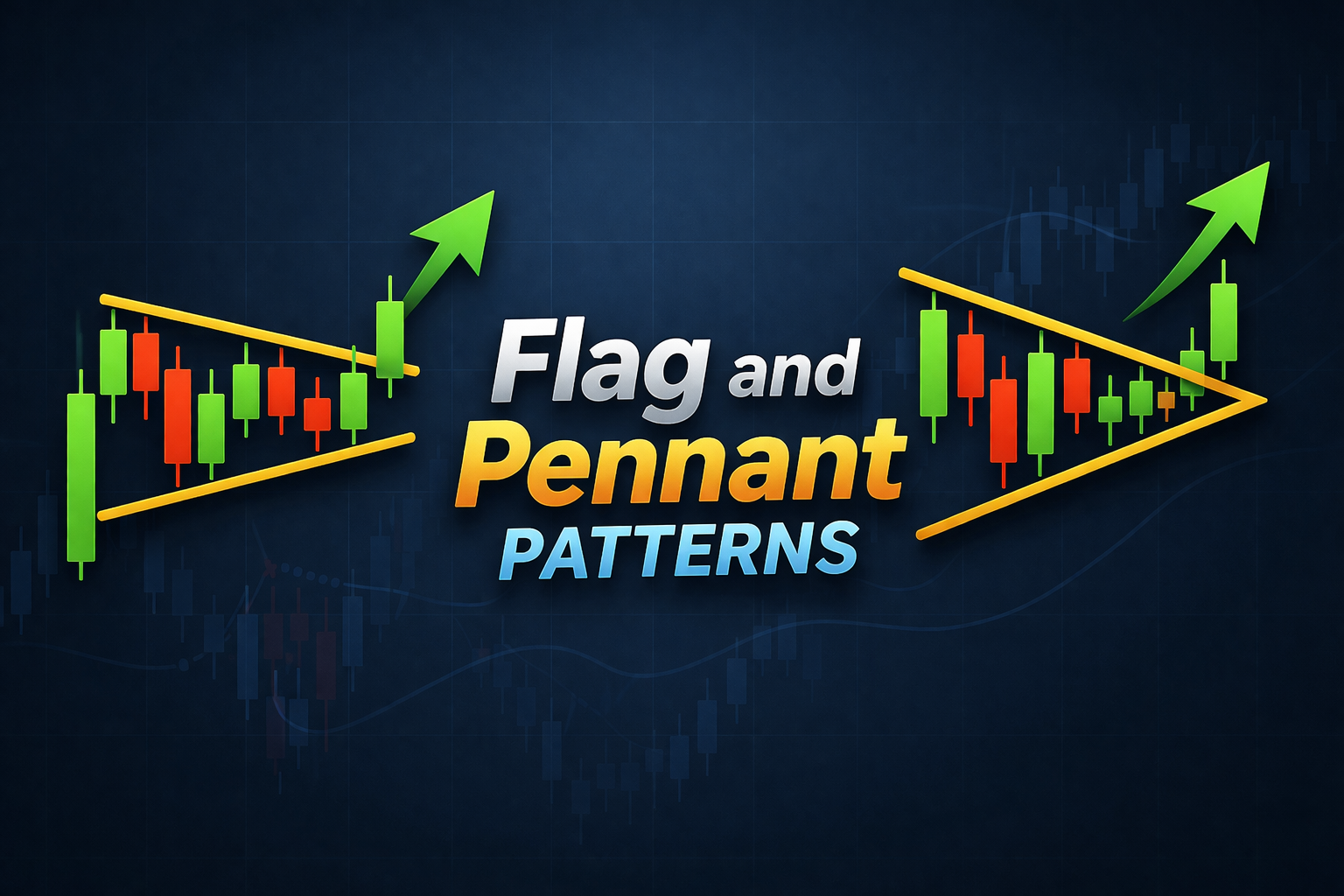
The two patterns differ only in the shape of the pause. A flag consolidates inside a small channel with two parallel boundary lines. A pennant consolidates inside a small triangle with two boundary lines that converge toward a point. Because both are read as continuation patterns, traders watch them to judge whether a trend is pausing or ending.
A flag and a pennant both begin with a steep flagpole, and both point toward trend continuation.
A flag is a parallel channel that tilts against the trend. A pennant is a small converging triangle.
Volume is central: heavy on the flagpole, light during the pause, and expanding on the breakout.
The measured move projects the flagpole height from the breakout point to estimate a target.
These are probabilities, not certainties. Breakouts can fail, and confirmation matters.
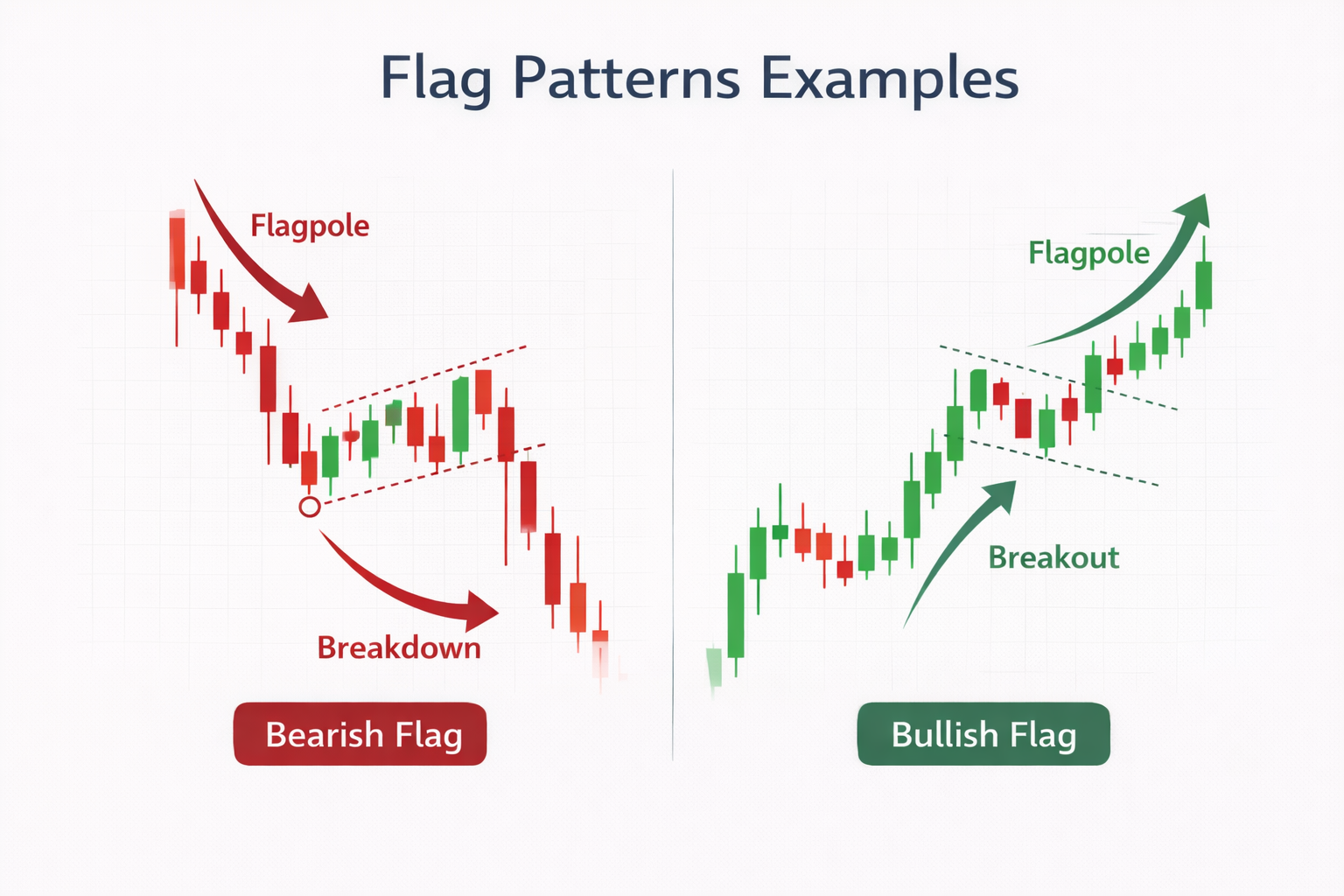
A flag pattern is a short consolidation that forms after a sharp price move and slopes against the direction of that move. The sharp move is the flagpole. The consolidation is the flag itself, drawn as two roughly parallel lines that contain the price.
The slope runs opposite to the trend. In an uptrend, the flag drifts down or sideways. In a downtrend, the flag drifts up or sideways. This counter-trend drift is the market catching its breath. Early buyers or sellers take profits, and new participants step in at slightly better prices before the trend resumes.
A flag has two directional forms:
Bull flag: The flagpole points up. The flag drifts down. A break above the upper line points to continuation higher.
Bear flag: The flagpole points down. The flag drifts up. A break below the lower line points to continuation lower.
Flags are short. Classic technical-analysis guidance treats them as brief formations that resolve quickly, often within a few weeks on a daily chart, and much faster on lower timeframes.
A pennant pattern is a short consolidation that forms after a sharp price move and takes the shape of a small symmetrical triangle. It shares the flagpole with the flag, but the pause is different. Instead of a parallel channel, the boundary lines converge. The highs come down, and the lows come up, so the price range narrows toward a point called the apex.
That narrowing shows falling volatility. Buyers and sellers move closer to balance, and the swings get smaller. A pennant is usually neutral in slope. It does not lean strongly for or against the trend the way a flag does.
A pennant also has two forms:
Bullish pennant: Forms after an up flagpole. A break above the upper line points to continuation higher.
Bearish pennant: Forms after a down flagpole. A break below the lower line points to continuation lower.
The term “rising pennant” is often used loosely for a bullish pennant that appears in an uptrend. The key test is still the same: a sharp pole, a small converging triangle, then a breakout in the pole’s direction.
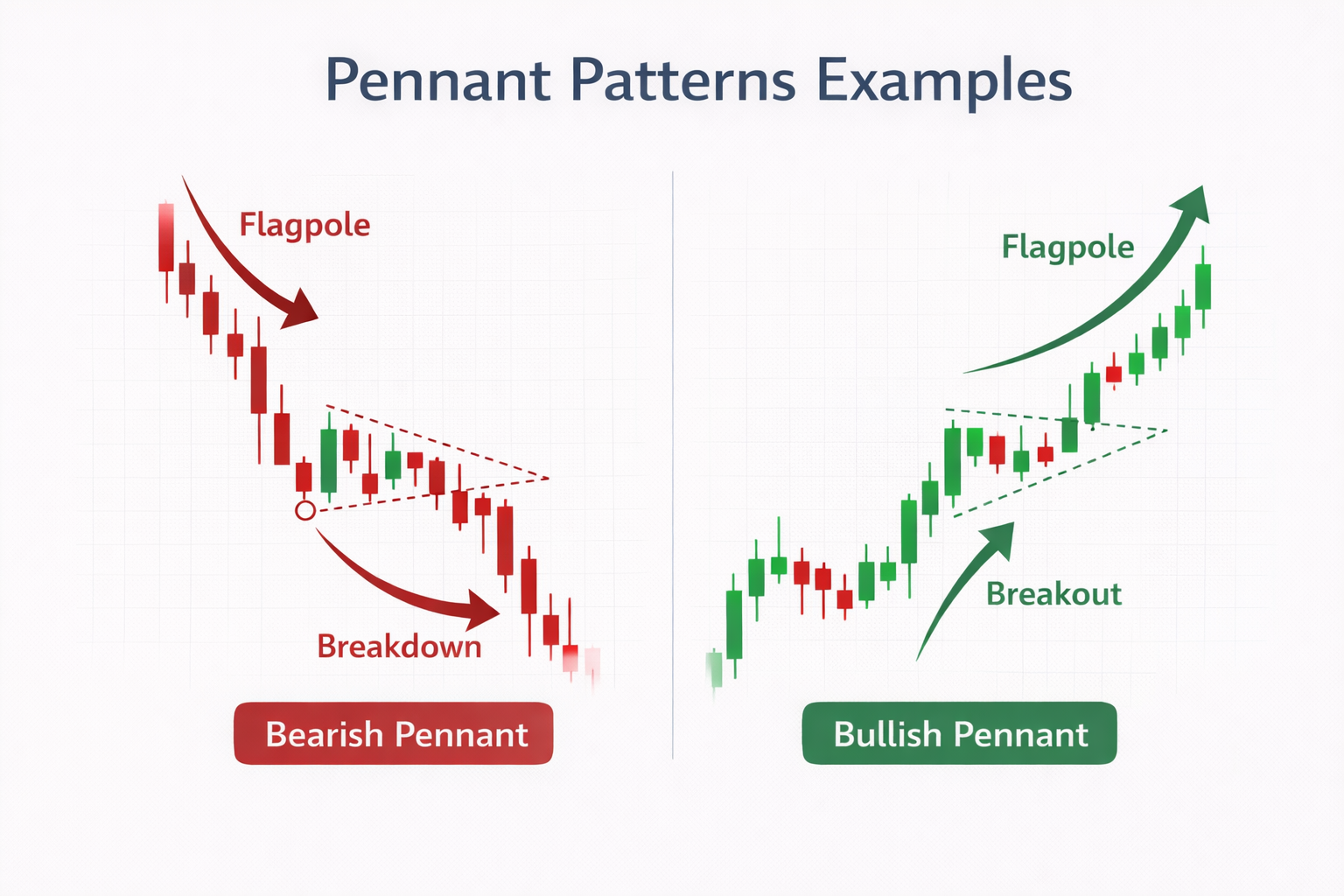
The core difference is the shape of the pause. A flag uses two parallel lines and tilts against the trend. A pennant uses two converging lines and forms a small triangle. Everything else is close to identical: both need a flagpole, both show shrinking volume during the pause, and both are read as continuation signals.
The table below sets the two side by side.
| Feature | Flag | Pennant |
| Consolidation shape | Parallel channel (rectangle or parallelogram) | Small symmetrical triangle |
| Boundary lines | Parallel | Converging toward an apex |
| Slope | Tilts against the trend | Roughly neutral |
| Preceded by a flagpole | Yes | Yes |
| Volume during pause | Declines | Declines |
| Volume on breakout | Expands | Expands |
| Signal type | Continuation | Continuation |
For a deeper look at just the bearish version and how it forms after a drop, see the guide on the bear flag pattern. For the bullish setup, the bull flag trading approach covers spotting and confirming that pattern in detail.
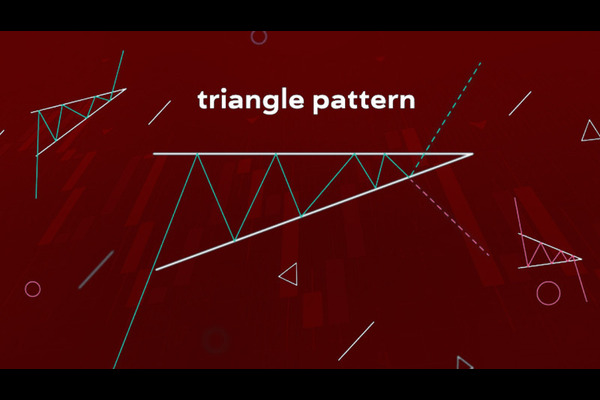
A pennant and a symmetrical triangle can look almost the same. Both are triangles formed by converging trendlines during consolidation. The difference is context and size.
A pennant always follows a flagpole. That steep, high-volume move into the pattern is the defining feature. Without it, the shape is not a pennant. A symmetrical triangle does not need a prior impulse move. It can form on its own during a slow, undecided market.
Pennants are also smaller and shorter. A pennant typically forms over days to a few weeks. A symmetrical triangle can develop over many weeks or months. A common guideline treats a pennant as a short formation of about three weeks or less; a converging pattern that runs longer is usually classed as a symmetrical triangle or a wedge instead.
Direction expectation differs too. A pennant carries the strong momentum of its flagpole, so traders lean toward continuation in the pole’s direction. A symmetrical triangle is neutral until price breaks one side. For more on the triangle family and how each one behaves, see the overview of triangle chart patterns.
Volume is the confirmation tool that separates a real pattern from random chop. The classic volume sequence has three stages.
Flagpole: Volume is heavy. The sharp move is driven by strong participation.
Consolidation: Volume falls. Interest cools as price rests inside the flag or pennant.
Breakout: Volume expands again. A rise in volume as price leaves the pattern supports the idea that the trend is resuming.
A breakout on weak volume is a warning. It raises the chance of a false breakout, where price leaves the pattern and then reverses back inside. Because a clear volume decline is central to a pennant, the pattern shows up most cleanly in liquid markets with steady participation, such as major forex pairs, large indices, and heavily traded stocks.
Traders generally read these patterns in a fixed sequence. This describes how the pattern is commonly interpreted. It is not a recommendation to buy or sell any instrument.
Confirm the flagpole. Look for a steep, fast move with strong volume. The quality of the pole matters more than the pause. A weak, drifting move into the pattern is a reason for caution.
Define the consolidation. Draw the two boundary lines. Parallel lines mean a flag. Converging lines mean a pennant. Watch for volume to fall as the pause develops.
Wait for the breakout. The signal comes when price closes beyond the boundary in the trend’s direction, ideally on rising volume. Traders often wait for a candle to close outside the pattern rather than acting on the first touch, which helps filter out false moves.
Read the entry level. Continuation traders generally look for entries as price breaks the boundary in the direction of the flagpole: above the upper line after an up pole, below the lower line after a down pole.
Locate the invalidation point. The pattern is usually considered failed if price moves back through the opposite boundary. Traders commonly place a stop-loss beyond that side of the consolidation, because a move there means the continuation idea is no longer valid.
The most common target technique is the measured move, which comes straight from the half-mast idea of Edwards and Magee. The logic: the pattern tends to form near the midpoint of the whole move, so the distance after the breakout often mirrors the flagpole.
The steps are simple:
Measure the height of the flagpole in price terms.
Add that height to the breakout price for a bull flag or pennant.
Subtract that height from the breakout price for a bear flag or pennant.
For example, if a flagpole runs from 10 to 20, the height is 10. If price then consolidates and breaks out at 18, the projected target is 28 (18 plus 10). For a bearish setup, a pole from 50 to 40 has a height of 10; a breakout at 42 projects a target near 32 (42 minus 10).
Treat the measured move as an estimate, not a promise. The half-mast projection is a framework for setting expectations, and price does not always travel the full distance.
Yes. These are price-action patterns, so they appear on any market that trends and has enough participation to produce clean charts. They show up across forex, indices, commodities, and stocks.
Forex is the largest arena for them. According to the Bank for International Settlements 2025 Triennial Central Bank Survey, published on 30 September 2025, trading in over-the-counter foreign exchange markets reached 9.6 trillion US dollars per day in April 2025, up 28 per cent from 7.5 trillion three years earlier.
That depth and constant activity give major currency pairs the steady volume that makes flag and pennant volume signals easier to read. Traders apply the same logic to forex CFDs and to index CFDs.
Flag and pennant patterns are useful, but they are not certainties. Continuation is far from guaranteed, and many breakouts fail to reach the full measured target.
In practical terms, an upward breakout from a pennant is only modestly more likely than a coin flip, which is why traders lean so heavily on volume and trend context. The pattern shifts probability; it does not remove risk. Several mistakes come up repeatedly.
Calling every pause a flag or pennant. Without a clear, steep flagpole, the shape is just consolidation. The pole is the qualifying feature.
Ignoring volume. A breakout with weak volume often fails. The volume expansion is part of the signal, not an optional extra.
Entering before the breakout closes. Acting while price is still inside the pattern exposes a trader to false moves. A confirmed close outside the boundary is the standard trigger.
Skipping the invalidation level. A pattern needs a point where it is proven wrong. Trading without one removes the ability to manage risk.
Trading against the bigger trend. These patterns work best when aligned with the dominant direction. A continuation signal that fights the primary trend is weaker.
Because context decides so much, many traders confirm these patterns with other tools. Support and resistance levels, momentum indicators such as the Relative Strength Index (RSI) or Moving Average Convergence Divergence (MACD), and moving averages are all used to test whether a breakout is likely to hold. If a pause converges into a wedge shape rather than a channel or a symmetrical triangle, review the common mistakes in wedge trading, because a wedge carries a different meaning.
A flag consolidates inside two parallel lines and tilts against the trend. A pennant consolidates inside two converging lines and forms a small triangle. Both follow a flagpole, and both are continuation patterns, so the practical difference is the shape of the pause.
They can be either. The direction comes from the flagpole. An up flagpole makes a bull flag or bullish pennant. A down flagpole makes a bear flag or bearish pennant. The pattern points toward continuation of whatever move came before it.
A pennant follows a sharp flagpole and is small and short, usually forming over days to a few weeks. A symmetrical triangle does not need a prior impulse move and can develop over many weeks or months. A pennant leans toward continuation; a symmetrical triangle is neutral until it breaks.
Traders commonly use the measured move. Measure the flagpole height, then add it to the breakout price for a bullish pattern or subtract it for a bearish pattern. This comes from the half-mast idea that the pattern forms near the middle of the full move. It is an estimate, not a guarantee.
They shift probability toward continuation but do not guarantee it. Reliability improves when a clear flagpole is present, volume expands on the breakout, and the pattern aligns with the larger trend. Breakouts can still fail, which is why an invalidation level matters.
Yes. They form on charts from one minute to weekly. The same rules apply on every timeframe. Signals on higher timeframes are generally treated as more meaningful because they reflect more trading activity.
Flag and pennant patterns give traders a simple way to describe a pause inside a strong trend and to judge whether that trend may continue. The flagpole, the shrinking volume, and the volume expansion on the breakout are the parts worth studying most, because they separate a genuine pattern from ordinary noise.
One point is easy to overlook: these patterns are only as good as the trend that carries them. A flag or pennant does not create momentum. It reflects momentum that already exists. When the flagpole is weak, or the broader trend is fading, the pattern loses its edge no matter how clean the shape looks.
Read the trend first, then the pattern. To see how these formations sit alongside triangles, wedges, and reversal shapes, start with the chart patterns guide, and compare them with a reversal setup such as the double top and double bottom.
Disclaimer: This material is for general information purposes only and is not intended as (and should not be considered to be) financial, investment or other advice on which reliance should be placed. No opinion given in the material constitutes a recommendation by EBC or the author that any particular investment, security, transaction or investment strategy is suitable for any specific person.