Published on: 2026-06-18
Updated on: 2026-06-18
The Defiance Autism Impact ETF (ticker: ASD) turns autism care, diagnostics, therapies, education, and assistive technology into a listed investment theme, as autism prevalence among U.S. 8-year-olds is near 1 in 31. The appeal is immediate: investors can now track the once-scattered autism care economy with a single ETF.
The central question is whether ASD offers real exposure to that economy, or simply a new wrapper around a powerful theme.
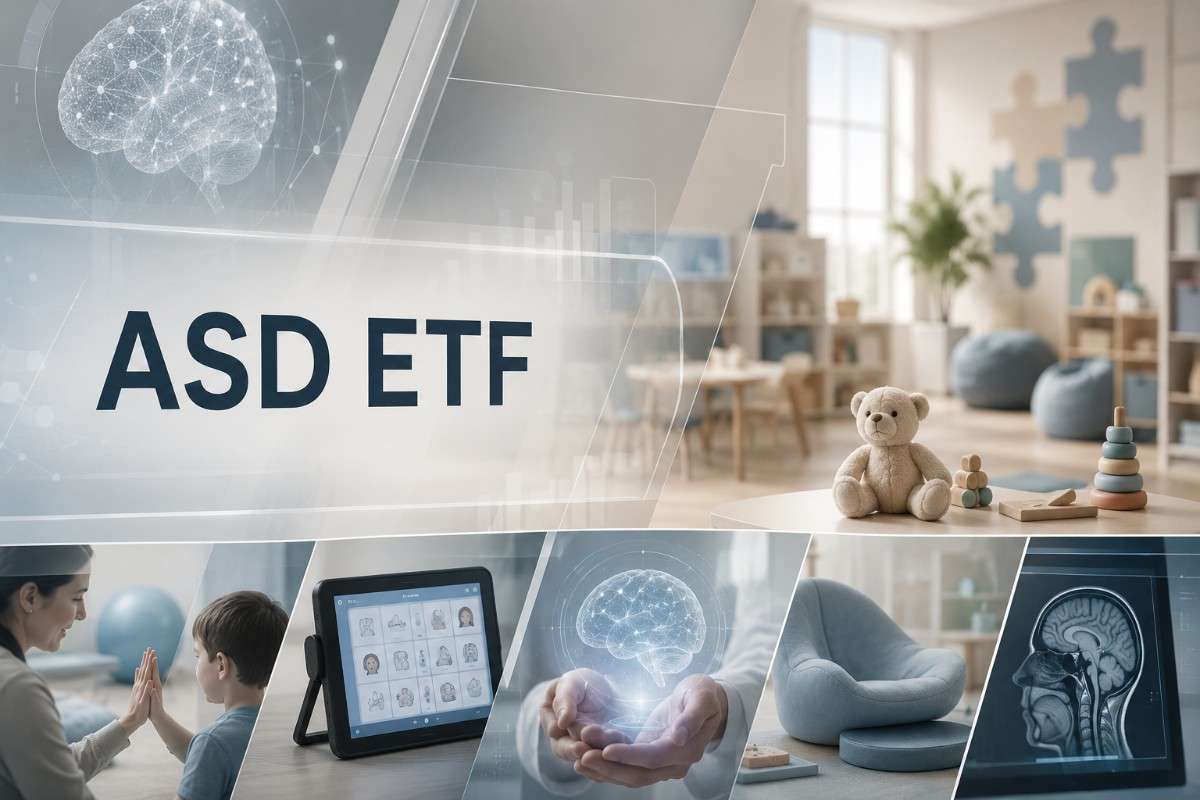
ASD launched on June 1, 2026, providing investors with targeted exposure to autism-linked care, testing, education, and support companies.
The fund holds 38 stocks, with the top 10 positions making up about 34.4% of assets.
ASD charges 0.79%, a notable cost for a new thematic ETF with a small early asset base.
Autism prevalence stands near 1 in 31 among U.S. 8-year-olds, giving the theme a large real-world need.
Adoption is the first test, measured by assets, volume and spreads rather than early price movement.
| Detail | Defiance Autism Impact ETF |
|---|---|
| Ticker | ASD |
| Exchange | Nasdaq |
| Launch date | June 1, 2026 |
| Issuer | Defiance ETFs |
| Index | VettaFi Autism Impact Index |
| Holdings | 38 |
| Expense ratio | 0.79% |
| Net assets | About $1.24 million |
| Theme | Autism care, diagnostics, therapies, education and assistive technology |
| Early signal to watch | Assets, volume and spreads |
The most important row is net assets: at about $1.24 million, ASD is still in its earliest adoption phase. Fund details are based on Defiance data as of June 16, 2026, while top holdings are listed as of June 18, 2026.
The Defiance Autism Impact ETF is a Nasdaq-listed fund tracking the VettaFi Autism Impact Index. The index selects developed-market companies with products, services or research connected to the autism and broader neurodevelopmental support market.
Investors are buying a basket of public companies, not direct exposure to autism outcomes. The portfolio centres on the services, tools, and research infrastructure used across care delivery, assessment, education, and treatment development.
Most healthcare ETFs spread exposure across insurers, hospitals, devices and large drugmakers. ASD narrows the universe to companies connected to autism treatment, assessment, care delivery, education and enabling technology.
The narrower screen is both the product and the risk. ASD gives investors a more direct route into the autism care economy, while relying on revenue growth, fund adoption and trading liquidity to support the story.
ASD is broader than an autism drug bet. Its largest holdings span care services, behavioral health, neuroscience, diagnostics, education and pharmaceutical exposure.
| Holding | Weight | Exposure |
|---|---|---|
| BrightSpring Health Services | 4.52% | Care services |
| MapLight Therapeutics | 4.15% | Neuroscience therapeutics |
| LifeStance Health Group | 3.70% | Behavioral health |
| Jazz Pharmaceuticals | 3.39% | Specialty pharma |
| Repligen | 3.22% | Life-science tools |
| Pearson | 3.19% | Education |
| Revvity | 3.13% | Diagnostics and tools |
| H Lundbeck | 3.09% | CNS pharma |
| Eli Lilly | 3.04% | Large-cap pharma |
| Teva Pharmaceutical | 2.96% | Generic and specialty pharma |
The top 10 holdings account for about 34.4% of assets. ASD has more breadth than a single-stock theme, yet enough concentration for individual holdings to shape returns.
Defiance says it will donate 100% of ASD’s net advisory profits during the first two years, and at least 50% thereafter, to organizations supporting autism care, research and services.
Buying ASD does not send investor capital directly to autism nonprofits. The pledge comes from the adviser’s net advisory profits. The ETF still carries its expense ratio, market risk and trading risk, making ASD an investment product with an impact pledge rather than a charitable vehicle.
ASD charges a 0.79% expense ratio and reports about $1.24 million in net assets, with 50,000 shares outstanding and a 0.28% median 30-day spread. The fee is visible from day one; the fund’s trading depth still needs time to develop.
Early price movement matters less than liquidity for a new thematic ETF. The more useful signal is whether ASD can attract assets, improve volume and tighten spreads after launch.
CDC data estimate autism spectrum disorder prevalence at 32.2 per 1,000 U.S. 8-year-olds in 2022, equal to about 1 in 31 children. The rate was 1 in 36 in 2020 and 1 in 150 in 2000.
Need creates the investment theme. Revenue has to prove it. ASD becomes more than a story only when autism-related demand reaches company income statements through reimbursed care, diagnostics, education tools, clinical progress and scalable services.
ASD’s biggest risk is not only its short trading history. The larger risk is a story that attracts attention faster than the portfolio can prove commercial strength.
The fund’s materials highlight autism-related investment risk, including the absence of FDA-approved medications addressing the core symptoms of autism spectrum disorder and uncertainty around therapies, diagnostics and related technologies. Autism care has real human urgency. ETF returns still depend on holdings quality, adoption, margins and durable cash flow.
The Defiance Autism Impact ETF (ticker: ASD) is a Nasdaq-listed fund tracking the VettaFi Autism Impact Index. It owns companies connected to autism care, diagnostics, therapies, education, behavioral services and assistive technologies.
ASD launched as the first autism-impact ETF, built around companies advancing autism therapeutics, diagnostics, education and care. Its donation pledge also gives the fund a more defined impact structure than a broad healthcare or biotech ETF.
ASD’s top holdings include BrightSpring Health Services, MapLight Therapeutics, LifeStance Health Group, Jazz Pharmaceuticals, Repligen, Pearson, Revvity, H Lundbeck, Eli Lilly and Teva Pharmaceutical. The list shows a fund spread across care services, education, diagnostics and pharma.
Defiance says it will donate 100% of ASD’s net advisory profits during the first two years and at least 50% afterward to autism-focused organizations. The pledge comes from adviser profits, not directly from investor principal.
ASD is too new to judge by performance. The cleaner test is whether assets grow, trading volume improves, and spreads tighten. Investors also need to weigh the 0.79% fee, narrow theme and small early asset base against the fund’s first-mover exposure.
ASD’s first test is adoption. The VettaFi Autism Impact Index is scheduled to rebalance after market close on the third Friday of March, June, September and December, making the June 19, 2026, rebalance the next checkpoint for portfolio alignment.
ASD can launch on a powerful cause; it can only survive on assets, volume and revenue.