Published on: 2026-07-01
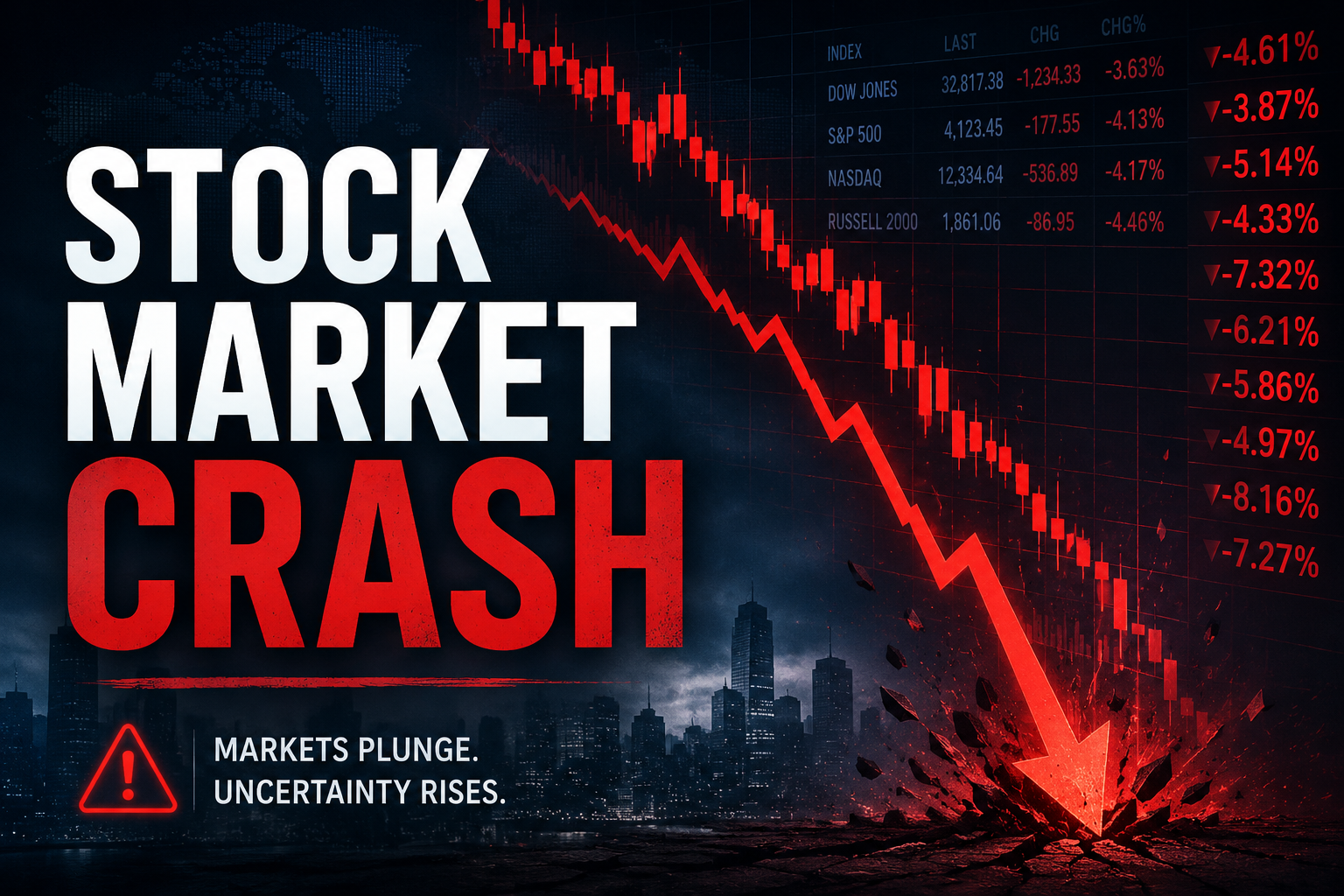
A stock market crash is a rapid and severe decline in stock prices that affects broad markets, major indexes and investor portfolios. Crashes are difficult to predict, but understanding their causes and warning signs can help investors prepare for periods of market stress.
A stock market crash is a fast, disorderly and broad decline in share prices.
Major crashes often stem from various triggers, but panic selling, leverage, and liquidity stress exacerbate the damage.
The 1929, 2008, and 2020 crashes show how speculation, credit stress, and sudden economic shocks can undermine market confidence.
Warning signs include stretched valuations, narrow market leadership, excessive leverage, weakening earnings, credit stress and rising volatility.
Portfolio protection starts before a crash through diversification, cash buffers, position sizing, lower leverage and a written plan.
Hedging tools such as put options, inverse ETFs, Index CFDs and volatility products reduce downside exposure, but each carries costs and risks.
A stock market crash is a sudden and steep decline in stock prices. It usually affects major indexes, sectors, and individual stocks simultaneously.
The fall can happen over days or weeks. What separates a crash from a normal decline is the speed of the move, the level of panic and the loss of market confidence.
| Market Decline Type | Common Meaning | Main Takeaway |
|---|---|---|
| Pullback | Small short-term decline | Normal market movement |
| Correction | Around 10% from recent highs | Risk is rising, but not always a crisis |
| Bear Market | Around 20% or more from highs | Broader trend damage |
| Crash | Fast, disorderly and panic-driven fall | Speed and liquidity matter as much as size |
A crash is not defined by one official percentage. A market can fall 10% calmly and still feel manageable. It can also fall sharply in a few sessions amid widening spreads, forced selling, and panic across the headlines. The second situation is what investors usually mean by a crash.
Stock market crashes rarely have a single cause. They usually happen when several risks combine.
When prices rise much faster than earnings, cash flow or economic growth, the market becomes fragile. Expensive markets do not crash simply because they are expensive, but they leave less room for disappointment.
Panic selling turns a normal decline into a crash. As prices fall, investors rush to exit positions, creating a feedback loop where selling triggers even more selling.
Leverage magnifies both gains and losses. When prices fall, margin calls and forced liquidations push investors to sell even when they would rather hold.
Recessions, banking stress, pandemics, inflation shocks, wars, and policy surprises can quickly change investor expectations. During severe crises, investor concerns shift from stock valuations to broader questions about financial and economic stability.
Liquidity dries up when buyers step back. In fast markets, prices gap lower, bid-ask spreads widen, and trades execute at worse levels than expected.
Crowded trades become dangerous when too many investors own the same stocks, sectors or themes. Once the trade reverses, the exit door narrows quickly.
Past crashes show how different triggers can lead to the same outcome: falling prices, broken confidence and forced risk reduction.
The 1929 crash followed years of strong market gains and speculative buying. Many investors used borrowed money to buy stocks, making the market vulnerable when confidence began to weaken.
On Black Monday, October 28, 1929, the Dow Jones Industrial Average fell nearly 13%, according to Federal Reserve History.
What 1929 showed: speculative markets built on leverage can unravel much faster than investors expect.
The 2008 financial crisis began in the U.S. housing market and spread through the banking system. The subprime mortgage crisis stemmed from an expansion of mortgage credit, including lending to borrowers who previously would have struggled to obtain mortgages, and this was tied to rapidly rising home prices.
As mortgage losses grew, investors lost confidence in banks, lenders and complex credit products. Stock prices fell because markets were no longer pricing in only slower growth. They were pricing financial-system stress.
What 2008 showed: credit markets often reveal trouble before stock indexes fully reflect the risk.
The 2020 crash was caused by a sudden global shock. COVID-19 disrupted travel, consumption, supply chains, and business activity simultaneously.
The decline was unusually fast. The S&P 500 triggered Level 1 market-wide circuit breakers on March 9, 12, 16 and 18, 2020, during the pandemic selloff.
The recovery was also unusually fast because central banks and governments responded with aggressive liquidity support, rate cuts and fiscal stimulus.
The 2020 crash shows that a market collapse triggered by a sudden shock can recover quickly once liquidity returns, but investors still incur serious losses if they sell in a panic or use excessive leverage during the decline.
Stock market crashes rarely come with one clear warning signal. Risk usually builds through several pressure points, and danger increases when multiple signs appear simultaneously.
Extreme Valuations: High valuations leave less room for disappointment. If prices assume strong earnings growth and the outlook weakens, stocks reprice quickly.
Narrow Market Leadership: Markets become vulnerable when a small number of large stocks drive most of the index’s gains. If those leaders fall, the broader market can weaken even if many stocks were already struggling.
Excessive Leverage: Margin debt, speculative options activity, leveraged ETFs, and crowded trades increase the risk of forced selling. Leverage reduces the time investors have to be right.
Weakening Earnings: A market priced for strong profits becomes fragile when earnings expectations fall. Slower revenue growth, margin pressure and weaker guidance all matter.
Credit Stress: Widening credit spreads, pressure on bank funding, and rising default concerns point to weaker risk appetite. Credit stress deserves attention because stock markets often react late.
Rising Volatility: Rising volatility often signals growing investor anxiety. A higher VIX, repeated intraday reversals, and large price gaps suggest markets are becoming more fragile.
Policy Shocks: Interest rate surprises, inflation shocks, trade disputes, fiscal stress and geopolitical events can trigger rapid repricing. Markets are most exposed when investors are heavily positioned for one expected outcome.
During a crash:
Prices fall rapidly.
Volatility surges.
Liquidity deteriorates.
Forced selling increases.
Correlations rise across risky assets.
Investors face intense emotional pressure.
Headlines become more extreme.
Market-wide circuit breakers can temporarily halt trading in severe declines. In the United States, circuit breakers are triggered by S&P 500 drops of 7%, 13% and 20% from the previous close. A Level 3 decline stops trading for the rest of the day.
Circuit breakers slow trading. They do not prevent losses or guarantee price stability once trading resumes.
Crash preparation works best before volatility rises. Once markets are already falling, hedges become more expensive, spreads widen, and decisions become emotional.
Know how much of the portfolio is allocated to stocks, bonds, cash, commodities and other assets. Then compare that mix with your risk tolerance, time horizon and cash needs.
If the portfolio is too concentrated in equities, high-growth stocks, or a single market theme, consider gradually reducing exposure, adding cash, or increasing defensive assets. The aim is to avoid entering a crash with a portfolio that depends too heavily on one outcome: stocks continuing to rise.
A portfolio with many stocks can still be concentrated. If most holdings depend on the same sector, country, theme or economic cycle, diversification is weaker than it looks.
After identifying the concentration, reduce the exposure that creates the biggest portfolio risk would be a better move. That could mean trimming oversized positions, spreading exposure across different sectors or regions, or adding assets that do not rely on the same market driver. The aim is not to eliminate risk entirely, but to avoid a single crowded trade determining the outcome of the entire portfolio.
Cash gives investors flexibility. It reduces the need to sell high-quality assets at depressed prices and allows gradual buying as valuations improve.
The cash buffer can come from trimming oversized positions, taking partial profits after strong rallies, reducing exposure to weaker holdings or setting aside new savings before adding more risk. The aim is not to hold too much idle cash, but to keep enough liquidity so a market crash does not force selling at the worst moment.
Leverage turns market stress into survival risk. Margin trading, options, futures and CFDs require strict position sizing because gaps and margin calls become more dangerous during crashes.
To control leverage, focus on effective leverage rather than the maximum offered by a broker. Effective leverage is the total market exposure compared with account equity. For example, a $10,000 account controlling $30,000 of market exposure is using 3:1 effective leverage.
There is no single perfect leverage level for every investor or trader, but lower leverage gives more room to survive volatility.
No single position should be large enough to damage the entire portfolio. A common rule for traders is to risk only a small percentage of account equity on each trade, often around 1% to 2%.
For investors, the rule is simpler: avoid oversized exposure to a single stock, sector, or theme. If a single holding falling sharply would change the overall portfolio outcome, the position is too large.
A crash plan should answer:
What will be held through volatility?
What will be reduced first if cash is needed?
What would become attractive at lower prices?
How much loss is acceptable before risk is reduced?
Is the position an investment, a trade or a hedge?
Clear rules reduce emotional decisions when markets move quickly.
Portfolio protection does not remove all losses. It reduces the chance that a market decline becomes permanent damage.
| Strategy | How It Helps | Main Limitation |
|---|---|---|
| Diversification | Reduces single-stock or sector risk | Correlations often rise during crashes |
| Cash Buffer | Prevents forced selling | Cash may lag during bull markets |
| Rebalancing | Keeps portfolio aligned with the plan | Buying too early still hurts |
| Defensive Assets | Helps reduce volatility | No asset protects in every crash |
| Stop-Loss Orders | Controls trade-level risk | Gaps can trigger worse fills |
| Lower Leverage | Reduces margin pressure | Limits upside in strong markets |
The strongest protection is usually simple: enough cash, limited leverage, reasonable diversification and position sizes that do not force panic decisions.
Hedging means taking a position designed to reduce losses in another position. It is most effective when the hedge is well understood, appropriately sized, and matched to the underlying risk. Here are several hedging strategies that investors can use to help protect against a stock market crash.
Put Options: Rise in value when the underlying stock or index falls. They offer defined downside protection, but premiums, expiry dates and timing matter.
Index CFDs: Allow traders to take short exposure to a stock index. They are flexible, but leverage makes position sizing critical. A sharp rebound can create losses on the hedge.
Inverse ETFs: Move opposite to an index on a daily basis. They suit short-term hedging better than long-term holding because daily compounding changes performance over time.
Volatility products: Instruments linked to market volatility, such as VIX futures, VIX options and volatility-linked ETFs or ETNs, often rise when market fear increases. They are designed for short-term risk management or trading, but they are complex and can lose value quickly when volatility falls or when held for too long.
Safe-haven assets: Gold, high-quality government bonds such as U.S. Treasuries, German Bunds and UK gilts, and currencies such as the U.S. dollar, Japanese yen and Swiss franc often attract demand during periods of stress. They can reduce portfolio sensitivity to stocks, but they do not move opposite to equities every time.
Buying during a stock market crash can create long-term opportunities, but timing the exact bottom is extremely difficult.
Many investors use a staged approach. Instead of investing all available cash at once, they divide it into several parts and add gradually as prices, valuations and market conditions change.
Quality matters more during crashes. Strong balance sheets, durable cash flow and manageable debt separate companies that survive stress from those that only look cheap.
For traders, the priority is survival: smaller positions, tighter risk control and no forced trades. For long-term investors, the priority is discipline: buying gradually, focusing on quality and staying aligned with the original portfolio plan.
The first mistake is panic selling everything at once. Selling makes sense when the investment case has changed, or the portfolio is too risky, but panic selling often happens after much of the damage is already done.
The second mistake is increasing leverage because prices look cheaper. A falling market can keep falling longer than expected. Leverage reduces room for error.
The third mistake is averaging down without a plan. Buying more only because a position has fallen increases exposure to a weak asset. Averaging down should be based on valuation, quality and risk limits.
The fourth mistake is assuming every crash will recover like 2020. The COVID crash recovered quickly because the policy response was fast and large. Crashes linked to credit stress or long recessions usually take longer.
The fifth mistake is confusing hedging with speculation. A hedge should reduce portfolio risk. If the hedge is oversized or highly leveraged, it becomes another risky trade.
Most crash mistakes come from reacting too late, using too much size or changing strategy under pressure. A written plan helps investors avoid turning market volatility into permanent damage to their portfolios.
A stock market crash is a sudden, sharp and broad decline in share prices. There is no single official percentage to signal a stock market crash, but crashes are faster and more disorderly than normal corrections or bear markets.
Major crashes have been caused by speculation, leverage, banking stress, economic shocks, pandemics and investor panic. The 1929 crash followed speculative excess, the 2008 crash followed credit and banking stress, and the 2020 crash followed the COVID shock.
There is no fixed timeline. The 2020 COVID crash lasted only a few weeks before markets recovered, whereas the effects of the 1929 crash and the 2008 financial crisis lasted much longer. Recovery speed depends on the cause of the crash, economic conditions and policy response.
Warning signs show rising risk, but they do not predict the exact timing of a crash. Valuation pressure, narrow leadership, credit stress, leverage and rising volatility become more concerning when they appear together.
A stock market crash cannot be predicted perfectly. Investors prepare by controlling what they can: allocation, cash, leverage, position size, diversification, and decision rules.
Crashes damage portfolios most when investors enter them without a plan. Investors cannot control when the next crash happens. They can only control how prepared they are when it arrives.