Published on: 2026-08-19
Updated on: 2026-08-19
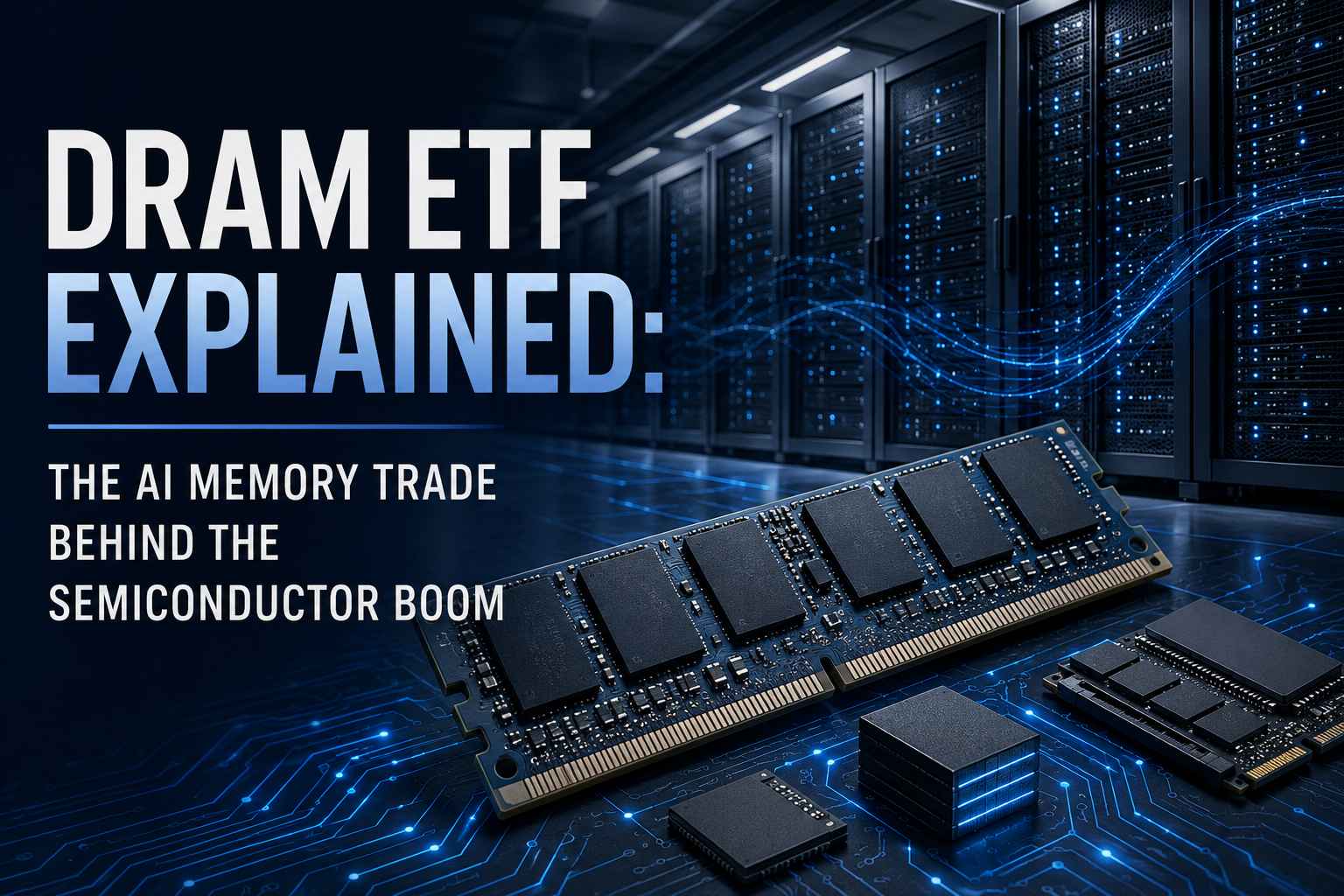
A memory ETF is an exchange-traded fund that concentrates on companies producing memory and storage technologies used to store data and feed it quickly to processors.
AI infrastructure has pushed this previously niche corner of semiconductors into a separate investment theme as demand for high-bandwidth memory, DRAM and NAND rises alongside spending on accelerators and data centres. World Semiconductor Trade Statistics forecasts the global semiconductor market to grow 90% to $1.51 trillion in 2026, with memory revenue alone rising around 250% to more than $800 billion. AI infrastructure, high-bandwidth memory and accelerated computing are driving much of that expansion.
That revenue increase should not be confused with a 250% increase in the physical amount of memory being consumed. Micron expects industry DRAM bit shipments to grow in roughly the low-20% range in 2026, far below the increase in industry revenue. The much larger revenue expansion therefore reflects a combination of genuine volume growth, higher memory prices and a shift toward higher-value products such as HBM.
What Is a Memory ETF?
A memory ETF packages several companies exposed to computer memory and storage into one tradable fund. Instead of choosing an individual producer such as Micron Technology, Samsung Electronics or SK Hynix, one fund can provide exposure to several companies participating in the memory cycle.
The category covers more than one technology. Dynamic random-access memory, or DRAM, provides temporary working memory for computers and servers. High-bandwidth memory, or HBM, is a specialised form of stacked DRAM designed to move large quantities of data rapidly between memory and high-performance processors. NAND flash retains data without power and is widely used in solid-state drives, while hard drives remain important for large-scale storage.
The Roundhill Memory ETF, ticker DRAM, was the first dedicated memory ETF when it launched on April 2, 2026. Roundhill defines eligible companies across HBM, DRAM, NAND, SSD, hard-drive and speciality-memory technologies. The fund charges an annual expense ratio of 0.65%.
Its early growth was extraordinary. DRAM attracted more than $21 billion of net inflows within roughly three months, pushing assets close to $26 billion by July 8 and making it the fastest-growing ETF launch on record according to ETF.com. Roundhill reported approximately $27.44 billion in AUM as of August 14, showing that the fund has maintained an unusually large asset base only months after launch.
That success encouraged other issuers to enter the theme, including the Tuttle Capital Concentrated Memory Stack ETF, or HBMX, the Kurv Memory Select ETF, or KMEM, and the Tema Memory ETF, or DISK. Their early asset gathering remained far smaller, with ETF.com reporting roughly $30 million in each fund shortly after launch. DRAM's success helped turn memory into a standalone ETF category, although investor demand had yet to spread evenly across its competitors.
Why AI Is Consuming More Memory
The first phase of the AI infrastructure boom centred heavily on processing power. Faster graphics processors and specialised accelerators allowed larger models and more demanding workloads to run, while the expanding compute base created another constraint. Those processors need enormous quantities of data delivered quickly enough to keep them operating efficiently.
HBM addresses that requirement by placing high-speed memory close to advanced processors and providing far greater bandwidth than conventional memory configurations. As AI models expand and inference workloads multiply, memory capacity and bandwidth requirements can rise alongside computing performance.
Storage demand is growing at the same time. Training datasets, model parameters and inference workloads still need to be retained outside the accelerator itself, extending the opportunity into conventional DRAM, NAND flash, enterprise SSDs and other storage technologies.
The physical buildout extends well beyond semiconductor sales. McKinsey estimated that shipments of chips, servers and networking equipment needed for data-centre construction increased almost 40% in 2025 and accounted for roughly one-third of global trade growth. AI software ultimately depends on a much larger physical infrastructure underneath it.
HBM Has Become an AI Bottleneck, Pulling the Wider Memory Cycle Higher
Memory has historically been one of the semiconductor industry's most cyclical businesses. Producers increase capacity when prices and margins are strong, additional supply eventually pressures prices, investment slows and the cycle begins again.
AI has strengthened demand considerably. Micron's latest fiscal third-quarter materials describe rapidly growing customer demand and record investment in technology, products and supply, while the company continues expanding its HBM product portfolio.
The difference between revenue growth and bit growth shows how unusual the current cycle has become. WSTS expects memory sales to rise around 250% in 2026, while Micron's industry outlook points to DRAM bit-shipment growth of only around the low-20% range. Physical demand is expanding, yet the much larger increase in industry revenue shows that pricing, supply tightness and higher-value memory products are contributing heavily to the current boom.
That combination supports producer earnings while shortages and pricing power persist, while also increasing sensitivity to any future reversal in memory pricing. A sharp revenue cycle can therefore coexist with a much slower increase in the physical number of memory bits shipped.
A Memory ETF Is More Concentrated Than It Looks
Owning an ETF usually creates some diversification across individual companies, yet DRAM remains unusually concentrated even after its portfolio expanded. Roundhill's latest published holdings, dated August 9, showed 24 holdings, with Micron at 26.86%, Samsung Electronics at 24.61% and SK Hynix at 20.35%. Together, the three companies still accounted for approximately 71.8% of the fund.
The updated numbers reinforce the original concentration argument rather than weakening it. DRAM has expanded from the 17 holdings shown in its earlier June factsheet, and the exact weights of its largest positions have shifted, yet more than seven dollars out of every ten in the portfolio remain tied to Micron, Samsung and SK Hynix. The ETF therefore reduces dependence on one producer while doing relatively little to diversify away from the fortunes of the industry's dominant memory companies.
Roundhill classifies DRAM as a non-diversified fund. The ETF consequently remains highly exposed to common industry forces such as memory pricing, HBM demand, supply expansion and semiconductor capital spending even as the number of securities in the portfolio increases.
The fund also uses total-return swaps for some exposures to maintain compliance with regulated-investment-company diversification tests. Such derivatives can add counterparty, valuation and liquidity risks beyond ordinary direct share ownership.
The term “memory ETF” also describes a theme rather than a standardised portfolio. KMEM initially placed roughly 42% of its portfolio in SK Hynix, while DISK leaned much more heavily toward NAND and storage companies such as Kioxia and SanDisk. HBMX casts a wider net by including semiconductor-equipment suppliers such as Applied Materials, ASML and Lam Research. Two funds carrying the same memory label can therefore respond differently to HBM pricing, NAND demand and semiconductor capital spending.
Structural AI Demand Does Not Remove the Memory Cycle
High prices and shortages are already encouraging manufacturers to expand capacity. SEMI expects DRAM manufacturing-equipment sales to rise 39% to $38.8 billion in 2026, while NAND equipment sales are forecast to increase 30.7% to $13.9 billion. HBM demand, advanced DRAM production and continued NAND technology investment are supporting the increase.
Those investments help suppliers meet growing demand, although additional capacity eventually creates another risk. AI can drive structural growth in memory consumption for years while memory-company earnings remain cyclical. If supply begins growing faster than demand, memory prices can decline, margins can compress and producer earnings can fall even as the number of DRAM and NAND bits consumed continues increasing.
DRAM has already demonstrated how violently those expectations can move. After trading at $80.72 around the June 22 semiconductor peak, DRAM fell to an intraday low of $48.64 on July 17, a decline approaching 40%. The broader AI-infrastructure thesis remained intact while the ETF surrendered a large portion of its earlier gains in less than a month.
The drawdown captures the central risk better than the ETF label does. Buying several memory companies together spreads some company-specific risk, while memory pricing, supply expansion and HBM-cycle risk remain shared across much of the portfolio.
Memory ETFs Turn the AI Memory Cycle Into a Tradable Theme
Memory has become a separate semiconductor trade because AI infrastructure increasingly depends on the bandwidth and storage surrounding processors. HBM connects directly to advanced accelerators, conventional DRAM supports server workloads, and NAND and enterprise storage handle expanding quantities of data.
DRAM's rapid asset growth shows how quickly investors have embraced that theme, although its latest portfolio still leaves approximately 71.8% concentrated in Micron, Samsung and SK Hynix. Rival memory ETFs also demonstrate that the label can represent very different exposures depending on whether a fund emphasises HBM, NAND, storage or semiconductor equipment.
The strongest case for memory remains continued growth in AI-related bit demand while supply stays constrained, particularly in premium products such as HBM. WSTS's revenue forecast shows how strongly demand, pricing and product mix are currently translating into industry sales, while Micron's substantially lower bit-growth outlook shows why that revenue number cannot be treated as physical consumption growth.
AI demand can remain structural for years without eliminating the memory industry's cycle. For a memory ETF, the eventual balance between bit growth, pricing and new manufacturing capacity will determine whether today's revenue boom develops into a durable earnings expansion or another sharp turn in one of semiconductors' most cyclical industries.