Published on: 2026-08-18
Updated on: 2026-08-18
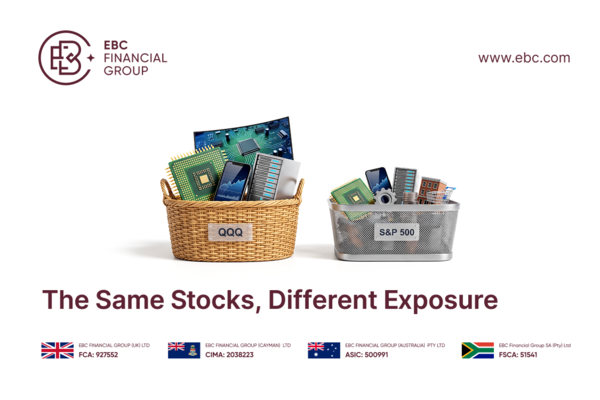
QQQ and the S&P 500 hold many of the biggest names in the US stock market, but they give those companies different levels of influence. The second quarter of 2026 showed this clearly. QQQ gained 27.54% on a net asset value basis, while the S&P 500 returned 15.20%, and the gap came largely down to QQQ's heavier exposure to technology and lighter exposure to energy. Measured on the same sector classification, technology made up an average of 64.75% of QQQ, compared with 43.28% of the S&P 500. Technology’s strong performance therefore had a great influence on QQQ.
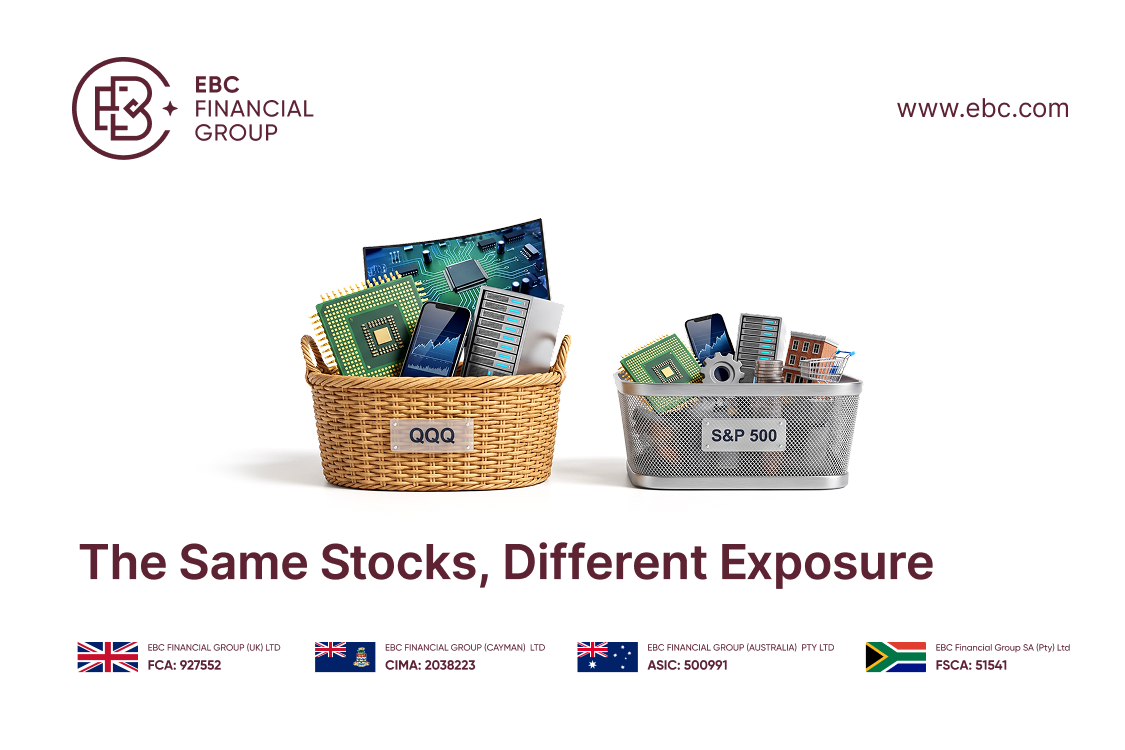
This article explains what QQQ follows, why its price may move differently from the wider US stock market, and what traders should know before trading it as a contract for difference (CFD).
The Nasdaq-100 is an index. It tracks 100 of the largest non-financial companies primarily listed on Nasdaq. QQQ is an exchange-traded fund (ETF) that holds those stocks to follow the Nasdaq 100 as closely as possible before fees and expenses.
The index does not select companies because they are in the tech sector. Companies qualify through rules covering their Nasdaq listing, size, liquidity, and other requirements. Financial companies are excluded. Tech companies still end up with the larger share, because many Nasdaq-listed companies operate in semiconductors, software, cloud computing and digital services.
QQQ however, also holds companies from sectors that include consumer discretionary, healthcare, telecommunications, and industrials.
Weighting works by size, with a little twist. Larger companies generally receive more weight, subject to limits. The index is reconstituted annually and rebalanced quarterly, and QQQ adjusts its holdings as the index changes.
The name does not always match the exact number of securities held at a given time. Multiple share classes, replacements, and current index rules may temporarily take the total above 100.
The SPDR S&P 500 ETF Trust (SPY) is one of the best-known ETFs tracking the S&P 500. Like QQQ, it gives the largest companies more influence. The difference lies in the wider mix around them.
| Area | QQQ | SPY |
|---|---|---|
|
Index Tracked |
Nasdaq-100 | S&P 500 |
|
Companies Represented |
Around 100 large Nasdaq-listed non-financial companies | Around 500 leading US companies |
|
Financial Companies |
Excluded | Included |
| Sector Mix | More concentrated in technology and growth-focused companies | Spread across a wider range of sectors |
| Main Trade-Off | More focused exposure, with greater concentration risk | Broader market exposure, with less focus on technology |
Several of QQQ's largest holdings also sat near the top of SPY as of30 June 2026. However, QQQ holds a smaller group of companies and has a heavier technology tilt, so developments affecting its largest stocks may have a greater effect on the ETF.
On that date, its ten largest holdings were NVIDIA, Apple, Alphabet, Micron Technology, Microsoft, Advanced Micro Devices, Amazon, Tesla, Intel, and Broadcom. Developments affecting semiconductors, artificial intelligence (AI), cloud computing, digital advertising, and consumer technology can move several major holdings at once.
However, QQQ doesn’t give every large technology company a substantially higher weighting than SPY. Micron made up 5.64% of QQQ at the end of June against 2.01% of SPY, and Tesla 3.30% against 1.83%. NVIDIA and Apple, though, carried almost the same weight in both funds. So QQQ's behaviour comes from its overall mix, not from every big tech name simply getting a much larger share.
Its heavier exposure to technology and growth companies helps explain these wider price swings. However, QQQ will not always move more sharply during every trading day or market event.
Several factors explain why QQQ can move more sharply. One is the influence of large technology companies, whose earnings affect a significant share of the fund and often shape expectations for similar stocks. Many of these stocks are also driven by the same themes, including artificial intelligence (AI) spending, semiconductor demand, cloud computing, and digital advertising. A change in any of these areas could move several major QQQ holdings at the same time. Interest rates create another shared pressure because higher rates can make investors less willing to pay high prices for companies whose profits are expected further in the future. The effect can be stronger in QQQ because it has less exposure to financial and energy companies. Banks can earn more from lending when interest rates rise, while energy shares often follow oil and gas prices. These sectors can help cushion the S&P 500 when technology stocks fall, although they will not do so in every market downturn.
When technology earnings are strong and investors are willing to pay more for future growth, QQQ may rise faster than the wider market. When earnings disappoint or interest-rate expectations rise, the same concentration may lead to a sharper fall.
Holding around 100 companies doesn't mean 100 separate sources of risk. Many of them react to the same things: one earnings trend, one interest-rate move, one shift in AI spending.
QQQ gives traders exposure to a group of companies instead of requiring them to choose one stock. However, a trader holding QQQ and NVIDIA has direct exposure through the individual stock and indirect exposure through the ETF. If NVIDIA's earnings disappoint, both positions may be affected.
Before combining QQQ with individual stocks, traders can check how much of the same company or theme appears across their positions. Holdings and weights change over time.
Buying QQQ shares means owning a stake in the ETF. Trading a QQQ CFD means trading the change in its price without owning any shares in the fund.
A CFD allows a trader to take a long position if they expect the price to rise or a short position if they expect it to fall. It also uses leverage, meaning the trader provides only part of theposition's full value as margin.
That leverage cuts both ways. Your gains and losses are based on the full position size, not only the amount set aside as margin.
A QQQ CFD may involve a spread, commission, overnight swaps, and slippage where applicable. Exact terms depend on the provider, account, position direction, and holding period.
EBC's zero commission and zero swaps campaign apply to eligible US stock and ETF CFDs from 12 June to 11 September 2026.
| Trading Cost or Risk | Standard Conditions | Campaign Conditions |
|---|---|---|
|
Opening Commission |
Standard commission | Zero commission on qualifying trades |
|
Closing Commission |
Standard commission applies | Zero commission when an eligible position is closed during the campaign |
| Overnight Swap | A charge or credit may apply | Negative and positive swaps are both set to zero during the campaign |
| Spread | Still applies | Still applies |
Removing commission reduces the separate charge for opening and closing eligible positions. Setting swaps to zero removes an overnight charge where a negative swap would normally apply, but it also removes any positive swap credit.
Lower trading costs do not make a weak trade stronger. A market move against the position may be much larger than the commission or swap removed. Traders still need to consider the spread, position size, leverage, market volatility, and upcoming announcements.
For traders who want to follow the Nasdaq-100 through one instrument, see how to access QQQ and other US ETF CFDs with zero commission and zero swaps during the campaign, subject to eligibility, regional availability, and campaign terms.