Published on: 2026-07-08
Updated on: 2026-07-08
QQQ, VGT and SMH are often used as shortcuts for AI exposure, yet they capture different parts of the same trade. The index design decides whether a fund mainly owns AI users, AI platform companies or the chip suppliers behind the buildout.
For anyone comparing direct exposure, SMH sits closest to the AI trade because it is tied to the chip supply chain, while VGT provides broader technology-sector exposure and QQQ provides the widest Nasdaq-growth exposure of the three.
SMH has the most direct AI exposure of the three because it is concentrated in semiconductors, chip equipment and the compute supply chain.
VGT offers broader information technology exposure, including the major AI-linked mega-cap names, without being a pure chip fund.
QQQ is the broadest of the three because it tracks the Nasdaq-100 rather than a pure technology or semiconductor index.
The three funds overlap heavily in the same mega-cap AI winners, so holding more than one may concentrate rather than diversify exposure.
The most useful comparison is exposure type and overlap, not past performance alone, since holdings and weights change over time.
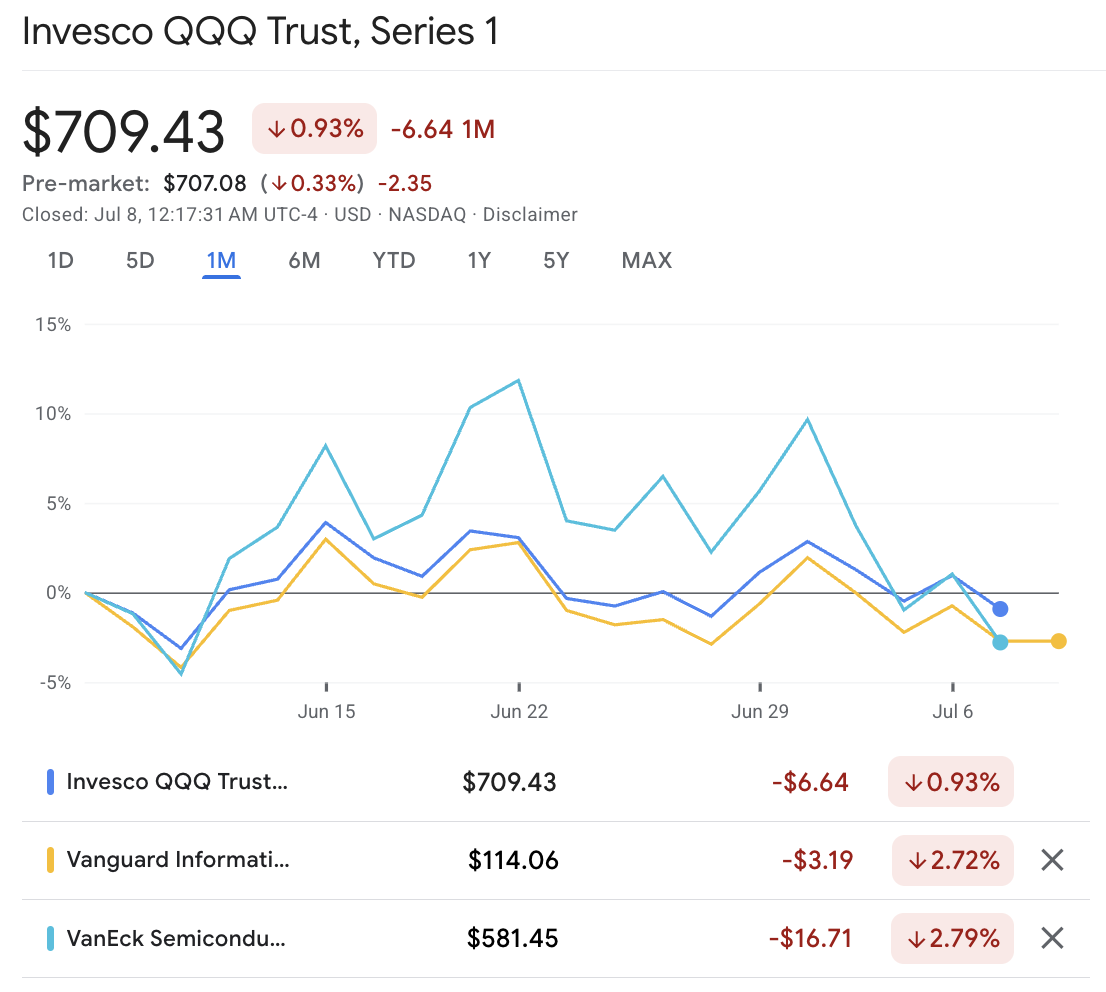
Holdings and weights change with rebalancing and daily price moves. The comparison below uses the latest available holdings snapshots cited in this article, including early July 2026 data for QQQ and SMH and late May 2026 data for VGT.
| ETF | Tracks | Holdings Profile | AI Exposure Type | Top AI-Linked Names | Main Risk |
|---|---|---|---|---|---|
| QQQ ETF | Nasdaq-100 | Broad Nasdaq large-cap growth | Broad AI beneficiaries | NVIDIA, Apple, Micron, Microsoft, Amazon | AI exposure diluted by broader Nasdaq holdings |
| VGT ETF | U.S. information technology sector | Broad technology sector | Technology infrastructure and platforms | NVIDIA, Apple, Microsoft, Broadcom, Micron | Mega-cap technology concentration |
| SMH ETF | Semiconductor index | Concentrated chip supply chain | Direct AI hardware infrastructure | NVIDIA, TSMC, Broadcom, AMD, Micron | Highest chip-cycle and concentration risk |
Invesco QQQ tracks the Nasdaq-100, a modified market-cap weighted index of 100 of the largest non-financial companies listed on Nasdaq, and typically holds roughly 100-plus positions.
That mandate pulls in far more than chips. QQQ spans information technology, consumer discretionary, communications services and healthcare, so a single fund mixes AI infrastructure names with retailers, streaming platforms, biotech and other growth businesses that have little to do with the AI compute layer.
Its largest holdings show why QQQ is AI-linked but not AI-specific. As of early July 2026, NVIDIA, Apple, Micron, Microsoft and Amazon sit near the top, giving the fund exposure to AI chips, devices, cloud platforms and mega-cap growth.
Because it also owns many Nasdaq-100 companies outside the AI infrastructure chain, QQQ works as a broad Nasdaq-growth proxy rather than a clean way to isolate AI infrastructure. Investors comparing exposure will find plenty of AI-linked mega-caps inside it, diluted by the wider index.
Vanguard’s VGT tracks the MSCI US Investable Market Information Technology 25/50 Index, which limits the fund to the U.S. information technology sector. That single-sector focus makes VGT more directly technology-oriented than QQQ, because it strips out the consumer, communications and healthcare names a Nasdaq-100 fund carries.
VGT recently held roughly 300-plus technology stocks spanning software, hardware, IT services and semiconductors.
Its top holdings make the middle-ground exposure clearer. As of late May 2026, the fund is led by NVIDIA, Apple, Microsoft, Broadcom and Micron, with the top ten accounting for around 60% of net assets.
That concentration means a few mega-caps drive much of the fund’s movement, even though it holds hundreds of names. Semiconductor-linked companies form a meaningful slice of the portfolio, which gives VGT chip exposure without turning it into a chip fund. The difference from SMH is that VGT also spreads across IT services, software and hardware rather than concentrating only on the semiconductor chain.
SMH is the most direct of the three because it concentrates on the semiconductor supply chain rather than broad technology or Nasdaq growth. VanEck’s SMH tracks an index of the largest U.S.-listed semiconductor companies and holds a compact portfolio of around 26 names.
Based on the latest holdings snapshot, it is led by NVIDIA and Taiwan Semiconductor Manufacturing, with Broadcom, AMD and Micron also among the largest holdings, alongside equipment and design names such as ASML, Lam Research and KLA. That lineup gives the fund exposure to AI accelerators, foundries, custom silicon, networking and memory.
AI demand is not only about applications and cloud services. It runs on chips, memory, foundry capacity and the tools that manufacture them, and SMH owns more of that hardware layer directly than QQQ or VGT. The trade-off is concentration.
If AI chip demand, semiconductor margins or NVIDIA-led sentiment weakens, SMH has less room to hide than a broader technology or Nasdaq-100 fund.
Beyond exposure type, a side-by-side comparison usually comes down to a short list of numbers that describe cost, concentration, size and volatility.
| Metric | QQQ ETF | VGT ETF | SMH ETF |
|---|---|---|---|
| Expense ratio | 0.18% | 0.09% | 0.35% |
| Number of holdings | 105 | 329 | 26 |
| Top 10 holdings weight | 45.03% | 60.61% | 69.53% |
| Largest single holding | NVIDIA, 7.62% | NVIDIA, 16.78% | NVIDIA, 19.01% |
| Concentration profile | Broadest of the three | Concentrated in mega-cap tech | Most concentrated |
| Relative volatility profile | Lower | Moderate | Higher |
The numbers show why the three ETFs behave differently. VGT has the lowest expense ratio, QQQ sits in the middle with its current expense ratio at 0.18%, and SMH is the most expensive of the three.
Cost is not the main driver of returns here, but it still matters for longer holding periods. Concentration is the bigger difference: QQQ spreads exposure across 100-plus Nasdaq names, VGT holds more than 300 technology stocks but remains top-heavy, and SMH owns only 26 semiconductor names.
That makes SMH the cleanest AI-hardware proxy, but also the ETF most exposed to chip-cycle risk.
QQQ, VGT and SMH are different funds, but they are not three completely separate AI bets. All three can hold major AI-linked companies such as NVIDIA, while VGT and SMH both carry meaningful semiconductor exposure.
The practical issue is overlap: adding SMH on top of VGT or QQQ may increase exposure to the same AI hardware cycle rather than creating a fully diversified position.
That overlap matters because the AI trade is increasingly concentrated in a handful of companies. If NVIDIA, advanced chip demand or semiconductor valuations weaken, the impact can show up across all three funds, even if SMH would usually feel it most directly. The cleaner question is how much of each fund depends on the same AI winners.
QQQ is the broadest option, pairing Nasdaq-growth exposure with AI exposure built in. It is the least direct of the three, but it also avoids relying only on the semiconductor cycle and carries the widest spread of businesses.
VGT is the cleaner technology-sector option. It owns major AI platform and infrastructure companies while still spreading exposure across software, hardware, IT services and semiconductors, placing it between QQQ and SMH.
SMH is the most direct option in terms of AI compute spending. It is closest to chips, memory, foundries and semiconductor equipment, but it also carries the highest concentration risk if the chip cycle turns.
Leadership can also rotate. If capital moves from chips into software, cloud platforms, power generation or data-centre operators, a semiconductor-heavy ETF may lag broader technology exposure. That makes the comparison less about which ETF is “best” and more about whether the exposure target is broad Nasdaq growth, broad technology, or concentrated AI hardware.
A semiconductor-only comparison sits between SMH and SOXX, which comes down to concentrated AI-chip leadership versus broader semiconductor supply-chain exposure, while EBC’s 2026 technology ETF list sets out a wider set of broad tech, software, cloud and AI-themed options side by side.
Not specifically. QQQ tracks the Nasdaq-100 and holds many AI beneficiaries, but it also includes consumer, communications and healthcare names, so it is a broad growth fund rather than a dedicated AI or technology fund.
VGT is more directly technology-focused because it tracks only the information technology sector, while QQQ spans several sectors. “Better” depends on whether an investor wants pure tech exposure or broader Nasdaq growth.
SMH concentrates on semiconductors and chip equipment, the physical infrastructure powering AI compute. That focus puts it closer to AI hardware demand than a broad tech or Nasdaq fund.
Yes. All three can hold the same mega-cap AI names such as NVIDIA, and VGT and SMH share semiconductor exposure. Holding more than one may concentrate exposure to the same AI winners rather than diversify it.
SMH is the cleanest AI-hardware proxy among QQQ, VGT and SMH, but that directness comes with higher concentration and chip-cycle risk. VGT sits in the middle as a broad technology-sector fund with strong AI-linked holdings, while QQQ is the broadest Nasdaq-growth option.
The comparison is less about which ETF is better than another, and more about whether the exposure target is broad AI beneficiaries, broad technology, or concentrated semiconductor infrastructure.