Published on: 2026-07-13
Updated on: 2026-07-13
The global tech sector has seen some wild market moves lately, but few stories match the absolute rocket ship ride of SanDisk Corporation. Operating under the Nasdaq ticker SNDK, the newly independent company has rapidly gone from a corporate spinoff to Wall Street’s biggest breakout star. Just under a year and a half after splitting from its former parent company, Western Digital, this flash memory pure-play has completely shattered what investors thought was possible in the semiconductor space.
Currently trading right around $1,915.92 per share, the stock has pulled off a breathtaking rally that almost no one saw coming. This meteoric rise of SanDisk stock is the direct result of a massive shift in global computing: an insatiable, AI-driven rush to build out infrastructure, which is devouring high-performance memory faster than factories can churn it out.
As institutional money pours into the hardware needed to power massive AI models and hyperscale data centers, the memory market has entered a historic boom. This analysis dives into the financial numbers, the supply-and-demand chaos, and the corporate shakeups that have pushed the valuation of SanDisk stock to these mind-boggling heights.
To understand why SanDisk stock is commanding such a premium today, you have to look back to February 2025, when Western Digital finalized its highly anticipated corporate split. The logic behind the divorce was pretty straightforward: separate the legacy hard disk drive (HDD) business from the fast-growing, highly volatile flash memory division. When the dust settled, Western Digital shareholders got their slice of the new independent company, which started trading on the Nasdaq at a modest price in the $22 to $38 range.
The move paid off almost immediately. By cutting ties with the slower-moving HDD business, management finally had the freedom to pour cash directly into their bread and butter: cutting-edge NAND flash memory solutions. Wall Street loved it.
Throughout 2025 and into early 2026, big funds, quantitative trading desks, and tech ETFs aggressively loaded up on shares. What started as a quiet corporate restructuring quickly turned into the best-performing stock on the Nasdaq, surging from a 52-week low of just $40.10 all the way to a historic peak of $2.354.39 in late June before settling into its current consolidation phase.
The real engine driving the explosive action behind SanDisk stock is a classic case of supply and demand tilted totally out of balance. The rapid buildup of AI data centers worldwide has forced cloud giants to completely rethink their storage hardware. Old-school storage options just can't feed data to modern graphics processing units (GPUs) fast enough to keep up with intense AI training and real-time processing.
Because of this, demand for ultra-fast, high-capacity enterprise Solid-State Drives (SSDs) has gone through the roof. This desperate need for hardware has given top-tier manufacturers incredible leverage, allowing them to raise prices and supercharge revenues across the entire chip industry.
Quarterly Price Hikes: Enterprise SSD prices shot up by 30% to 40% in consecutive quarters over the past year, translating into massive profit margins for the companies producing them.
A Rising Tide for Tech: The sheer scale of this memory boom is visible across the board, with global semiconductor revenues hitting a jaw-dropping $298.5 billion in the first quarter of 2026 alone—a massive 79.2% jump year-over-year.
SanDisk happened to be in the perfect place at the perfect time. Thanks to its advanced BiCS8 3D NAND technology, the company locked down massive enterprise contracts with the world's biggest cloud providers. As these tech giants openly admit that memory costs are rising, SanDisk has successfully passed those costs onto buyers. The proof is in the pudding: in its latest earnings report, SanDisk posted a jaw-dropping non-GAAP gross margin of 78.4%.
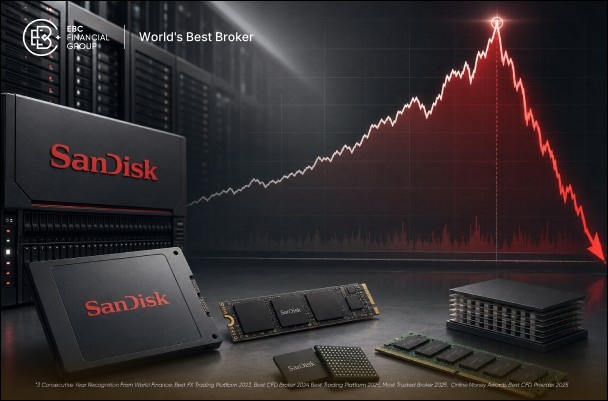
Even with SanDisk stock trading at its current multi-thousand-dollar valuation, analysts are deeply divided. Some worry the stock has flown too close to the sun, while others argue it’s a perfectly reasonable bet on the infrastructure powering the future of tech. Recent market turbulence—partly caused by a broader tech selloff in Asian markets—actually knocked the stock down from its $2.350 highs to the current $1,915.92 mark, giving investors a moment to breathe and look at the actual math.
When you compare SanDisk's financial health to its closest rivals, the valuation looks surprisingly grounded.
| Ticker | Company | Market Cap | Trailing Gross Margin | Forward P/E Ratio |
| SNDK | SanDisk Corporation | ~$283.7 Billion | 78.4% | ~9.3x - 11.7x |
| WDC | Western Digital | ~$73.5 Billion | ~22.5% | ~42.5x |
| MU | Micron Technology | ~$375.1 Billion | ~41.6% | ~18.5x |
While a $1,915.92 price tag feels incredibly intimidating to everyday retail investors, the company's forward price-to-earnings (P/E) ratio is actually sitting in the modest single-to-low-double digits (around 9.3x to 11.7x). That is noticeably cheaper than Micron and significantly lower than Western Digital’s 42.5x multiple, which is still weighed down by debt and post-split restructuring.
Furthermore, SanDisk’s enterprise value to EBITDA sits at roughly 8.5x, well below the chip industry's median average of nearly 18x. This tells us that even though the stock price has gone vertical, the company's actual earnings and cash flow have largely kept pace with its ballooning market cap.
The drama surrounding SanDisk stock intensified mid-year due to a major corporate cleanup. In June 2026. Western Digital decided it was time to completely hand over the keys and divest its remaining financial stake in its former baby. They executed a private equity-for-equity swap with institutional investors, trading off their final block of 1.03 million SanDisk shares.
The deal wrapped up late last month. While short-sellers initially panicked, thinking Western Digital’s exit meant the memory market had peaked, long-term bulls saw it as a massive win. Because the transaction happened privately through institutional blocks rather than hitting the open market, it didn't trigger the typical panic-selling and downward pressure you see with standard secondary offerings. Now, SanDisk is officially operating on its own two feet, free of corporate baggage.
Now that SanDisk stock is a permanent member of the four-figure club, traders are openly wondering when management will step in to adjust the share structure. Trading near $2.000 makes the stock visually daunting and tough to trade for regular retail investors who don't use platforms with fractional shares.
Typically, when tech companies experience this kind of explosive growth, they roll out a forward stock split to bring the share price down and make things a bit more accessible.
To be clear, a stock split doesn't change anything about the company's actual value or market cap—it just slices the pizza into more pieces. However, it does make options trading way easier and sparks fresh interest from everyday traders. Rumors are swirling that if SanDisk keeps spending heavily to boost factory capacity, a stock split announcement could be the next big psychological catalyst to keep the momentum going ahead of their highly anticipated August earnings call.
SanDisk’s journey from a corporate division to an independent market titan is a masterclass in how much value a clean corporate split can unlock. By riding the massive wave of AI data center expansion and capitalizing on soaring NAND flash memory prices, the company has made itself indispensable to the modern cloud economy.
A Quick Reality Check: The chip industry is notoriously cyclical. What goes up can come down fast if competitors suddenly flood the market with supply, so keeping an eye on global production capacity is a must for anyone holding long-term positions.
For now, though, the financial engine under the hood is firing on all cylinders. With a highly attractive valuation compared to its peers and enterprise demand showing zero signs of slowing down, SanDisk stock continues to prove that its multi-thousand-dollar status is backed by real pricing power and massive macroeconomic tailwinds.