Published on: 2026-04-14
Updated on: 2026-04-14
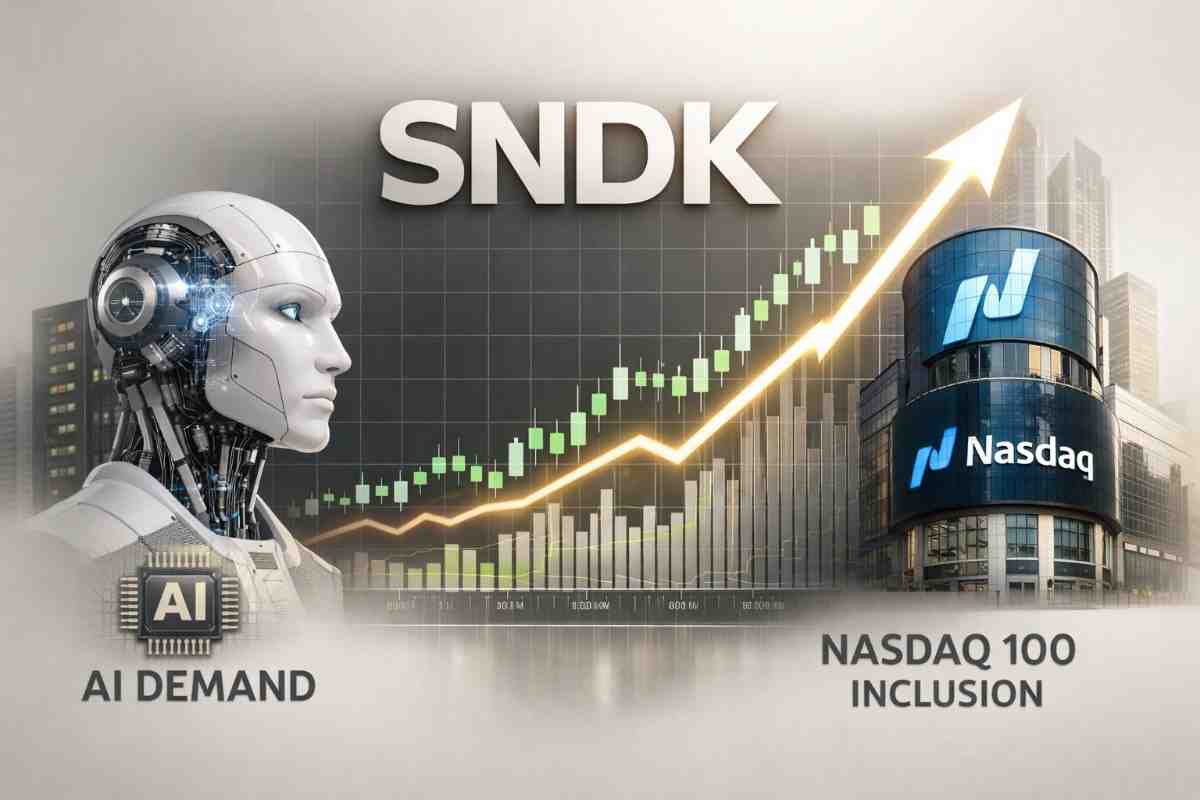
SanDisk will join the Nasdaq-100 on April 20, 2026, replacing Atlassian, creating a near-term passive flow catalyst on top of an already extended rally.
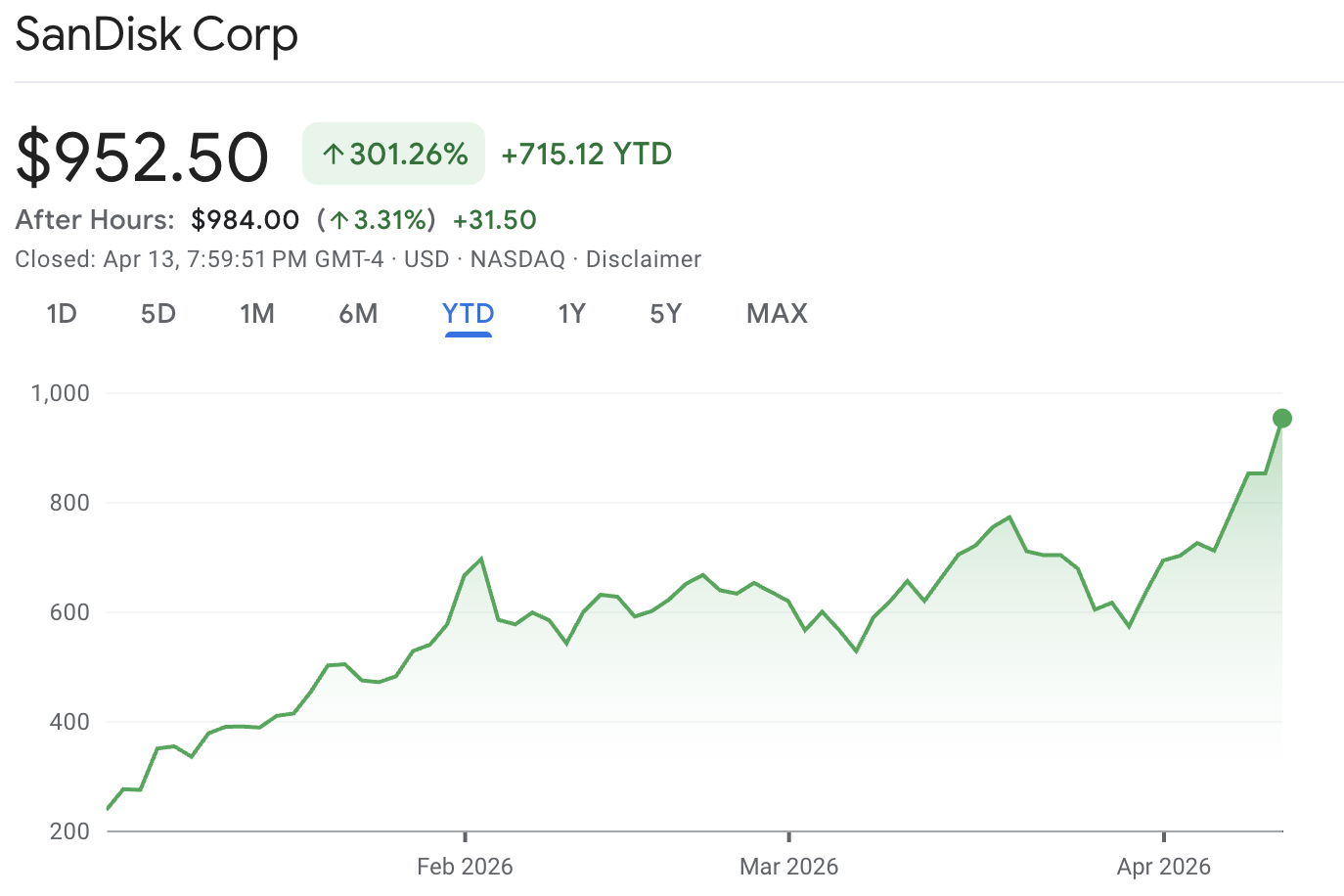
SanDisk stock traded at $952.50 in the latest session, after a record-setting jump that left shares up more than 300% in 2026.
Fiscal Q2 revenue reached $3.03 billion, GAAP gross margin hit 50.9 percent, and Sandisk guided fiscal Q3 revenue to $4.40 billion to $4.80 billion with non-GAAP EPS of $12.00 to $14.00.
Datacenter revenue rose 64% sequentially, but it was still just 14.5% of total sales, indicating that the bull case is also about industry-wide NAND pricing and mix, not just direct AI server shipments.
The overall memory market remains exceptionally robust, with TrendForce projecting NAND Flash contract prices to increase by 70-75% quarter over quarter in Q2 2026 due to heightened demand from AI and data centers, which is tightening supply.
SanDisk's surge today looks like a two-stage move. Stage one was the fundamental rerating driven by stronger pricing, tighter supply, and a faster AI storage ramp. Stage two is the flow-driven extension created by Nasdaq-100 inclusion.
| Metric | Q1 FY26 | Q2 FY26 | Q3 FY26 Guide |
|---|---|---|---|
| Revenue | $2.31B | $3.03B | $4.40B to $4.80B |
| GAAP Gross Margin | 29.8% | 50.9% | 64.9% to 66.9% |
| Datacenter Revenue | $269M | $440M | Not Disclosed |
| GAAP Net Income | $112M | $803M | N/A |
| Non-GAAP EPS | $1.22 | $6.20 | $12.00 to $14.00 |
*Data based on SanDisk's fiscal Q2 2026 earnings release and fiscal Q3 2026 guidance.
The strongest evidence is in the mix, not just the headline revenue number. In SanDisk's Q2 deck, bit shipments were only up in the low single digits, while average selling price per gigabyte rose in the mid-30% range.
Simply put, SanDisk did not just sell more. It sold better and at much better prices. When margins jump that hard, the market usually assumes the cycle has more power than expected.
Management also spelled out where the strength is coming from. Datacenter revenue rose 64% sequentially, driven by adoption among AI infrastructure builders, semi-custom customers, and large technology companies deploying AI at scale. Sandisk said it had completed qualification of PCIe Gen5 TLC drives at a second hyperscaler and said Stargate was advancing through qualification with two major hyperscalers.
Independent industry data points the same way. TrendForce said at the end of March that NAND Flash contract prices were expected to rise 70% to 75% quarter over quarter in Q2 2026, driven by AI and data center demand spreading across the product portfolio.
Nasdaq announced on April 10 that Sandisk will join the Nasdaq-100 before the market opens on April 20, replacing Atlassian. Once that happens, index funds and ETFs tied to the benchmark need to buy SNDK. Even discretionary managers who benchmark themselves to the Nasdaq-100 often have to adjust. That kind of demand can exaggerate an existing uptrend.
Still, the sequence is the key. Sandisk had already absorbed a major secondary offering in February, when Western Digital sold 5.82 million Sandisk shares at $545 each. Sandisk itself was not selling stock and did not receive proceeds.
In practice, that deal helped reduce a large legacy overhang from the former parent. The fact that SNDK moved from that offering price to the mid-$900s in less than two months tells you the market was already willing to pay for the fundamental story.
| Time frame | Key move | What it suggests |
|---|---|---|
| Last week | $724.63 to $952.50 (~+31%) from April 6 to April 13 | The move shifted from strong to explosive, with the Nasdaq-100 inclusion acting as a late accelerant rather than the sole driver |
| One month | $661.62 to $952.50 (~+44%) from March 13 to April 13 | The rally was volatile, but buyers kept stepping in at higher levels, suggesting steady institutional accumulation |
| Six months | Revenue rose from $1.90B to $3.03B and non-GAAP EPS from $0.29 to $6.20 across Aug. 2025 to Jan. 2026 | The stock’s rerating appears to be supported by strong quarter-by-quarter fundamental acceleration |
*Data based on StockAnalysis and SanDisk's fiscal earnings release
The one-week move shows momentum became much stronger in mid-April. While the Nasdaq-100 inclusion helped fuel the final leg higher, the stock was already making new highs before that announcement.
The one-month move is important because it was not a straight-line rally. The stock had sharp pullbacks, but each dip found buyers at higher levels, which is often a sign of institutional demand rather than just short-term headline chasing.
The six-month trend is the strongest part of the story. Revenue and earnings accelerated sharply over successive quarters, a kind of operating improvement that can support a real rerating rather than just a temporary momentum spike.
For the rally to hold, SanDisk needs to prove that current pricing is not just a squeeze. Two developments help that argument.
First, management has already guided to another step up in both revenue and earnings for fiscal Q3. Second, the company has moved to secure supply, including a March 25 strategic investment of about $1.0 billion in Nanya and a concurrent multi-year DRAM supply arrangement.
That is a notable sign that management sees the memory environment as structurally tight enough to justify balance-sheet action.
This is where the distinction between AI narrative and AI monetization becomes crucial. Sandisk doesn't require all growth to stem from AI servers. AI is essential to maintaining a memory market that is sufficiently undersupplied, enabling enterprise SSD adoption, an improved product mix, and contract pricing to mutually support one another. On that front, the setup still looks favorable going into April 30.
From a chart perspective, the stock is in a very strong short-term uptrend, but it is also stretched. The most obvious near-term support zone is around $850 to $852, which was the April 9 and April 10 closing area before the latest breakout.
Below that, $780 to $781 matters because that was the April 8 close, and then roughly $710 to $725 becomes the next important area based on the April 6 and April 7 price action.
On the upside, the first level is the April 13 intraday high near $953, followed by the psychological $1,000 level.
The immediate catalyst is SanDisk's addition to the Nasdaq-100 on April 20, which forces benchmarked funds to own the shares. The deeper driver is a sharp improvement in NAND pricing, enterprise SSD demand, and AI-linked datacenter spending that has already translated into stronger revenue and margins.
The next major test is SanDisk's fiscal Q3 2026 earnings report on April 30. After this kind of run, investors will be watching guidance, gross margin, enterprise SSD traction, and any update on hyperscaler ramps.
Because it was a Western Digital sell-down, not new dilution from SanDisk, the market treated it as an overhang-clearing event, especially once the stock kept climbing far above the $545 offering price.
The current SanDisk stock surge is best understood as a layered rerating. Nasdaq-100 inclusion is providing the near-term liquidity shock, but AI demand is doing the heavier strategic work by lifting storage intensity, reinforcing NAND pricing, and expanding SanDisk's earnings power.
That makes SNDK one of the clearest examples in today's market of fundamentals and flows reinforcing each other. For now, the business trend explains the base, and passive buying explains the spike.
The next test is straightforward: if April 30 confirms that pricing, mix, and datacenter demand are still accelerating, the move can remain fundamentally credible. If not, the index catalyst alone will not be enough to defend a parabolic chart.
Disclaimer: This material is for general information purposes only and is not intended as (and should not be considered to be) financial, investment, or other advice on which reliance should be placed. No opinion given in the material constitutes a recommendation by EBC or the author that any particular investment, security, transaction, or investment strategy is suitable for any specific person.