Published on: 2026-04-07
Updated on: 2026-04-07
Key Takeaways
Sandisk became an independent public company in February 2025, giving investors direct exposure to NAND flash and SSD demand after the separation from Western Digital.
Fiscal Q2 2026 marked a step change in fundamentals, with revenue at $3.03 billion, Non-GAAP EPS at $6.20, and datacenter revenue at $440 million.
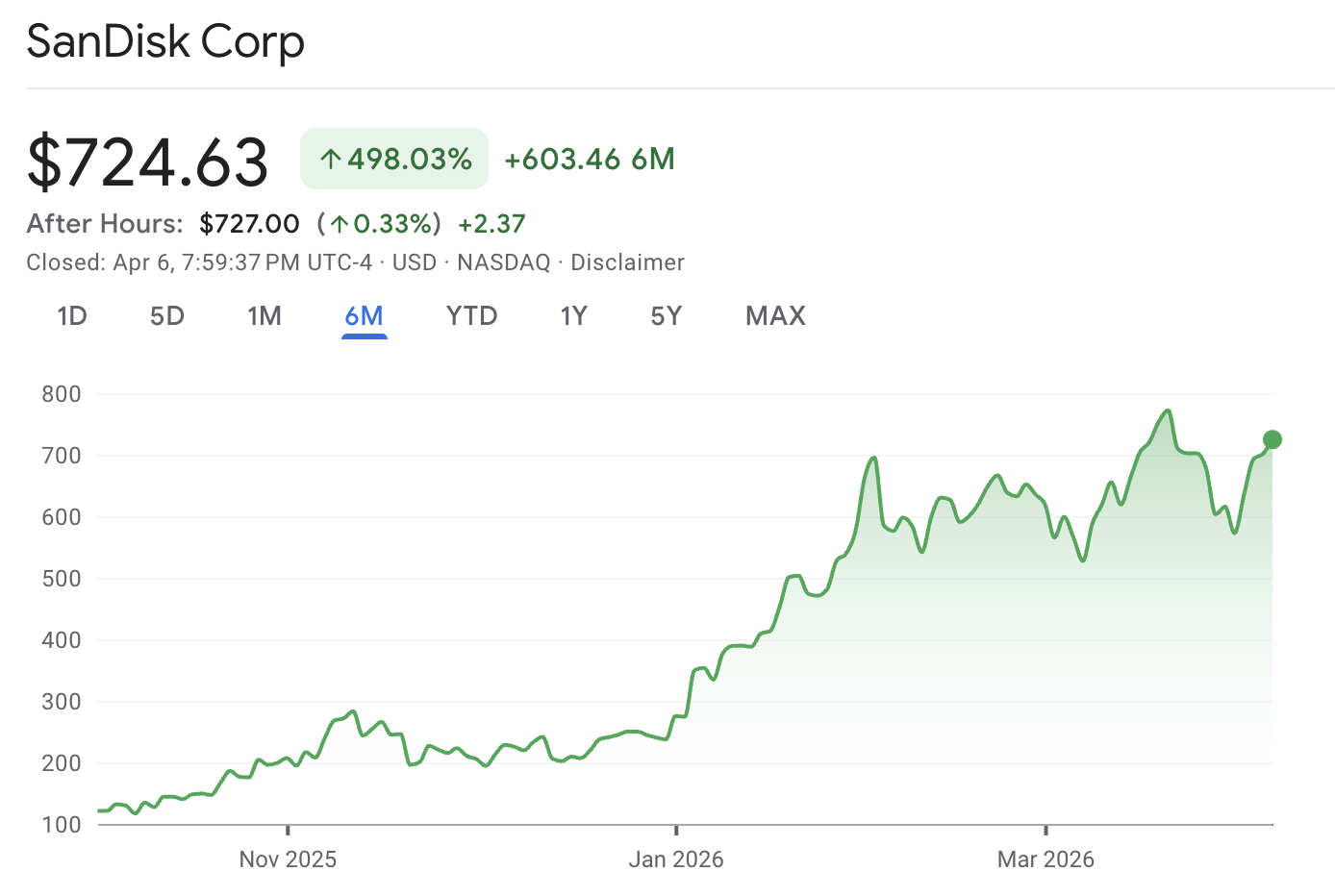
As of the April 6, 2026 close, SNDK stood at $724.63, up 3.28% on the day, 26.57% from March 30, and 498.03% from October 6, 2025.
Datacenter was still only about 14.5% of Q2 revenue, which suggests further room for mix improvement if enterprise SSD demand keeps rising.
Sandisk has strengthened its strategic position through the Kioxia joint-venture extension to 2034, a $1 billion Nanya investment with supply ties, and a High Bandwidth Flash standardization effort with SK hynix.
Sandisk stock has become one of the market’s most explosive AI-linked memory trades as stronger NAND pricing, accelerating enterprise SSD deployments, and a clearer post-spin identity reshape the company’s earnings outlook. After a near-500% six-month rally, the central question is whether SNDK can keep converting AI infrastructure demand into durable margin expansion.
In its latest reported quarter, Sandisk posted $3.03 billion in revenue, up 61% year over year and 31% sequentially.
The rally suggests investors increasingly view SNDK as a focused flash and enterprise storage company with rising exposure to AI infrastructure demand.
AI data centers require large, high-performance solid-state drives using flash memory to store training data, and that demand has surged considerably.
As one of the world’s leading NAND flash memory producers, Sandisk is a direct beneficiary of this structural shift.
CFO Luis Visoso has explained that the NAND market is undergoing a “structural evolution catalyzed by AI” that should reduce cyclicality and support higher long-term margins. Management has further indicated that customer demand is expected to exceed supply well beyond calendar year 2026.
Key drivers behind the SNDK AI demand thesis include:
AI training and inference workloads require significantly more storage than traditional computing
A multi-year supply-demand imbalance in NAND flash is unlikely to be resolved quickly
A manufacturing joint venture with Kioxia, providing scale and cost advantages competitive with Samsung
A strategic $1 billion investment in Nanya Technology, securing a multi-year DRAM supply agreement
Sandisk’s fiscal Q2 2026 results were strong enough to reset expectations for the full year. Revenue grew to $3.03 billion from $2.31 billion in fiscal Q1 2026 and $1.90 billion in fiscal Q4 2025.
Non-GAAP EPS rose from $0.29 in Q4 FY2025 to $1.22 in Q1 FY2026 and then to $6.20 in Q2 FY2026. That is not a normal cyclical bounce. It is a sharp earnings inflection backed by higher pricing, stronger mix, and accelerating enterprise SSD deployments.
| Metric | Q4 FY2025 | Q1 FY2026 | Q2 FY2026 |
|---|---|---|---|
| Revenue | $1.90B | $2.31B | $3.03B |
| Non-GAAP EPS | $0.29 | $1.22 | $6.20 |
| Key signal | Return to profitability | Revenue acceleration | Major earnings inflection |
In Q2, edge revenue was $1.678 billion and consumer revenue was $907 million, compared with $440 million from datacenter.
That makes the AI narrative stronger, not weaker, because it shows that SanDisk still has room to improve its mix if enterprise demand keeps rising.
As of the close on April 6, 2026, SNDK finished at $724.63. Using the prior close, the March 30 close, and the October 6, 2025 close as reference points, the stock was up 3.28% on the day, 26.57% over one week, and 498.03% over six months.
| Period | Performance |
|---|---|
| 1D | +3.28% |
| 1W | +26.57% |
| 6M | +498.03% |
The move is extraordinary even by semiconductor standards. It suggests the market is no longer waiting for proof that Sandisk has recovered. It is now debating how much further the company’s earnings power can expand if flash pricing and enterprise demand remain firm.
The key issue is not whether flash demand exists. The question is whether supply discipline and higher-value enterprise demand can sustain a constructive pricing environment. Sandisk’s latest quarter suggests that is exactly what has been happening, with margins and guidance both moving sharply higher.
Sandisk has also moved to reinforce its supply position. On January 29, 2026, Sandisk and Kioxia extended their Yokkaichi joint venture agreements through 2034, providing the company with longer-term manufacturing continuity. The agreement also aligns the Kitakami arrangement through the same date.
Another important step came on March 25, 2026, when Sandisk disclosed a $1.0 billion strategic investment in Nanya Technology and a multi-year DRAM supply arrangement.
Sandisk remains primarily a NAND and SSD story, but the Nanya deal shows management is trying to secure broader memory inputs as AI systems become more data-intensive.
The bullish outlook rests on genuine fundamentals. Sandisk projects data center exabyte growth to reach the high-60% range for 2026, up from the mid-40% range just last quarter.
This figure does not yet account for NVIDIA’s key value cache (KV cache) storage requirements, which could add meaningful incremental demand in 2027.
CEO David Goeckeler has stated that High Bandwidth Flash represents a new paradigm for AI inference, and a first 500-layer NAND architecture announcement with Kioxia is expected by late 2026.
That said, the risks are real:
Valuation compression is possible if AI infrastructure spending slows or macro conditions deteriorate
Alphabet’s TurboQuant tool raised near-term demand concerns, though analysts broadly argue efficiency gains expand AI use cases rather than reduce total memory demand
The NAND market is historically cyclical, and a supply surge from competitors could reverse current pricing dynamics
Export controls on high-end AI storage to China constrain the total addressable market, though U.S. and European hyperscaler demand has more than offset this pressure
Tariff-related volatility in early April 2026 contributed to the S&P 500’s worst quarter since Q3 2022, a reminder that macro headwinds can reprice high-beta semiconductor names rapidly; SNDK carries a beta of 2.85
Investors entering today are buying a company priced for continued execution. The April 30 earnings call is the next critical test.
Sandisk has strong fundamental momentum backed by AI-driven NAND demand and expanding margins. It suits growth-oriented investors with a higher risk tolerance, but it is not a conventional value play.
Sandisk manufactures NAND flash memory and high-capacity SSDs used in AI data centers for training and inference workloads. Accelerating infrastructure spending has significantly lifted demand, directly boosting revenue and gross margins.
Sandisk will report fiscal Q3 2026 results on April 30, 2026. Given the scale of guidance issued for the quarter, this is the stock’s most significant near-term catalyst.
The key variables are datacenter revenue growth, gross margin follow-through, and the tone of demand commentary. Investors will also want to see whether management can support its Q3 revenue guidance of $4.40 billion to $4.80 billion and its Non-GAAP EPS range of $12.00 to $14.00.
Sandisk’s rally is grounded in more than momentum. Since emerging as an independent public company, it has delivered a sharp improvement in revenue, earnings, and datacenter traction, while reinforcing its longer-term position through the Kioxia partnership, the Nanya investment, and its High Bandwidth Flash initiative.
The next question is whether SNDK can convert AI-linked storage demand into durable earnings power through the next stage of the cycle. If datacenter demand and flash pricing remain firm, SNDK can continue to support a higher earnings base.
If either weakens, the stock’s margin for error is now much thinner.
Disclaimer: This material is for general information purposes only and is not intended as (and should not be considered to be) financial, investment or other advice on which reliance should be placed. No opinion given in the material constitutes a recommendation by EBC or the author that any particular investment, security, transaction or investment strategy is suitable for any specific person.