Published on: 2026-03-30
Updated on: 2026-03-30
The S&P 500 headline number is masking far deeper damage happening beneath the surface.
Most S&P 500 industry groups are already in correction territory, with several in a full bear market.
Energy stands as the lone bright spot in March, while growth-oriented sectors have taken the hardest hits.
Market breadth has deteriorated sharply, raising the stakes for investors who are watching only the index level.
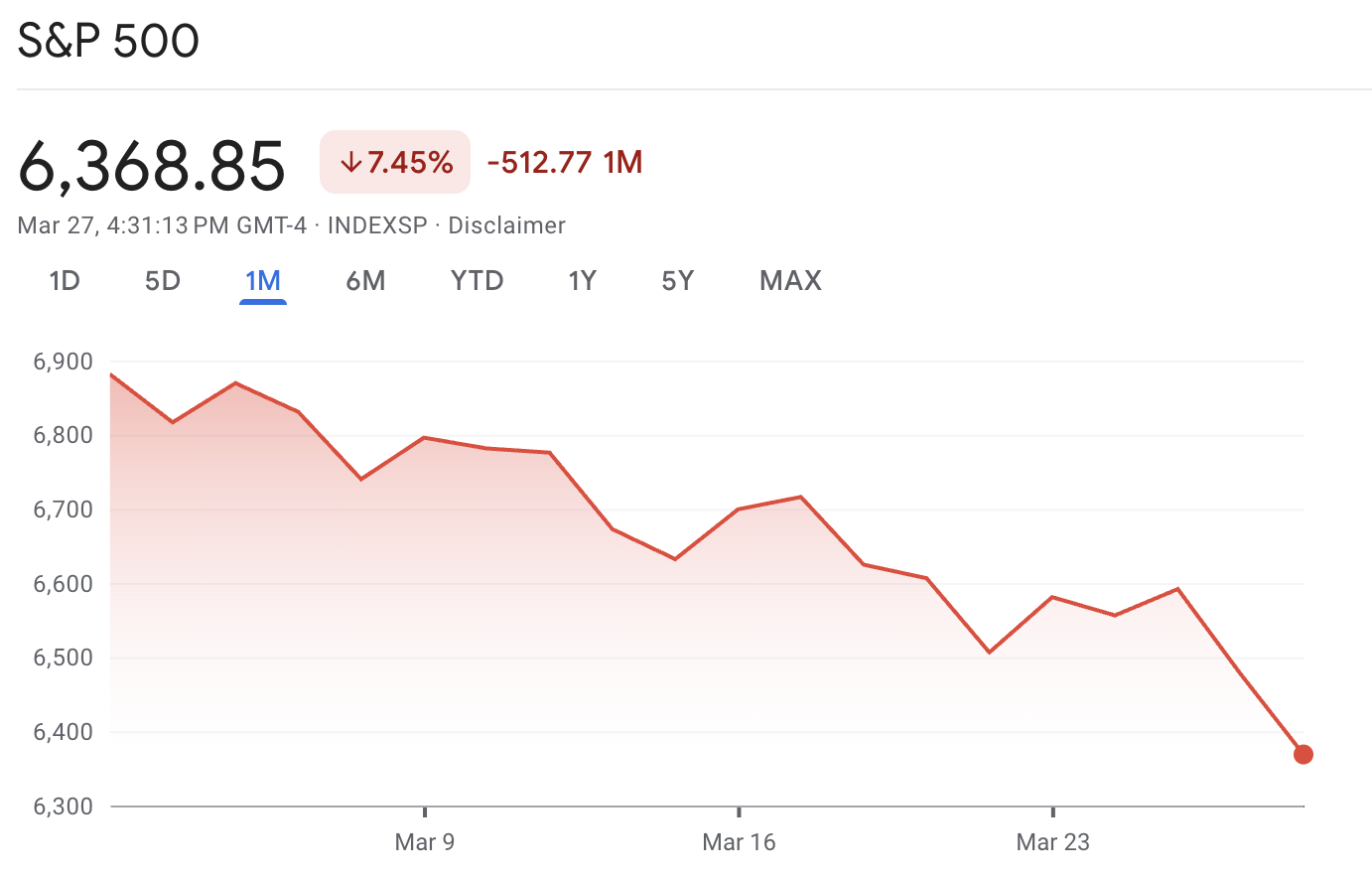
If you checked the S&P 500 this week and felt only mildly concerned, you may be watching the wrong number. The index is down roughly 8.7% from its January 27 record high, which may not look alarming on the surface. Beneath that headline, however, the damage is much deeper.
As of the latest weekend coverage, 16 of 25 S&P 500 industry groups were already in correction territory, while four had entered bear-market territory. That divergence matters because the index can still look relatively stable even as broad internal weakness spreads across sectors.
This is what market veterans call a stealth bear market: a broad, grinding deterioration that the composite index obscures until it can no longer do so. For investors, that gap between what the index shows and what is actually happening is where real portfolio damage occurs.
The headline S&P 500 is a cap-weighted index, meaning a small group of mega-cap stocks can hold it up even when the broader market weakens. In contrast, the equal-weight S&P 500 gives each stock equal weight, offering a clearer view of how the average stock is performing.
This distinction is particularly relevant in the current S&P 500 correction. Although the index has declined less than 10% from its peak, most sectors and industry groups are already in correction territory. This divergence indicates that the extent of market weakness is broader than the headline figure suggests.
The equal-weight index reflects this reality. It captures the weakness in areas like software, real estate, and consumer discretionary, which are under pressure from higher rates and slowing growth expectations. At the same time, the narrow strength in energy is not enough to offset broader declines when every stock is weighted equally.
This dynamic contributes to the deterioration of S&P 500 market breadth. A market sustained by a limited number of large-cap stocks is structurally fragile. When market leadership narrows and the equal-weight index underperforms, it often signals that the correction is both deeper and more advanced than the headline index suggests.
The sector rotation in March 2026 has been unusually sharp, with leadership narrowing fast as investors moved away from growth and rate-sensitive sectors.
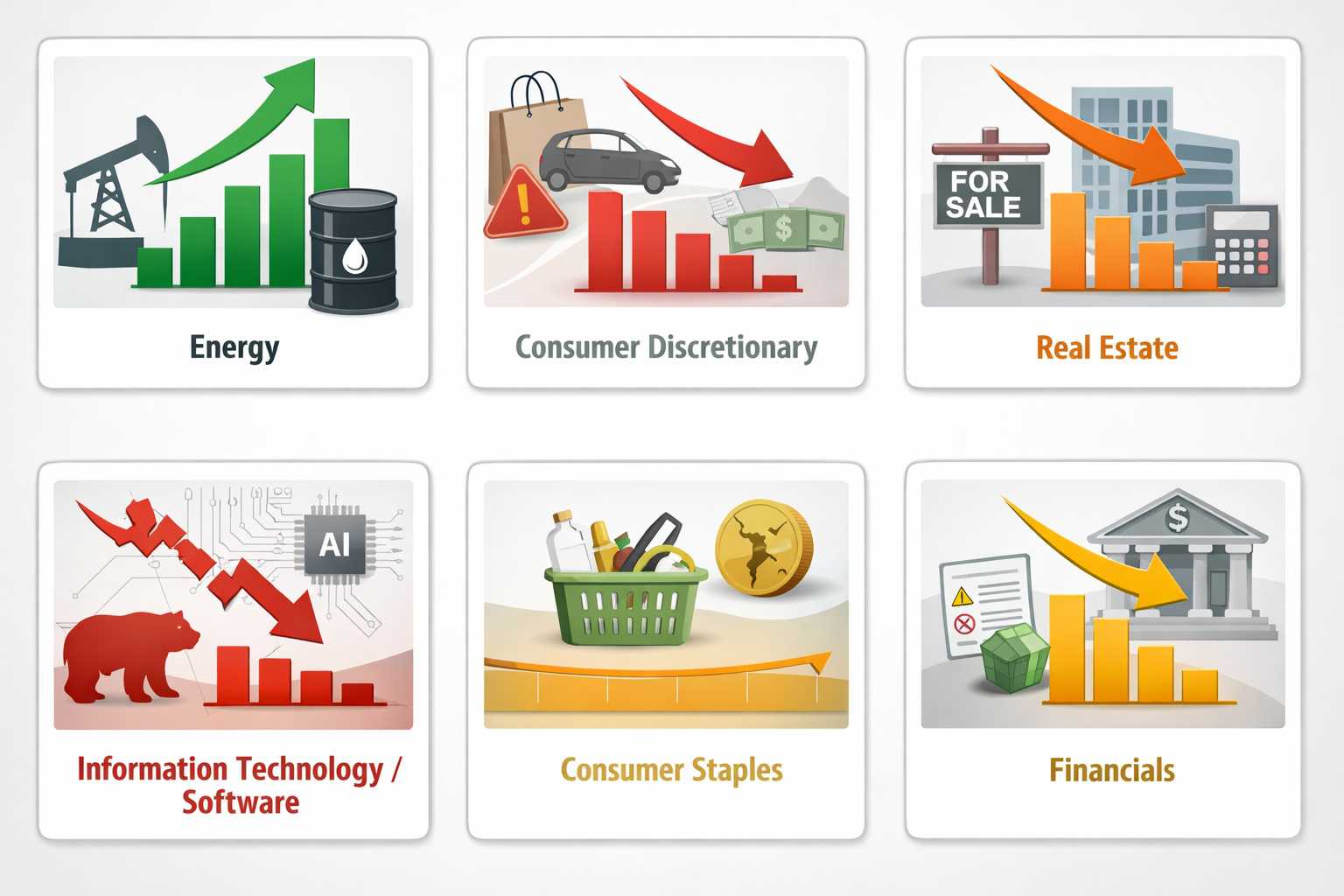
| S&P 500 Sector | March 2026 Status | Key Driver |
|---|---|---|
| Energy | Positive, only gainer | Oil above $90/bbl, geopolitical premium |
| Consumer Discretionary | Worst performer, about -12% MTD | Fuel cost spikes, recession fears |
| Real Estate | In correction territory | Office supply glut, high financing costs |
| Information Technology / Software | Bear market territory in select groups | AI fatigue, high valuations, rate sensitivity |
| Consumer Staples | Underperforming | Weak revenue and free cash flow growth |
| Financials | Underperforming | Credit quality concerns, economic uncertainty |
The data above makes clear that the S&P 500 correction is not evenly distributed. Investors holding a passive index position may feel less exposed than they actually are, given how narrow the support base has become.
Energy has been the only major S&P 500 sector showing clear positive momentum in both prices and forward expectations since late February. In March alone, the energy sector was up more than 18% month-to-date as of March 24, driven by Brent crude trading above $90 per barrel.
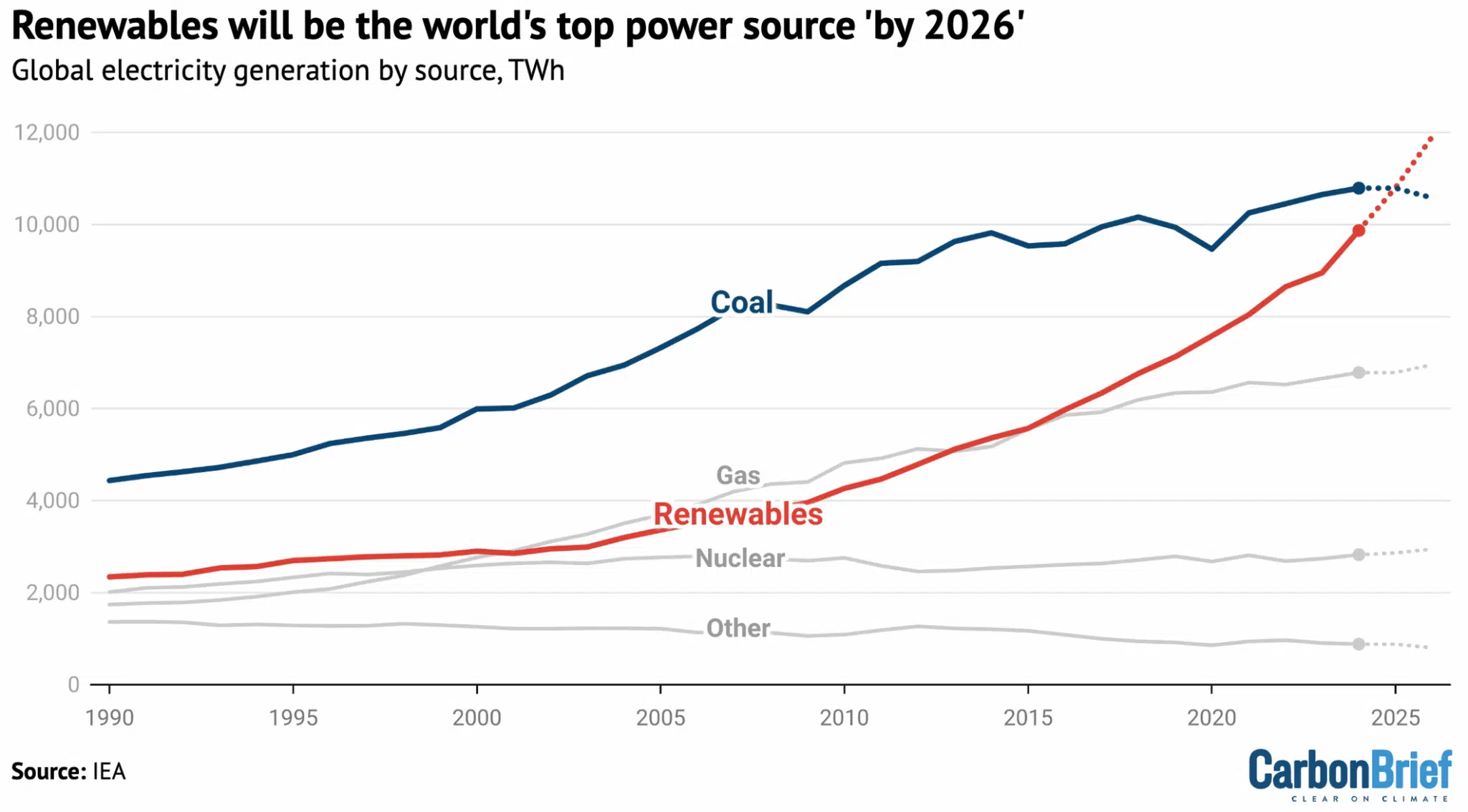
Companies like ExxonMobil have benefited directly, with XOM posting significant share-price gains as oil prices surged amid tightening global supply conditions. The geopolitical backdrop has compressed what would typically be a gradual repricing into a matter of weeks.
It is worth noting that energy stocks have become the most widely discussed sector on Wall Street. When positioning becomes crowded, the sector can become vulnerable to mean reversion.
The software and broader information technology industry groups represent some of the worst damage below the surface. Select software-related industry groups are down more than 20% from their highs, meeting the technical definition of a bear market.
The culprit is a combination of factors:
Valuation compression: After three years of AI-driven multiple expansion, software stocks entered 2026 priced for perfection, with some names trading at over 100 times forward earnings.
Rate sensitivity: Software and growth stocks are long-duration assets. Any upward pressure on discount rates hits their present-value calculations hardest.
"AI fatigue": Investor enthusiasm for AI-driven revenue stories has cooled as the timeline for meaningful earnings impact has extended.
Stocks like Palantir, which is down more than 28% from its high, illustrate the problem: strong business momentum has not prevented brutal multiple compression amid a risk-repricing environment.
The real estate sector has been caught in a difficult position. On one hand, it carries the lingering overhang of the commercial office market, which has never fully recovered from pandemic-era remote work adoption.
On the other hand, high financing costs continue to weigh on property valuations and development pipelines.
The Schwab Center for Financial Research, as of its March 13, 2026, update, rates real estate as "Less Favored" over the next six to twelve months, citing supply imbalances in the commercial office segment as the primary drag. Real estate profit margins in Q1 2026 are also expected to come in below their five-year average.
Dividend-focused investors who treated real estate as a defensive allocation have faced deeper losses than many expected.
For those who track S&P 500 market breadth, this correction did not come out of nowhere. The percentage of S&P 500 stocks trading above their 200-day moving average fell below 50% in mid-March 2026, signaling a confirmed deterioration in market breadth.
Historically, that kind of reading has preceded extended periods of weakness.
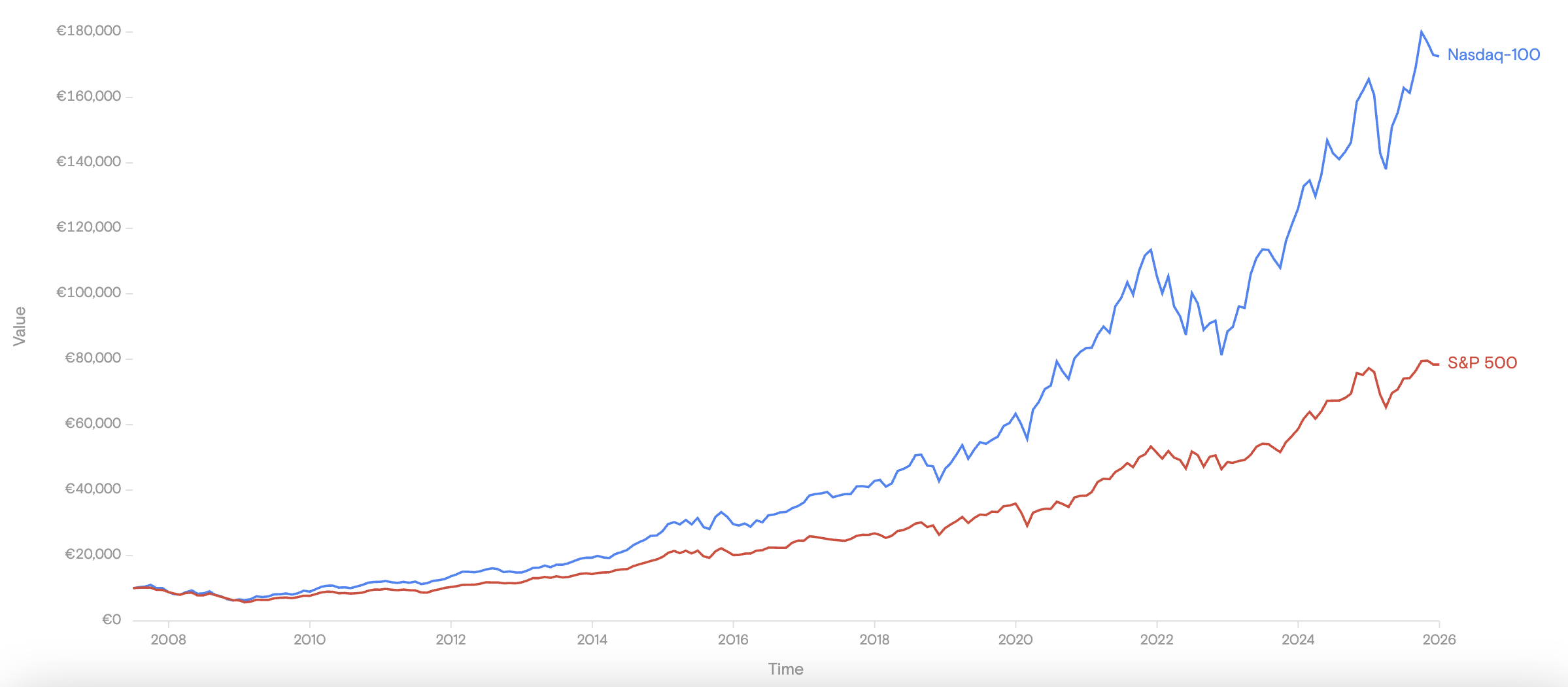
The Nasdaq 100's breadth broke down even earlier, in early March, providing an advance warning that leadership was narrowing. As one technical analyst noted, every major correction begins with weakening breadth, even if the index takes time to reflect it.
The BBB credit spread, a measure of stress in the investment-grade corporate bond market, has also widened significantly in March, echoing a pattern that appeared ahead of prior market dislocations.
The market has entered a phase that many strategists refer to as "show me" mode, in which earnings results and economic data are subject to heightened scrutiny compared to six months prior. Key indicators to monitor include the following:
Oil prices: The energy sector's leadership depends on oil staying elevated. A ceasefire or a recovery in supply could unwind the trade quickly.
Fed communication: Rate policy expectations remain a critical input for growth stock valuations.
Earnings revisions: Data show that eight of eleven sectors have seen downward earnings revisions for Q1 2026. Any further cuts could accelerate the drawdown.
Breadth recovery: A sustained move back above 50% in the percentage of S&P 500 stocks above their 200-day moving average would be the clearest signal that the internal damage is healing.
As of late March 2026, 16 of 25 S&P 500 industry groups were in correction territory, while four had already fallen into bear-market territory.
Energy has benefited from a sharp spike in oil prices, with Brent crude trading above $90 per barrel. Geopolitical supply disruptions have driven both energy stock prices and analyst earnings estimates higher, making it the standout sector this month.
The S&P 500 index itself is not in a bear market, sitting roughly 8.7% below its January 27 record high. However, several individual sectors and industry groups within the index have already crossed the 20% threshold that defines a bear market.
Software and certain technology industry groups have fallen by more than 20% from recent highs, entering bear-market territory. High valuations, rate sensitivity, and cooling AI investor sentiment have driven the selloff in growth-oriented software names.
No. Weak breadth is a warning sign, not a guarantee. But persistent deterioration in breadth often appears before deeper index-level weakness.
Late last week, real estate management, software, autos and parts, and commercial services were already in bear-market territory, with real estate management and software among the most damaged.
The S&P 500 headline index suggests the market is in a downturn. However, this measure does not fully convey the extent of the challenges faced by most stocks and sectors, which are experiencing more severe declines than the composite index suggests.
With 16 of 25 industry groups already in correction and 4 in bear-market territory, the internal damage is substantial. Energy stands as the sole sector posting gains in March, propped up by elevated oil prices and geopolitical supply disruptions.
Meanwhile, software stocks, real estate, consumer discretionary, and financials are all absorbing meaningful losses. The correction happening beneath the surface of the S&P 500 is real, broad, and, for many sectors, already well advanced.
Disclaimer: This material is for general information purposes only and is not intended as (and should not be considered to be) financial, investment or other advice on which reliance should be placed. No opinion given in the material constitutes a recommendation by EBC or the author that any particular investment, security, transaction or investment strategy is suitable for any specific person.
Sources