Published on: 2026-04-01
Updated on: 2026-04-01
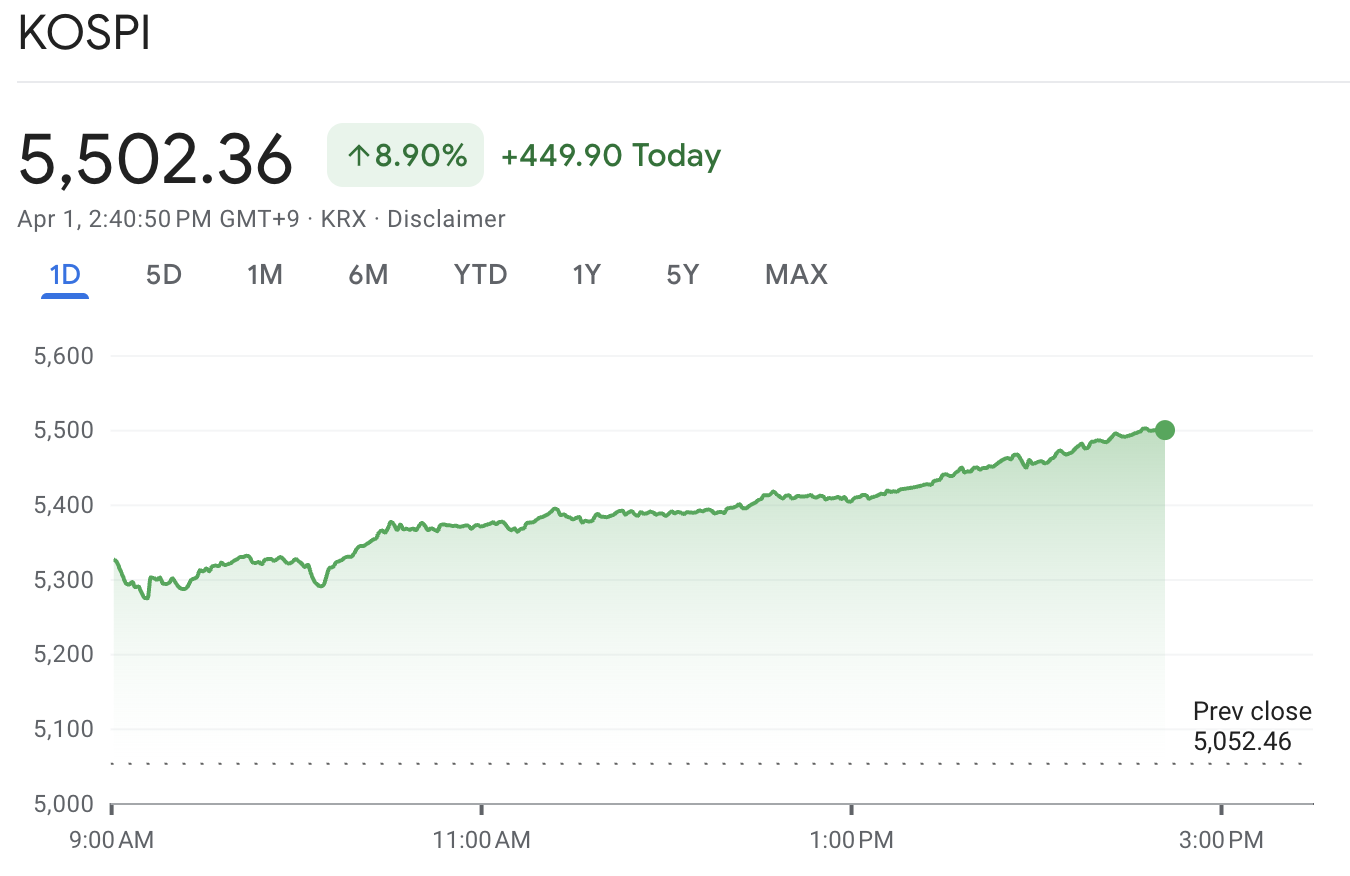
South Korea's KOSPI jumped more than 8% in Wednesday trade, and the Korea Exchange triggered a five-minute buy-side sidecar shortly after the open.

The immediate driver was a global relief rally after Wall Street's best session in nearly a year, as markets responded to signs that the Iran conflict may not become a prolonged oil shock.
| Metric | Latest reading | Significance |
|---|---|---|
| KOSPI intraday move | Up more than 8% in Wednesday trade | A sharp rebound after a brutal March selloff |
| Buy-side sidecar | Triggered shortly after the open | Confirms exceptional opening momentum and futures volatility |
| Samsung Electronics | Up about 10% intraday | Heavyweight leadership matters for index direction |
| SK Hynix | Up about 9% to 10% intraday | Memory names amplified the rebound |
| Brent crude | Still above $100, around $103 to $105 in cited reports | Relief rally is not the same as a full oil reset |
| 2026 KOSPI sidecar count | 10 as of March 24 | Shows how abnormal 2026 volatility has been |
This appears to be a relief rally rather than a complete reset. Oil prices remain high, the disruption in the Strait of Hormuz has not been fully resolved, and the debate over memory demand is still ongoing.
The primary catalyst was a fast reversal in how markets priced war risk. Asian equities rallied following Wall Street's best trading session in nearly a year.
This boost was supported by reports indicating that President Donald Trump suggested that U.S. operations in Iran could conclude within two to three weeks. Additionally, there are signs that Tehran may be willing to end hostilities under certain conditions.
South Korea's market notably outperformed other major Asian markets because it had more ground to recover after March's selloff. The KOSPI increased by over 8%, driven by Samsung Electronics and SK Hynix. The futures surge was strong enough to trigger a five-minute buy-side sidecar, which is activated when KOSPI 200 futures rise 5% or more for at least one minute.
That is the real surprise. Korea did not just join a global risk-on move; it led it. The market had been hit hard by higher oil prices, a weaker won, and violent swings in semiconductor names, so even a partial easing in geopolitical stress created room for a sharp rebound.
The headline frames today as an Iran relief rally. A more careful read is that investors are also reassessing whether the recent selloff in memory shares went too far. Google's TurboQuant announcement clearly affected sentiment across memory names, but its eventual impact on high-bandwidth memory demand is still a debate, not a settled fact.
The broader point is that semiconductor shares were already under pressure before Wednesday's rebound. Geopolitics pushed oil and the won into the foreground, while memory stocks also faced a separate valuation shock as investors reassessed how AI efficiency gains could affect future chip demand.
For that reason, TurboQuant should be presented as a sentiment factor that added to volatility, not as a confirmed structural hit to Samsung Electronics or SK Hynix earnings.
Technically, the move repaired near-term damage but not the full chart.
| Category | Level / Zone | What it means |
|---|---|---|
| Current tone | Above 5,400 intraday | Strong relief rebound, but still headline-driven |
| Intraday range | 5,272.45 to 5,502.63 | Shows how quickly buyers reclaimed risk |
| Immediate resistance | Around 5,420 to 5,430 | Day-high zone that needs follow-through |
| First support | Around 5,300 | Opening area to watch if momentum fades |
| Key reference | 5,052.46 prior close | A move back toward the prior close would weaken the rebound story |
| 52-week range | 2,284.72 to 6,347.41 | The index remains below its full-year high, despite the rebound |
| Macro risk | Brent above $100 and Hormuz disruption unresolved | Korea remains highly exposed through energy imports |
The primary execution risk is that the market is reacting to headlines more quickly than physical energy flows are resuming. Even with a strong equity rebound, charts still showed Brent crude above $100 on Wednesday, and the Strait of Hormuz situation remained unsettled.
If the disruption continues or diplomacy fails, South Korea may quickly experience renewed pressure from imported inflation and additional strain on the won.
April 1: Any new comments from the White House or regional officials about Iran and the Strait of Hormuz could quickly alter the de-escalation narrative.
April 3: The U.S. Employment Situation report is due, a key input for global yields and risk appetite.
April 23: Samsung Electronics is expected to release first-quarter results in April, which matters because semiconductor leadership still drives the index.
Because KOSPI 200 futures rose sharply enough after the open to trigger Korea Exchange volatility controls. Yonhap reported the buy-side sidecar was activated about seven minutes into trading after the benchmark opened nearly 5.5% higher.
Yes. March was one of the year's sharpest setbacks for Korean equities after a very strong start to 2026, which helps explain why today's rebound felt so powerful.
No. It offsets part of it. The index has regained short-term trend levels but remains below the 200-day moving average.
KOSPI's surge is statistically significant, but it still looks more like a relief move than a full all-clear. Oil remained above $100, the Strait of Hormuz disruption had not been fully resolved, and the debate over how AI efficiency changes memory demand remains unsettled.
For this rebound to become a sustainable trend, traders will likely need further easing of energy risks and renewed confidence in semiconductor earnings, particularly from Samsung Electronics and SK Hynix.
Disclaimer: This material is for general information purposes only and is not intended as (and should not be considered to be) financial, investment or other advice on which reliance should be placed. No opinion given in the material constitutes a recommendation by EBC or the author that any particular investment, security, transaction or investment strategy is suitable for any specific person.