Published on: 2026-07-07
Updated on: 2026-07-07
QQQ investors are picking up SpaceX exposure because the company is entering the Nasdaq-100, the index that the Invesco QQQ ETF is built to track. The headline is straightforward, but the effect on the portfolio is more layered.
The five points that matter for Nasdaq-100 investors are how the tracking works, SpaceX's starting weight, its public float, the passive demand around inclusion and whether the stock shifts QQQ's risk profile.
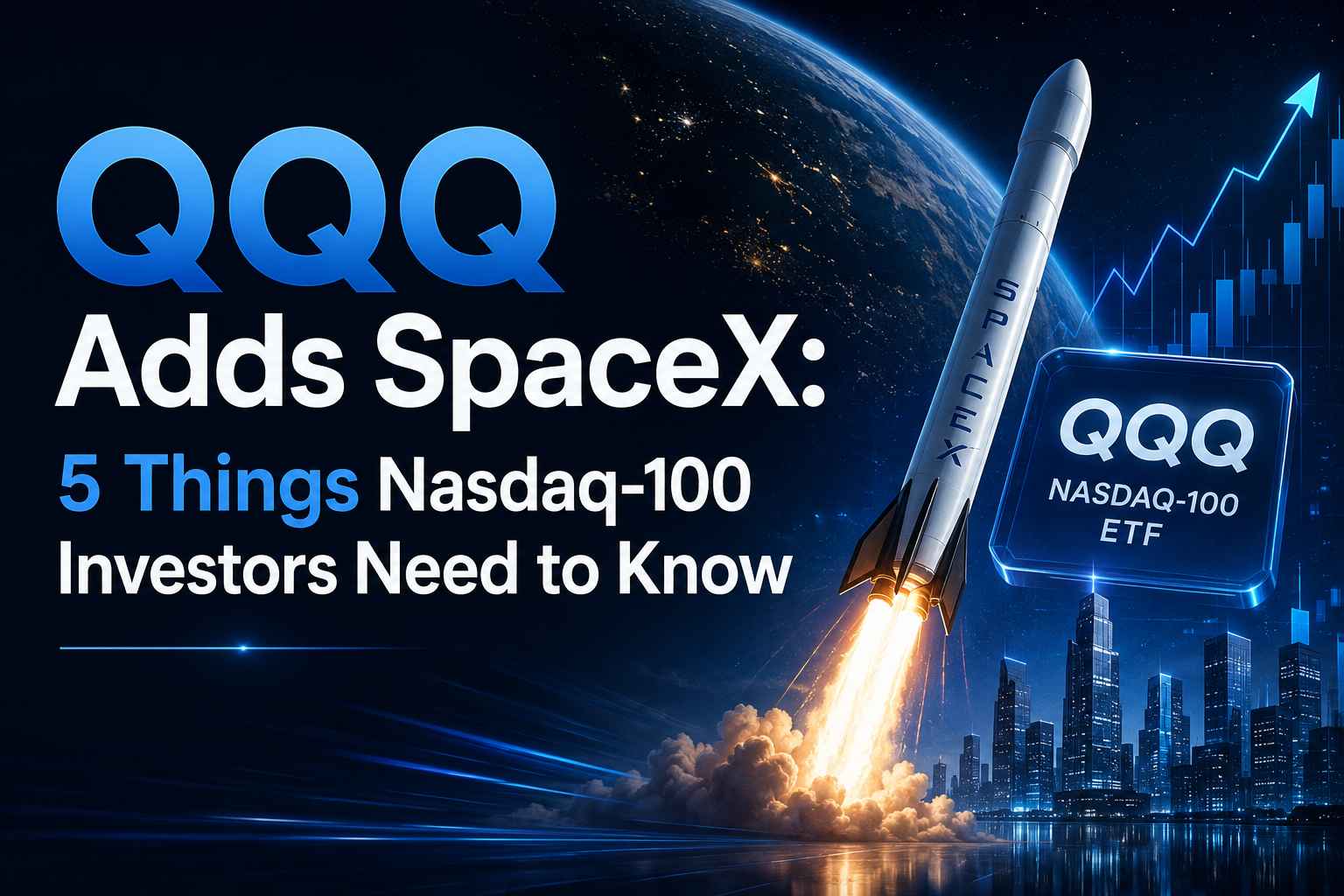
SpaceX is scheduled to join the Nasdaq-100 before market open on July 7, 2026, giving QQQ indirect exposure through index tracking.
QQQ tracks the Nasdaq-100, so the SpaceX exposure comes through benchmark replication rather than active stock selection.
SpaceX may start with a small QQQ weight despite its large valuation, because Nasdaq's updated methodology uses modified market capitalization for low-float securities.
Passive buying can support demand around inclusion, but the longer-term test rests on valuation, liquidity and operating results.
QQQ adds SpaceX for one plain reason: the Nasdaq-100 is adding SpaceX. Nasdaq has confirmed that Space Exploration Technologies Corporation, trading under the ticker SPCX, will join the index as a component before the market opens on July 7, 2026.
Because Invesco QQQ is built to track the Nasdaq-100, the ETF picks up that exposure automatically as part of its replication process.
None of this reflects an active stock-picking decision. QQQ holders become indirect SpaceX investors because the benchmark itself has changed, not because a fund manager has made a fresh call on the company. How much exposure they end up with is set by Nasdaq's index rules and the way QQQ tracks them.
SpaceX's valuation grabs the headlines, but QQQ investors are better off starting with its index weight. A company can be enormous by market value and still move an ETF very little if the weight it is assigned turns out to be small.
Market reporting puts SpaceX's expected starting weight in the Nasdaq-100 below 1%, even though its market value sits near $2.1 trillion. The same coverage notes that less than 5% of the company's shares were sold in the public offering, which keeps the freely tradable share base thin.
At a weight that low, SpaceX would be a visible new holding for QQQ without yet being a meaningful driver of the ETF's day-to-day performance. That balance could shift over time if SpaceX's public float expands, its share price climbs or future rebalances raise its allocation in the index.
Nasdaq's updated methodology explains how a very large company can still land with a modest index weight.
Analyst summaries of the May 2026 Nasdaq-100 changes note that security weights, including those for fast-entry companies, are set using modified market capitalization rather than full market capitalization. That modified figure takes the lesser of a company's eligible listed market capitalization or three times the value of its free-floating shares.
The framework ties QQQ exposure directly to public float. When only a small portion of a company's shares trades freely, as with SpaceX, its index weight can sit well below what the full valuation might imply. Market cap explains why SpaceX draws attention; the float-adjusted weight explains how much of it QQQ actually owns.
A thin float also shapes the rebalance itself. Funds tracking the index need to own the new Nasdaq-100 component, yet the pool of freely available shares is limited. That mismatch can make the inclusion window more sensitive to order flow, particularly around the date when passive funds move to adjust their holdings.
Index inclusion creates mechanical demand, because every fund tracking the Nasdaq-100 has to adjust to match it. Nasdaq notes that the index is tracked by more than 200 investment products holding over $800 billion in assets globally, which is why adding a single component can translate into meaningful benchmark buying.
That buying can support the stock around the inclusion window, especially when the float is tight, and it tends to draw in traders who play index-flow mechanics. For QQQ investors, the timing is what counts. Passive demand runs strongest through the adjustment period, then fades once funds have reached their target exposure.
From there, SpaceX has to trade on the evidence the public market can see. Attention will turn to Starlink growth, launch cadence, government and defense contracts, margins, capital spending and free cash flow. Inclusion hands the ETF ownership of the stock, but the valuation still has to be earned through operating results.
SpaceX brings QQQ a different kind of growth business. The ETF already leans heavily on technology, communication services, semiconductors, internet platforms and other long-duration growth companies. SpaceX adds launch services, satellite broadband, space infrastructure, orbital logistics and defense-related technology to that mix.
That widens QQQ by industry, though it does not automatically lower the fund's risk. SpaceX may sit outside the usual software and chip cycle, but its stock can still trade like a high-valuation growth asset. If interest rates rise, liquidity tightens or investors rotate away from expensive growth, SpaceX is unlikely to act as a defensive offset.
The cleaner way to read the addition is as new growth exposure rather than a genuine diversification upgrade. QQQ gains a fresh industry engine, yet the fund stays tied to much the same valuation and liquidity cycle that already drives many of its holdings.
QQQ picks up SpaceX earlier simply because the Nasdaq-100 and the S&P 500 run on different eligibility frameworks. Nasdaq's May 2026 update opened a fast-entry route for large newly listed securities and eased how very low-float companies are treated for weighting, which together cleared SpaceX's path into the index.
S&P 500 inclusion runs through a separate process, with its own profitability and eligibility tests. As a result, Nasdaq-100 investors can hold SpaceX well before many S&P 500-linked investors do, which leaves a temporary gap between what QQQ holds and what broader-market ETFs hold.
The first signal is SpaceX's final weight in QQQ, since that figure sets the actual exposure ETF holders take on. A low starting weight keeps the early portfolio effect contained, while a rising weight would give SpaceX more sway over QQQ's returns.
The second is price action once the rebalance is done. Strength after passive demand fades would suggest the market is treating SpaceX as more than an index-flow trade, whereas weakness would hint that inclusion mainly pulled some demand forward.
The third is the float. Lockup expirations, secondary offerings or employee share sales could add tradable supply, improve liquidity and feed into future index weight. The fourth is operating performance. Starlink revenue, launch activity, contract demand, margins and free cash flow will carry more weight once SpaceX settles in as an ordinary Nasdaq-100 constituent.
QQQ gains SpaceX exposure once SpaceX enters the Nasdaq-100 and the ETF adjusts to track the updated index. How large that exposure is depends on the index weight SpaceX is assigned.
No. QQQ tracks the Nasdaq-100, so its SpaceX exposure comes from benchmark replication rather than any active stock selection by the fund's managers.
SpaceX's public float is limited, and Nasdaq's methodology scales back the weight of low-float securities. That can leave the ETF exposure much smaller than the company's full market value might suggest.
SpaceX broadens QQQ by adding space infrastructure, satellite broadband and launch exposure. The diversification benefit may be limited, though, if the stock behaves like just another high-growth asset when markets come under stress.
Index inclusion can create a burst of temporary passive demand, but it does not guarantee lasting gains. Once the rebalance is behind it, valuation, liquidity and fundamentals matter more.
QQQ adds SpaceX for the simple reason that the Nasdaq-100 is adding it. The ETF now holds a stake in one of the market's largest new growth companies, but the real impact rests on index weight, float, passive flows and valuation.
For Nasdaq-100 investors, the practical way to read SpaceX is as a new growth-risk component sitting inside QQQ. It stretches the ETF into space and satellite infrastructure without making the fund any more defensive.
Once the rebalance is done, SpaceX's influence will come down to how much QQQ actually holds and whether the company can back its valuation with revenue growth, margins, cash flow and execution.
After more than two decades as a private company, SpaceX became accessible to a wider group of retail market participants on June 12, 2026. EBC now offers SPCX as a CFD across all regions and account types, with access starting from $50. To trade, open an EBC account, make a deposit, then search for SPCX.OQ on MT4 or MT5. Pricing is based on the live Nasdaq market.