Published on: 2026-05-12
Updated on: 2026-05-12
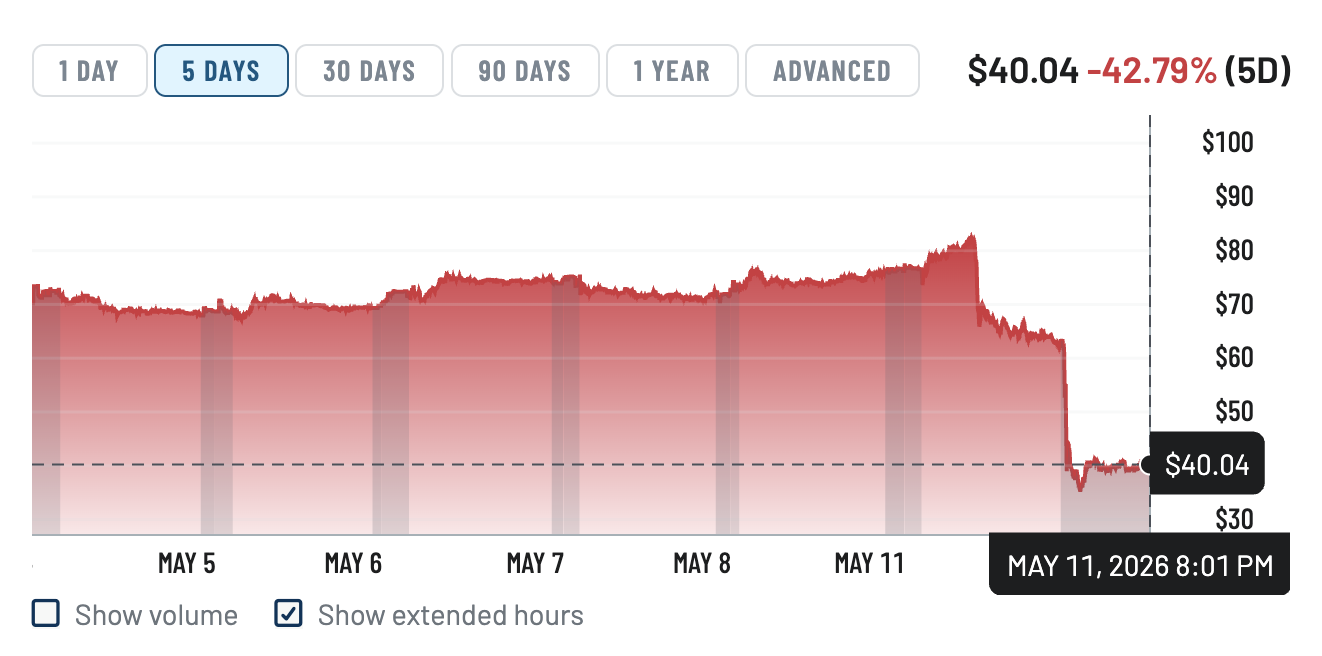
PSIX stock did not collapse because one quarter disappointed. It collapsed because two straight quarters showed revenue failing to become profit. Q1 sales fell only 5% to $128.6 million, yet net income dropped 62% to $7.3 million. (1) The sharper warning had appeared one quarter earlier: Q4 sales rose 33%, but net income still fell 31%. A stock priced for data center exposure is now being tested on whether that exposure can produce scalable earnings.
That is the real break beneath the price action. PSIX did not lose its data center narrative overnight. It lost the benefit of the doubt on operating leverage. Full-year 2025 sales rose 52% to $722.4 million and net income rose 65% to $114.0 million, setting a high reference point for valuation. The next two reported quarters revealed a more serious problem: demand can persist even as margin conversion weakens. (2)
Q1 revenue fell 5%, but gross profit fell 27%, and net income dropped 62%, showing a sharp earnings-quality break rather than a simple sales decline.
Gross margin compressed to 22.9% from 29.7%, pressured by product mix and elevated Wisconsin production costs tied to data center-related capacity ramp-up.
Q4 had already shown the same fracture: sales rose 33%, net income fell 31%, and gross margin dropped to 21.9% from 29.9%.
Management expects stronger second-half sales as larger Power Systems orders move into production, but shipment timing remains subject to customer scheduling, throughput, and supply-chain factors.
The MTL acquisition strengthens vertical integration, but it also confirms that supply-chain control and manufacturing capacity now sit at the center of the PSIX stock thesis. (3)
Retail traders may see a revenue miss. The income statement shows a margin event.
Net sales declined by $6.8 million year over year. Gross profit declined by $10.9 million. Net income declined by $11.8 million. Profit fell by more dollars than revenue. That is the operating leverage reversal that investors punish most aggressively because it means cost pressure is overwhelming the revenue base.
| Metric | Q1 2026 | Q1 2025 | Change |
|---|---|---|---|
| Net sales | $128.6 million | $135.4 million | -5% |
| Gross profit | $29.4 million | $40.3 million | -27% |
| Gross margin | 22.9% | 29.7% | -690 bps |
| Net income | $7.3 million | $19.1 million | -62% |
| Diluted EPS | $0.32 | $0.83 | -$0.51 |
| Adjusted EBITDA | $13.9 million | $26.1 million | -47% |
The table explains why the PSIX stock reaction extended beyond a normal earnings reset. A company can defend a growth multiple through a weak sales quarter if margins hold. PSIX showed the opposite. Revenue softened modestly, while earnings power compressed across gross profit, net income, EPS, and adjusted EBITDA.

The retail mistake is treating data center exposure as the entire thesis. For PSIX, exposure is only the entry ticket. The real test is conversion: how much demand survives customer timing, labor absorption, fabrication costs, throughput limits, and product mix before reaching operating income.
Management did not describe a collapsed data center market. It pointed to uneven order patterns and shipment timing for data center-related products, while still citing strong demand for data center power solutions. It also said second-half sales should improve as larger Power Systems orders enter production and convert into revenue.
That creates a harder interpretation. The demand signal remains intact, but the revenue-recognition path is uneven, and the cost base remains high. PSIX has to prove that data center-related growth can pass through manufacturing without losing too much value along the way.
The stock’s old premium rested on a clean story: power demand from data centers would lift sales, margins, and earnings. Q1 forced a harsher model. Data center demand may lift the order book, but Wisconsin ramp-up costs, product mix, and shipment timing can still dilute the earnings outcome.

Q1 looked severe because Q4 had already weakened the margin argument.
In Q4 2025, PSIX reported sales of $191.2 million, up 33% from the prior year. Net income fell to $16.1 million from $23.3 million. Gross margin declined to 21.9% from 29.9%, with operating inefficiencies tied to accelerated production ramp-up for data center product lines.
That pattern is more damaging than a single weak print. Q4 showed sales growth failing to create profit growth. Q1 then showed a small sales decline producing a large profit decline. Together, the two quarters tell the same story from opposite sides of the cycle: PSIX is struggling to translate demand into margin.
The tax line also complicates the 2025 comparison. Full-year 2025 earnings benefited from a $38.3 million valuation allowance release, which contributed $1.66 to EPS, while the company expected a return to a normalized effective income tax rate in 2026. The market is now separating operating earnings from headline profitability, which is supported by tax.
PSIX still has a credible place in the data center power chain. The company designs and manufactures emission-certified engines and power systems, including products used for standby, prime, demand response, and microgrid applications. Those are relevant end markets as data centers require reliable backup and distributed power capacity.
PSIX’s stock problem is valuation discipline. A data center label can attract attention. It cannot defend a premium multiple when gross margin sits near the low-20% range, and management is still dealing with ramp-up costs.
If second-half revenue growth arrives with gross margin recovery, the market can frame Q1 as a capacity-ramp dislocation. If revenue improves while gross margin remains near 22% to 23%, PSIX loses the right to trade like a clean AI-infrastructure compounder. The multiple then shifts toward an industrial manufacturer with volatile data center exposure.
The MTL Manufacturing acquisition is central to the margin debate.
MTL manufactures switchgear subbases, electrical enclosure assemblies, and fuel tanks used in large power generation products, including data center applications. It also brings engineering capabilities, vertically integrated manufacturing, UL certifications, and more than 185,000 square feet of production space in Beloit, Wisconsin.
The strategic logic is margin control. PSIX wants greater control over fabrication, lead times, enclosure production, and supply chain reliability. Those are not side issues. They are the bottlenecks now shaping earnings quality.
The acquisition strengthens PSIX’s competitive position, but it also raises the execution bar. Vertical integration can improve supply control over time. It can also create near-term integration costs, labor absorption issues, and coordination pressure. For the stock, MTL is no longer just an expansion story. It is a margin-repair mechanism that must prove itself in reported numbers.
PSIX has become a proof-of-margin stock. The next quarter does not need to show spectacular revenue growth to repair confidence. It needs to show that revenue is no longer leaking through the cost structure.
If Q2 revenue stays close to Q1 levels, as management expects, gross margin becomes the market’s first checkpoint. A sequential move above 22.9% would suggest Wisconsin ramp-up costs are starting to dilute across production. A flat or lower margin would tell traders that the same bottleneck is still absorbing the demand benefit.
If second-half sales strengthen and gross margin moves back toward the mid-20% range, PSIX can rebuild part of its lost data center premium. That outcome would reframe Q1 as a painful capacity-ramp reset rather than structural earnings damage.
If second-half sales strengthen without margin recovery, the stock’s valuation ceiling falls. Revenue growth without operating leverage forces the market to discount the data center story. In that scenario, every sales rebound becomes less convincing because PSIX has not proven it can monetize the demand.
The cleanest bull case is not “more data center orders.” It is higher data center-related revenue with better gross margin. The cleanest bear case is also clear: rising sales, low-20% margins, and continued shipment timing caveats. That combination would make PSIX look less like an AI-infrastructure compounder and more like a manufacturer exposed to an attractive but uneven demand cycle.
PSIX collapsed because the market focused on profit conversion. Q1 sales fell only 5%, but net income dropped 62% and gross margin compressed by 690 basis points. The reaction reflected an earnings-quality reset, not a simple revenue disappointment.
The demand thesis is not broken. Management still cited strong demand for data center power solutions. The valuation thesis has weakened because that demand is not yet flowing cleanly through margins, shipment timing, and production efficiency.
The biggest warning was the mismatch between revenue and profit. A 5% sales decline became a 62% decline in net income. That spread showed cost pressure and mix effects overwhelming the revenue base.
The repair path requires revenue recovery with margin expansion. Higher sales alone will not restore the prior multiple if gross margin stays in the low-20% range. PSIX needs evidence that Wisconsin ramp-up costs are easing and data center-related volumes are becoming more profitable.
Was 2025 the start of a scalable data center earnings cycle, or the year PSIX earned a premium multiple before its manufacturing base was ready to support it?
(1) https://investors.psiengines.com/news-releases/news-release-details/power-solutions-international-announces-first-quarter-2026
(2) https://investors.psiengines.com/node/13721/pdf
(3) https://investors.psiengines.com/news-releases/news-release-details/power-solutions-international-inc-acquires-mtl-manufacturing