Published on: 2026-05-11
Updated on: 2026-05-11
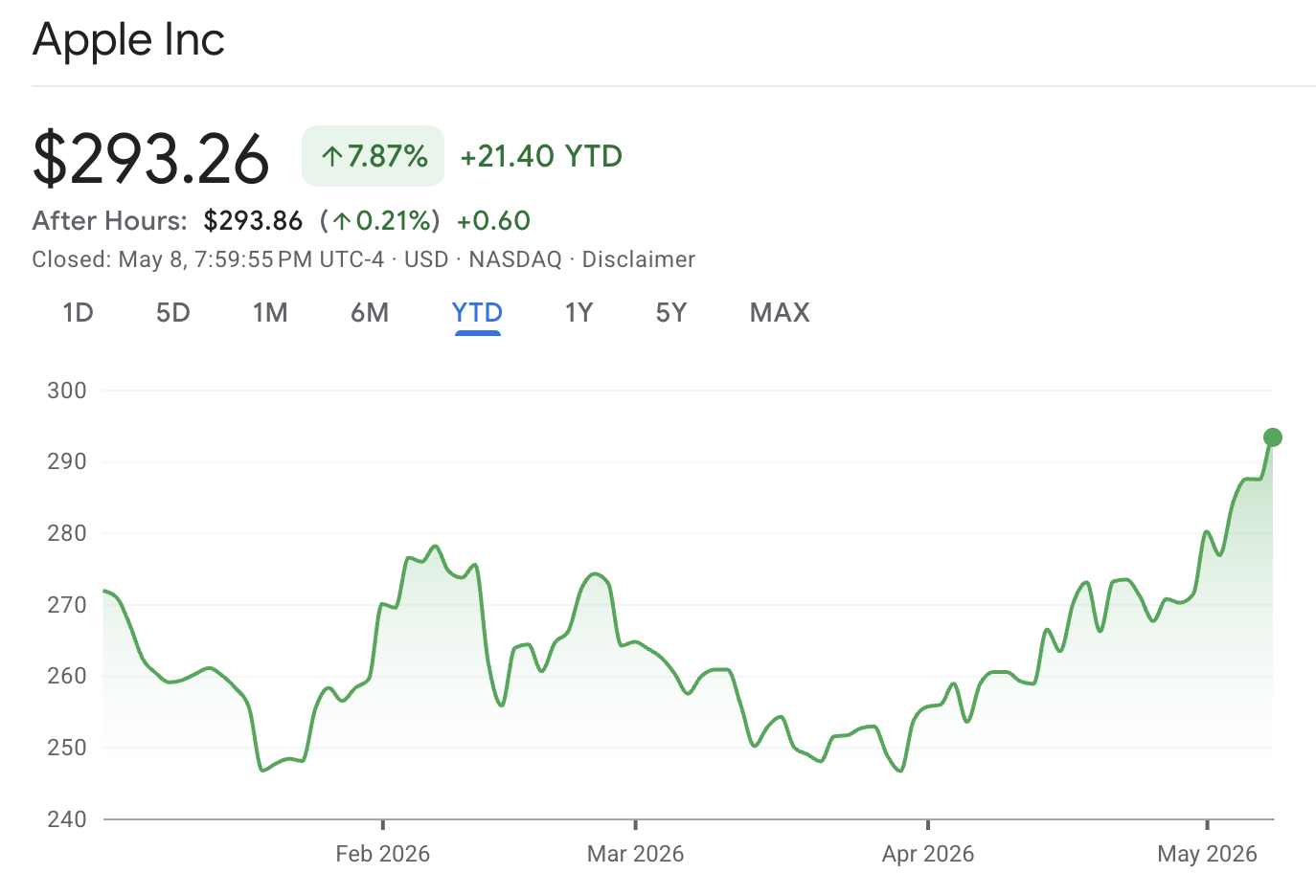
Apple stock closed at $293.32 on May 8 after touching an intraday high of $294.76, placing the shares back in record territory.
Fiscal Q2 revenue rose 17% year over year to $111.2 billion, while diluted EPS increased 22% to $2.01.
iPhone revenue climbed to $56.99 billion, while Services revenue reached $30.98 billion, strengthening Apple’s recurring-revenue profile.
Apple authorized up to $100 billion in additional share repurchases and raised its quarterly dividend by 4% to $0.27 per share.
WWDC 2026 runs from June 8 to June 12, with investors focused on Apple Intelligence, Siri, and AI-enabled developer tools.
Apple stock has surged back into record territory, driven by a record March-quarter earnings report, a major capital-return announcement, and rising investor expectations ahead of the company’s most important Worldwide Developers Conference in years.
Apple stock closed at $293.32 on May 8, up from $287.44 on May 7 and $287.51 on May 6. The stock reached an intraday high of $294.76, with volume of 52.7 million shares, according to Apple’s investor data.
Apple’s fiscal Q2 2026 earnings report, released on April 30, gave the rally a firm fundamental base. The Cupertino-based tech giant posted revenue of $111.2 billion, beating the Wall Street consensus of approximately $109.5 billion and marking the strongest March quarter in the company’s history, a 17% year-over-year increase, the fastest growth rate since 2021.
| Apple Latest Snapshot | Figure |
|---|---|
| Latest close | $293.32 |
| Intraday high | $294.76 |
| Market value | About $4.32 trillion |
| Fiscal Q2 revenue | $111.2 billion |
| Fiscal Q2 revenue growth | 17% |
| Diluted EPS | $2.01 |
| EPS growth | 22% |
| iPhone revenue | $56.99 billion |
| Services revenue | $30.98 billion |
| New buyback authorization | Up to $100 billion |
| Quarterly dividend | $0.27 per share |
Earnings per share came in at $2.01, surpassing analyst forecasts of $1.93 and representing a 22% jump from the same period a year ago. Gross margin held firm at 49.3%, a remarkably resilient figure given rising memory costs that management flagged as a growing headwind.
Q3 guidance called for revenue growth of 14% to 17% year-over-year, again coming in well above Street forecasts and setting a constructive tone heading into the summer.
iPhone remained the central growth engine. Revenue from the category reached $56.99 billion, up from $46.84 billiona year earlier. Services revenue climbed to $30.98 billion, compared with $26.65 billion in the prior-year period. That mix reinforces the market’s view that Apple is no longer valued solely on hardware replacement cycles.
The capital-return announcement strengthened the bullish reaction. Apple said March-quarter operating cash flow exceeded $28 billion, setting a March-quarter record. The board also authorized up to $100 billion in additional share repurchases and raised the quarterly dividend by 4% to $0.27 per share.
The buyback supports EPS growth by reducing share count and signals confidence in Apple’s cash-generation capacity.
Apple’s R&D spending offers one of the clearest signals that the company is investing more aggressively in its next platform cycle. Research and development reached 10.3% of revenue in the March quarter, up from 9% a year earlier and 7.6% in the prior quarter.
In dollar terms, R&D rose about 34% year over year, roughly twice the pace of revenue growth. That increase matters because investors are looking for evidence that Apple Intelligence, Siri upgrades, and AI-enabled features can become more than product enhancements.

The leadership transition adds continuity to that strategy. Tim Cook will become executive chairman on September 1, 2026, while John Ternus, Apple’s current senior vice president of Hardware Engineering, will become CEO. For investors, the message is clear: Apple is increasing AI investment while keeping its hardware-software integration model intact.
That scale of increase has historical precedent. In 2001, Apple lifted R&D from roughly 5% to 8% of revenue ahead of the iPod launch, the product that redefined the company entirely.
Apple has confirmed that WWDC 2026 will run online from June 8 to June 12, with an in-person event at Apple Park on June 8. The company said the conference will showcase platform updates, AI advancements, new software, developer tools, frameworks, and features.
For investors, the event is less about branding and more about execution. Apple needs to show that Apple Intelligence can improve Siri, strengthen on-device computing, expand developer activity, and make AI useful across daily consumer workflows.
A clearer Siri roadmap with visible consumer utility.
AI tools that help developers build deeper app experiences.
On-device intelligence that supports Apple’s privacy positioning.
Services integration that creates measurable monetisation paths.
A convincing WWDC could support the argument that Apple’s installed base is becoming a mass-market AI distribution layer. A disappointing event would leave the stock exposed to valuation pressure after a sharp run into record territory.
Wall Street has started to reprice that optionality. Wedbush analyst Dan Ives raised his Apple price target to $400 from $350, citing the company’s AI opportunity ahead of WWDC. Recent market reports describe Ives as the most bullish analyst on Apple, with WWDC viewed as a potential inflection point for the company’s AI strategy.
At the current share price, AAPL stock trades at roughly 31 to 34 times forward earnings, a premium that reflects the Services growth engine, the buyback programme, and mounting AI optionality, but also one that leaves little room for execution shortfalls.
The bull case remains exposed to three risks.
Margin pressure: Higher component and memory costs could weigh on product gross margins.
Valuation risk: A premium multiple leaves limited room for weak AI execution.
Regulatory pressure: App Store scrutiny remains a structural risk to Apple’s Services model.
The most immediate risk is expectation. Apple does not need to match Microsoft or Google in enterprise AI. It needs to prove that its consumer AI strategy can increase engagement, support upgrades, and expand Services revenue.
Apple stock’s return to record-high territory is backed by stronger earnings, expanding Services revenue, and a $100 billion buyback. The next test is WWDC 2026, where investors will look for evidence that Apple Intelligence can turn AI momentum into measurable growth.
For AAPL stock, the setup remains constructive but demanding: fundamentals are strong, yet further upside depends on Apple proving that its AI strategy can support upgrades, engagement, and Services monetisation.