Published on: 2026-08-05
Updated on: 2026-08-05
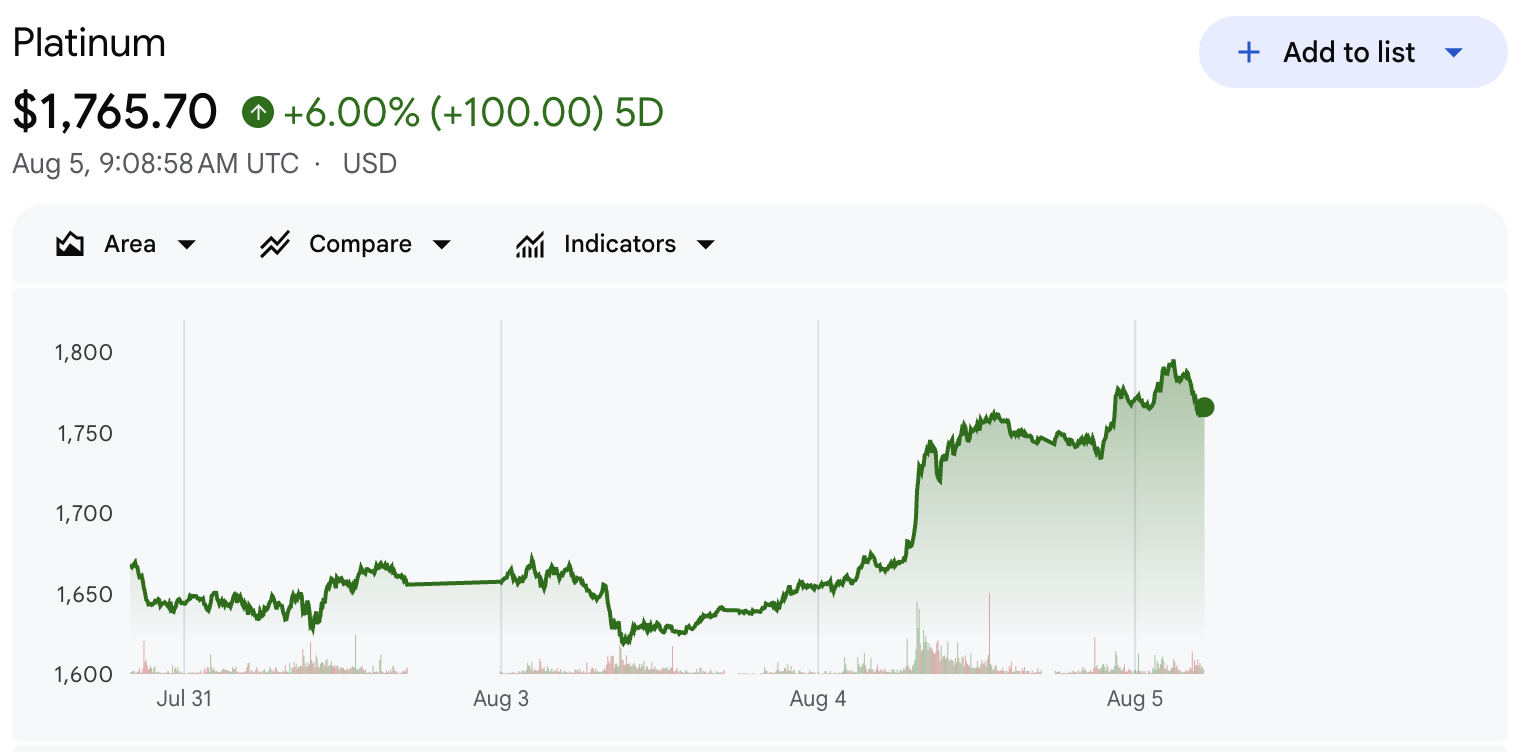
Platinum rose 8.02% to $1,756.70 an ounce on 4 August, outpacing silver futures at 4.1% and gold futures at 1.5%. Palladium rose 8.24%.
The abrdn Physical Platinum Shares ETF (PPLT) gained 6.64% to $15.74 on 5.11 million shares, roughly 213% of its 65-day average volume.
WPIC forecasts a 297,000 ounce supply deficit in 2026, the fourth consecutive annual shortfall, even though total demand is expected to fall 9%.
Above-ground stocks are forecast to end the year at 1.747 million ounces, less than three months of global demand, after a cumulative four-year shortfall of roughly 3.32 million ounces.
The rebound is a repricing, not a confirmed trend. Platinum remains close to 40% below January’s record, and WPIC still expects 100,000 ounces of ETF outflows.
Platinum outpaced gold and silver on Tuesday, rising 8.02% to $1,756.70 an ounce as gold futures gained 1.5% and silver futures advanced 4.1%. Palladium moved with it, up 8.24%. The abrdn Physical Platinum Shares ETF (PPLT) added 6.64%, closing at $15.74 on volume more than twice its recent average.

Falling oil prices, weaker labour-market signals and softer expectations for US interest rates lifted the entire metals complex. Platinum’s outperformance came from a second force. Supply is forecast to fall short of demand for a fourth consecutive year in 2026, and the inventory cushion that absorbed the previous three shortfalls is now approaching less than three months of global consumption.
One session has not repaired platinum’s 2026 collapse. The metal remains roughly 40% below the record near $2,924 set in January. What Tuesday did was force the market to price the deficit again.
Tuesday had more than one catalyst. Oil’s decline eased inflation concerns, the JOLTS release pointed to a softening labour market, and expectations for a September Federal Reserve rate increase receded. Yields fell, which supports metals that pay no income. Gold and silver joined the move, so the session was partly a macro rebound.
The scale of the divergence is where the story sits:
Platinum: up 8.02% to $1,756.70
PPLT: up 6.64% to $15.74
Silver futures: up 4.1%
Gold futures: up 1.5%
Two caveats. The platinum figure is a benchmark spot quote set against front-month futures settlements for gold and silver, so the instruments and closing times differ and the multiples are approximate.
And while a thinner, tightly supplied market gives platinum more room to reprice, liquidity, technical buying, positioning and the parallel palladium rally plausibly contributed too. The fundamental explanation is the most durable one, not the only one available.
Nor is this obviously a short squeeze. Managed money was net long 6,526 futures and options contracts on 28 July, which weakens a market-wide trapped-short reading. That report also carried 7,588 gross shorts and was a week old by Tuesday, so short covering cannot be ruled out.
The most useful fact about the 2026 platinum market is that the deficit persists even as demand falls. The World Platinum Investment Council forecasts total demand of 7.674 million ounces this year, down 9%. Jewellery demand is expected to fall 12%, automotive demand 2%, and total investment demand 54%. On those figures alone, the market would read as bearish.
Platinum is still expected to finish the year undersupplied because supply has even less room to move:
Total supply forecast: 7.377 million ounces
Mine supply: broadly flat at 5.551 million ounces
Recycling: up 9% to 1.826 million ounces
Industrial demand: up 9% to 2.238 million ounces
Resulting shortfall: 297,000 ounces
The point is that platinum does not need booming demand to stay short. Demand can drop 9% and still exceed what the market is able to deliver.
One complication belongs in the same frame. The market recorded a 268,000 ounce surplus in the first quarter, helped by strong South African output and 374,000 ounces of combined ETF and exchange stock outflows. WPIC expects those conditions to reverse, which is how a surplus quarter still produces an annual deficit. A yearly shortfall is not proof of tightness in every month.
At 297,000 ounces, the 2026 deficit is far smaller than 2025’s 1.191 million ounce shortfall. What gives it weight is the buffer behind it. WPIC’s annual balances show deficits of 799,000 ounces in 2023, 1.033 million in 2024, 1.191 million in 2025 and a forecast 297,000 in 2026, a cumulative four-year shortfall of roughly 3.32 million ounces.
Above-ground stocks are forecast to fall from 4.268 million ounces at the end of 2023 to 1.747 million by the end of this year, or less than three months of global demand. A smaller deficit drawn against a much thinner cushion can move price harder than a larger deficit drawn against a full one.
Supply cannot respond quickly. South Africa is forecast to account for roughly 72% of refined production in 2026, concentrating risk in one jurisdiction with a long record of power and cost disruption. Recycling is meant to fill part of the gap, but WPIC has flagged that higher working capital requirements and falling metal recovery per used catalyst could stop recyclers from delivering the forecast 9% increase.
PPLT holds physical platinum and aims to reflect the metal’s price after expenses. It traded 5.11 million shares on Tuesday, roughly 213% of its 65-day average of 2.40 million, and closed at $15.74 against $14.76. The rebound reached a liquid US-listed vehicle rather than staying inside overseas futures trading.
The 6.64% market price gain ran ahead of net asset value, which rose 5.74%. Different valuation times explain part of that gap and intraday buying pressure explains part, and the published data does not separate the two.
The restraint matters as much. PPLT’s 52-week high is $26.16, so even after Tuesday the fund sits close to 40% below it, in line with the metal’s own distance from January’s record.
Positioning data points the same way. WPIC expects global platinum ETFs to post net outflows of 100,000 ounces in 2026 after strong inflows in 2025. Retail demand is moving in the opposite direction, with bar and coin demand forecast to rise 27% to a six-year high of 718,000 ounces.
The open question after Tuesday is whether institutional ETF demand has started to return, or whether PPLT simply tracked a violent one-day recovery in the underlying metal.
Four observable signals matter more than a price target.
ETF demand stops contracting. Sustained PPLT creations or rising global ETF holdings would challenge the forecast for 100,000 ounces of outflows. One high-volume session does not.
The recycling forecast weakens. The supply side leans on a 9% recovery in recycling. Continued difficulty recovering metal from used catalysts would tighten the projected balance further.
Prices hold the rebound. Platinum extended the move on Wednesday, quoted at $1,770.30 on the benchmark spot market, up 0.81% on the day, before the US session opened.
September brings a revision. WPIC publishes its next Platinum Quarterly on 9 September. Changes to South African output, recycling and investment demand will carry more weight than another long-range forecast.
Tuesday looked like the market remembering that platinum’s deficit survived the collapse from January’s record. The balance is tight enough that small shifts in investment demand produce outsized moves.
The real test comes after the rebound. Continued ETF demand, disappointing recycling supply and another draw on above-ground inventories would support a durable recovery. Without them, an 8% jump is a sharp repricing inside a market still trading close to 40% below its peak.