Published on: 2026-02-16
Updated on: 2026-02-16
BHP reports its half-year results for the period ended 31 December 2025 on 17 February 2026 at around 8:00 AM Melbourne time, and the setup is unusually clean. The stock is trading close to its highs, copper has been strong, and BHP has already lifted its FY26 copper production guidance to $1,900–$2,000 kt.

The market is also leaning toward a bigger interim payout. BHP's published consensus shows a $0.62 dividend per share for the half-year, a clear jump from last year's interim and in line with the company's "minimum 50% payout" dividend framework.
What matters most on results day is not whether BHP earnings "beat" by a rounding error. What matters is whether the numbers confirm a simple story: copper is doing the heavy lifting, cash costs are behaving, and the balance sheet can handle growth spending without squeezing the dividend.
| Metric (HY26) | Consensus |
|---|---|
| Total revenue | $27,427m |
| Underlying EBITDA | $15,274m |
| Net income (operating) | $6,006m |
| Earnings per share (operating) | $1.18 |
| Dividend per share declared | $0.62 |
| Net operating cash flows | $8,603m |
| Net debt | $14,561m |
In short, that $0.62 implies an estimated payout ratio of roughly 52% relative to the $1.18 EPS consensus, which aligns with BHP's stated minimum payout policy while leaving room for balance sheet flexibility.
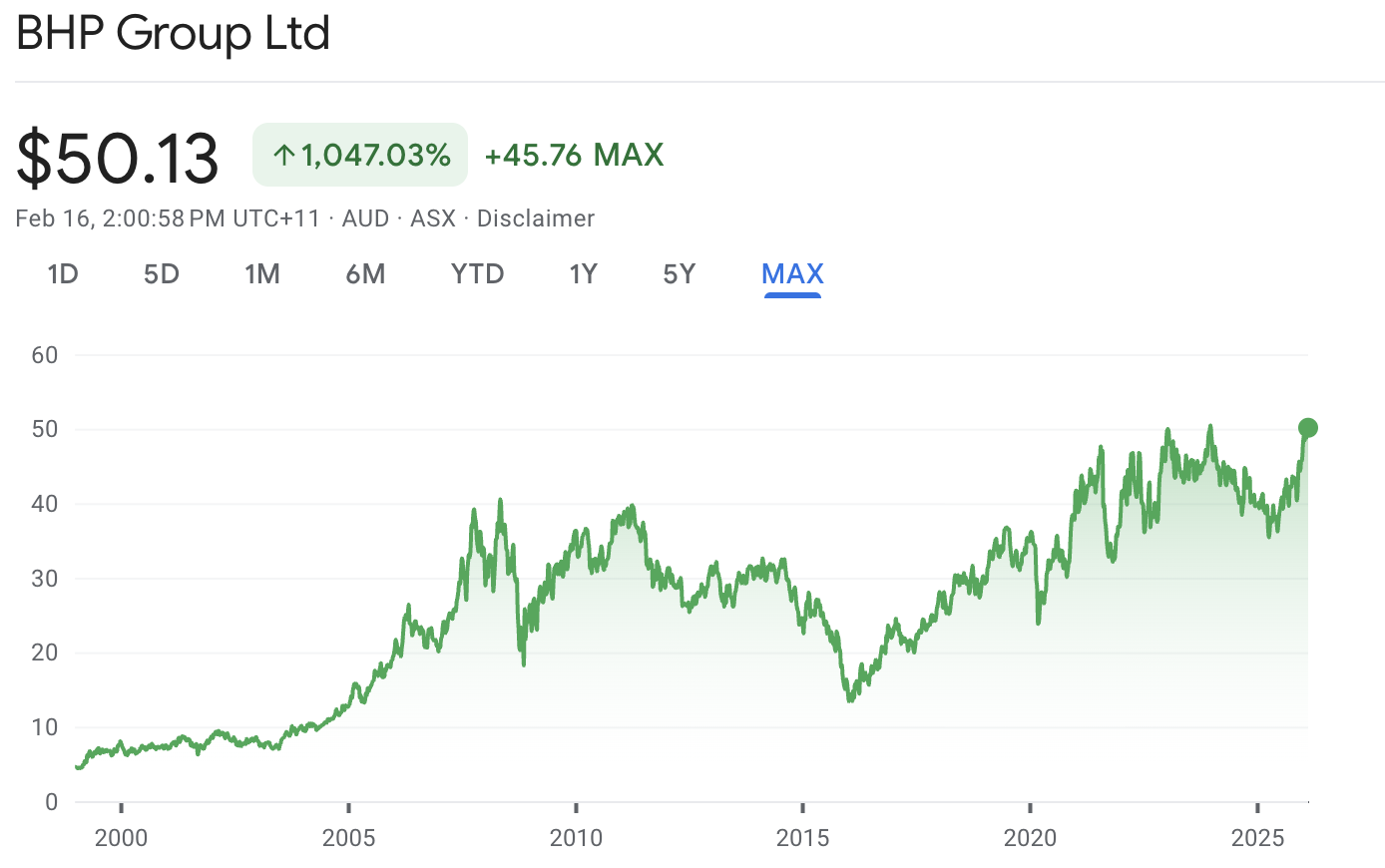
BHP shares will likely react most to
The interim dividend
Comments on copper momentum
Any pressure points in costs and capital spending.
In January, BHP announced that copper prices had increased by 32% YoY, while iron ore prices had risen by 4%. The company also emphasized its record operational performance.
This strong performance and rising prices support the idea of a "62-cent dividend," as higher prices, combined with effective operations, typically lead to improved cash generation.
But there is a catch. BHP is also investing heavily for the next decade, and big projects can pull cash forward. Management has flagged an updated cost estimate for its major potash project while maintaining the target start date.
Thus, this BHP earnings day focuses not only on profits but also on the remaining cash after expenses and its distribution to shareholders.
Using the consensus segment numbers published by BHP, you can see how concentrated the engine is. Below are derived margins based on the consensus revenue and underlying EBITDA by segment.
| Segment | Revenue ($m) | Underlying EBITDA ($m) | Implied EBITDA margin | Share of group EBITDA |
|---|---|---|---|---|
| Copper | $12,752 | $7,487 | 58.7% | 49.0% |
| Iron ore | $12,205 | $7,739 | 63.4% | 50.7% |
| Coal | $2,468 | $312 | 12.6% | 2.0% |
In short, BHP is being priced like a two-engine plane in the market. Copper and iron ore are carrying almost all the underlying EBITDA in the consensus. If either engine stutters, the stock can react quickly, even if the headline profit still looks fine.
BHP has been clear that it targets at least 50% of the underlying attributable profit as a payout each reporting period. That policy provides traders with a practical shortcut: if you have a reasonable estimate of the underlying profit, you can determine a reasonable estimate of the dividend.
For context, BHP's interim dividend in the prior comparable period was 50 US cents, which was described as a 50% payout in reporting coverage at the time.
A Simple Dividend Model (Our Working Range)
Since BHP's earnings fluctuate with commodity prices and volumes, consider thinking in terms of ranges rather than a specific forecast. Here is a clean way to frame the "62c dividend seen" idea using the 50% policy:
| Assumed underlying profit (half-year) | Payout ratio | Implied interim dividend per share* |
|---|---|---|
| US$5.8bn | 50% | ~US$0.58 |
| US$6.2bn (base case) | 50% | ~US$0.62 |
| US$6.6bn | 50% | ~US$0.66 |
| US$6.2bn (base case) | 55% | ~US$0.68 |
*Implied per-share values use a rounded share count based on recent payout history. This is a scenario tool, not a company forecast.
Key Takeaway:
If underlying profit lands in the low $6 billion and BHP sticks close to the 50% floor, 62 cents is a sensible midpoint. If management leans a little more generous, the number could rise, but the market will want a clear reason.
In its operational review, BHP increased its FY26 group copper production guidance to 1,900–2,000 kt, up from the previous estimate of 1,800–2,000 kt. It also lifted guidance at key copper assets and flagged strong operational execution.
Two details in that same update matter for earnings framing:
The company highlighted a positive commodity price environment (copper up 32% year on year).
It stated that it is investing for the next decade and still sees a path to approximately 2 million tonnes of attributable copper production in the 2030s.
The Unique Angle Here:
The market does not just reward copper volume. It rewards confidence.
When a miner raises copper guidance, it reduces the probability of "surprise downtime" and improves the visibility of cash flow.
That tends to support both valuation and dividend confidence, especially when prices are already favorable.
BHP also highlighted resilience in China's commodity demand and a positive global growth environment, while noting that momentum moderated in the second half of calendar 2025.
This matters because iron ore still accounts for a significant share of BHP's cash generation. When the market is nervous about China's construction and steel demand, it often treats miners like a single macro trade.
Even strong company execution can get ignored if traders are de-risking the macro.
So on earnings day, watch for commentary that answers two questions clearly:
Are shipments holding up without higher costs?
Is demand steady enough to keep cash margins healthy into the next quarter?
BHP reiterated that its large potash project remains on track for first production in mid-2027, while also pointing to an updated cost estimate.
This is where dividend expectations can get capped.
Even with stronger commodity prices, if investors think spending is rising faster than cash flow, they start discounting future payouts.
What traders will be listening for in the results presentation is simple:
Do they describe the cost increase as "contained and funded," or as "still moving"?
Do they signal any re-phasing that changes near-term cash flow?
The dividend is expected to be in the low to mid-60s, and management is confident in its payout policy.
Copper momentum stays strong, and the guidance uplift feels credible.
Cost commentary is calm and specific.
Likely price action: A quick push towards resistance may occur, followed by trend continuation if the overall market sentiment remains stable.
The dividend is fine, but not exciting.
Copper is strong, but the iron ore commentary is cautious.
Spending is higher, but not alarming.
Likely price action: A sharp initial move, then a drift back toward the pivot area as traders fade the first impulse.
Dividend comes in clearly below the low-60s discussion range.
Management is focusing on future growth, but with significant short-term expenses.
The market starts doing dividend math in the wrong direction.
Likely price action: Break first support below, with a fast test of the next support if risk sentiment worsens.
BHP's half-year results for the period ending 31 December 2025 are set to be released on 17 February 2026 at approximately 8:00 AM Melbourne time.
BHP targets at least 50% of the underlying attributable profit as a payout each reporting period. If the underlying profit comes in at around $6 billion, a dividend of 62 cents fits the math.
BHP lifted FY26 group copper guidance to $1,900–$2,000 kt, which signals stronger delivery and supports earnings quality because copper margins are a major driver of group profitability when prices are firm.
BHP states that its dividend policy provides for a minimum 50% payout of underlying attributable profit at every reporting period, with the board assessing any additional amounts based on its capital allocation framework
In conclusion, BHP earnings day is a test of cash confidence. BHP has already set the tone with strong operational momentum, higher copper guidance, and a better price backdrop for key commodities.
The market's biggest question is whether that strength is reflected in the interim dividend, where a 62-cent discussion point makes sense if profits fall within the right range and the payout remains near the policy floor.
If the company demonstrates that these pressures are related to timing and can be managed, the market typically rewards the stock's trend. If the message shifts toward "spend first, cash later," the stock can still pull back even with a decent dividend.
Disclaimer: This material is for general information purposes only and is not intended as (and should not be considered to be) financial, investment or other advice on which reliance should be placed. No opinion given in the material constitutes a recommendation by EBC or the author that any particular investment, security, transaction or investment strategy is suitable for any specific person.