Published on: 2026-08-05
Updated on: 2026-08-05
The Reserve Bank of India has raised $40.8 billion from its diaspora in eight weeks. India’s forex reserves are still lower than when the financial year began. The money came through special swap windows aimed at overseas Indians and the banks that serve them. It beats the $34 billion raised in the emergency of 2013 and runs to more than 1.5 times last year’s current-account deficit.
Reserves stood at $682.4 billion on 24 July, $8.8 billion below where they began the financial year in April and $15.8 billion below a year earlier. The rupee closed on Tuesday at about 95.38 to the dollar, roughly 6% weaker in 2026 and largely unmoved since the scheme opened in June.

The window can stabilise the currency in the narrow sense of slowing the slide, damping volatility and buying room to intervene. It cannot reverse it. The money is behaving as a shock absorber rather than a rescue: much of it is consumed on arrival, and the terms leave the Indian state carrying a currency exposure that runs for three to five years.
The RBI raised $40.8 billion from its diaspora in eight weeks, beating the $34 billion of 2013.
Reserves still fell, to $682.4 billion on 24 July, $8.8 billion below the start of the financial year.
FCNR(B) deposits supplied $36.725 billion, a total banks may lend against, so it is not an equivalent sum of household savings.
No forward premium was charged on that leg, a subsidy worth around $1.0 billion to $1.2 billion a year on MUFG's launch estimates.
The whole raise covers about 47% of one quarter's merchandise deficit.
The rupee is roughly 6% weaker in 2026 and largely unmoved since the scheme opened in June.
Of the $40.816 billion mobilised between 8 June and 31 July, $36.725 billion arrived through foreign currency non-resident deposits, known as FCNR(B). The rest came through overseas bank borrowings ($2.575 billion) and external commercial borrowings by public-sector companies ($1.516 billion), treasury operations rather than money sent home by expatriate households.

Nor is the FCNR figure $36.7 billion of savings shipped home by nurses in the Gulf and engineers in New Jersey. Indian banks may lend against these deposits, issue standby letters of credit to overseas lenders and place liens on the accounts.
One reported offering, through a foreign bank’s GIFT City unit, extended qualifying clients financing of up to 19 times their own contribution. How widely such structures were used is not disclosed, but they show why the deposit total should not be read as an equivalent sum of unleveraged household savings.
Financing on that scale turns a deposit into a spread trade: the client earns the gap between the deposit rate and the loan, and most of the dollars belong to the lender. They still count in the reserve figure. They are not new household saving.
An FCNR(B) deposit is a fixed-term foreign currency account that a non-resident Indian holds with an Indian bank and that repays in the currency it received.
An overseas Indian places dollars in a three to five year FCNR deposit. The bank sells those dollars to the RBI at the FBIL reference rate and takes rupees. At maturity, it returns the rupees and buys back the same dollar amount at that same rate.
No forward premium is charged. Ordinarily, a bank funding rupee assets with dollar deposits would buy that protection in the swap market at roughly 2.8% to 3.3% a year, MUFG’s estimate when the facility opened. The waiver is what makes room for the rate depositors collect: a bank’s all-in cost of turning dollars into rupee funding is the deposit rate plus the swap cost, so removing the second leaves room to lift the first.
The RBI waived the charge on the FCNR leg, though not everywhere. The parallel window for overseas bank borrowings and public-sector external commercial borrowings carries a fixed 1.5%, compounded semi-annually. The hedge also covers principal only, so banks still owe depositors interest and must manage that exposure themselves.
The depositor collects an unusually high dollar rate and takes no exchange rate risk, because the account repays in the currency it received. The bank gets long-dated rupee funding with its principal hedging bill cancelled, leaving it the interest leg. The RBI gets the dollars and carries the principal hedge for three to five years. The currency risk does not disappear. It changes owner.
Priced at MUFG’s launch estimates, protection on $36.7 billion of principal was worth somewhere around $1.0 billion to $1.2 billion a year. That is a valuation of the subsidy, not a cash loss and not a forecast of what the facility will eventually cost.
The eventual cost is uncertain in both directions. A materially weaker rupee makes the forward obligation more expensive to mark; against that, the RBI holds the dollars meanwhile, earns a return on them and books valuation gains on foreign currency assets as the rupee falls.
The net effect on its income, and so on the surplus it transfers to the government, turns on the rate path, the maturity profile and its provisioning rules. It cannot be read off a future spot rate.
The direction of travel is not in doubt. A hedging cost that banks and depositors would otherwise have paid privately now sits with the central bank, on a three to five year clock, and it worsens as the rupee weakens. That exposure is public rather than private, and no press release puts a number on it.
India’s forex reserves stood at $682.4 billion on 24 July, below where the financial year opened, after seven weeks in which most of the money had already arrived. The mobilisation total runs to 31 July, so the dates do not line up and the final week of inflows will not appear until the next release.
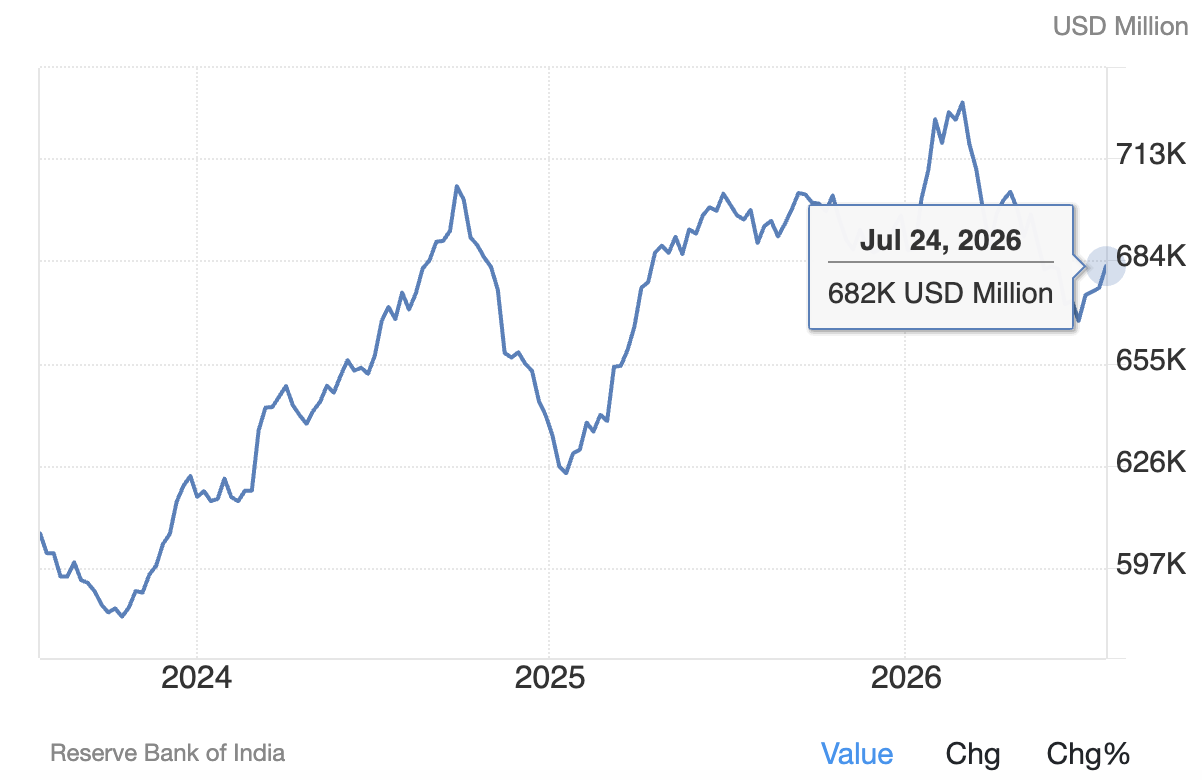
Financial Times puts gross reserves roughly $46 billion below their pre-conflict level, a decline mixing intervention with valuation effects rather than measuring dollars spent.
Reserves are reported in dollars but held partly in euros, yen and gold, so the total moves when those prices move, with nothing bought or sold. Some of the inflow may be offsetting that intervention, and some may be going to forward liabilities rather than the spot stock.
The RBI’s net short forward book stood at about $103.3 billion in June, having shrunk slightly on the month: future dollar obligations from derivative operations, including transactions used to manage the exchange rate. A central bank that buys dollars today and owes them back on a fixed date has not removed the pressure. It has moved it out in time.
Reuters reported shorter-dated liabilities falling while longer-dated ones rose, which is what absorbing new inflows looks like, and the new swaps add further long-dated obligations. Success would look like reserves rising while the forward book shrinks and the rupee holds. Reserves rising alongside an equally large rise in future dollar commitments would prove very little.
India’s underlying position is not catastrophic: the 2025-26 current-account deficit was $25.2 billion, or 0.6% of GDP, and the weakness sat in the capital account, where portfolio investors pulled out a net $16.4 billion and net direct investment was a thin $6.9 billion.
The first quarter of 2026-27 was worse. Merchandise imports hit $216.2 billion, from $180.3 billion, and the goods deficit widened to $86.9 billion from $68.8 billion. India’s services surplus, at $49.4 billion, remains formidable and still could not keep up: the combined goods and services deficit rose to $37.4 billion from $20.9 billion, though the June services component is an estimate and may be revised.
The entire mobilisation covers about 47% of one quarter’s merchandise deficit. The inflows do not finance imports directly; the comparison shows how fast a buffer goes when oil is expensive. India buys most of its crude abroad and pays in dollars, so a higher crude price lifts the import bill and dollar demand together.
Nominally, 2026 beats 2013: $40.8 billion against $34 billion, of which $26 billion was FCNR, and on more generous terms, since the RBI charged banks a fixed 3.5% swap cost then, roughly three points below the market rate, and charges nothing on the FCNR leg now.
The illness is milder too, with a current-account deficit approaching 5% of GDP going into the 2013 taper tantrum against 0.6% last year, though this episode’s mix of weak investment flows and an oil shock is less controllable, part of it originating in allocation decisions taken outside India.
Relative to India’s defences, though, this is the smaller scheme: about 6% of $682.4 billion of reserves, against 12.3% of the $277.2 billion held in 2013. More dollars, half the punch.
Redemption arrives either way. When the 2013 deposits matured in late 2016, NRI deposits recorded an $18.5 billion quarterly outflow, absorbed without drama because the deficit had narrowed and reserves had grown. The RBI has again bought three to five years for the external position to improve.
The RBI’s Monetary Policy Committee held the repo rate at 5.25% on 5 August, unanimously, and kept its neutral stance, lifting the FY27 growth forecast to 6.7% and trimming the inflation projection to 5%. It has not run out of monetary options. It has chosen not to spend them on the currency, which leaves currency intervention, the swap windows and liquidity management carrying the load.
Watch the next reserve and forward-book releases rather than the mobilisation total: gross reserves clearing $682 billion on more than valuation effects, the forward book falling below $100 billion, the rupee holding its range through a rise in crude rather than only on the way down, and portfolio and direct investment returning.
Those tools buy time. The $40.8 billion has slowed the rupee’s slide without reversing it, a shock absorber rather than a rescue, and the cost of the hedge that made it work arrives on the central bank’s balance sheet rather than in the policy rate, three to five years from now.