Published on: 2026-06-11
Updated on: 2026-06-11
Honeywell stock has slipped into a high-stakes valuation reset as investors prepare for the company’s aerospace spin-off, HONA listing, and reverse stock split.
The decline has raised a sharper question for the market: is HON stock being unfairly punished before a value-unlocking breakup, or is the selloff correctly pricing the risks of a more complex post-spin structure?
The answer depends less on Honeywell’s latest earnings and more on how investors value the two businesses after separation. Honeywell Aerospace could command a premium as a pure-play aerospace supplier, while the remaining HON will need to prove that its automation portfolio can deliver enough growth, cash flow, and margin expansion to stand alone.
Honeywell stock has fallen as investors reprice HON before the aerospace spin-off, not because full-year guidance has collapsed.
Honeywell Aerospace is expected to trade on Nasdaq under HONA after the planned June 29 distribution.
Shareholders of record on June 15 are expected to receive one HONA share for every two HON shares held.
Honeywell plans a 1-for-2 reverse stock split immediately after the aerospace distribution.
Full-year 2026 guidance remains intact, with sales expected at $38.8 billion to $39.8 billion and adjusted EPS at $10.35 to $10.65.
HON becomes a breakup bargain only if the market assigns a higher combined value to post-spin HON and HONA than to today’s pre-spin company.
Honeywell stock traded near $205.88 in the latest available market data, down about 4.6% on the session, with intraday trading between $205.52 and $216.81. The move reflects a break-up trade rather than a conventional earnings disappointment.
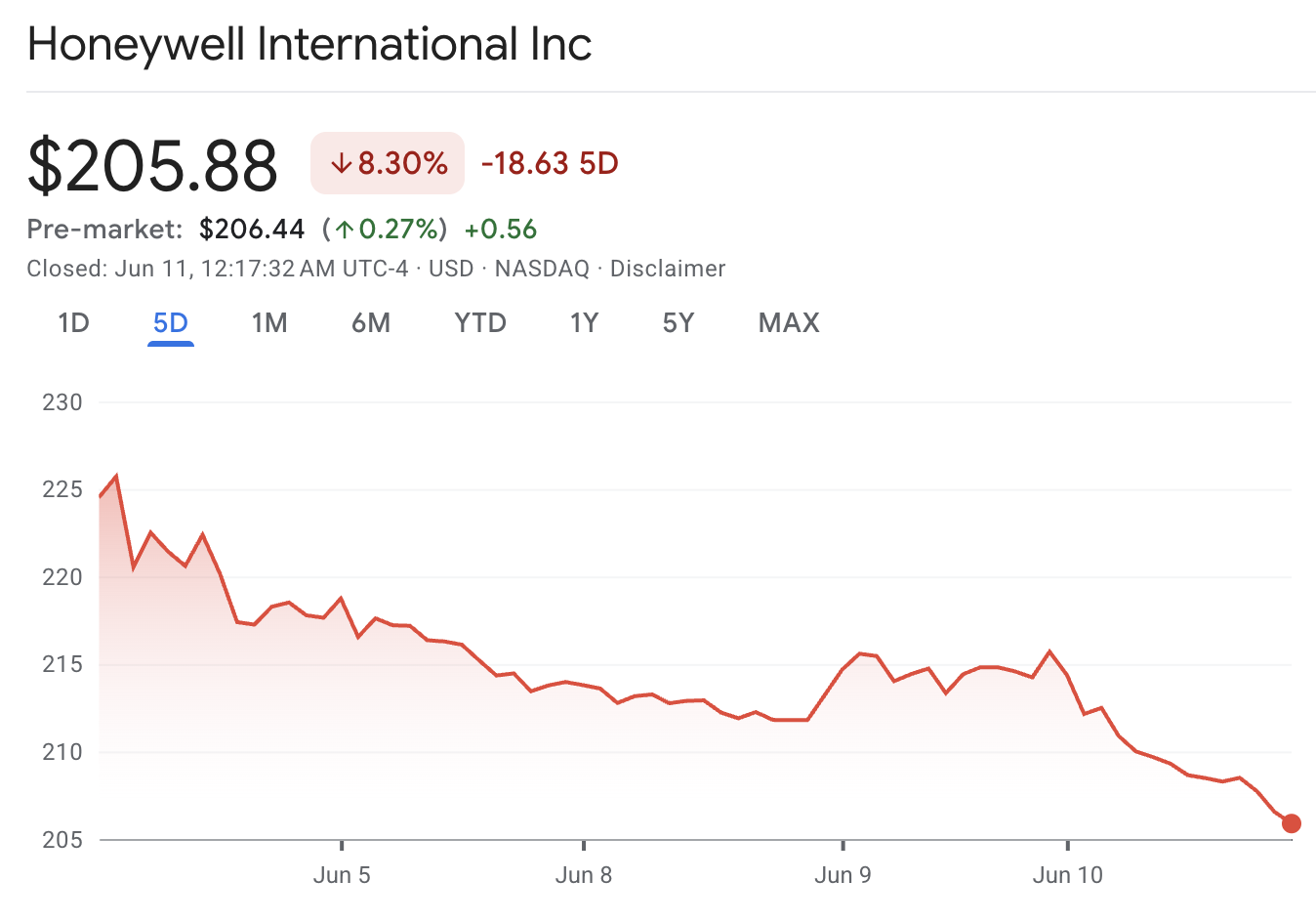
The company has set a June 15 record date for the aerospace spin-off, with distribution expected on June 29. Honeywell Aerospace is expected to begin regular-way trading on Nasdaq under HONA on the same date. Investors will receive one Honeywell Aerospace share for every two Honeywell shares held as of the record date.
Honeywell will then carry out a 1-for-2 reverse split, reducing its outstanding share count from roughly 634 million to about 317 million. That means the post-spin HON share price will not be directly comparable with the current quote.
The relevant test will be the combined market value of HONA plus the reverse-split-adjusted HON position.
The latest operating data does not show a broken business. First-quarter sales rose 2% to $9.1 billion, with organic sales also up 2%. Orders increased 7%, lifting backlog to about $38.3 billion. Segment margin expanded 90 basis points to 23.3%, while adjusted EPS rose 11% to $2.45.
The weak point was cash flow. Operating cash flow from continuing operations was negative $650 million, while free cash flow was $56 million, down from $191 million a year earlier. The pressure reflected spin-off and separation-related payments, a Flexjet litigation settlement payment, and collection timing.
| Metric | Latest reading | Market signal |
|---|---|---|
| HON latest price | $205.88 | Spin-related pressure |
| Market cap | About $130.5 billion | Large-cap industrial repricing |
| Q1 sales | $9.1 billion | Moderate growth |
| Q1 organic sales growth | 2% | Stable demand |
| Q1 orders growth | 7% | Backlog support intact |
| Q1 backlog | $38.3 billion | Revenue visibility |
| Q1 adjusted EPS | $2.45 | Up 11% year over year |
| Q1 free cash flow | $56 million | Weak cash conversion |
Honeywell reaffirmed its full-year 2026 outlook before the separation. The company expects sales of $38.8 billion to $39.8 billion, organic growth of 3% to 6%, segment margin of 22.7% to 23.1%, adjusted EPS of $10.35 to $10.65, and free cash flow of $5.3 billion to $5.6 billion.
At the latest price, the midpoint of adjusted EPS guidance implies a forward multiple near 20 times before the spin-off and reverse-split mechanics. That is not a distressed valuation. It suggests the market is pricing uncertainty around structure, not a sudden impairment of earnings power.
The more important debate is what multiple each company deserves once separated. Honeywell Aerospace may receive a premium aerospace and defense valuation because of long-cycle platforms, aftermarket exposure, defense demand, and high switching costs.
The remaining HON, branded Honeywell Technologies, will need to prove it can earn an automation premium without the aerospace growth anchor.
Honeywell stock may look more attractive after the latest decline, but the bargain case depends on post-spin math. The opportunity is not simply that HON has fallen. It is that the separated businesses may be valued more generously than the combined industrial group.
HONA is the likely value anchor. Aerospace suppliers often command stronger multiples when they have mission-critical content, large installed bases, recurring aftermarket revenue, and exposure to aircraft production and defense spending.
If HONA trades as a premium aerospace asset, it could unlock value previously hidden inside Honeywell’s conglomerate structure.
Honeywell’s capital-return record also supports the quality argument. The company returned about $31 billion to shareholders over the past five years through dividends and buybacks, including roughly $14 billion in dividends and $17 billion in repurchases.
The risk is that the market does not reward both pieces. HONA may attract demand, while the remaining HON could be valued as a slower-growth automation platform. In that case, the break-up may create clarity without creating immediate upside.
After the aerospace distribution, Honeywell Technologies will retain the HON ticker and focus on automation. The company introduced a 2026 outlook for the remaining business, with expected sales of $19.9 billion to $20.2 billion, organic growth of 2% to 3%, adjusted EPS of $3.95 to $4.15, and free cash flow of about $2.0 billion.
This remaining HON will be cleaner, but it will also face a more direct comparison with industrial automation peers. Building automation, process controls, industrial software, and connected systems remain attractive long-term markets, but the near-term growth profile is less obviously premium than aerospace.

That is why the separation can cut both ways. A simpler Honeywell may deserve a clearer valuation, but that clarity could expose slower-growth units that previously benefited from aerospace’s higher-quality earnings stream.
The bull case is that HONA earns a premium aerospace valuation while HON Technologies proves margin expansion and steady automation growth. That outcome would support a higher combined value after the split.
The base case is more balanced. HONA may trade well, but the remaining HON could receive a standard industrial automation multiple. That would stabilise the combined value but limit near-term upside.
The bear case is that investors discount weak first-quarter cash conversion, stranded costs, divestiture complexity, and slower automation growth. If that happens, the market may treat the break-up as a necessary restructuring rather than a clean value-unlock event.
Honeywell stock is entering a breakup moment. The company is not being repriced because its operating story has collapsed, but because investors are preparing to value two very different businesses separately.
The bullish case is clear: HONA could emerge as a premium aerospace supplier, while the remaining HON becomes a cleaner automation platform with margin upside. The bearish case is just as important: a complicated distribution, reverse split, weak first-quarter cash flow, and slower automation growth could limit the sum-of-the-parts benefit.
That makes HON a potential breakup bargain, but not an obvious one. The real test will come after June 29, when investors can finally compare the combined market value of post-spin HON and HONA against the valuation Honeywell commands today.
Honeywell Board of Directors sets record date, distribution timing, HONA ticker and reverse split details: https://www.honeywell.com/us/en/press/2026/06/honeywell-board-of-directors-sets-record-date-and-announces-expected-timing-for-spin-off-of-honeywell-aerospace-and-honeywell-reverse-stock-split
Honeywell first-quarter 2026 results, backlog, margins, EPS and free cash flow: https://www.honeywell.com/us/en/press/2026/04/honeywell-reports-first-quarter-results-and-reaffirms-2026-outlook-announces-sale-of-warehouse-and-workflow-solutions
Latest HON market data as of June 11, 2026: market quote data for Honeywell International Inc.