Published on: 2026-04-01
Every investor learns the same correction playbook early in their career. Stocks fall, bond prices rise, yields drop, the Fed cuts rates, and the cycle resets. It is clean, logical, and has worked reliably for the better part of four decades.
This framework is no longer effective in 2026. Oil prices and equities are diverging, and the bond market is now increasing volatility rather than reducing it.
Market participants refer to this breakdown among oil prices, stocks, Treasury yields, and growth expectations as the 'doom loop.'
The mechanism is not complicated once the sequence is clear. What makes it dangerous is how each step makes the next one worse.
Oil jumps as geopolitical disruptions tighten supply and lift energy costs across the economy.
Inflation pressure builds because fuel feeds into transport, manufacturing, and food prices.
Treasury yields rise as bond investors demand more compensation for higher inflation risk.
Stocks weaken because higher yields compress valuations and raise pressure on future earnings.
Growth slows as expensive energy, tighter credit, and weaker confidence hit demand together.
The Fed faces a policy bind because it must balance slowing growth against inflation it cannot directly control.
Financial conditions tighten further, and the same cycle begins again.
Markets have repriced the same shock across all major asset classes. Oil spiked amid supply concerns, Treasury yields rose amid inflation risk, and equities declined amid weaker sentiment and lower valuations.
By March 31, Brent closed at $103.97, WTI at $101.38, the 10-year Treasury yield eased to 4.31% after reaching 4.44% on March 27, and the S&P 500 still ended the first quarter down 4.6%. The Nasdaq finished the quarter down 7.1%.
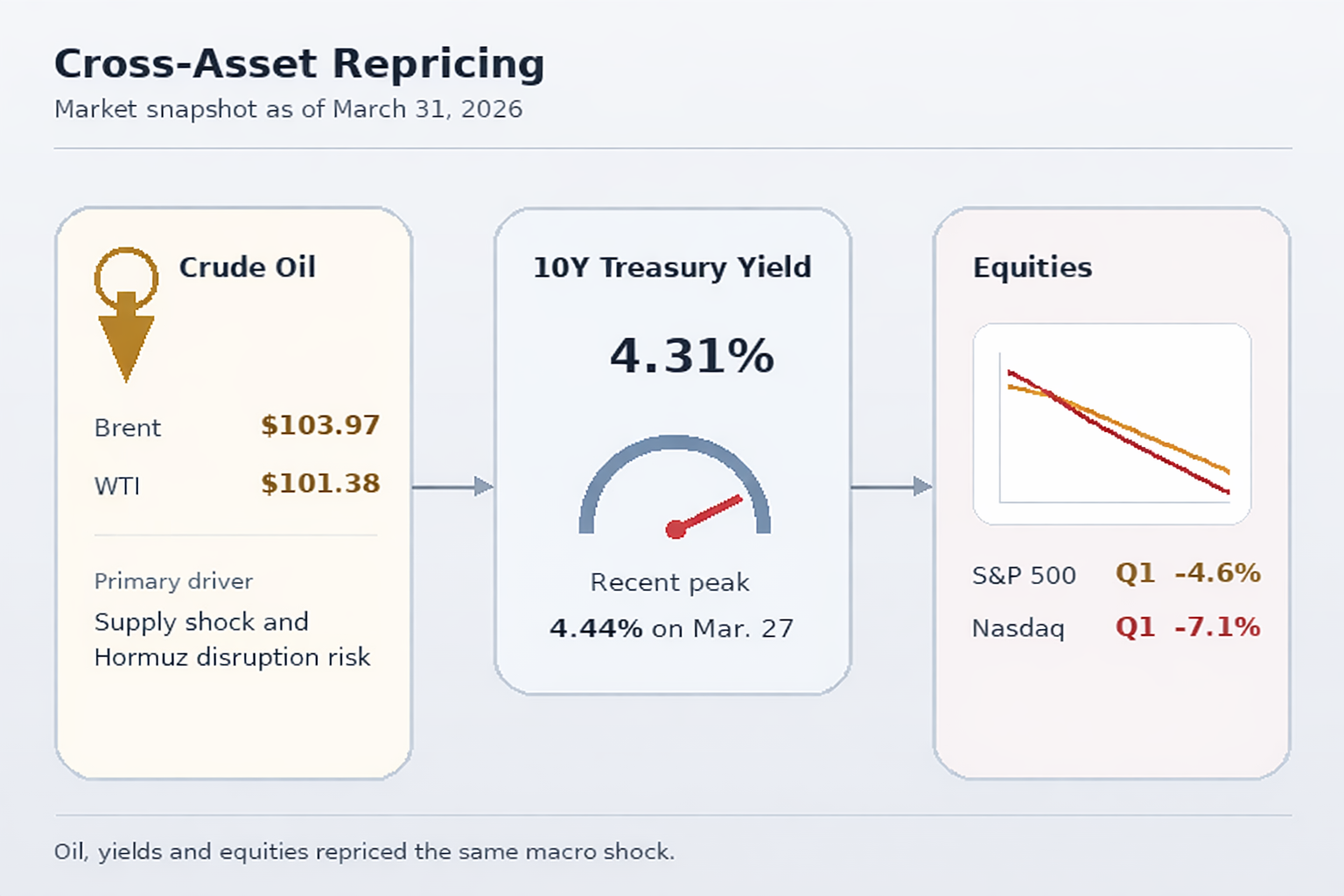
A summary of cross-asset impacts is as follows:
| Asset | Latest reading | Main driver |
|---|---|---|
| Brent crude | $103.97 | Supply shock, Hormuz risk |
| WTI crude | $101.38 | Energy disruption |
| 10-year Treasury yield | 4.31% | Inflation repricing |
| S&P 500 Q1 return | -4.6% | Valuation pressure |
| Nasdaq Q1 return | -7.1% | Growth-stock repricing |
Treasuries are no longer offsetting stock losses as they typically do. As oil surpassed $100 per barrel, the 10-year yield increased from about 3.97% in early March to 4.44% on March 27 before easing.
When yields rise during an equity selloff, balanced portfolios lose their usual hedge.
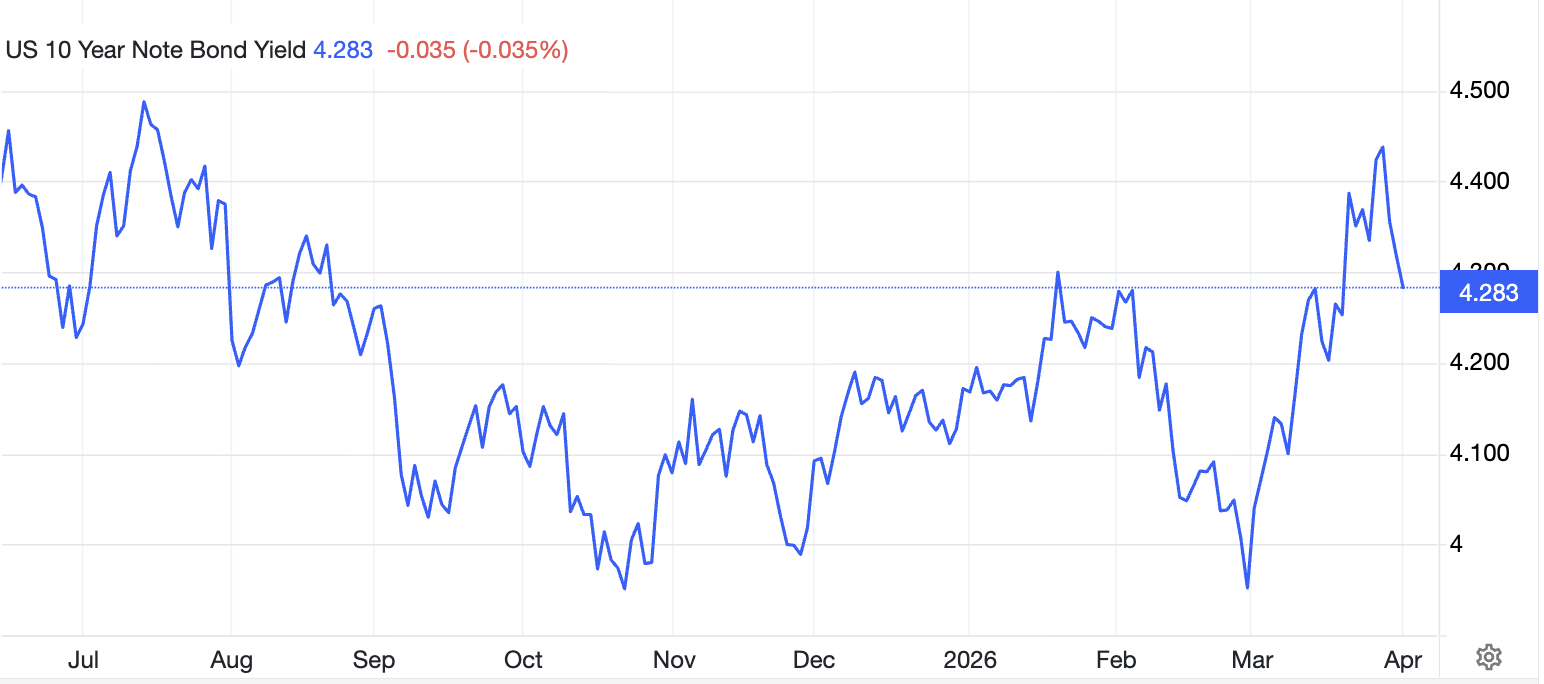
This bond weakness reflects inflation risk rather than stronger growth. The OECD noted that higher oil and gas prices, combined with tighter financial conditions, could reduce global GDP by 0.5% in two years, while consumer prices could rise 0.7 percentage points in year one and 0.9 points in year two.
The Fed left its target range at 3.50% to 3.75% on March 18. Jerome Powell said the economy was still expanding at a solid pace, but he also warned that higher energy prices will push up overall inflation in the near term and that the implications of the Middle East shock remain uncertain.
This is the policy dilemma. Cutting rates could support growth, but may worsen energy-driven inflation. Keeping rates high for longer would further constrain credit, spending, and valuations.
By March 27, markets had priced out rate cuts for 2026 and were showing a 54% chance of at least one rate hike by December.
Markets are not fully pricing in stagflation, but several indicators are emerging. S&P Global’s flash March survey showed the U.S. composite PMI at 51.4, an 11-month low, while input costs rose at the fastest pace in ten months.
This suggests slower growth and renewed price pressures, creating a more challenging environment for equities.

This is why the current oil shock has broader implications. Powell has indicated that higher energy prices are increasing near-term inflation risk, making this both a rates and a growth issue.
The clearest way to break the loop is a sustained fall in crude prices. If oil retreats, inflation fears should ease, Treasury yields should face less upward pressure, and equities would get relief from both lower input costs and a softer discount-rate headwind.
Markets have already shown how that works. On March 31, oil prices fell, the 10-year yield eased to 4.31%, and the S&P 500 rose 2.9%.
Until oil stabilises and growth data improve, stagflation risk is likely to remain a key pressure on the S&P 500 outlook.
Yes. A traditional balanced portfolio is most effective when bonds appreciate as stocks decline. In the current oil shock, both asset classes have experienced downward pressure, reducing diversification benefits.
Yes. Powell said the Fed is watching inflation expectations closely and cannot treat an energy shock lightly if broader inflationary pressures stall.
No. Yields may decline amid growing concerns about economic growth. Equities typically recover more robustly when yields fall alongside easing oil prices and reduced inflation risk.
Energy producers and certain refiners generally perform better during oil shocks, as higher crude prices support their revenues and margins. In contrast, rate-sensitive and consumer-discretionary sectors typically face greater pressure.
In 2026, the relationship between oil prices and stocks is no longer characterized by a simple inverse correlation.
Geopolitical shocks, such as the Middle East conflict and elevated oil prices, have generated inflationary pressures, leading the Federal Reserve to adopt a higher-for-longer interest rate stance that now serves as the primary constraint on equity markets.
Navigating this environment requires investors to recognize that traditional strategies, such as buying market declines and relying on bond diversification, are currently ineffective.
Exiting the doom loop necessitates a decline in oil prices, which will only occur if the geopolitical factors driving the supply shock change significantly.
Disclaimer: This material is for general information purposes only and is not intended as (and should not be considered to be) financial, investment or other advice on which reliance should be placed. No opinion given in the material constitutes a recommendation by EBC or the author that any particular investment, security, transaction or investment strategy is suitable for any specific person.