Published on: 2026-05-15
Updated on: 2026-05-15
Cerebras stock is not trading on today’s revenue. CBRS closed near $311 after pricing at $185, valuing a roughly $510 million revenue business near $67 billion.
The real bet is backlog conversion. Cerebras’ $24.6 billion order backlog, largely tied to OpenAI compute demand, must be recognised as revenue, profit, and cash flow.
OpenAI validates the backlog, but it also concentrates the risk. Delivery delays, weaker margins, or slower revenue recognition from one major relationship could reprice the entire CBRS thesis.
Cerebras is an Nvidia challenger in selected workloads, not a full replacement. Its wafer-scale architecture targets inference speed and memory bottlenecks, while Nvidia still controls the broader AI software and data-center ecosystem.
The IPO rally raised the burden of proof. CBRS can defend its premium only if demand broadens beyond OpenAI and the backlog turns into cash-generating revenue.
Cerebras' stock isn't trading like a $510 million revenue business. It is trading like investors already believe its $24.6 billion backlog can become real, profitable AI compute revenue. That is the tension behind CBRS after its IPO.
The technology is impressive, the OpenAI relationship is powerful, and the demand story is real. The risk is that the stock has already priced in much of the proof investors still need to see.
Cerebras priced at $185 and closed its first Nasdaq session near $311, giving the company a market value close to $67 billion. Those figures explain the excitement. They do not settle the investment case. The IPO did not answer whether Cerebras is the next Nvidia. It made that question more expensive to ask. (Business Insider)

Cerebras stock is expensive on current numbers. At roughly 131 times trailing sales, CBRS is not being valued as a normal semiconductor stock. It is being valued as a category winner before the category win has been proven.
That does not mean the stock must fall. It means the margin for error is thin.
For the valuation to hold, revenue growth, backlog conversion, customer diversification, and cash-flow progress need to move in the same direction quickly. Weakness in any one of those areas can change how investors view the multiple.
AI compute demand remains large. Cerebras has a real market. The problem is price: the stock already assumes Cerebras can capture far more of that market than the public numbers can yet support.
A disciplined investor does not need to decide whether the company is brilliant. The harder question is whether brilliance has already been paid for.
The key number in the Cerebras stock debate is no longer the IPO price. It is the $24.6 billion order backlog.
Much of that backlog is tied to a December agreement to supply OpenAI with 750 megawatts of AI compute through 2028, with options for nearly 3 gigawatts more by 2030. OpenAI also provided Cerebras with a $1 billion loan and received warrants for about 33 million shares. (Cerebras-Open AI Announcement)
The market is treating that backlog as future revenue. Cerebras still has to build capacity, deliver compute, recognise revenue, protect margins, and prove that demand extends beyond OpenAI.
A large backlog can make it seem as if risk has already been removed. In Cerebras’ case, it still has to pass through execution, margin, accounting, and customer-diversification tests.
If backlog converts into profitable revenue, today’s valuation becomes easier to defend. If conversion is slow, low-margin, or too dependent on OpenAI, CBRS has little traditional valuation support beneath the post-IPO premium.
OpenAI gives Cerebras rare visibility into demand in a market where AI compute remains scarce.
That visibility supports the backlog, the IPO premium, and the idea that CBRS can become more than a niche AI hardware company. It also makes OpenAI the stock’s central proof point.
If Cerebras delivers capacity on schedule and protects margins, the OpenAI relationship strengthens the bull case. If delivery slips, revenue recognition slows, or margins disappoint, the same relationship becomes the pressure point behind the valuation.
A diversified semiconductor platform can absorb one weak customer cycle. A newly public AI infrastructure stock priced around one dominant demand story has less protection.
OpenAI reduces demand uncertainty. It increases concentration risk.
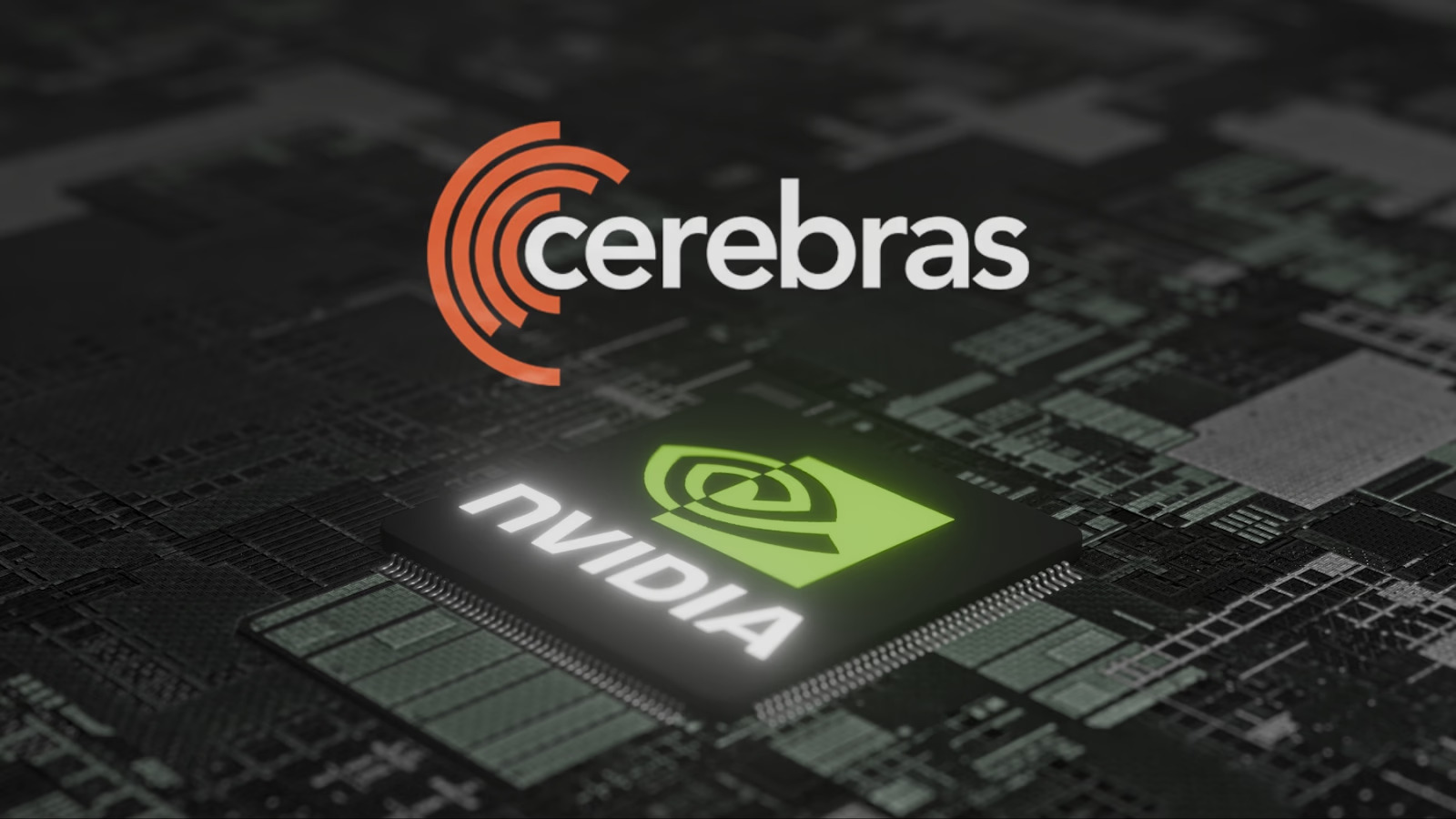
Cerebras is a real Nvidia competitor in selected parts of AI computing. It is not a full Nvidia replacement.
Its Wafer-Scale Engine 3 uses a radically different design from traditional GPU clusters, placing large amounts of compute and memory close together to reduce the data movement that slows AI workloads. That gives Cerebras a credible lane in high-speed inference, research workloads, sovereign AI systems, and on-premise deployments where latency and memory bandwidth shape the buying decision.
Nvidia’s position is wider. Its advantages include GPUs, CUDA, networking, software libraries, model optimisation, developer habits, hyperscale relationships, and years of deployment depth. Cerebras has architectural differentiation. Nvidia has ecosystem gravity.
That difference shapes the valuation debate: Cerebras can win important workloads without owning the entire AI stack. Cerebras does not need to replace Nvidia across the board. It needs to prove that its strongest workloads are large enough, repeatable enough, and profitable enough to justify the valuation.
| Metric | Latest figure | What it tells investors |
|---|---|---|
| IPO price | $185 | Demand cleared well above earlier expectations |
| First-day close | $311.07 | Scarcity pricing formed immediately |
| First-day high | $386.34 | Intraday buyers briefly priced a richer AI premium |
| Market value at close | About $67B | Valuation already reflects major future growth |
| 2025 revenue | About $510M | Strong base, still small against market value |
| Approx. price-to-sales | About 131x | Execution risk sits inside the multiple |
| Order backlog | $24.6B | Core support for the bull case |
| OpenAI commitment | 750 MW through 2028 | Validation with concentration risk |
The numbers explain why CBRS can look compelling and expensive at the same time. Cerebras has strong demand signals, but the stock already discounts much of the future growth investors hope to see.
The danger is treating backlog as revenue. The sharper question is whether that backlog converts on time, at attractive margins, and across enough customers to support a valuation near 131 times sales.
Cerebras stock now needs three forms of evidence after the IPO: backlog conversion, customer diversification, and margin progress.
The first test is revenue. If the $24.6 billion backlog converts into recognised revenue while operating losses narrow, CBRS can keep trading as a scarce AI infrastructure platform rather than a conventional chip stock.
The second test is customer breadth. If OpenAI remains the centre of the story without wider adoption, the stock becomes more fragile. A concentrated backlog can support the IPO premium early, then magnify disappointment once investors judge revenue quality.
The third test is economics. If cloud services scale beyond anchor customers and margins improve, Cerebras earns a wider valuation debate. If demand stays concentrated in specialized inference workloads, the business can still be strong while the stock remains too expensive.
Lock-up supply adds a separate test. If more shares reach the market before Cerebras proves operating leverage, the debut premium becomes vulnerable. IPO scarcity can create price discovery. It cannot replace margin expansion, customer diversification, and cash flow growth.
The next proof point is not another headline calling Cerebras a rival to Nvidia. It is evidence that technical speed can become a recurring economic driver.
Yes. Cerebras trades on Nasdaq under the ticker CBRS. The stock priced at $185 and closed its first session near $311, so post-debut buyers are entering after the scarcity premium has already formed. At roughly 131 times trailing sales, the entry point carries a different risk profile from the IPO price.
Cerebras' stock is expensive relative to current revenue, trading near 131 times trailing sales after its IPO debut. The valuation can hold only if backlog converts into high-quality revenue, margins improve, and customer demand broadens beyond OpenAI.
CBRS rose because investors wanted scarce public exposure to AI chips, OpenAI-backed compute demand, and an alternative to Nvidia-linked AI infrastructure trades. Limited float after the IPO likely amplified the first-day price move.
Cerebras competes with Nvidia in parts of AI infrastructure, especially inference and high-throughput workloads. It is not yet a full substitute for Nvidia’s broader data-center platform, which includes GPUs, networking, CUDA, software libraries, and a large developer ecosystem.
The most useful signals are backlog conversion, revenue recognition, gross margin, cash flow, customer concentration, OpenAI capacity delivery, cloud adoption, and lock-up supply. Price action alone will not answer whether CBRS deserves its post-IPO multiple.
Cerebras does not need to become Nvidia to justify investor attention. It needs to prove that its fastest workloads can become a broad, profitable AI infrastructure business.
The OpenAI backlog gives CBRS a path to scale. The post-IPO valuation gives it little room for slow execution.
Can Cerebras turn wafer-scale speed into recurring economics before the stock demands proof faster than the company can deliver it?