Published on: 2026-05-15
Updated on: 2026-05-15
Figma stock rose sharply after Q1 earnings forced the market to rethink one of the biggest questions around the company: whether AI will weaken demand for premium design software. Revenue accelerated, guidance moved higher, and enterprise customers kept expanding, turning the report into more than a routine earnings beat.
The FIG stock closed the 14 May U.S. session at $20.24, up 6.86%, before rising to $22.60 in after-hours trading, a further 11.66% gain. The core catalyst was clear: Figma’s Q1 revenue rose 46% year over year to $333.4 million, ahead of expectations near $316 million.
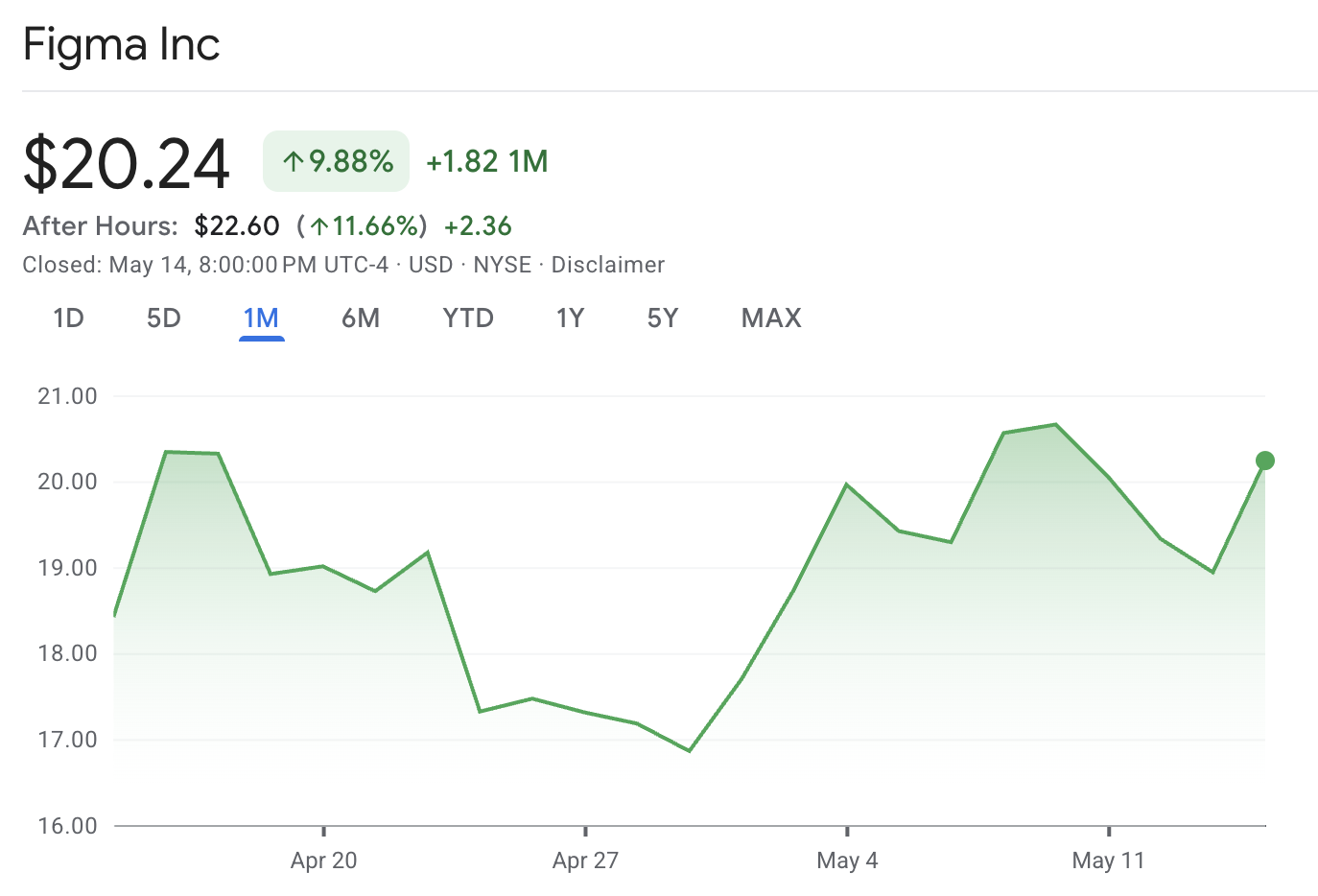
Figma stock rose after Q1 results beat expectations, easing part of the pressure created by AI disruption concerns.
Q1 revenue increased 46% year over year to $333.4 million, accelerating from 40% growth in the previous quarter.
FY2026 revenue guidance was raised to $1.422 billion to $1.428 billion, above the prior range of $1.366 billion to $1.374 billion.
Paid customers rose about 54% year over year to roughly 690,000, while customers above $100,000 ARR increased 48%.
Net dollar retention reached 139%, its highest level in more than two years.
AI monetization became central to the market debate, with Figma Make, MCP, Figma Weave, and AI credits supporting the shift from disruption risk to revenue opportunity.
Figma’s Q1 results gave the market three reasons to reassess the stock: revenue beat expectations, earnings came in ahead of consensus, and guidance moved higher.
Revenue reached $333.4 million, compared with expectations of roughly $316 million. Non-GAAP diluted EPS was $0.10, above the $0.06 consensus. Figma also guided Q2 revenue to $348 million to $350 million, ahead of expectations near $330 million.
The full-year guidance raise carried the strongest signal. Figma lifted its FY2026 revenue outlook to $1.422 billion to $1.428 billion and raised non-GAAP operating income guidance to $125 million to $135 million. The prior revenue range was $1.366 billion to $1.374 billion, so the new midpoint added roughly $55 million.
Balance is still important. On a GAAP basis, Figma reported a net loss of $142.4 million, reflecting elevated stock-based compensation and investment costs. Even so, the market focused on accelerating revenue, higher guidance, and stronger signs of AI-led product adoption.
Before the report, Figma had traded like a vulnerable SaaS stock exposed to AI-native competition. Q1 showed a business still growing seats, expanding large accounts, and turning AI usage into a clearer commercial opportunity.
The strongest feature of Figma’s Q1 results was acceleration. A newly public software company facing AI substitution risk would normally face sharper scrutiny for slower growth or cautious guidance. Figma delivered faster revenue growth and better forward expectations.
| Metric | Q1 2026 Result | Market Significance |
|---|---|---|
| Revenue | $333.4 million, up 46% YoY | Growth accelerated from 40% in Q4 |
| Non-GAAP diluted EPS | $0.10 | Beat consensus of about $0.06 |
| Q2 revenue guidance | $348 million to $350 million | Above estimates near $330 million |
| FY2026 revenue guidance | $1.422 billion to $1.428 billion | Raised by about $55 million at the midpoint |
| Paid customers | About 690,000, up 54% YoY | Shows broader paid adoption |
| Customers above $10K ARR | 15,218, up 37% YoY | Indicates mid-market and enterprise expansion |
| Customers above $100K ARR | 1,525, up 48% YoY | Shows stronger large-account penetration |
| Net dollar retention | 139% | Highest level in more than two years |
Taken together, the figures show a quarter driven by broad operating strength rather than a single earnings surprise. Revenue, customer growth, large-account expansion, and retention all moved in the same direction. For a high-growth SaaS stock, that is a stronger signal than an isolated EPS beat.
AI was the central issue behind the Figma earnings reaction. The stock had been pressured by fears that generative AI could make design workflows cheaper, faster, and less dependent on specialist software.
Figma’s Q1 results challenged the most bearish version of that view. The company is positioning AI as a monetization and collaboration layer across product development, supported by Figma Make, MCP, Figma Weave, AI credits, and workflow integrations linking design, code, and product teams.

Reports that more than 75% of enterprise users continued using Figma’s AI features after credit limits were enforced suggest usage remained durable after monetization began. The next test is whether Figma can turn that adoption into recurring revenue while defending its role against AI-native design and coding tools.
Figma’s enterprise metrics show why the rally extended beyond a one-quarter earnings beat. Revenue growth can fluctuate, but 139% net dollar retention points to existing customers expanding usage, buying more seats, and adopting more products.
For a SaaS stock, this is a strong quality signal because it reflects growth inside accounts already using the platform. Paid customers rose about 54% year over year to roughly 690,000, while customers spending more than $100,000 in annual recurring revenue increased 48%.
The figures suggest Figma remains embedded in enterprise product-development workflows. Designers, engineers, product managers, and brand teams often collaborate inside the same files, creating network effects that can raise switching costs over time.
The rally improved sentiment, but valuation risk remains. Figma is still priced as a high-growth SaaS stock, with the market expecting durable revenue expansion, enterprise adoption, and successful AI monetization.
The IPO context keeps the move in perspective. Figma priced its IPO at $33 in 2025, so an extended-hours move into the low $20s still leaves the stock below its listing price. The rally looks more like a recovery from depressed expectations than a return to IPO-era enthusiasm.
Margin pressure is still a constraint. AI features can lift usage and revenue, but infrastructure spending and product investment may weigh on operating leverage.
A newer regulatory wrinkle also sits inside Figma’s AI strategy. Figma’s federal AI products use Anthropic’s Claude, so any restriction on Anthropic models in U.S. government procurement could weigh on sales to government and regulated customers while the issue remains legally unresolved.
Q1 weakened the view that AI will quickly erode Figma’s business model, but execution risk, software valuation risk, and AI-native competition remain unresolved.
Figma stock rallied because Q1 earnings changed the market’s view of its growth trajectory. Revenue rose 46%, paid customers expanded sharply, enterprise accounts kept growing, and guidance moved higher. The quarter directly challenged the idea that AI would quickly weaken demand for collaborative design software.
The next test is execution. Figma must prove it can turn AI adoption, 139% net dollar retention, and large-customer growth into profitable expansion while defending its role across design, product, and engineering workflows. The latest results weakened the immediate AI bear case, but valuation risk, margin pressure, and AI-native competition remain central to the stock’s outlook.