Published on: 2026-01-22
Updated on: 2026-01-22
In early 2024, USD/KES served as a stress indicator, reflecting a dollar-liquidity premium in the exchange rate. By early February 2024, the shilling traded around 160.09 per USD. Over the subsequent eight weeks, it appreciated rapidly, reaching 144.15 by February 22, 137.49 by March 14, and 131.80 by March 28 as near-term external refinancing risks diminished and FX market clearing improved. The exchange rate later fell below 130, with USD/KES at 128.46 by June 13, 2024. By mid-January 2026, the rate remained near 129, while usable reserves increased to a level covering more than 5 months of imports. This progression demonstrates that the initial strengthening resulted from a rapid compression of risk and liquidity premia, followed by a consolidation phase supported by reserve accumulation and improved FX supply. [1]
In 2026, the primary consideration for USD/KES is not the availability of US dollars in Kenya, but rather the market-clearing exchange rate amid higher domestic inflation relative to the US, fluctuating current account balances, and central bank efforts to restore policy space through rate reductions. In this context, inflation differentials and reserve dynamics become more significant than short-term news events.
USD/KES remains effectively range-bound near 129. As of January 15, 2026, the shilling traded at 129.03 per USD, largely unchanged from late 2024 levels despite fluctuations in global interest rates and oil prices. This stability reflects both policy measures and market dynamics.
Kenya is experiencing reduced import inflation due to the stability of the shilling. Headline inflation stood at 4.5% in December 2025, primarily driven by food and transport costs. The steady USD/KES rate has limited currency pass-through effects on fuel, fertilizer, machinery, and tradable consumer goods, thereby maintaining inflation near target levels. [2]
The US inflation rate has regained significance as an anchor. US CPI inflation was 2.7% in December 2025. If Kenya's inflation remains in the mid-single digits while US inflation stays near 2.7%, purchasing power parity suggests gradual KES depreciation over time, unless counterbalanced by productivity improvements or net capital inflows. [3]
Foreign exchange reserves have become a primary determinant of market confidence. As of January 15, 2026, usable reserves totaled $12.477 billion, equivalent to 5.4 months of import cover. This buffer reduces the likelihood of disorderly repricing, lowers the FX liquidity premium required by banks and corporates, and enhances forward market pricing.
Remittances continue to serve as the most stable stabilizer for USD/KES. Total remittances increased to $5.037 billion in 2025. Even during periods of weaker exports or increased imports, remittances help smooth foreign exchange cycles and provide a consistent baseline of hard-currency supply.
The interest rate differential continues to support carry trades, although risk remains a limiting factor. The Central Bank of Kenya reduced the policy rate to 9.00% in December 2025, while the Federal Reserve's target range is 3.50% to 3.75%. While the nominal spread is substantial, the effective traded spread is determined after accounting for inflation expectations, hedging costs, and Kenya-specific risk premia. [4]
USD/KES should be viewed as a market that has shifted from a one-way depreciation risk to a managed two-way risk environment. The shilling has maintained stability around the 129 level for extended periods, including late 2024 and early 2026. [5]
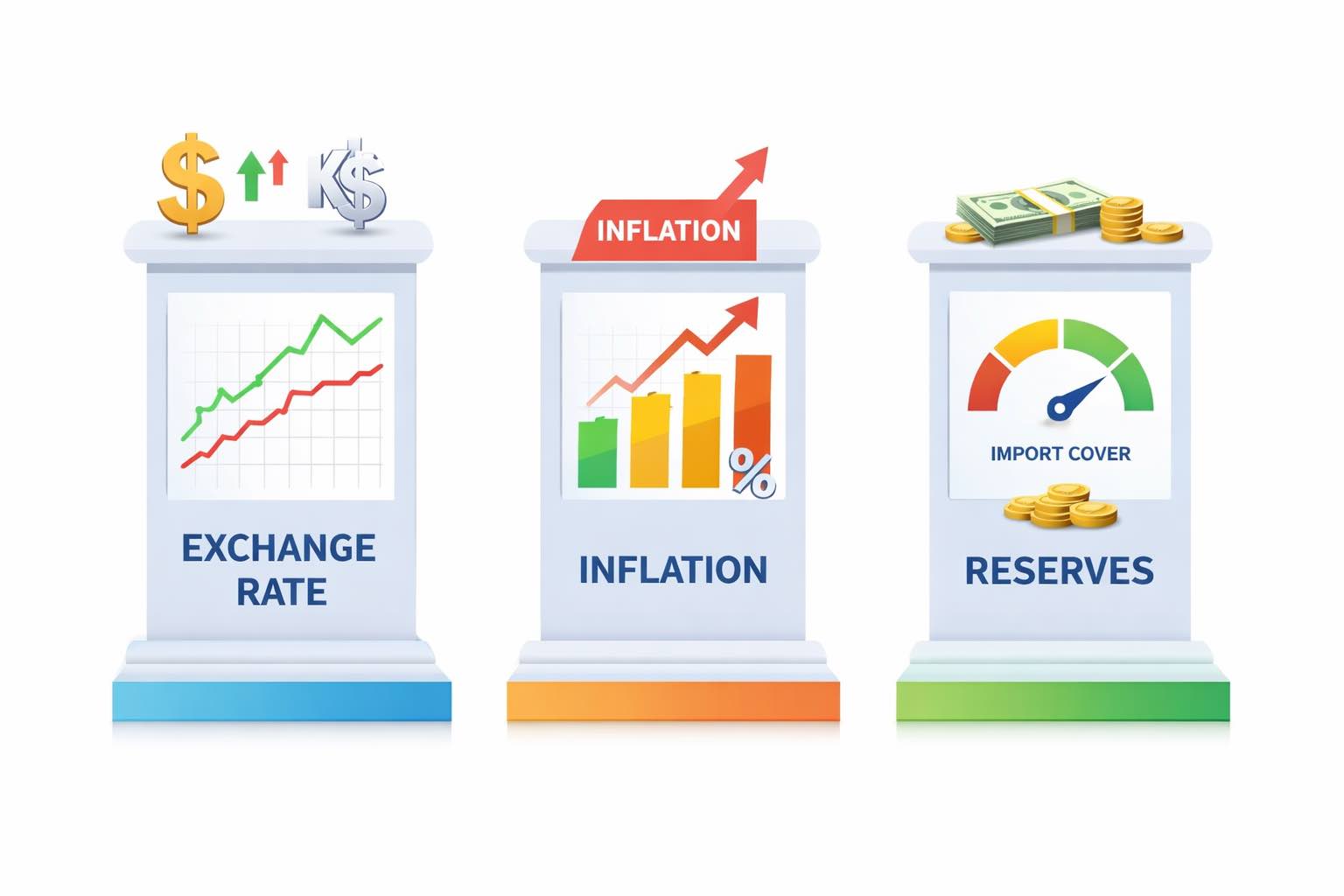
In January 2024, the USD/KES rate was near 160, reflecting a combination of tight dollar liquidity, heightened external financing concerns, and limited reserve cover. Usable reserves at that time were approximately $6.829 billion (3.7 months), a level that compelled the private sector to pay a premium for dollar liquidity even in the absence of formal controls. [1]
By January 2026, reserves had nearly doubled. This improvement in reserve adequacy is the primary factor enabling market stability, even amid fluctuations in monthly trade flows or shifts in risk sentiment.
Kenya’s inflation was 4.5% year on year in December 2025, with the main pressure coming from food and non-alcoholic beverages (7.8%) and transport (5.2%).
US inflation was 2.7% in December 2025. [3]
This inflation differential is significant because if the nominal exchange rate remains stable while Kenya's price level increases more rapidly than the US's, the shilling appreciates in real terms against the dollar. Real appreciation is not inherently positive or negative, but it produces distinct consequences:
Positive: lowers imported inflation pressure, supports household purchasing power for tradables, and reduces the shilling cost of servicing external obligations in the near term.
Negative: tightens conditions for exporters and import-competing firms, because domestic costs rise faster than the FX-adjusted revenue line unless productivity rises too.
This dynamic creates a unique tension in the current USD/KES environment. While the shilling appears stable, prolonged inflation above that of trading partners can gradually erode competitiveness.
CBK reduced the Central Bank Rate to 9.00% in December 2025.
With inflation at 4.5%, the ex-post real policy rate remains positive. Positive real rates generally support currency stability by discouraging marginal dollarization and maintaining the attractiveness of local-currency assets for domestic institutions. [2]
On the US side, the Fed cut the federal funds target range to 3.50% to 3.75% in December 2025.
This development provides marginal support by reducing global carry trade headwinds. However, it does not eliminate the risk of USD strength should the US economy outperform expectations or if risk-averse conditions reemerge.
Reserves do not determine a fixed exchange rate, but they alter the distribution of potential outcomes. When usable reserves are low, even typical demand spikes can trigger significant exchange rate movements, as the market anticipates possible rationing. In contrast, ample reserves allow similar demand spikes to be viewed as temporary flow issues rather than systemic regime concerns.
As of January 15, 2026:
Usable reserves: $12.477 billion
Import cover: 5.4 months
Definition note: “Usable” reserves exclude encumbered reserves.
This dynamic is significant for USD/KES for two primary reasons.
Liquidity premium compression occurs when banks and corporates reduce precautionary demand for US dollars, confident that the central bank can address short-term shortages. This reduces the self-reinforcing nature of foreign exchange stress.
Forward curve discipline is enhanced by adequate reserves, as the market is less inclined to price in extreme forward points based on fear. The likelihood of abrupt exchange rate movements is thereby reduced.
A simple way to see the regime change is to compare key points in time:
| Indicator | Jan 11, 2024 | Dec 24, 2024 | Jan 15, 2026 |
|---|---|---|---|
| USD/KES (KSh per $1) | 159.85 | 129.30 | 129.03 |
| Usable FX reserves | $6.829b | $9.201b | $12.477b |
| Import cover (months) | 3.7 | 4.7 | 5.4 |
Despite stronger reserves, Kenya remains structurally import-intensive, particularly for fuel, capital goods, and intermediate inputs. Consequently, USD/KES remains vulnerable to periods of current account widening.
CBK data shows the current account deficit narrowed to 1.6% of GDP in the 12 months to June 2025, supported by stronger goods exports. [6]
But quarterly numbers can still swing. In the third quarter of 2025, the current account deficit widened to KSh 135.3 billion, driven by a wider merchandise trade deficit and a weaker services surplus. [7]
This combination accounts for the phenomenon where USD/KES remains stable for extended periods but can experience rapid movement when specific conditions coincide:
Seasonal import demand (energy and inputs) rises.
Services receipts (tourism and transport) soften.
Capital account inflows pause or reverse.
Remittances are the most stable large FX inflow Kenya has. Total remittances rose to $5.037 billion in 2025, even though December inflows dipped slightly year on year.
From a market perspective, remittances mitigate left-tail risk for USD/KES by ensuring a continuous flow of US dollars through the banking system, even when other sources of foreign exchange are volatile.
In 2026, USD/KES is expected to be influenced by competing forces: inflation differentials, which suggest gradual depreciation, and reserve strength combined with positive real rates, which support stability.

Reserve trajectory, not just the level
Reserves equivalent to 5.4 months of import cover are considered robust. Market participants will monitor whether the Central Bank of Kenya can maintain this position if import demand increases or external debt servicing obligations intensify.
Kenya's inflation path relative to the US
If Kenya's inflation remains in the mid-4% range while US inflation stays in the high-2% range, nominal exchange rate stability implies continued real appreciation. Sustaining this dynamic over extended periods becomes increasingly challenging, both politically and economically, in the absence of productivity gains.
Rate and risk premium dynamics
The Central Bank of Kenya has initiated monetary easing, setting the policy rate at 9.00%, while the Federal Reserve maintains a range of 3.50% to 3.75%. Should global risk sentiment deteriorate, the interest rate spread may not sufficiently protect the shilling unless reserves continue to increase or domestic inflation declines more rapidly.
Base case (most likely): 126 to 134
This scenario assumes that reserves remain above five months of import cover, inflation stays within the target band, and remittances continue to demonstrate resilience.
KES-strong case: 122 to 126
This scenario requires additional reserve accumulation, lower oil prices, and sustained capital inflows, enabling the market to assign a lower foreign exchange risk premium.
KES-weak case: 135 to 145
This scenario would likely result from a combination of higher oil prices, wider trade deficits, and a risk-off event that restricts USD liquidity across emerging and frontier markets. Typically, the trigger involves the correlation of multiple variables rather than a single factor.
As of January 15, 2026, the Kenyan shilling traded at approximately 129.03 per USD on the central bank’s indicative rate series, suggesting a broadly stable exchange rate.
A stable-range base case, approximately KSh 125 to 135 per US dollar, aligns most closely with current fundamentals, barring a surge in oil prices or tightening global dollar conditions. Elevated reserves and robust remittances reduce the likelihood of disorderly depreciation.
The most significant change was the improvement in reserve adequacy and market confidence. Usable reserves increased from approximately 3.7 months of import cover in January 2024 to 5.4 months by mid-January 2026, thereby reducing foreign exchange stress premia.
When Kenya's inflation exceeds that of the US, the shilling is subject to long-term depreciation pressure according to purchasing power parity. If the USD/KES rate remains unchanged, the shilling appreciates in real terms, which may eventually place strain on the external balance.
Usable reserves exclude encumbered reserves, providing a more accurate measure of immediate buffer capacity. The Central Bank of Kenya reported usable reserves of $12.477 billion (5.4 months) as of January 15, 2026.
Kenya's policy framework prioritizes volatility smoothing over maintaining a fixed exchange rate peg. In practice, sufficient reserves enhance the central bank's capacity to mitigate disorderly movements, helping to keep USD/KES within a narrower range during periods of market stress.
The optimal hedging strategy depends on the timing of cash flows. Importers generally benefit from layered hedging strategies, while exporters often prioritize protection against adverse rates while retaining potential gains. Aligning hedge tenors with working-capital cycles is essential.
USD/KES has transitioned to a fundamentally different regime compared to early 2024. The shilling's stability near 129 is supported by significantly stronger reserves, resilient remittances, and a monetary policy stance that continues to provide positive real returns despite recent rate cuts.
However, current stability should not be interpreted as a permanent equilibrium. Given that Kenya's inflation remains above the US's and that the current account can widen significantly in certain quarters, the shilling's fair value is better represented as a range rather than a fixed point. In 2026, reserve momentum and inflation trends will serve as key market anchors. Should either indicator deteriorate, USD/KES may adjust more rapidly than recent stability would imply.
[1] Central Bank of Kenya
[2] Kenya National Bureau of Statistics
[3] Bureau of Labor Statistics
[4] Central Bank of Kenya
[5] Central Bank of Kenya
[6] Central Bank of Kenya
[7] Kenya National Bureau of Statistics