Published on: 2026-03-12
Updated on: 2026-03-12
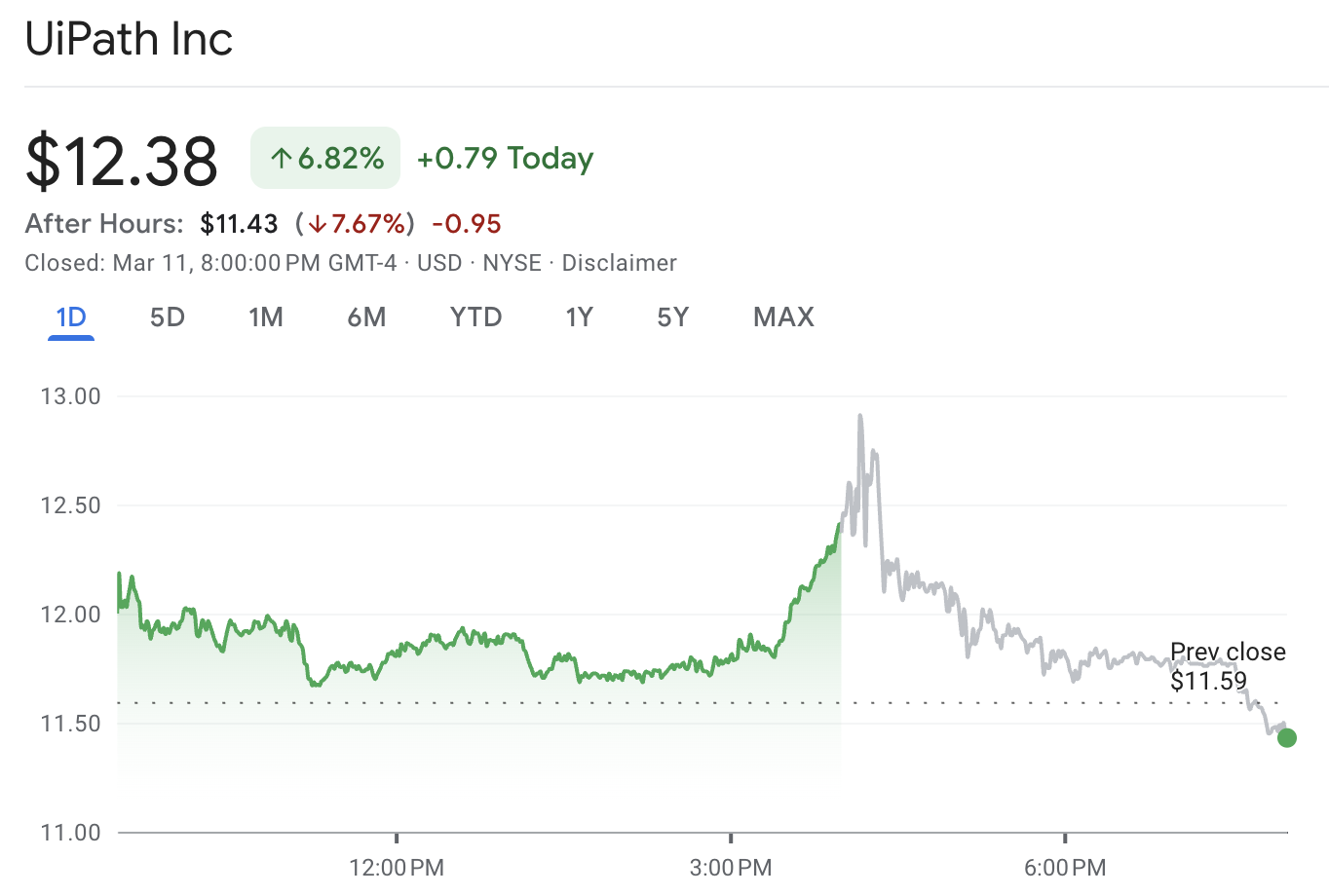
On March 11, 2026, UiPath released an intriguing earnings report, notable for its analytical depth. PATH stock rose 6.8% in the regular session to close at $12.38, touched an intraday high of $12.98, and traded more than 120 million shares. After the bell, the move faded, with the stock trading at $11.43 in after-hours, down 7.67% from the regular-session close.
The earnings report itself was strong. UiPath earnings reported fourth-quarter revenue of $481 million, up 14% year over year, annual recurring revenue of $1.853 billion, full-year revenue of $1.611 billion, first-time full-year GAAP operating profitability, and a fresh $500 million stock repurchase authorization after completing its previous $1 billion buyback plan. The company also guided for fiscal 2027 revenue of $1.754 billion to $1.759 billion.
However, the fade tells us it is not just a numbers story, it is also a sentiment story. PATH stock still sits below its 50-day and 200-day moving averages, short interest remains elevated, and the stock traded more than 2.5 times its 20-day average volume on earnings day. That combination can create fast upside bursts, but it can also attract sellers into strength.
Hard catalyst: Fourth-quarter revenue rose 14% to $481 million, with ARR up 11% to $1.853 billion.
Hard catalyst: UiPath authorized a new $500 million buyback after finishing its prior $1 billion repurchase program.
Hard catalyst: Fiscal 2027 guidance called for revenue of $1.754 billion to $1.759 billion.
Soft catalyst: Volume hit about 103.9 million shares on March 11 versus a 20-day average of 40.35 million.
Soft catalyst: Short interest remains high at about 24.1% of float, which can magnify both rallies and reversals
PATH stock jumped because the quarter beat expectations and showed that UiPath's operating model is improving. The company topped consensus on revenue and earnings, expanded operating income, and ended the year with $1.69 billion in cash, cash equivalents, and marketable securities. Those are the kind of numbers that can pull buyers back into a software stock.
The fade came because the guidance was good, but not strong enough to force a full re-rating. UiPath guided for fiscal 2027 revenue of $1.754 billion to $1.759 billion, which implies about 8.9% to 9.2% growth from fiscal 2026 revenue of $1.611 billion. For a company closely associated with AI and automation, its slower growth profile likely made investors cautious.
This was a real beat. UiPath earnings reported adjusted EPS of $0.30, exceeding the expected $0.25. The company's revenue reached $481.11 million, surpassing the anticipated $464.81 million.
Additionally, UiPath achieved a GAAP operating income of $80 million for the quarter. For the full fiscal year 2026, the company reported a 13% increase in revenue, totaling $1.611 billion.
That explains the first move higher. Investors were prepared for a tougher print. Instead, they got a clean revenue beat, stronger profitability, and a management team that could point to scaling adoption in agentic automation.
UiPath also announced a new $500 million buyback after completing its previously authorized $1 billion repurchase program. Buybacks are among the clearest signals management can send when it believes the stock is undervalued or wants to absorb market volatility.
For longer-term holders, that is an important positive. It does not guarantee upside, but it does add balance-sheet support to the investment case. UiPath finished the quarter with $1.69 billion in cash, cash equivalents, and marketable securities, enabling the company to continue investing while also returning capital.
The fade likely came from the part of the release that matters most for software stocks: future growth. UiPath projected fiscal 2027 revenue of $1.754 billion to $1.759 billion, up from $1.611 billion in fiscal 2026. That is healthy growth, but it is not the kind of acceleration that always satisfies investors in a market still obsessed with faster AI monetization.
That's why the stock can rally initially before stalling. The quarter was strong enough to attract buyers, but the outlook was not impressive enough to retain all short-term holders.
PATH is currently trading as a stock, not solely on fundamentals. The short interest stands at approximately 100.69 million shares, representing 24.1% of the float. On March 11, the trading volume reached 103.9 million shares, significantly exceeding its recent average.
When that much short positioning meets a positive earnings surprise, the move can overshoot fast. When the first squeeze cools, the fade can be just as quick.
For many investors, this situation is not a straightforward sell signal. The quarter was strong, the balance sheet is healthy, and the cash flow profile is better than it was a year ago. Those are fair reasons to keep a core position.
At the same time, trimming is not an unreasonable view either if the position has become too large or if you were expecting a much stronger growth re-acceleration. PATH stock price remains below major highs, indicating fragile sentiment.
| Question | Lean Hold | Lean Trim |
|---|---|---|
| Do you believe UiPath can keep winning in agentic automation? | Yes | Not yet convinced |
| Are you comfortable with high single-digit to low double-digit growth? | Yes | No, you wanted faster growth |
| Has the stock become too large in your portfolio after the run-up? | No | Yes |
| Can PATH break and hold above the $13 area? | If yes, that supports patience | If no, that supports caution |
The table is a framework, not a personal recommendation. It reflects the mix of strong fundamentals and still-cautious market pricing visible in the latest report and share reaction.
From a technical analysis perspective, PATH is in a short-term rebound inside a still-messy medium-term range. The stock closed above $12 for the first time this week, but it remains below both its 50-day and 200-day moving averages.
The RSI is currently at 55.25, indicating that momentum has improved; however, it is not yet at an extreme level.
| Level | Type | Why It Matters |
|---|---|---|
| $11.60 to $11.65 | Immediate support | March 10 close and March 11 intraday low |
| $11.35 to $11.43 | Stronger support | March 10 intraday low and after-hours print |
| $10.90 to $11.05 | Deeper support | Recent pivot zone from March 3 to March 5 |
| $12.42 to $12.50 | Near-term resistance | Earnings-day high and first breakout ceiling |
| $12.95 to $13.00 | Major resistance | February swing-high zone |
| $13.31 to $13.43 | Overhead resistance | 50-day and 200-day moving averages |
All of the levels are determined by recent price history and current moving average data.
The clean bullish case is a hold above $11.60, followed by a break through $12.42.
The bearish case is a failure back under $11.60, which would expose the stock to a move toward the low-$11 or even high-$10 area.
PATH jumped because UiPath beat on revenue and earnings, posted higher operating income, and showed continued ARR growth. The regular-session move reflected relief and renewed confidence in execution.
The fade likely came from guidance and valuation expectations. Fiscal 2027 growth looks solid, but not fast enough to remove all doubt in a market that wants clearer AI-led acceleration.
Not on a sales or book-value basis versus its own recent history. PATH is currently trading below its average price-to-sales and price-to-book multiples since its IPO, suggesting that the stock is not significantly overvalued even after the recent earnings increase.
In conclusion, UiPath's earnings delivered a strong quarter for the market. That part is clear. Revenue beat, ARR improved, margins stayed healthy, and cash flow remained solid.
The more challenging question is whether this is sufficient for a sustained re-rating. Currently, the answer appears mixed. The fundamentals argue for patience, but the guidance and price action argue for discipline.
That is why PATH looks more like a measured hold than a high-conviction chase, while selective trimming can also make sense for investors who want to manage risk after a rally that could not fully stick.
Disclaimer: This material is for general information purposes only and is not intended as (and should not be considered to be) financial, investment or other advice on which reliance should be placed. No opinion given in the material constitutes a recommendation by EBC or the author that any particular investment, security, transaction or investment strategy is suitable for any specific person.