Published on: 2026-04-24
Updated on: 2026-04-24
The Intel stock rally changed the market’s question. Investors are no longer asking whether Intel can survive its turnaround. They are asking whether AI CPU demand can fund it.
That distinction matters. Intel’s Q1 earnings showed a version of the company investors had not seen for several quarters: revenue growth, stronger non-GAAP earnings, margin expansion, and guidance that points beyond a one-quarter rebound.
The rally is credible, but not complete. Intel has earned renewed attention, but not yet a full rerating. The next phase depends on whether Data Center and AI momentum can turn into durable margin expansion before Intel Foundry’s losses absorb the upside.
Intel’s Q1 revenue rose 7% YoY to $13.6 billion, while non-GAAP EPS reached $0.29.
Q2 revenue guidance of $13.8 billion to $14.8 billion showed demand strength extending beyond the first quarter.
Data Center and AI revenue rose 22% YoY to $5.1 billion, making AI CPUs the strongest part of the bull case.
Intel Foundry revenue rose 16% YoY to $5.4 billion, but the segment still posted an operating loss of $2.44 billion.
Intel stock has moved from recovery pricing to execution pricing. That raises the valuation ceiling, but shortens the market’s patience.
Intel's stock jumped because Q1 changed the quality of the story. For much of the past several years, Intel was treated as a repair project. The company had to defend its CPU franchise, rebuild manufacturing credibility, and convince investors that Foundry was not just an expensive strategic slogan.
Q1 gave the market a cleaner version of the turnaround. Revenue beat expectations, non-GAAP EPS improved, and margins showed operating leverage. Non-GAAP gross margin reached 41.0%, up from 39.2% a year earlier.
Non-GAAP operating margin rose to 12.3%, compared with 5.4% in Q1 2025. That is the kind of improvement investors reward because it shows that demand is beginning to flow through the income statement.
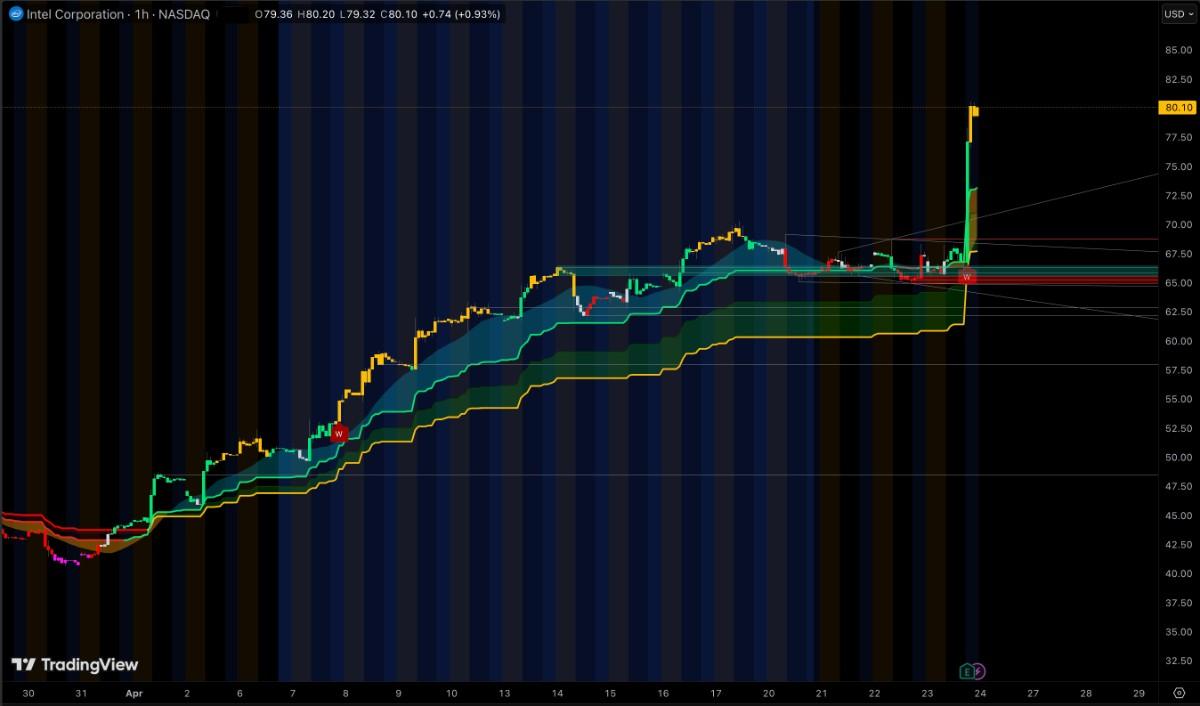
The stock reaction was forceful. As of the post-earnings session on April 24, Intel traded near $66.78, with a market value of around $302.6 billion, after touching an intraday high of $80.58.
At that scale, Intel is no longer priced like a broken semiconductor turnaround. It is priced for visible earnings recovery, with AI CPUs, advanced packaging, and Foundry optionality embedded in the valuation. That raises Intel’s valuation ceiling, but it also shortens the market’s patience if Foundry losses do not narrow.
The rally is not only pricing in a better quarter. It is pricing in three assumptions that now need to be proven over several reporting periods.
| Market Assumption | What It Means | What Could Prove It |
|---|---|---|
| AI CPU demand is durable | DCAI growth is not a one-quarter spike | DCAI keeps growing above company average |
| Margins can recover | Revenue growth is becoming earnings leverage | Gross margin holds near or above 40% |
| Foundry losses can narrow | Manufacturing strategy becomes investable | Losses decline and external demand scales |
This is the market’s new contract with Intel. The stock can keep rising if these assumptions are confirmed. It becomes vulnerable if even one of them weakens.
The strongest argument for Intel stock is not that the company is becoming the next Nvidia. That is the wrong comparison. Intel does not need to dominate AI accelerators for the stock to work. It needs the AI buildout to make CPUs more valuable again.
That is what Q1 suggested. Data Center and AI revenue rose 22% YoY to $5.1 billion, easily outpacing total company growth. AI infrastructure still needs host CPUs, inference support, workload orchestration, cloud instances, networking coordination, and advanced packaging. As AI moves from model training into enterprise deployment and agentic workloads, Intel’s CPU franchise becomes harder to dismiss.
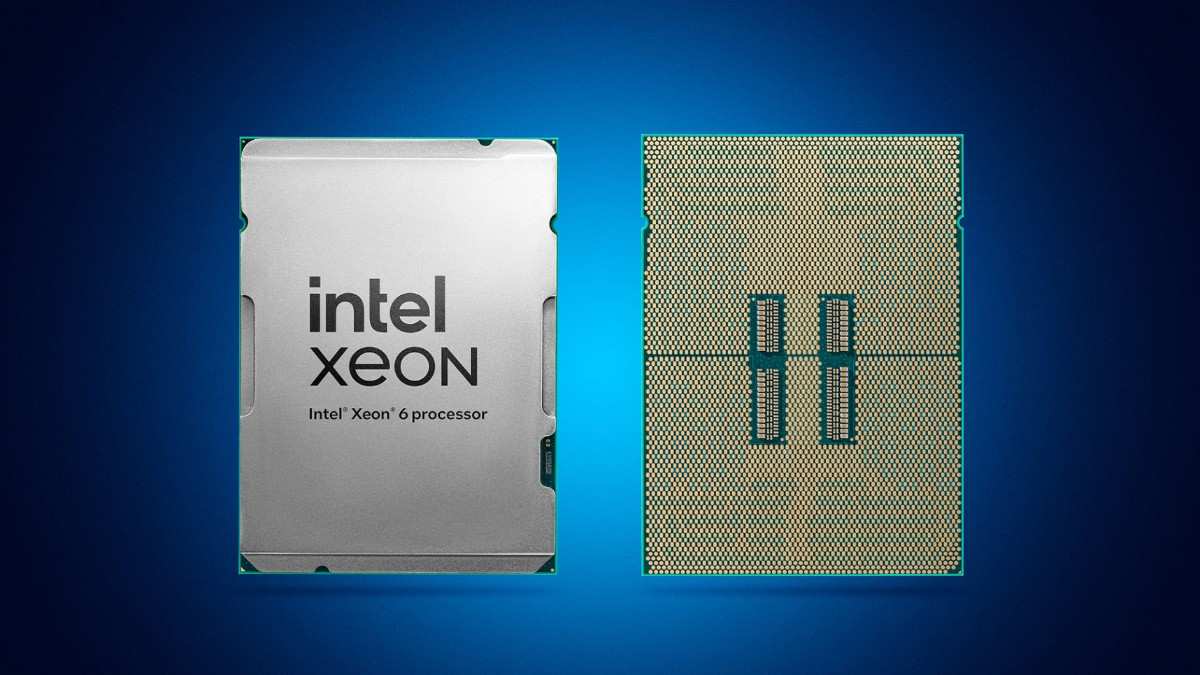
The customer signals matter. Intel announced a multiyear collaboration with Google for Xeon processors across workload-optimized cloud instances. NVIDIA selected Intel Xeon 6 as the host CPU for DGX Rubin NVL8 systems. SambaNova’s hardware blueprint also includes Intel Xeon 6 processors as host and action CPUs. These are not abstract AI talking points. They place Intel inside real AI infrastructure stacks.
Intel sits between two valuation models: it has not yet earned either. It is not Nvidia, where investors pay for accelerator dominance and extraordinary AI margins. It is not TSMC, where investors pay for proven foundry scale and manufacturing trust.
Intel is trying to become a hybrid: a CPU recovery story with foundry optionality. That makes the upside larger, but the proof burden heavier.
Foundry is not a rounding error. It is the bill Intel is paying for its future.
The strategic case is obvious. Intel Foundry gives the company geopolitical relevance, manufacturing optionality, advanced packaging capacity, and a possible long-term position as a Western alternative in semiconductor production. But investors do not value strategic ambition in isolation. They value earnings power.
| Intel Q1 2026 Metric | Result | Market Meaning |
|---|---|---|
| Total revenue | $13.6B | Recovery is visible |
| Non-GAAP EPS | $0.29 | Operating leverage improved |
| GAAP EPS | -$0.73 | Charges still weigh on profitability |
| DCAI revenue | $5.1B, +22% YoY | AI CPU demand strengthened |
| Intel Foundry revenue | $5.4B, +16% YoY | Scale improved |
| Foundry operating loss | -$2.44B | Main drag on rerating |
| Q2 revenue guide | $13.8B-$14.8B | Momentum extends beyond Q1 |
The Foundry issue is not only the size of the loss. It is the quality of the revenue. Intel’s supplemental segment table showed $5.421 billion of Foundry revenue, but also $5.251 billion of intersegment eliminations.
That means the reported Foundry scale still relies heavily on internal manufacturing activity. Investors need external customer demand to grow, become cleaner, and become more profitable before assigning Intel a full foundry premium.
This is why Foundry controls the valuation ceiling. Intel Products generated $4.06 billion in operating income across CCG and DCAI, while Intel Foundry reported a $2.44 billion loss. AI CPU demand is now strong enough to revive the earnings story, but Foundry remains large enough to dilute the rerating if losses do not narrow.
Intel Products can carry the transition only if DCAI and Client Computing generate enough profit to offset Foundry’s losses while funding the manufacturing buildout. The rally is therefore not just about AI CPUs. It is about whether Intel’s profitable businesses can finance Foundry long enough for Foundry to stop weakening the investment case.
The Musk-related search interest is more useful as a sentiment signal than an investment thesis. There is no verified acquisition story in Intel’s earnings materials. The relevant point is Intel’s strategic connection to the Terafab project alongside SpaceX, xAI, and Tesla, which supports the manufacturing narrative but does not change the near-term earnings equation.
The next phase of the Intel stock rally will be decided by five signals.
| Signal | Why It Matters | Bullish Read |
|---|---|---|
| DCAI growth | Tests AI CPU durability | Growth stays above company average |
| Gross margin | Shows operating leverage | Margin holds near or above 40% |
| External foundry traction | Tests third-party demand | External wins scale beyond headlines |
| Foundry operating loss | Measures financial discipline | Losses narrow consistently |
| Q2 and second-half outlook | Confirms demand depth | Guidance holds or improves |
This is where investors should focus. The next leg higher requires AI demand to become operating leverage, not another headline cycle.
Intel is more credible after Q1, but less forgiving after the rally. That is the correct way to think about the stock.
Existing holders have a stronger reason to stay involved because Q1 reduced the probability that Intel’s turnaround is purely narrative. Data Center and AI growth is real, margins improved, and guidance supports the idea that demand is not limited to one quarter.
New buyers need a higher conviction threshold. The easy relief-trade discount has narrowed. The stock is no longer a clean value trade. It is an execution trade with improving fundamentals.
That makes Intel attractive only for investors who believe two things. First, AI CPU demand can remain durable for several quarters. Second, Foundry losses will begin to narrow before the market loses patience. Without both, the rally can still fade even if the Q1 report was strong.
Yes. AI infrastructure still needs CPUs for host processing, inference, enterprise workloads, cloud instances, and orchestration. Intel’s Xeon partnerships with Google, Nvidia, and SambaNova show that CPUs remain central to AI deployment, even in a market dominated by GPU headlines.
There is no verified evidence that Elon Musk is buying Intel. The real story is Intel’s strategic role in the Terafab project alongside SpaceX, xAI, and Tesla. That supports Intel’s manufacturing narrative, but it is not an acquisition thesis.
Intel stock can keep rising if DCAI growth remains strong, margins hold near 40%, and Foundry losses begin to narrow. The rally is credible, but the next move requires confirmation that AI CPU demand can fund the turnaround rather than simply improve the headline.
Intel has earned the rally. It has not yet earned a full rerating.
That distinction will decide the next phase of the stock. AI CPUs have revived the earnings story, but Foundry still controls the valuation ceiling.
If DCAI growth stays strong and Foundry losses narrow, Intel stock can continue to reprice. If not, the rally will look less like the start of a new cycle and more like the market paying for proof before Intel has delivered it.