Published on: 2026-04-24
Earnings season is one of the most closely watched periods in financial markets. Company results can reset expectations for revenue, margins, guidance, and sector trends, especially when large-cap technology stocks influence broader index sentiment.
Implied volatility plays a central role in how options markets price upcoming risk. It helps investors estimate how much movement the market expects after an earnings announcement.
Implied volatility reflects expected price movement, not direction.
Options pricing before earnings often embeds an implied move that acts as a benchmark.
Implied volatility can underestimate or overestimate actual post-earnings movement.
“Cheap” options are usually cheap only relative to expected or historical realised volatility.
Comparing implied volatility with realised volatility can help investors assess whether options markets price earnings risk efficiently.
Volatility crush can reduce option value after earnings, even if the stock moves in the expected direction.
Implied volatility (IV) is a forward-looking measure derived from options prices. It represents the market’s expectation of how much an asset’s price may move over a specific period.
Unlike historical volatility, which measures past price fluctuations, implied volatility reflects expectations of future price volatility. It can be influenced by:
upcoming events, such as earnings announcements or macroeconomic data;
market sentiment and risk perception;
supply and demand in the options market;
time to expiration;
liquidity and positioning in specific option contracts.
Importantly, implied volatility does not indicate whether a stock is expected to rise or fall. It only reflects the expected magnitude of movement.
For example, higher implied volatility generally means options premiums are higher because the market is pricing a larger potential move. Lower implied volatility generally means lower option premiums, though this does not automatically make the option attractive.
Ahead of earnings announcements, implied volatility often rises as uncertainty increases. This is known as event-driven volatility.
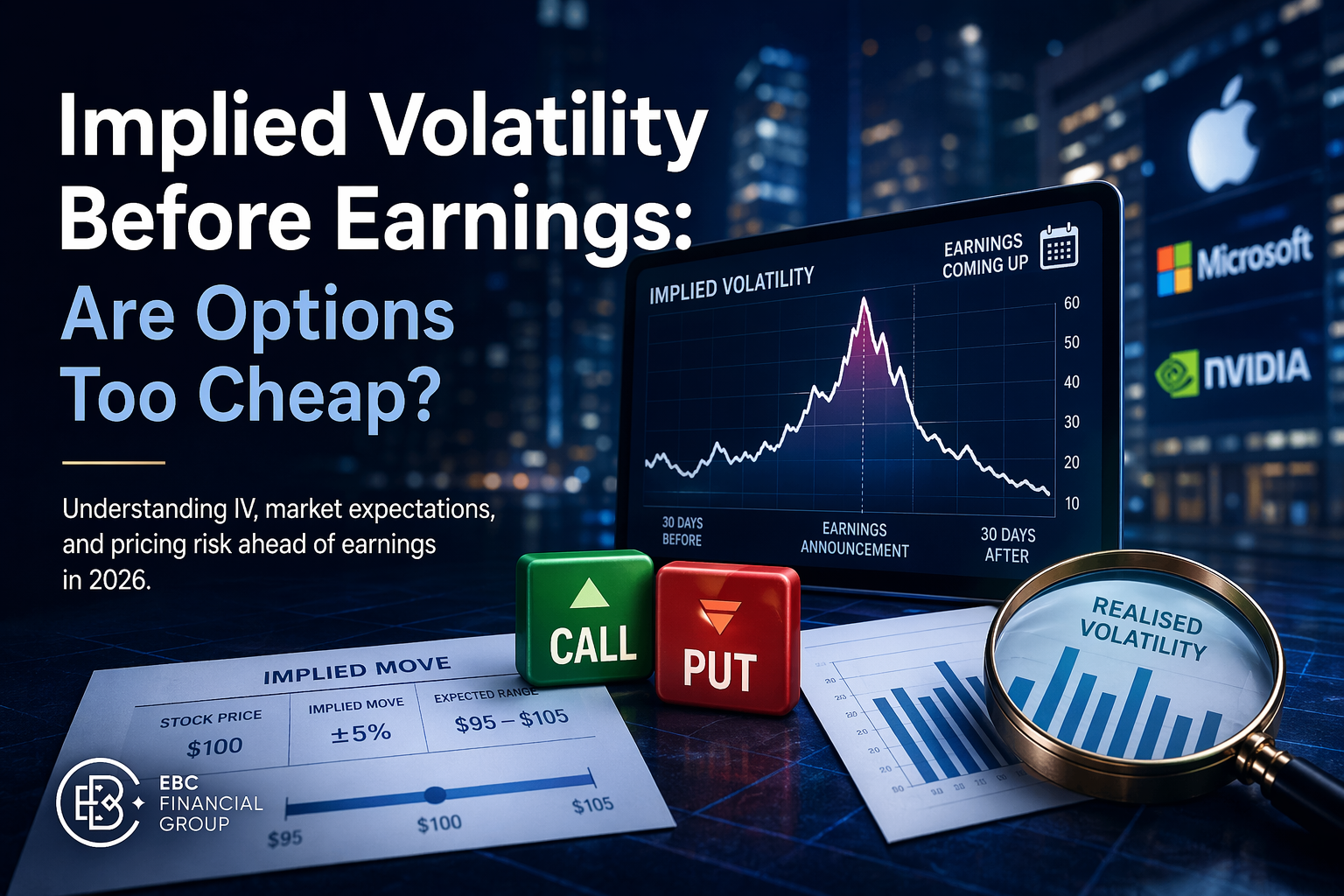
Options markets translate this uncertainty into an implied move. The implied move estimates the price range the market expects after an earnings announcement. It is often calculated from options prices, commonly using at-the-money options or straddle pricing.
Stock Price: $100
Implied Move: ±5%
Expected Range: $95 to $105
This range is not a prediction that the stock will definitely stay between $95 and $105. It is a market-implied estimate based on options pricing. Actual results can fall inside or outside the range, especially when earnings, guidance, or management commentary surprise investors.
Although implied volatility is widely used as a benchmark, it is not infallible. Earnings reactions can be uneven, even among companies in the same sector.
This divergence can happen because of:
overconfidence in consensus forecasts;
unexpected changes in forward guidance;
macroeconomic shifts affecting rates, currencies, or demand;
company-specific developments, such as margin pressure, product cycles, or artificial intelligence spending;
crowded positioning before the announcement.
When the actual post-earnings move is larger than the implied move, volatility may have been underestimated. When the stock moves less than expected, volatility may have been overestimated.
This is why investors often compare implied volatility before earnings with realised volatility after earnings. The comparison helps show whether options pricing captured the true scale of event risk.
Understanding the distinction between expected and realised volatility is essential when evaluating options pricing.
If realised volatility is consistently higher than implied volatility, options may have been priced too cheaply relative to the actual movement. If realised volatility is consistently lower, options may have been priced too expensively.
However, this comparison should be made over many events, not a single earnings report. One surprise result does not prove that options were structurally mispriced.
Options may appear “cheap” when implied volatility is low relative to the movement that investors reasonably expect.
This can occur when:
Implied volatility is below the stock’s historical earnings volatility.
The market expects limited movement despite meaningful catalysts.
Volatility expectations differ sharply across comparable companies or sectors.
positioning is unusually calm before a potentially important announcement.
A common reference point is the straddle, which involves holding both a call option and a put option at the same strike price and expiration. A straddle is often used to estimate the market’s expected move because it reflects the cost of betting on a large move in either direction.
However, a low-cost straddle is not automatically an opportunity. The stock usually needs to move enough to overcome the option premium, time decay, and any decline in implied volatility after earnings.
This is why “cheap” should mean cheap relative to expected realised movement, not simply low in absolute price.
Mega-cap technology companies continue to influence market sentiment due to their large index weights and strong ties to major themes such as cloud computing, artificial intelligence, semiconductors, and consumer demand.
However, earnings reactions are not uniform. One company may report strong headline results but fall because guidance disappoints. Another may rise after mixed results if investors had already priced in weaker expectations.
For example:
NVIDIA can attract heightened attention because its valuation is closely tied to demand for artificial intelligence and data centre spending.
Microsoft may react to cloud growth, artificial intelligence monetisation, margins, and enterprise software demand.
Apple may move on product demand, services growth, margins, and broader consumer spending trends.
This variation contributes to volatility dispersion. In other words, individual stocks can move very differently even when they belong to the same broad technology theme.
That makes it harder for implied volatility to capture actual risk across every stock before earnings.
A key feature of earnings-related options pricing is what happens after the announcement.
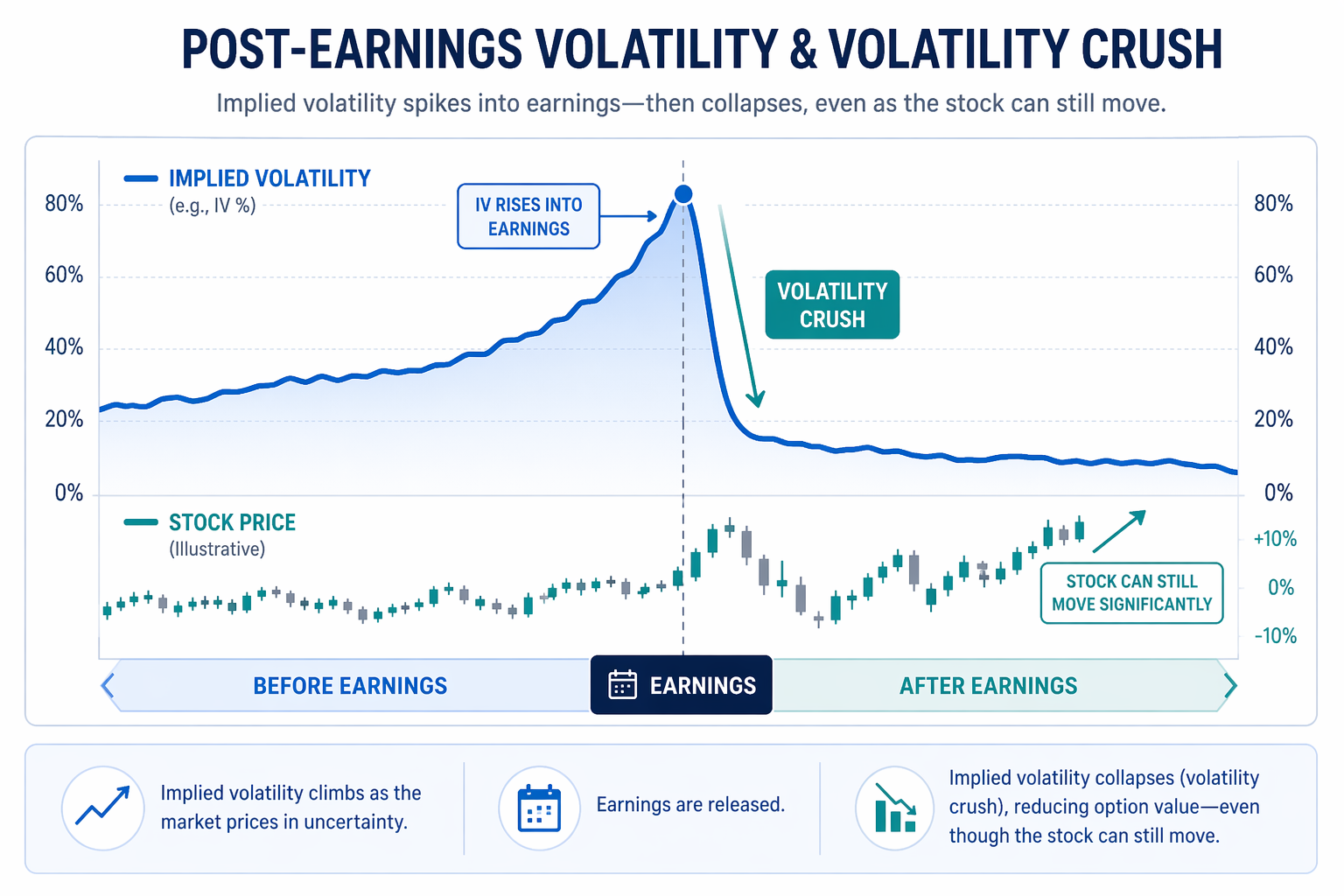
Implied volatility often rises before earnings because investors do not yet know the result.
Once the company reports, much of that uncertainty disappears. Implied volatility may then fall sharply. This is known as volatility crush.
Volatility crush can reduce the value of options positions even when the stock moves in the expected direction. For example, a call option may benefit from a stock price increase, but its value can still be pressured if implied volatility falls sharply after the event.
This is why earnings options are not only about direction. Traders also need to consider:
the size of the expected move;
the price paid for the option;
the time remaining to expiration;
the likely change in implied volatility after the announcement;
whether the realised move can exceed what the market already priced in.
Implied volatility can help investors frame risk before earnings, but it should not be used in isolation.
A practical review may include:
comparing the current implied move with the stock’s past earnings moves;
checking whether implied volatility is high or low relative to its own history;
reviewing guidance, risk, valuation, and investor positioning;
comparing the stock with similar companies in the same sector;
considering whether the option premium already reflects the likely catalyst.
This approach can help investors avoid a common mistake: assuming that a low-priced option is automatically attractive. In earnings season, the better question is whether the option is priced fairly relative to the likely realised move.
Implied volatility is the market’s expectation of how much a stock may move in the future. It is derived from options prices and reflects uncertainty, not direction.
Implied volatility often increases before earnings because uncertainty rises. Traders anticipate a possible price move, which can increase demand for options and raise option premiums.
An implied move is the market’s expected price range for a stock after an event such as earnings. It is usually estimated from options pricing and shows the size of the move the market has priced in.
Yes. Implied volatility reflects expectations, and expectations can be wrong. If the actual post-earnings move is larger or smaller than the implied move, the market either underestimated or overestimated volatility.
Options can lose value after earnings because implied volatility often falls sharply once the uncertainty is resolved. This decline is known as volatility crush.
Implied volatility is an essential tool for understanding how options markets price uncertainty before earnings. It helps investors estimate the scale of movement that may already be reflected in option prices.
However, implied volatility is not a guarantee. Earnings results, guidance, positioning, and broader market conditions can cause realised volatility to differ sharply from expectations.
Investors must compare implied volatility with realised volatility to better judge whether options are priced cheaply, expensively, or fairly before earnings.