Published on: 2026-04-15
Updated on: 2026-04-15
NVDA closed at $196.25 on April 14, 2026, marking a 10-day winning streak and an 18% rally from its March low of $164.27. The stock is testing resistance at the $190-$191 zone that has capped price action since November 2025.
The 50-day SMA has crossed back above the 200-day SMA, reversing the death cross that formed in March. RSI (14) is at 77, deep in overbought territory, signaling a potential short-term pullback before any move toward $207.
A confirmed daily close above $191 opens the path to $196-$197 (Fibonacci 23.6%) and then the all-time closing high of $207.02. Failure to hold above $183 on a pullback puts the $175-$176 demand zone and $165-$167 support back in play.
NVDA just printed its longest winning streak since 2023. Ten consecutive green sessions, an 18% move off the March lows, and a clean breakout above the 50-day moving average have brought the stock back to the $190 resistance zone that has defined the upper boundary of a five-month consolidation range. The question every trader is asking is whether this level breaks or rejects.
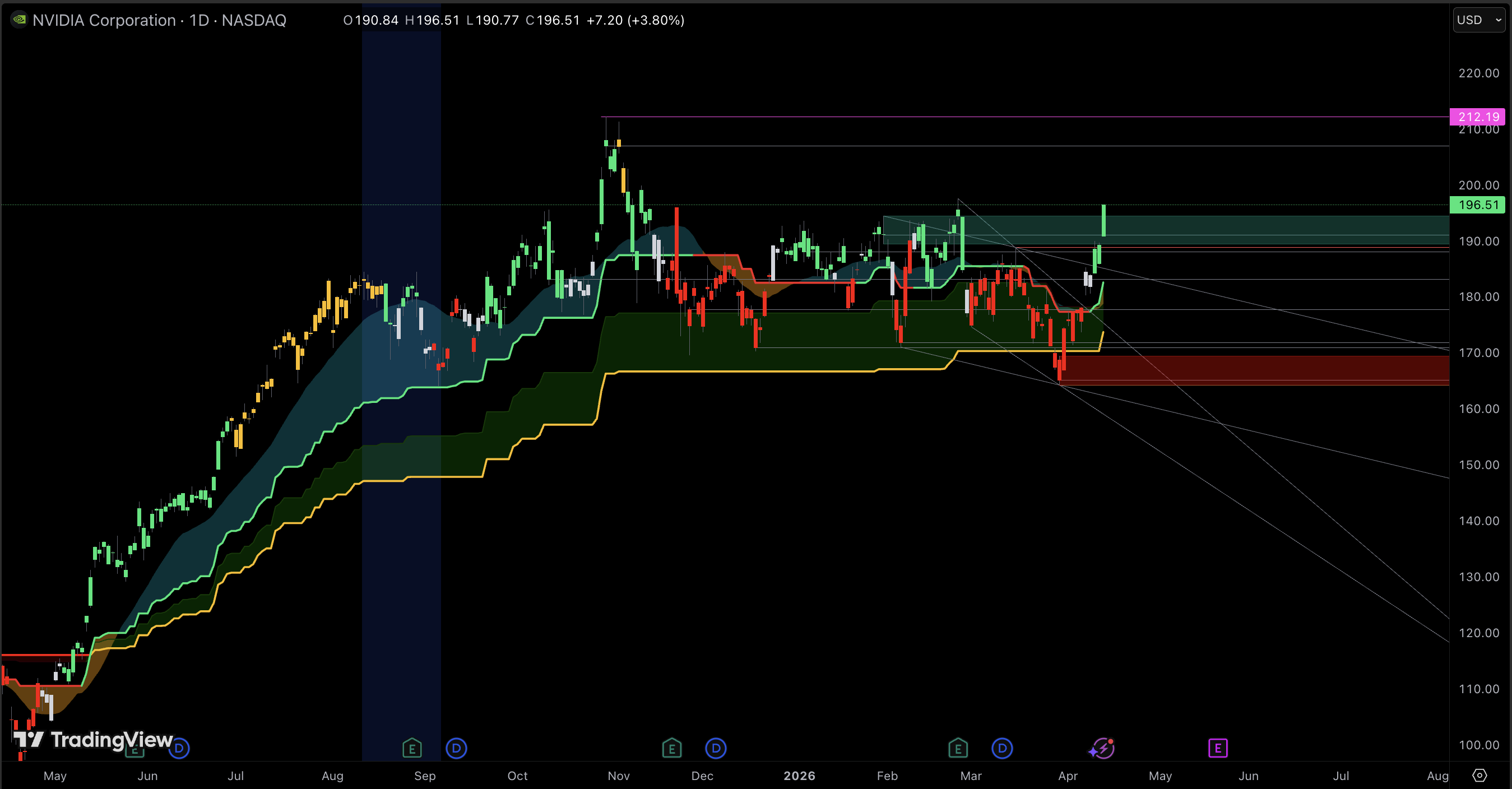 The chart structure says the answer depends on volume confirmation and the behavior of the daily RSI, which is now at 77 and flashing overbought. That reading alone does not guarantee a reversal, but it does mean the easy part of this rally is over. What comes next requires precision.
NVDA has been trading inside a rectangle consolidation pattern since November 2025, bounded by support near $165 and resistance at $191. Investtech and ChartMill both identify this as the dominant structure on the daily chart. The stock touched $165.17 in early March after the broader market sold off on the Hormuz crisis, then reversed sharply and has now climbed back to the top of the range.
The March 20 rally to $194.67 briefly pierced the upper boundary before pulling back. The current push to $196.25 is the second test of this zone in less than a month. Second tests of resistance carry more weight because they reveal whether sellers are still defending the level or have been absorbed.
The breakout above $183 on April 7 was the first meaningful signal. That level had acted as mid-range resistance throughout February and March. NVDA pushed through on rising volume and held it as support on the April 10 retest, suggesting buyers are accumulating with conviction.
| Indicator | Value | Signal |
|---|---|---|
| Price (April 14 Close) | $196.25 | – |
| 5-Day SMA | $188.62 | Bullish (price above) |
| 20-Day SMA | $177.42 | Bullish (price above) |
| 50-Day SMA | $179.67 | Bullish (price above) |
| 200-Day SMA | $179.04 | Bullish (price above) |
| 20-Day EMA | $179.18 | Bullish (price above) |
| 50-Day EMA | $180.92 | Bullish (price above) |
| 200-Day EMA | $174.14 | Bullish (price above) |
| RSI (14) | 77.05 | Overbought |
| MACD (12,26,9) | +2.81 | Bullish (above signal line) |
| Bollinger Bands (25) | $173.03 - $183.99 | Price above upper band |
| Bollinger Bands (100) | $177.10 - $188.66 | Price above upper band |
| ADX (14) | 22.05 | Trend developing |
| Beta | 1.93 | High volatility relative to S&P 500 |
The moving average alignment is fully bullish: price is above every major SMA and EMA from the 5-day through the 200-day. The 50-day SMA ($179.67) has crossed back above the 200-day SMA ($179.04), technically reversing the death cross that formed in mid-March.
The gap between the two averages is narrow, so the golden cross signal needs follow-through to be confirmed.
The MACD at +2.81 is positive with the histogram printing higher bars for six consecutive sessions, confirming accelerating momentum. However, the RSI at 77 and the price above both Bollinger Band upper boundaries raise the risk of a mean-reversion pullback before any sustained move higher.
Measured from the 52-week low of $95.04 to the 52-week high of $212.19:
| Fibonacci Level | Price | Significance |
|---|---|---|
| 0% (52-Week High) | $212.19 | Major resistance / prior peak |
| 23.6% Retracement | $184.54 | Recently reclaimed as support |
| 38.2% Retracement | $167.44 | Aligns with lower range support |
| 50% Retracement | $153.62 | Deep correction level |
| 61.8% Retracement | $139.79 | Major structural support |
| 100% (52-Week Low) | $95.04 | Cycle low (March 2025) |
The current price sits above the 23.6% retracement ($184.54), which was reclaimed during the April rally and now functions as Fibonacci support on any pullback. The 38.2% level at $167.44 aligns with the lower boundary of the consolidation range ($165-$167), creating a double-layered support zone.
| Level | Price Zone | Type |
|---|---|---|
| R3 | $212.19 | 52-week high / major resistance |
| R2 | $207.02 | All-time closing high (Oct. 29, 2025) |
| R1 | $190.53 - $191.11 | Range resistance / current test zone |
| Current Price | $196.25 | – |
| S1 | $183.00 - $184.54 | Breakout retest / Fib 23.6% |
| S2 | $175.00 - $176.00 | Demand zone / March pivot |
| S3 | $165.17 - $167.51 | Range floor / Fib 38.2% |
| S4 | $153.62 | Fibonacci 50% retracement |
A confirmed daily close above $191 on above-average volume (above 149.7 million) would signal a breakout from the five-month consolidation. The measured move target is $191 + ($191 - $165) = $217, which puts the first resistance checkpoint at the all-time closing high of $207.02 and the 52-week high of $212.19.
The catalyst calendar supports this. NVDA reports earnings on May 20, 2026, with analysts estimating $1.76 EPS. The GTC conference highlighted $1 trillion in cumulative Blackwell and Rubin revenue projected through 2027, and the 10-day streak has been partly fueled by easing geopolitical risks and a Citi upgrade of U.S. equities.
If NVDA fails to close above $191 and RSI rolls over from overbought territory, the first pullback target is $183-$184 where broken resistance should act as new support. Failure to hold $183 brings $175-$176 back into focus.
A breakdown below $165 would negate the entire five-month range and open the path toward the Fibonacci 50% at $153.62, though this scenario requires either a sharp market deterioration or a May earnings disappointment.
April 14 traded 161.3 million shares, above the 149.7 million daily average. Volume has been rising with price during the 10-day streak, which is textbook accumulation.
However, the initial April 2 rally came on declining volume, suggesting the early move was more drift than aggressive expansion. Volume picked up meaningfully after the $183 breakout, which is a healthier signal.
The stock’s beta of 1.93 means it moves nearly twice as much as the S&P 500 in either direction. In a recovering tech sector with easing geopolitical risk, that amplification works in NVDA’s favor. In a reversal, it works against it just as fast.
NVDA is at the most important technical level it has faced since the October 2025 highs, testing $190-$191 range resistance for the second time with fully bullish moving average alignment, positive MACD, and above-average volume.
The RSI at 77 historically precedes at least a short pause in NVDA, so traders watching for a breakout should wait for a confirmed daily close above $191 on volume, while pullback entries should target the $183-$184 zone. The May 20 earnings report is the next fundamental catalyst that could resolve this range one way or the other.
Disclaimer: This article is for informational purposes only and does not constitute financial advice. Always conduct your own research before making trading decisions.