Published on: 2026-01-14
Updated on: 2026-01-14
Intel (NASDAQ: INTC) is back in the spotlight after pushing to its highest levels since late 2023, powered by a sharp single-day move and heavy trading volume. Intel stock closed at $47.29, up $3.23 (+7.33%), with intraday trading stretching as high as $48.24 on strong momentum.
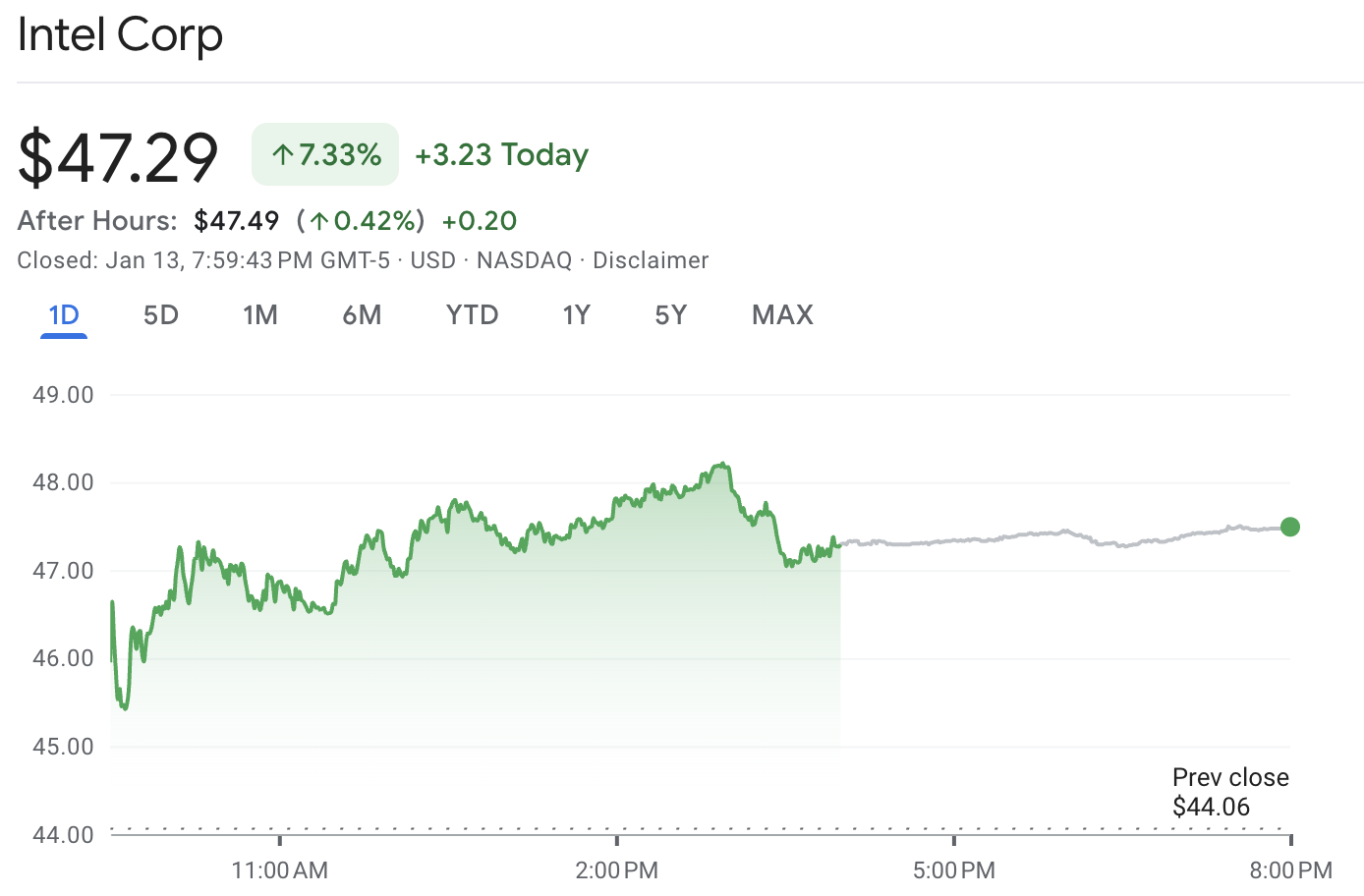
That kind of price action usually has a clear trigger, and this one does. A fresh analyst upgrade, improving confidence in Intel's next-generation manufacturing, and a clearer demand story in data centers and AI PCs have all combined into a strong sentiment shift.
| Metric | Latest reading |
|---|---|
| Last close | $47.29 |
| Day change | +7.33% |
| Intraday high / low | $48.24 / $45.215 |
| 52-week high / low | $48.24 / $17.665 |
| YTD performance | +28.16% |
| Market cap (approx.) | $226B |
Intel's recent rise appears prominent on the graph, but it rests on a solid short-term trend.
About +18.1% in roughly one week: from $40.04 (Jan 6 close) to $47.29 (Jan 13 close).
About +25.1% in one month: from $37.81 (Dec 12 close) to $47.29 (Jan 13 close).
More than +130% since late July 2025: The historical table indicates $20.17 (closing on July 31, 2025) compared to the current $47.29.
Such acceleration frequently attracts momentum buyers. It can also force short sellers to reduce risk, which can add extra fuel when the stock gaps higher.
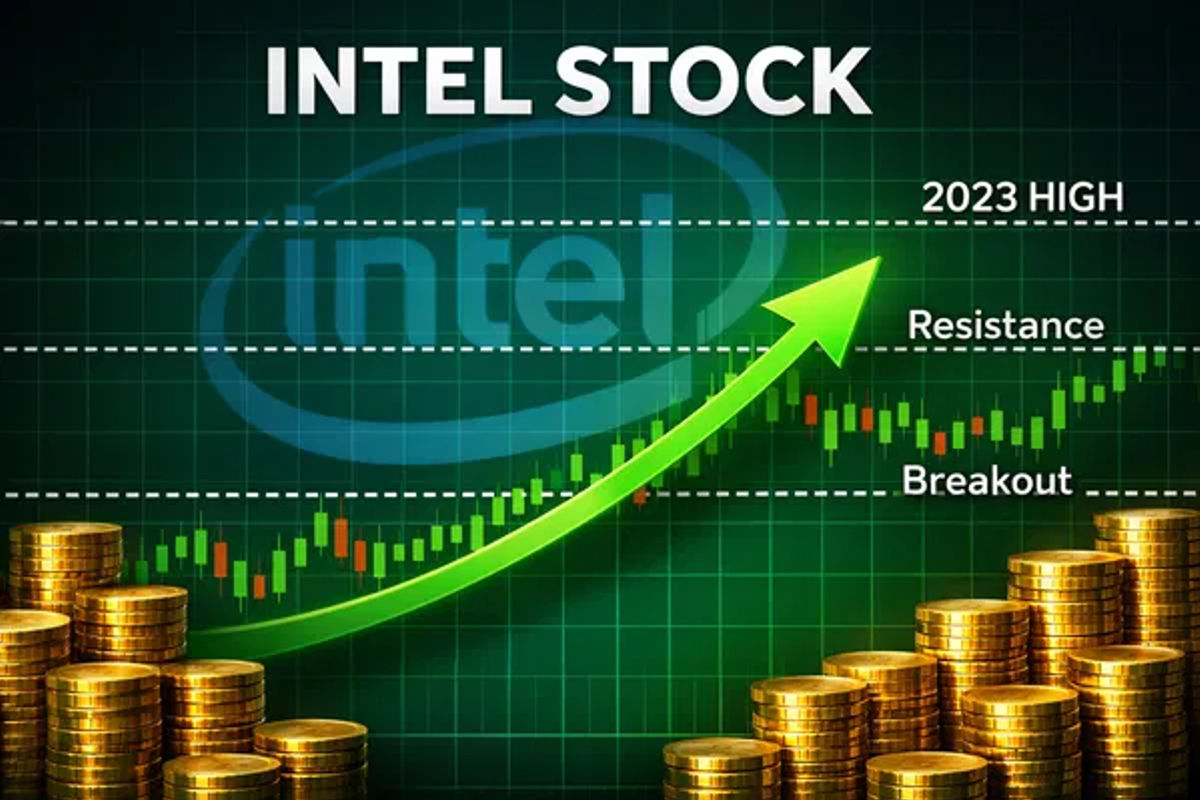
Intel stock is rising mainly because KeyBanc upgraded INTC to Overweight and raised its price target to $60, pointing to two market-moving themes:
Tight 2026 supply for server CPUs
Real progress in Intel's "18A" manufacturing process.
According to KeyBanc, Intel is largely sold out of server CPUs for 2026 and may be in a position to lift average selling prices by 10% to 15% if hyperscaler demand stays firm.
Moreover, Intel's 18A yields are now over 60%, and are "good enough" to ramp Panther Lake. Intel's foundry initiative is also gaining momentum, including projects related to Apple in the coming years.
Separately, Intel has been reinforcing the product narrative. At CES 2026, the firm unveiled the Core Ultra Series 3, its inaugural platform based on Intel 18A.
They announced that it will support over 200 PC designs, reinforcing the narrative that "execution is improving."
This is crucial because it shifts the debate from "Can they do it?" to "How fast can they scale it?"
Investors closely monitor who is spearheading the turnaround and if management has a clear operational plan in place.
For context, Intel appointed Lip-Bu Tan as CEO effective March 18, 2025, after Pat Gelsinger's departure. Tan moved to streamline leadership and elevate key technology roles shortly after taking over.
Markets tend to reward simple, believable execution stories:
Reduce complexity
Sharpen accountability
Prioritise products that can win
Keep spending aligned with realistic returns
Intel's share price strength suggests investors believe the plan is becoming more operational, not just aspirational.
Intel sits at the center of the U.S. push to strengthen domestic semiconductor manufacturing. That creates a separate pillar of support for the stock, even when cyclical demand is uncertain.
For example, Intel has announced major U.S. government support tied to its U.S. manufacturing plans, including an agreement described as $8.9 billion in direct investment plus $2.2 billion in CHIPS Act grants (total $11.1 billion)
This does not remove business risk, but it can improve investor willingness to hold the stock through volatility, especially when the market views Intel as strategically important.
| Indicator | Latest reading | Signal | What it suggests |
|---|---|---|---|
| RSI (14) | 66.974 | Buy | Momentum is strong, but it is not "extreme" yet. |
| MACD (12,26) | 1.41 | Buy | Trend remains positive. |
| Stoch (9,6) | 80.472 | Overbought | Short-term is stretched, pullbacks are normal. |
| ADX (14) | 28.86 | Sell | A mixed read that can appear as trends mature. |
| MA5 (Simple) | 47.53 | Sell | Price is close to the short-term average after a fast move. |
| MA10 (Simple) | 46.38 | Buy | Short-term trend is still rising. |
| MA20 (Simple) | 45.61 | Buy | Pullbacks toward this area often get watched. |
| MA50 (Simple) | 42.82 | Buy | A key "trend line" for swing traders. |
| MA200 (Simple) | 39.63 | Buy | Long-term trend has improved meaningfully. |
From a technical analysis perspective, Intel is in an uptrend on the daily chart, but it is also approaching levels where rallies often pause and consolidate.
Immediate support: $45.20–$45.60 (recent lows and the 20-day moving average area)
Stronger support: $42.80–$43.20 (50-day moving average zone)
Near-term resistance: $48.20–$48.25 (recent intraday high / 52-week high zone)
Major resistance: around $50–$51 (late-2023 high area often referenced by traders
A clean hold above the mid-$45 area after the spike, followed by another push toward $48+.
A breakout that sticks above the $48 area on strong volume, not a quick pop and fade.
A breakdown back under the $45 area that turns the recent rally into a failed breakout.
A deeper pullback toward the $43 zone if momentum cools and short-term indicators remain stretched.
Even robust stocks can decline swiftly when aspirations exceed reality. For Intel, the biggest risk points are straightforward.
Execution risk: Intel still has to prove the roadmap in volume and on schedule.
Competitive pressure: PCs and servers are crowded markets, and market share can shift quickly.
Policy headline risk: Political support can help, but political noise can also add volatility.
Crowded momentum: When a stock moves this quickly, late buyers can get trapped if the next headline disappoints.
Intel is up mainly because KeyBanc upgraded the stock to Overweight and raised its price target to $60, citing strong hyperscaler demand, tight 2026 server CPU supply, and improving 18A manufacturing yields.
18A is Intel's advanced process technology for making chips. "Yield" is the share of usable chips produced from a wafer. A better yield usually means lower cost per chip and a smoother ramp, which improves confidence in margins and delivery.
Some short-term indicators are stretched. Stochastic is above 80 (often read as overbought), while RSI near 67 still reflects strong momentum rather than an extreme blow-off.
Pivot-point levels cluster around 48.04 (pivot), with support near 47.84 and resistance near 48.37 on the classic set.
In conclusion, Intel's stock jump to its strongest levels since late 2023 is not about a single soundbite. The market is reacting to a tighter demand picture for 2026 server CPUs, the idea that pricing power may be returning, and improving confidence that 18A is moving from promise to delivery.
At the same time, this is still a high-expectations phase, and Intel's own history shows how quickly sentiment can swing when execution is questioned.
The trend is bullish, but after a one-day jump above 7% and a fast multi-week run, the next phase often becomes a test of discipline: either the stock builds a base near key levels, or it shakes out late buyers before the next leg higher.
Disclaimer: This material is for general information purposes only and is not intended as (and should not be considered to be) financial, investment or other advice on which reliance should be placed. No opinion given in the material constitutes a recommendation by EBC or the author that any particular investment, security, transaction or investment strategy is suitable for any specific person.