Published on: 2026-04-23
Updated on: 2026-04-23
Intel reports after the close on April 23 with Wall Street looking for about $12.39 billion in revenue and $0.02 in adjusted EPS, while options markets imply a roughly 9% post-earnings move.
For a stock that has already climbed about 80% this year and is trading around $65, a routine beat is no longer enough. The market wants evidence that Intel’s manufacturing recovery is becoming economically credible.
That is why this quarter matters beyond the headline print. In January, Intel guided Q1 revenue to $11.7 billion to $12.7 billion, non-GAAP EPS to breakeven, and non-GAAP gross margin to 34.5%, while telling investors supply conditions would be at their weakest in Q1 before improving in Q2 and beyond.
The stock can tolerate a soft quarter if management still defends that trough narrative. It will be harder to defend a valuation that already reflects turnaround optimism if Q1 starts to look less like a low point and more like a stall.
Wall Street expects Intel to report about $12.39 billion in Q1 revenue and $0.02 in adjusted EPS, modestly above the company’s January guide.
The real pressure point is gross margin and Q2 direction, not whether Intel beats by a cent, after management guided to a weak 34.5% non-GAAP gross margin.
Intel’s mix improved in Q4, with Data Center and AI revenue up 9% to $4.7 billion while Client Computing fell 7% to $8.2 billion, reinforcing the view that server demand matters more than the PC cycle right now.
Intel Foundry generated $17.8 billion of 2025 revenue but still posted a $10.3 billion operating loss, which is why investors are demanding signs of utilization and customer traction rather than more node milestones alone.
Tesla’s 14A comments help the narrative, but investors still need to hear that external interest extends beyond one project and one headline.
The consensus numbers are low enough that Intel can beat them. The harder question is whether a beat would matter. Intel’s average analyst target still sits well below the current share price, suggesting the stock has moved faster than broad sell-side consensus.
In practical terms, that raises the burden on management’s forward commentary. A quarter that looks acceptable on paper may still be treated as disappointing if it does not improve the operating case.
| Metric | Intel baseline | Market expectation | What investors are testing |
|---|---|---|---|
| Q1 2026 revenue | $11.7B to $12.7B | ~$12.39B | Whether Q1 still looks like the trough |
| Q1 2026 non-GAAP EPS | $0.00 | ~$0.02 | Whether demand and execution are stabilizing |
| Q1 2026 non-GAAP gross margin | 34.5% | Focus on direction | Whether margin pressure is bottoming |
| 2025 Intel Foundry revenue | $17.8B | N/A | Scale without proven economics |
| 2025 Intel Foundry operating loss | -$10.3B | N/A | Why customer traction matters |
| Options-implied move | N/A | ~9% | How tightly the stock is wound |
The table makes the setup clear. Intel is not being repriced as the winner of the AI accelerator race. It is being repriced on the idea that leading-edge manufacturing and stronger server CPU demand can still give the company a viable second path into the AI buildout.
That is a more fragile thesis than a simple earnings beat story, and it is the lens investors are likely to use on the call.
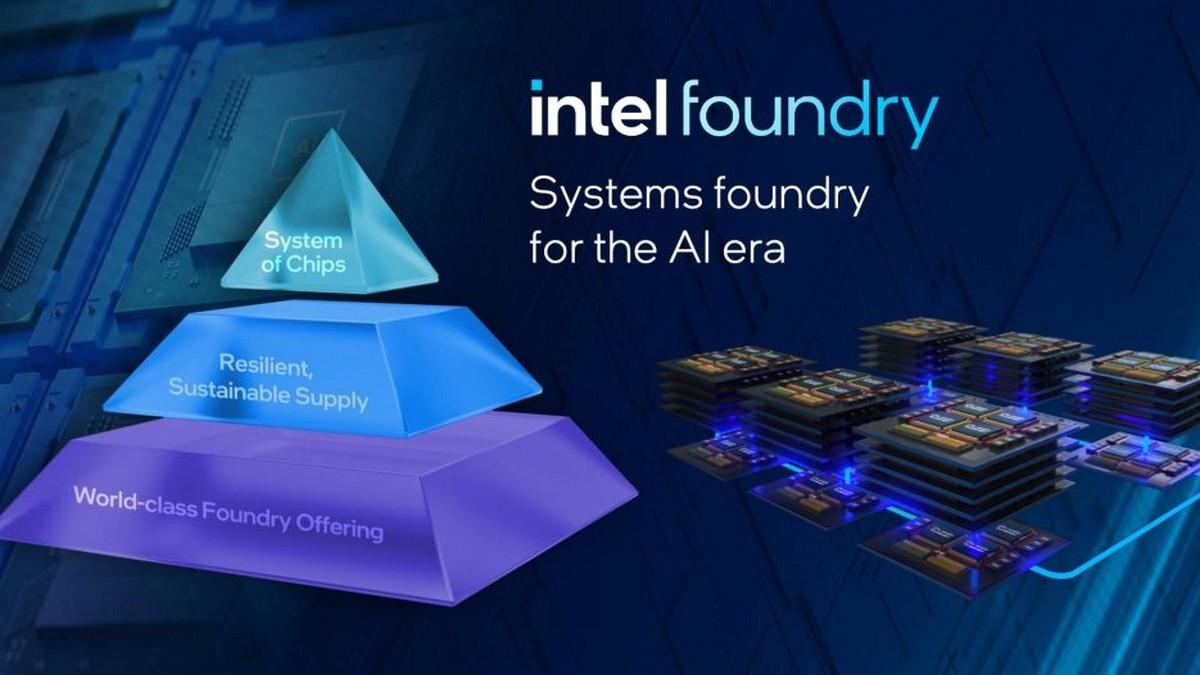
Intel has crossed an important technical line. The company says Panther Lake, its first client platform built on Intel 18A, is already in production, and it expects Clearwater Forest, its first 18A-based server processor, in the first half of 2026. Those are real milestones, and they help establish that Intel can move its own products onto its next leading-edge node.
But internal node execution and external foundry monetization are not the same thing. One proves engineering progress. The other determines whether the capital spent on that progress can generate an economic return.
That distinction sits at the center of the margin debate. Foundry economics do not improve solely on roadmap milestones. They improve when yields rise, expensive leading-edge capacity fills, and fixed costs are spread across a broader mix of internal and external volume. Intel can therefore make visible technical progress on 18A without yet delivering the financial proof investors want.
That is why this quarter’s gross margin and customer commentary matter more than another process update.
Tesla’s statement that it plans to use Intel’s future 14A process for the Terafab project is the most important narrative boost Intel has received in the run-up to earnings.
It matters because Intel has previously warned that if it cannot secure a significant external customer and hit key customer milestones for 14A, the company could pause or discontinue its pursuit of 14A and successor leading-edge nodes. In that context, Tesla is not trivial news. It speaks directly to a strategic vulnerability.
But the market should not overread it. Musk’s comment is still not the same as disclosed foundry revenue, committed production volume, or a visible multi-customer order book. MarketWatch noted that Tesla’s broader Terafab disclosures remain murky, with responsibilities and timelines still being worked through.
For investors, the right question is not whether Tesla helps. It clearly does. The right question is whether management can place Tesla inside a broader customer pipeline that begins to look repeatable.
The part of Intel’s story that already has operating evidence is the product side, especially servers.
In Q4, Data Center and AI grew while client revenue declined, and Intel’s expanded collaboration with Google reinforces the idea that AI infrastructure still needs a large CPU layer around inference, orchestration, and general-purpose compute.
That does not make Intel the primary AI winner. It does mean the company can benefit if hyperscalers keep spending on the broader system stack around accelerators.
A bullish outcome is not complicated: Intel beats modestly, reaffirms that Q1 was the supply trough, points to improving gross margin from here, and frames Tesla as part of a widening external customer funnel rather than a one-off.
A neutral outcome is more subtle and may be the biggest risk for the stock: Intel clears low estimates, repeats the long-term story, but offers little new evidence on utilization, customer commitments, or margin inflection.
A bearish outcome would be weaker margins, softer Q2 language, or commentary that leaves foundry progress sounding more like roadmap execution than booked business.
Intel does not need to prove the turnaround in full this quarter. It does need to show that the market has not moved ahead of the business by too much.
That means defending Q1 as the trough, showing that gross margin can begin to recover, and convincing investors that Foundry has moved at least one step closer to utilization and customer scale.
If management can do that, the rerating can hold. If not, this earnings report may expose the central risk in Intel stock: investors have started to price the economics of foundry before the company has fully delivered them.