Published on: 2026-01-23
Updated on: 2026-01-23
INTC stock finished the regular session at $54.32, then declined in after-hours trading to around $48.00, representing a drop of approximately 11.16%.
That kind of move usually has one clear trigger, and this one did: forward guidance. Intel's fourth-quarter numbers were not the problem. The company reported its Q4 2025 revenue as $13.7 billion and non-GAAP EPS of $0.15, exceeding expectations.
However, what changed the mood was Intel's first-quarter 2026 outlook, which came in below consensus, and Intel flagged that supply will be at its lowest point in the current quarter.
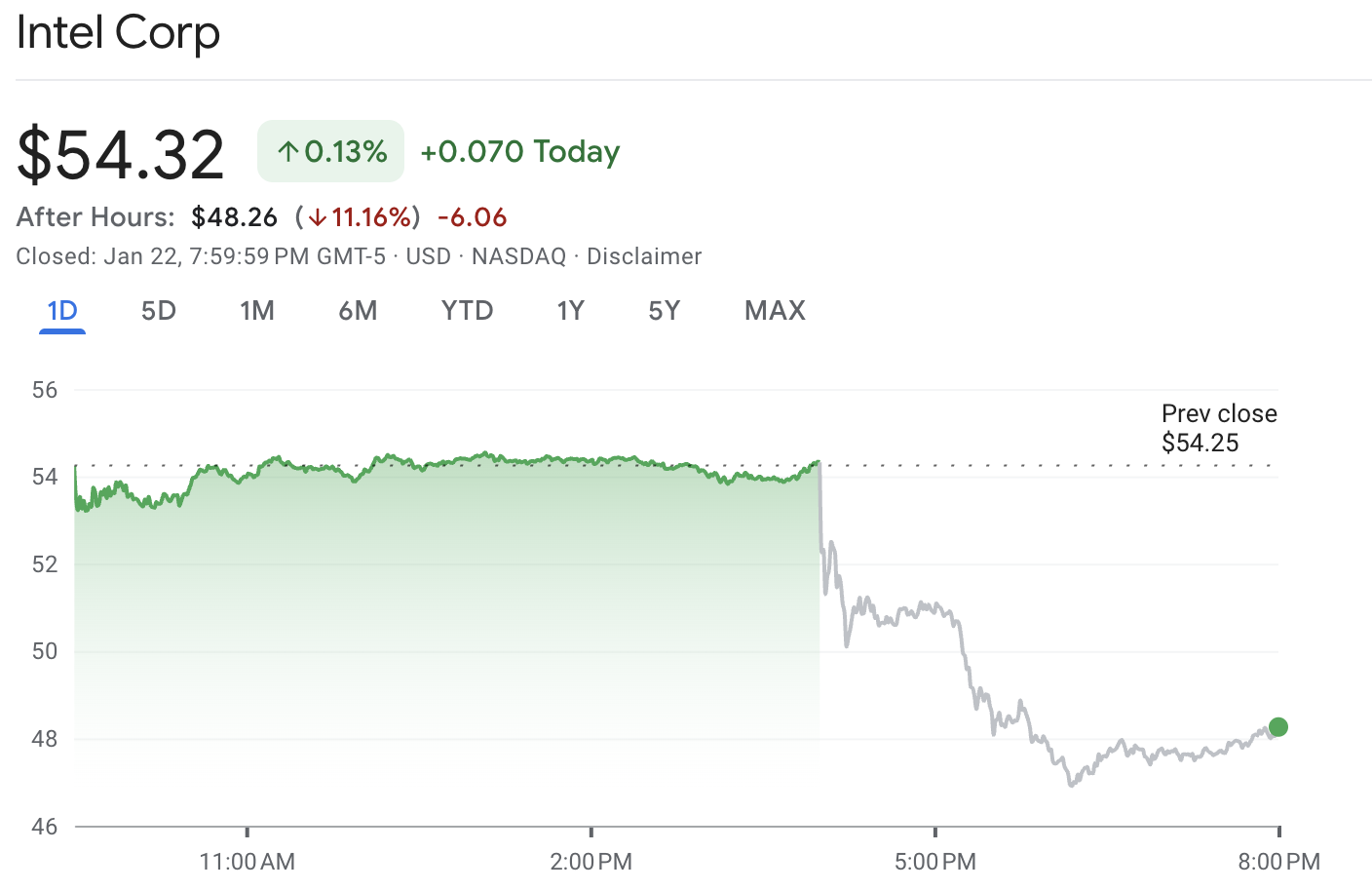
Regular session: INTC stock closed at $54.32.
After hours: INTC traded near $48.26 (about -11.16%).
Why: Intel's Q1 2026 guidance came in below what the Street was expecting, and Intel framed Q1 as a quarter where supply would be tight before improving later in the year.
Additionally, Intel had already rallied hard into the print, which can amplify the downside when guidance disappoints.
Simply put, earnings reports are backward-looking, and guidance is forward-looking. The stock price tends to react more to what comes next than to what just happened.
| Intel guidance (Q1 2026) | GAAP | Non-GAAP |
|---|---|---|
| Revenue | $11.7B to $12.7B | $11.7B to $12.7B |
| Gross margin | 32.3% | 34.5% |
| EPS (diluted) | -$0.21 | $0.00 |
Why the market did not like it:
Intel guided Q1 2026 revenue to $11.7–$12.7 billion.
That range has a midpoint of $12.2 billion, which is about $0.4 billion below the $12.6 billion consensus, or roughly 3.2% under.
Intel also guided non-GAAP EPS to $0.00 (breakeven) and implied a softer margin profile.
In short, the market read Q1 guidance as: "Good quarter, but the next one is going to be harder."
| Q4 2025 (Intel) | GAAP | Non-GAAP |
|---|---|---|
| Revenue | $13.7B (down 4% YoY) | $13.7B (down 4% YoY) |
| Gross margin | 36.1% | 37.9% |
| EPS (diluted) | -$0.12 | $0.15 |
| Cash from operations | $4.3B | $4.3B |
Intel's Q4 headline results were better than the after-hours chart might suggest.
Intel also called out that year-over-year comparisons were affected by the deconsolidation of Altera in Q3 2025.
So why did a "beat" still lead to a sharp drop? Because the market's next question is always, "What are you going to earn next quarter?"
| Metric | Intel guidance for Q1 2026 |
|---|---|
| Revenue | $11.7B to $12.7B |
| GAAP EPS | -$0.21 |
| Non-GAAP EPS | $0.00 |
| GAAP gross margin | ~32.3% |
| Non-GAAP gross margin | ~34.5% |
| Non-GAAP tax rate | ~11% |
Intel's guidance was weak on three fronts: revenue, margin, and supply commentary.
Intel's CFO, David Zinsner, stated that the company anticipates supply levels to be at their lowest in Q1, with improvements expected in the Q2 and beyond. He characterized demand as healthy in core markets.
That sentence matters because it frames Q1 weakness as partly structural, not just seasonal.
Intel is effectively telling the market that demand is not the only variable. Currently, capacity and availability are significant constraints.
Intel said it expects supply to bottom in Q1 and improve from Q2 onward.
When a chipmaker cannot supply enough units, revenue can come in light even if the product is selling well.
Intel's guidance implies a non-GAAP gross margin of roughly 34.5% in Q1. That is meaningfully below Intel's Q4 non-GAAP gross margin of 37.9%.
Margins can soften for several reasons that often show up together:
A less favourable product mix in a seasonally weaker quarter.
Higher costs tied to ramps, yields, or supply-chain tightness.
Competitive pricing pressure in PCs and data centres.
Furthermore, the revenue outlook is affected by delays and challenges surrounding Intel's 18A manufacturing technology. This is significant, as advanced-node ramps typically begin with lower yields and a higher cost per usable wafer.
When a stock rises rapidly, investors start to demand "perfect" execution.
Intel's stock surged earlier this month, increasing the likelihood of a sharp repricing if there's any disappointment.
Valuation concerns and a cooling of "red-hot" momentum are part of the reaction.
What traders should take from these:
If supply is the constraint, results can snap back faster once supply loosens.
If demand is the constraint, weakness often persists longer because customers do not return overnight.
| Business unit revenue | Q4 2025 | YoY | FY 2025 | YoY |
|---|---|---|---|---|
| Client Computing Group (CCG) | $8.2B | -7% | $32.2B | -3% |
| Data Center and AI (DCAI) | $4.7B | +9% | $16.9B | +5% |
| Intel Foundry | $4.5B | +4% | $17.8B | +3% |
| All other | $0.6B | -48% | $3.6B | -1% |
Intel's segment detail shows a mixed picture.
Two points stand out:
Data Center and AI grew year over year in Q4, which helps the story.
PC-related revenue continued to decline, a reminder that Intel is not out of the woods in its largest legacy market.
The market can handle a weak spot when the forward outlook is strong. The issue is that the Q1 guidance did not provide investors with the reassurance they sought.
Intel has informed investors that it expects supply to be tightest in Q1, but will improve from Q2 onwards.
If Q2 does not show a clear supply recovery, the market may question the timing of the turnaround.
Intel's release highlighted 18A-based products and demand, while delays and yield challenges contributed to pressure on guidance.
The upcoming quarters will be assessed based on delivery dates, yields, and customer acquisitions, rather than just slogans.
Zinsner said rising memory chip prices have not yet significantly affected Intel, but they could become a challenge in the second half of 2026.
Intel's Q1 2026 outlook came in below consensus and warned supply would be at its lowest point in Q1. Markets usually price the next quarter more heavily than the last quarter.
Intel guided revenue of $11.7B to $12.7B, non-GAAP gross margin of 34.5%, and non-GAAP EPS of $0.00.
Intel guided Q1 2026 revenue to $11.7–$12.7 billion, with a midpoint of $12.2 billion, below the $12.6 billion market consensus.
Traders should pay attention to the $50 price, the after-hours price near $48, and the recent swing zone around $46.7 to $47.0, while $54.6 serves as a notable resistance level.
In conclusion, INTC stock is down after hours because Intel's guidance reset the near-term story. It was the classic "good quarter, weaker outlook" reaction.
Intel's Q4 was solid, but Q1 looks constrained by supply and pressured margins, and the stock had already priced in a lot of good news before the release.
From here, the debate is straightforward: if supply truly improves as Intel expects, the market can start looking past Q1. If it does not, the stock may need more time and lower expectations before it stabilizes.
Disclaimer: This material is for general information purposes only and is not intended as (and should not be considered to be) financial, investment or other advice on which reliance should be placed. No opinion given in the material constitutes a recommendation by EBC or the author that any particular investment, security, transaction or investment strategy is suitable for any specific person.