Published on: 2026-03-09
Updated on: 2026-03-09
At first glance, Ford Stock appears cheap. The stock is currently trading at approximately $12, giving it an equity value of around $48 billion, despite the company generating nearly $200 billion in annual vehicle and service sales.
Therefore, why is Ford stock so cheap?
The short answer is that the market is not missing those numbers; it is discounting them. It is valuing Ford like a business with wide profit swings, high fixed costs, and an expensive transition to electric vehicles.
Ford's own 2025 results also show why headline earnings can be confusing: the company reported record revenue of $187.3 billion but a net loss of $8.2 billion, while adjusted EBIT was $6.8 billion.

Below is a clear explanation of why Ford stock may appear inexpensive at first glance, but it is priced cautiously due to underlying factors.
| Metric | Latest reading | What it tells you |
|---|---|---|
| Share price | ~$12.15 | The stock is back near the low teens after recent weakness. |
| Market cap | ~$48.47B | Equity value is modest for a company with ~$187B revenue. |
| Forward P/E | 7.96 | The market is pricing earnings as uncertain and cyclical. |
| Price-to-sales | 0.26 | The market is not willing to pay up for revenue in autos. |
| Dividend yield | 4.94% | High yield reflects low price, not necessarily low risk. |
| Enterprise value | ~$185.78B | EV is far higher than market cap because of the capital structure and finance arm footprint. |
| Debt / equity | 4.61 | Leverage optics stay heavy, even if some relates to financing operations. |
A second "tell" is how the stock trades. The daily technical summary recently indicated a strong sell signal, with the RSI (14) at 28.359, indicating deeply oversold territory and reflecting cautious sentiment.
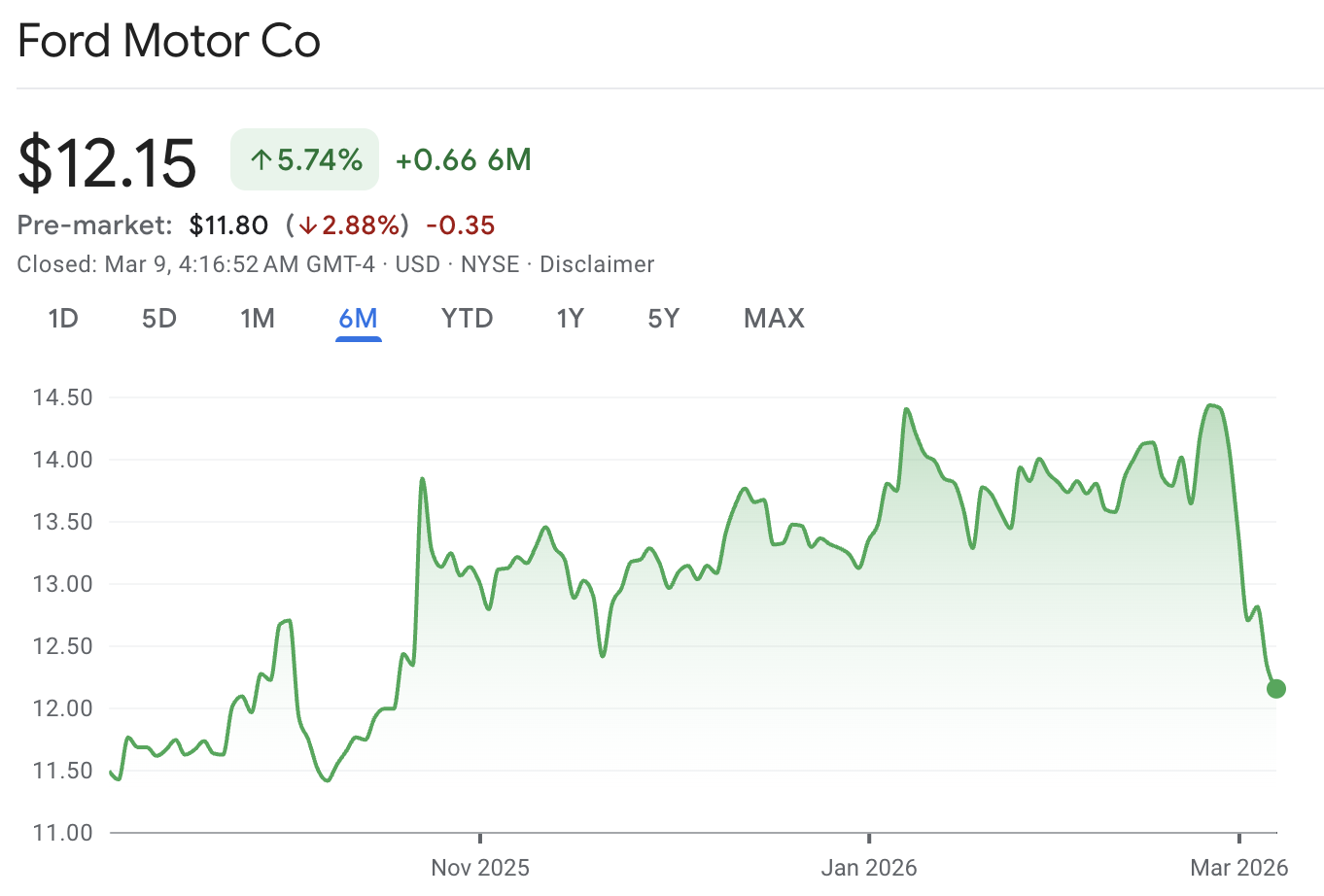
Before we explore the deeper reasons, let's review the stock's recent performance.
Ford's stock price fell from $14.09 on February 27, 2026, to $12.15 on March 6, 2026, reflecting a drop of approximately 13.8% within one week.
That is a sharp move for a mega-cap automaker, and it helps explain why Ford's technical indicators look stretched today.
Over a month, Ford's stock fell from $13.80 on February 6, 2026, to $12.15 on March 6, 2026, representing a decrease of approximately 12.0%.
This slide came after Ford touched a 52-week high of $14.80 in late February, which made the pullback feel fast.
Six months ago, Ford's stock was trading in the low teens. By mid-September 2025, it closed at approximately $11.65, showing only a modest increase despite notable fluctuations during that period.
The key takeaway here is the stock's range. Ford's 52-week trading range has varied from around $8.44 to $14.80, indicating that the market has consistently priced in both positive and negative outcomes.
The market values autos like a business that can look great in a strong demand window and then compress quickly when incentives rise, financing tightens, or fleet demand cools.
Ford's 2026 outlook anticipates U.S. industry sales of 16.0-16.5 million units, with stable pricing across the industry. It implies that the company does not expect any significant increase in pricing.
When investors perceive that pricing is steady and sales volumes are returning to normal levels, they typically assign lower earnings multiples. They expect profit margins to revert to average levels.
It is why Ford can look "cheap" on a good year's profit and still not re-rate higher. The market assumes today's earnings are not guaranteed.
Ford's electric vehicle business is making progress, yet it remains unprofitable on a large scale.
For context, Ford guided Model e EBIT of $(4.0)B to $(4.5)B for 2026, after $(4.8)B in 2025. That is a significant negative swing factor for a company that is guiding total 2026 adjusted EBIT of $8.0B to $10.0B.
Investors also heard management indicate that there is still significant pressure on EV pricing. In Ford's earnings materials, the company has pointed to a $19.5B write-down related to the EV transition, as it pulled back from earlier expectations and reset plans to reflect profitability and demand realities.
Key Takeaway:
Even if EV losses shrink, the market is not ready to pay a growth multiple until it sees an EV path that is both credible and economically durable.
Quality issues hurt twice: they cost money now, and they damage confidence in future margins.
For context, Ford has announced nearly 2.4 million vehicle recalls in six actions, bringing the total to about 7.3 million vehicles recalled in 17 actions so far in 2026.
Additionally, Ford's warranty costs were nearly 5% of 2025 sales, compared with 4% for GM.
Even small differences matter. If warranty costs exceed peers by 1 percentage point, it can amount to hundreds of millions of dollars annually. In a business where operating margins are narrow, it becomes a valuation problem rather than just an operational one.
Ford's capital structure is a major reason the stock trades differently from many consumer brands.
Ford has a market capitalization of approximately $48.5 billion, while its enterprise value is around $185.8 billion, indicating significant net debt and financing duties.
This is not automatically "bad" because Ford Credit is a core part of Ford's ecosystem and can be profitable. Ford's earnings release noted Ford Credit delivered $2.6 billion of full-year earnings before taxes in 2025.
Still, investors apply a discount for two reasons:
Credit results can weaken if delinquencies rise in a downturn.
A large debt stack limits flexibility when markets tighten.
Ford expects to spend between $9.5 billion and $10.5 billion in 2026.
While this level of capital spending is typical for a global automaker, it affects valuation by limiting the cash that can be consistently returned to shareholders throughout the financial cycle.
Ford's own targets for 2026 include:
Adjusted EBIT of $8.0B to $10.0B
Adjusted free cash flow of $5.0B to $6.0B
Those are solid numbers, but investors often discount them because autos have a history of:
Cash flow swinging sharply with demand
Capex needing to stay elevated to remain competitive
"Investment years" arriving faster than expected
A persistent reason Ford stock looks "cheap" is that GAAP earnings have been volatile, which makes traditional P/E comparisons less useful.
Ford's earnings materials show net income attributable to Ford of $8.182 B in 2025 versus $5.879B in 2024, while 2025 included large special items.
That GAAP volatility is one reason StockAnalysis lists the trailing P/E ratio as "n/a" while highlighting the forward multiple instead.
The most honest answer is that Ford's discount is not a single thesis. It is a bundle of smaller discounts that stack:
A structural discount for being cyclical and capital-intensive.
A credibility discount for EV losses and strategy resets.
A quality discount for recalls and warranty cost variability.
A macro discount for tariffs, rate sensitivity, and policy volatility.
This is why F stock can re-rate quickly when earnings visibility improves, and quality costs decline simultaneously.
Ford's stock trades at a low valuation because the automotive industry is cyclical and capital-intensive. Investors often undervalue earnings that can change due to fluctuations in pricing, volume, and policy.
On an adjusted basis, Ford reported $6.8 billion of adjusted EBIT in 2025. However, Ford also reported a net loss of $8.2 billion for 2025, underscoring how large special items and transition costs can alter the headline result.
Ford pays an annual dividend of $0.60 per share, which equates to approximately 4.94% at current prices. The reliability of this dividend depends on the company's cash flow during economic cycles and its need to fund capital expenditures.
While Ford's free cash flow guidance for 2026 appears promising, the automotive industry can experience rapid changes during downturns.
A sustained rating likely requires clear progress on faster-than-expected reduction in EV losses and visible improvement in warranty and recall costs.
In conclusion, Ford stock appears undervalued as its headline multiples are low and the dividend yield is high. This discount persists because investors are not accounting for just "one good year" in the automotive sector.
They are paying for predictable earnings power across the cycle, and Ford is still proving it can reduce EV losses, stabilize quality costs, and maintain durable cash flow while investing heavily.
Disclaimer: This material is for general information purposes only and is not intended as (and should not be considered to be) financial, investment or other advice on which reliance should be placed. No opinion given in the material constitutes a recommendation by EBC or the author that any particular investment, security, transaction or investment strategy is suitable for any specific person.