Published on: 2026-03-09
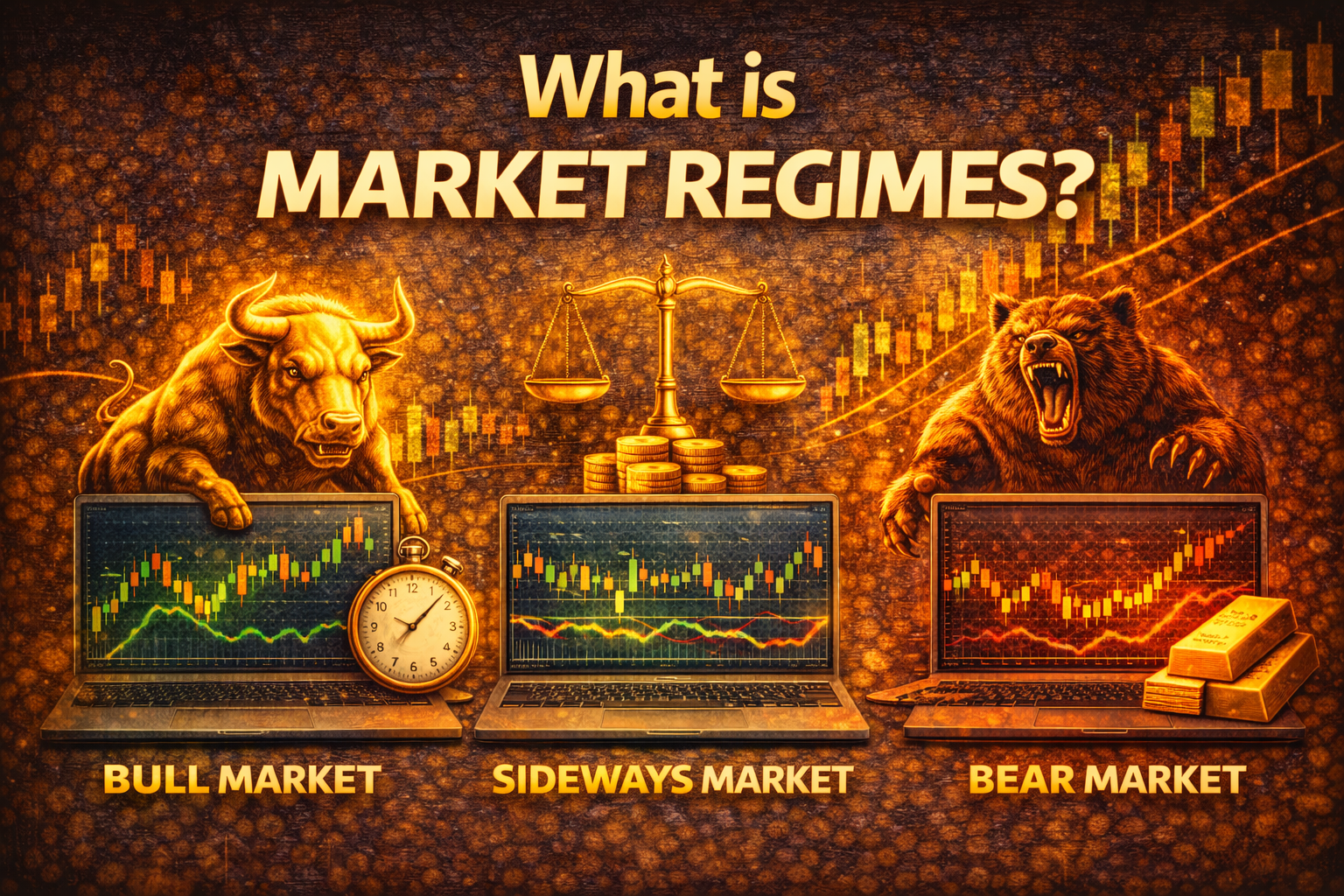
A market regime refers to the overall environment or behavioural pattern of financial markets during a specific period. It reflects how prices move, the level of volatility present, and how investors respond to economic and financial developments.
Understanding market regimes is essential because trading strategies do not perform equally well across environments. A strategy that works during a strong trend may perform poorly when markets become range-bound or highly volatile.
A market regime refers to the overall condition of financial markets during a certain period. It describes how prices behave and the type of environment in which traders operate.
Many factors shape market regimes: price trends, market volatility, ease of buying or selling assets, the broader economy, and investor mood. These factors show if markets are rising, falling, moving sideways, or swinging sharply.
Simply put, a market regime tells traders what kind of market they face. For example, markets can rise quickly, fall for a long time, stay flat, or swing in price often. Each situation is a different regime.
Market regimes can be compared to different moods of the financial market.
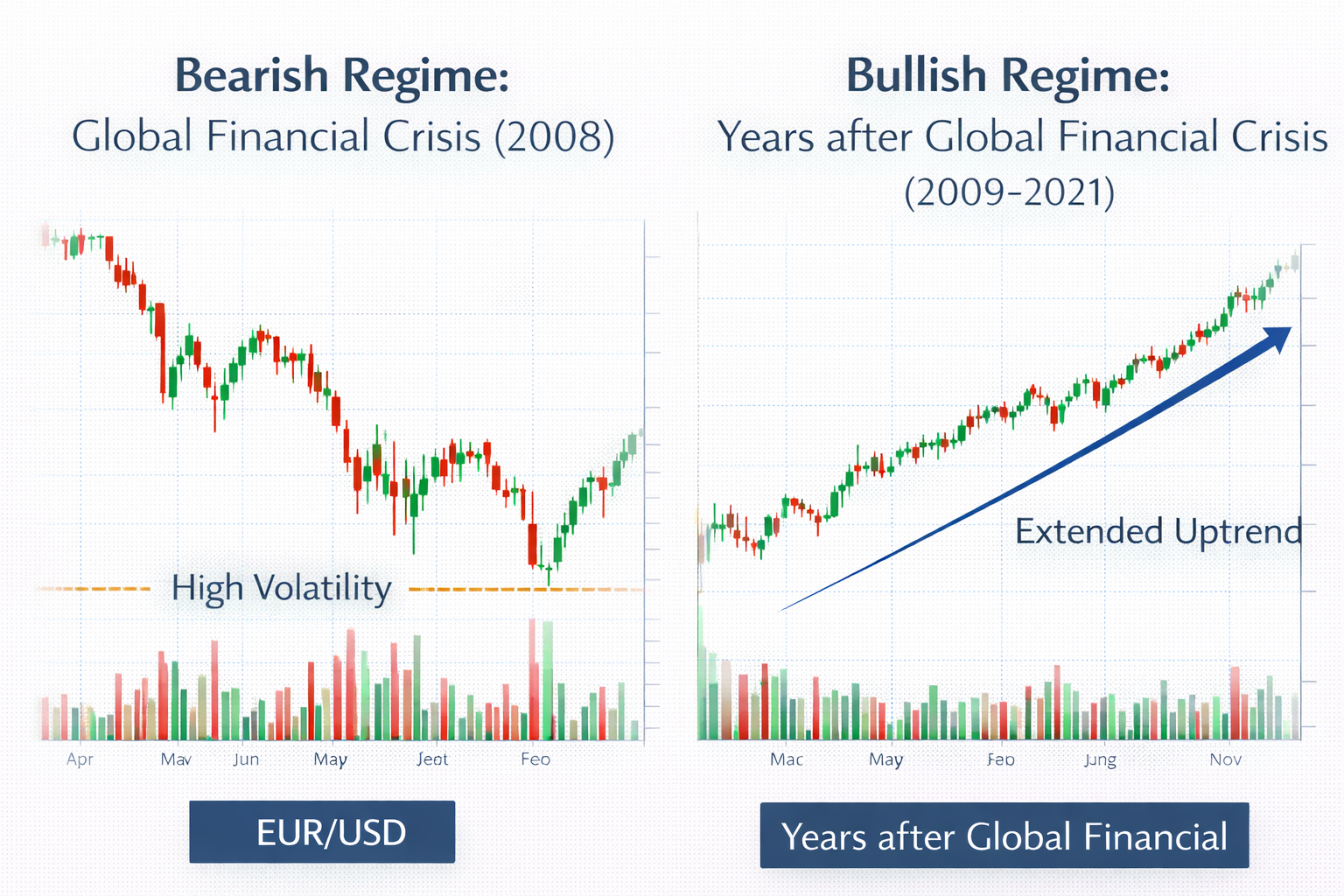
Identifying the market regime helps traders make more informed decisions and avoid using strategies that are poorly suited to the current environment.
Better strategy selection: traders can choose methods that align with current market behaviour.
Improved risk management: understanding volatility helps manage position size and exposure.
Reduced trading mistakes: avoiding strategies that do not fit the market environment.
More realistic expectations: traders can adjust profit targets and time horizons.
For example:
Trend-following strategies perform best in strong trending markets.
Range trading strategies are more effective when markets move sideways.
Scalping strategies often perform well in liquid markets with moderate volatility.
Traders who ignore regime changes often struggle because they continue applying strategies designed for a completely different market environment.
Markets rarely remain in the same regime indefinitely. Instead, they transition through different phases as economic and financial conditions evolve.
A simplified market cycle often follows this sequence:
A market regime is the condition of financial markets during a given period. It covers how prices move, how volatile the market is, and how investors react to events. Knowing the regime helps traders understand price moves and pick strategies that fit current conditions.
Market regimes are important because different trading strategies perform better under specific market conditions. For example, trend-following strategies work well in trending markets, while range-trading strategies are more effective when prices move sideways. Recognising the regime helps traders apply the most suitable strategy.
Traders identify market regimes by analysing a combination of technical indicators, volatility measures, price pattern structures, and macroeconomic data. Tools such as moving averages, volatility indexes, and market structure analysis help determine whether markets are trending, consolidating, or experiencing heightened volatility.
Yes, market regimes can change fast. News, policy moves, global events, or sudden changes in investor mood cause these shifts. So, traders check market signals often to spot regime changes early and shift their strategies.
A market regime shows the market's main mood at a given time. It reflects how prices move, how volatile the market is, and how investors react to events.
Traders must spot if markets are trending, flat, or highly volatile so they can match their strategies to current conditions. Because markets often shift, adaptability and effective risk management are key to long-term trading success.
Disclaimer: This material is for general information purposes only and is not intended as (and should not be considered to be) financial, investment or other advice on which reliance should be placed. No opinion given in the material constitutes a recommendation by EBC or the author that any particular investment, security, transaction or investment strategy is suitable for any specific person.