Published on: 2026-02-16
Updated on: 2026-02-16
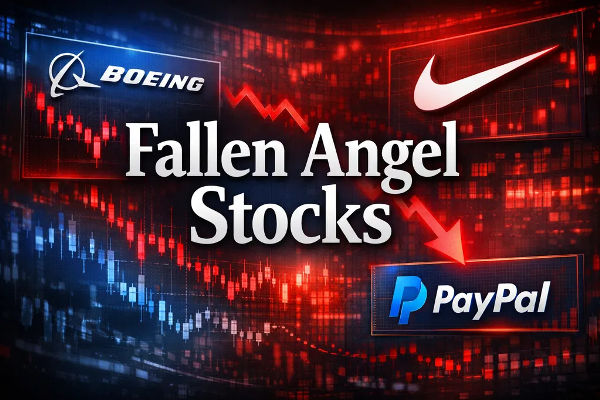
Some of the best trades begin with a stock that was once loved, then faced significant punishment, and finally shows signs of stabilization. Those are fallen angel stocks. It is not about catching a random dip.
It is about spotting the moment when bad news stops getting worse, the business starts to show small improvements, and the chart stops breaking down.
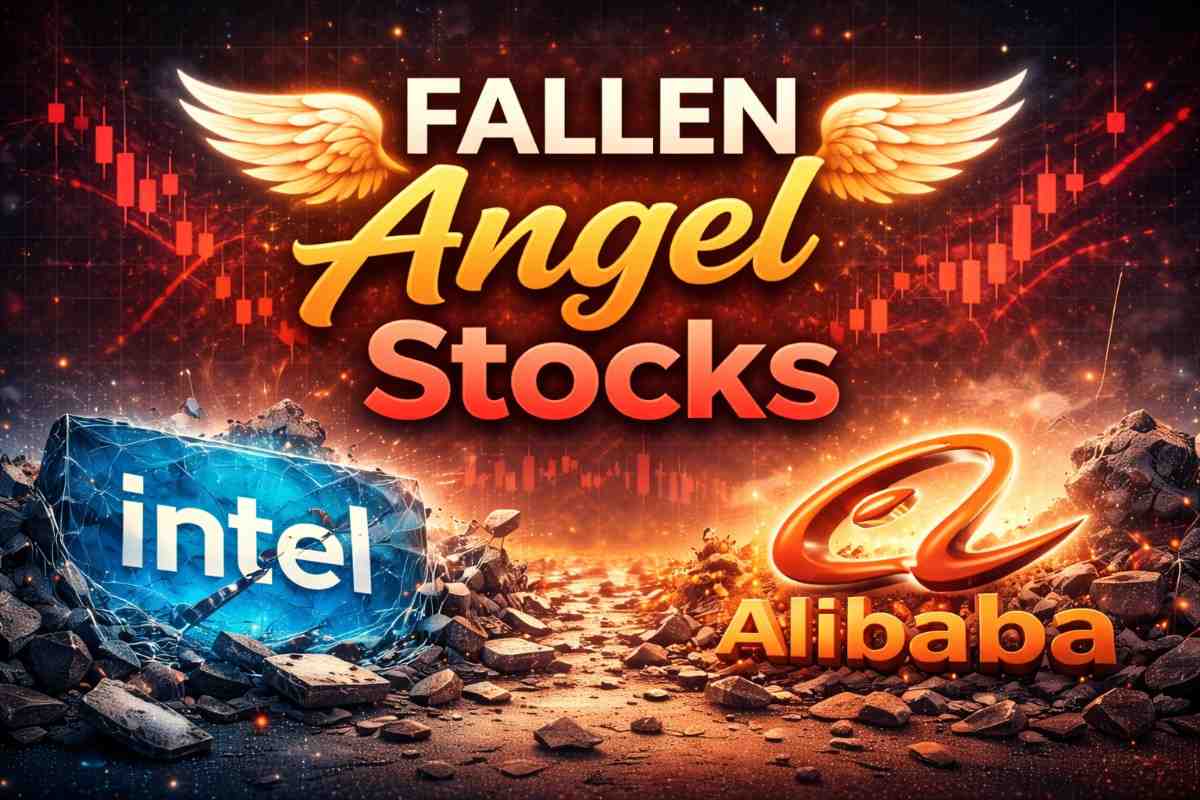
In 2026, the market continues to reward consistent cash flow and solid execution. That is why many former high flyers are stuck far below their peaks. The good news is that a handful of them are now flashing early turnaround signals that traders can actually use.
Below are our picks for the seven fallen angel stocks with real, visible signs of improvement, plus their strengths and weaknesses.
| Stock | Highest Price (All-Time High Close) | Lowest Price (52-Week Low) | Current Price (Feb 13, 2026 Close) | Drop From Peak to Current |
|---|---|---|---|---|
| Boeing (BA) | $430.30 | $128.88 | $242.96 | -43.5% |
Boeing's drawdown was primarily self-inflicted and therefore fixable. The stock spent years repricing safety, quality control, certification delays, and supply-chain fragility, which pressured deliveries and free cash flow.
The reset is now evident in operational cadence and backlog strength, which are more significant than headlines when the market evaluates multi-year repair cycles.
Boeing announced a revenue of $89.5 billion for full-year 2025, with 600 commercial deliveries, the highest annual totals since 2018. Additionally, the total backlog reached a record $682 billion.
Those numbers do not eliminate risk, but they strengthen the case that output stability is returning, which typically precedes a multi-quarter re-rating.
Boeing holds one of the deepest commercial aerospace backlogs in the global industry, which supports multi-year revenue visibility.
Boeing's 2025 delivery momentum improves fixed-cost absorption and narrows the gap to normalized free cash flow.
Boeing remains exposed to certification timing and regulatory scrutiny, which can disrupt production plans without warning.
Boeing's defense programs can still pressure margins when fixed-price development issues persist.
Boeing is a "mechanical" turnaround, where incremental execution can unlock disproportionate earnings power, given the strong demand backdrop.
The company doesn't need perfect conditions, but it requires consistent deliveries and predictable quality. The backlog suggests the market will reward sustained normalization.
| Stock | Highest Price (All-Time High Close) | Lowest Price (52-Week Low) | Current Price (Feb 13, 2026 Close) | Drop From Peak to Current |
|---|---|---|---|---|
| Intel (INTC) | $62.09 | $17.66 | $46.79 | -24.6% |
Intel's decline was due to lost process leadership, margin compression, and investor doubts about the scalability of its foundry strategy.
What changes the 2026 setup is that Intel's roadmap has moved from narrative to measurable milestones, which can shift the market from skepticism to probabilistic pricing.
Intel stated that Intel 18A is in risk production and is expected to reach volume manufacturing, while ecosystem readiness and early wafers for an 18A variant are already in the fab.
When "risk production" converts into higher yields and customer commitments, the market typically shifts from valuing Intel as a melting incumbent to valuing it as a re-emerging platform.
Intel possesses a unique combination of design expertise and manufacturing scale, which becomes increasingly valuable when security of supply is a concern.
Intel's 18A advancements offer a clear pathway for progress through yield improvements, customer adoption, and product competitiveness.
Intel's capital intensity remains high, and execution mistakes can widen the gap between revenue growth and free cash flow.
Intel's turnaround depends on hitting technical milestones, which historically carry schedule risk.
Intel is appealing because its growth potential does not depend on achieving significant increases in market share. The upside requires credible process execution that narrows the "trust discount," and that discount has been the dominant driver of valuation since the downcycle began.
| Stock | Highest Price (All-Time High Close) | Lowest Price (52-Week Low) | Current Price (Feb 13, 2026 Close) | Drop From Peak to Current |
|---|---|---|---|---|
| PayPal (PYPL) | $307.82 | $38.88 | $40.29 | -86.9% |
PayPal's decline from its peak reflects a market that has lost faith in sustainable branded checkout growth. This skepticism runs so deep that even minor stability can prompt a re-evaluation of the equity.
In 2026, management change and a sharper operational agenda create the conditions for a sentiment inflection, although the execution bar is high.
PayPal has appointed Enrique Lores as CEO, effective March 1, 2026, following a board-led review aimed at accelerating execution.
Leadership transitions do not guarantee outcomes, but they often mark a decisive shift from incremental tweaks to structural change, which is the type of catalyst fallen angels need.
PayPal benefits from a large, two-sided network and extensive merchant distribution, which should enhance operating leverage if branded checkout stabilizes.
PayPal's diverse platform, including branded checkout, Braintree, and Venmo, offers various opportunities to enhance growth quality.
PayPal faces persistent pricing pressure in unbranded processing, which can cap margin recovery.
PayPal's turnaround is vulnerable to execution missteps because the market is already impatient and highly skeptical.
PayPal is favored as a contrarian "re-rating" candidate because expectations are compressed and the franchise still matters in global digital commerce.
The stock does not need to regain its old growth profile, but it does need to prove that branded checkout can stabilize and that new leadership can restore operating discipline.
| Stock | Highest Price (All-Time High Close) | Lowest Price (52-Week Low) | Current Price (Feb 13, 2026 Close) | Drop From Peak to Current |
|---|---|---|---|---|
| Alibaba (BABA) | $317.14 | $66.63 | $155.73 | -50.9% |
Alibaba remains a textbook fallen angel stock because its decline was driven by regulatory pressure, macro deceleration, and investor distrust of China risk premia.
In 2026, operational momentum in high-quality segments such as cloud improves, even though competition remains intense.
Alibaba announced a 34 percent increase in cloud business revenue for the July-September 2025 quarter, driven by strong demand for AI services. The company also announced a multi-year investment plan for AI and cloud infrastructure.
This combination can be powerful because cloud revenue growth tends to carry higher quality than subsidy-driven commerce growth, provided margins do not erode excessively.
Alibaba's scale in commerce and logistics provides cash generation capacity that can fund AI investment without immediate balance-sheet stress.
Alibaba's cloud momentum gives the company a credible second engine that can diversify earnings drivers.
Alibaba's AI cloud competition is becoming more intense, partly due to ByteDance's push into the enterprise market, which may prompt pricing concessions.
Alibaba's significant spending plans could alarm investors if short-term profit margins decline.
Alibaba is favored because the market's China discount can unwind quickly as global AI infrastructure fundamentals strengthen.
The risk remains real, but the payoff is asymmetric when cloud growth accelerates and investor positioning shifts from avoidance to selective ownership.
| Stock | Highest Price (All-Time High Close) | Lowest Price (52-Week Low) | Current Price (Feb 13, 2026 Close) | Drop From Peak to Current |
|---|---|---|---|---|
| Pfizer (PFE) | $50.04 | $24.48 | $27.58 | -44.9% |
Pfizer's drop is a classic example of an earnings cliff colliding with a valuation regime that demands visibility. In 2026, the company's challenge is not survival.
The challenge is proving that new product contributions and cost actions can offset declining COVID revenues and patent expirations.
Pfizer guided for 2026 revenue of $59.5 billion to $62.5 billion and adjusted diluted EPS of $2.80 to $3.00, which anchors expectations and provides a framework to measure execution.
Even if growth is uneven, a stable guidance floor can reduce the equity risk premium when investors see cost discipline and pipeline traction.
Pfizer maintains massive commercial scale and global distribution, which can amplify the impact of successful launches.
Pfizer's guidance framework enhances transparency, helping investors differentiate genuine operational progress from external distractions.
Pfizer faces significant patent expirations that may negatively impact revenue and earnings, even in a stable macroeconomic environment.
Pfizer's growth depends on effective launch execution and payer dynamics, which may delay the visibility of that growth.
Pfizer is favored as a stability-and-upside compounder rather than a momentum story.
The stock can work if management proves that the post-COVID base is durable, that cost reductions are real, and that the pipeline can carry the next cycle of growth without requiring a return to pandemic economics.
| Stock | Highest Price (All-Time High Close) | Lowest Price (52-Week Low) | Current Price (Feb 13, 2026 Close) | Drop From Peak to Current |
|---|---|---|---|---|
| Enphase Energy (ENPH) | $336.00 | $25.59 | $43.49 | -87.1% |
Enphase is one of the most damaged former leaders in clean energy, which is precisely why it can rebound sharply when the cycle turns. The decline in the stock was attributed to higher interest rates, a slowdown in residential solar energy, and a correction in industry-wide inventory levels.
In 2026, better guidance and product momentum support the case that the trough is behind the business, even if volatility remains elevated.
Enphase highlighted stronger-than-expected first-quarter 2026 revenue guidance and progress on new products, including next-generation microinverters and storage-related offerings.
When guidance improves at the same time that channel inventory normalizes, semiconductor-like operating leverage can reappear quickly.
Enphase's microinverter technology and product ecosystem create differentiation that supports premium positioning when demand recovers.
Enphase can benefit from a restart in U.S. residential solar activity if financing conditions stabilize and utility costs remain elevated.
Enphase remains highly sensitive to residential solar policy and installer economics, which can change quickly by region.
Enphase's demand visibility can deteriorate when channel inventory builds again, which raises earnings volatility.
Enphase is favored because the downside narrative is widely understood and heavily priced, while early-cycle recovery signals can drive a powerful multiple reset.
The stock may remain volatile, but the risk-reward improves when guidance and product cadence strengthen simultaneously.
| Stock | Highest Price (All-Time High Close) | Lowest Price (52-Week Low) | Current Price (Feb 13, 2026 Close) | Drop From Peak to Current |
|---|---|---|---|---|
| Nike (NKE) | $166.19 | $52.28 | $63.13 | -62.0% |
Nike's fallen-angel stock status is not about brand irrelevance. It is about execution. The market punished Nike for inventory liquidation, margin compression, and uneven demand, especially as consumers became more price-sensitive.
In 2026, the early repair work is becoming measurable through wholesale traction and an explicit "Win Now" agenda, even as margins remain under pressure.
Nike reported first-quarter revenue of $11.7 billion for fiscal 2026, with wholesale revenue increasing, as management highlighted progress under the Win Now actions, despite a 320-basis-point decline in gross margin.
A brand turnaround typically starts with cleaner inventory, healthier wholesale reorder patterns, and faster product cycles, and those are the levers Nike is explicitly pulling.
Nike's brand equity and distribution scale are unparalleled in athletic footwear and apparel, which provides long-term pricing power as execution improves.
Nike's wholesale stabilization can reduce reliance on discount-heavy channels and improve demand quality over time.
Nike's margin recovery can take multiple quarters because inventory clearing and promotional resets are slow processes.
Nike's growth remains exposed to regional demand softness, including periods of weaker performance in Greater China.
Nike is favored because it is a fixable execution story attached to a world-class brand.
If management restores product speed, reduces discount dependence, and stabilizes digital conversion, the stock can re-rate well before headline growth returns, which is typical for consumer brand recoveries.
A fallen angel stock is a former market leader that suffered a large, prolonged decline due to operational problems, cyclical pressure, or structural disruption.
Turnarounds are most effective when inflation is moderating and policies are stable. This stability allows management teams to plan, refinance, and improve margins without being disrupted by frequent macroeconomic events. In January 2026, the CPI decreased to 2.4 percent year-over-year, while policy rates remained stable but restrictive.
The largest risk is execution failure, not valuation. If a company misses operational milestones, investors often demand additional discounts, and management may respond with actions that dilute shareholders or reduce long-term competitiveness.
In conclusion, the most compelling fallen angel stocks of 2026 demonstrate a common trend. While the market has already accounted for the failures, it has not yet fully considered the potential for recovery.
In other words, turnarounds need proof, not promises, and that is exactly why fallen angel stocks with visible progress can re-rate sharply when execution improves.
Disclaimer: This material is for general information purposes only and is not intended as (and should not be considered to be) financial, investment or other advice on which reliance should be placed. No opinion given in the material constitutes a recommendation by EBC or the author that any particular investment, security, transaction or investment strategy is suitable for any specific person.