Published on: 2026-03-09
Updated on: 2026-03-09
A scalping strategy is a trading approach that seeks to exploit small price changes through frequent, rapid-fire trades over very short intervals.
Instead of tracking major market moves, scalpers aim to profit from minor price shifts that occur repeatedly throughout a session. Positions are generally held for seconds to minutes, and traders often execute dozens or hundreds of trades daily. The objective is to accumulate numerous small gains that compound into significant profits.
Scalping is widely used in forex, stock, and futures markets, especially in highly liquid instruments where prices move constantly, and spreads remain relatively tight.
Scalping is a short-term trading strategy focused on capturing small price movements.
Trades usually last a few seconds or minutes, and many occur in a single session.
Strong liquidity and rapid order execution are critical for effective scalping.
Traders often rely on technical indicators and short-term charts.
Trading costs and market noise can affect profitability, making risk management critical.
A scalping strategy is a trading method that aims to profit from very small price movements that occur frequently in financial markets.
Instead of seeking large market trends, scalpers focus on quick opportunities that yield small gains per trade. For instance, a trader may capture a few pips in a currency pair or a few cents in a stock price.
Because these gains are relatively small, scalpers rely on high trading frequency to build cumulative profits.
The strategy depends heavily on speed, quick decision-making, and efficient execution.
Scalping relies on fast analysis, high liquidity, and rapid trade execution. Traders typically analyse markets using very short timeframes such as 1-minute or 5-minute charts.
A typical scalping process includes the following steps:
Identify a short-term trading opportunity.
Enter the trade quickly when conditions align.
Capture a small price movement in the expected direction.
Exit the trade as soon as the target is reached or momentum slows.
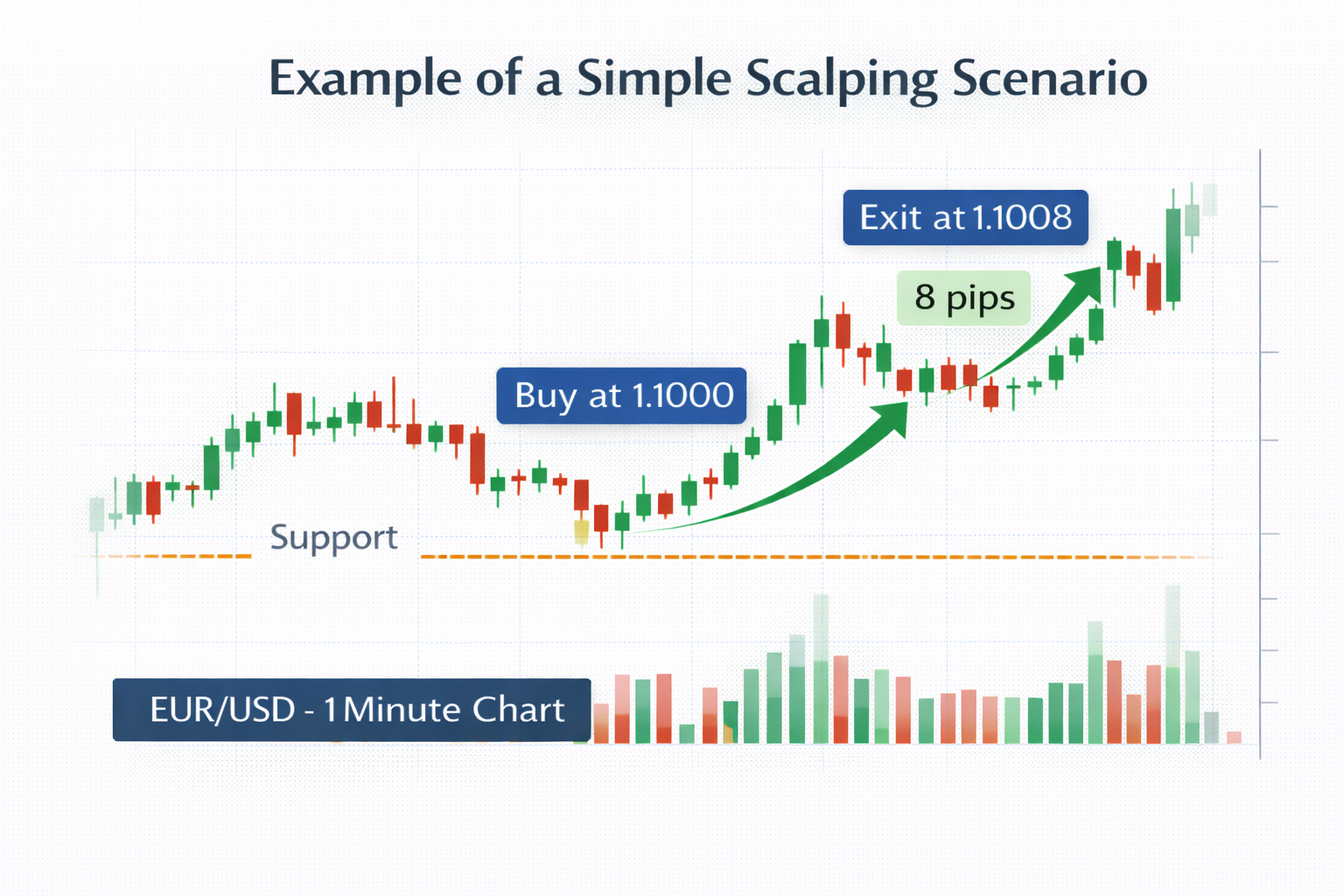
For example, a trader watching the EUR/USD pair may buy when the price dips briefly toward a support level and exit after gaining a few pips.
This process may be repeated many times during a single trading session.
Although the objective remains the same, traders use different techniques to identify short-term opportunities.
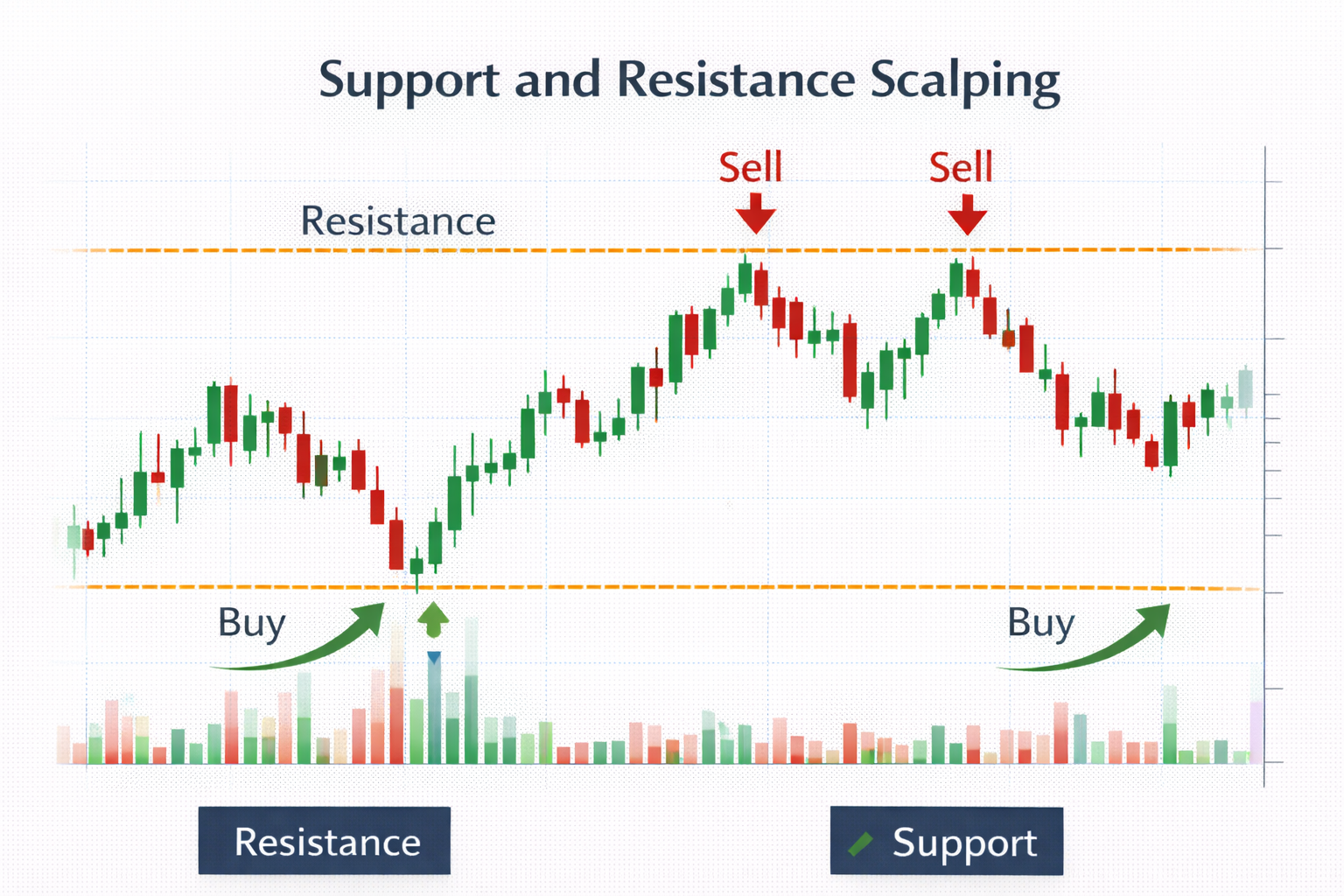
This strategy focuses on quick price reactions near key support and resistance levels.
Traders often:
Buy when the price approaches support.
Sell when the price approaches resistance.
Exit quickly after capturing a small movement.
Because many market participants monitor these levels, short-term reactions often occur when the price reaches them.
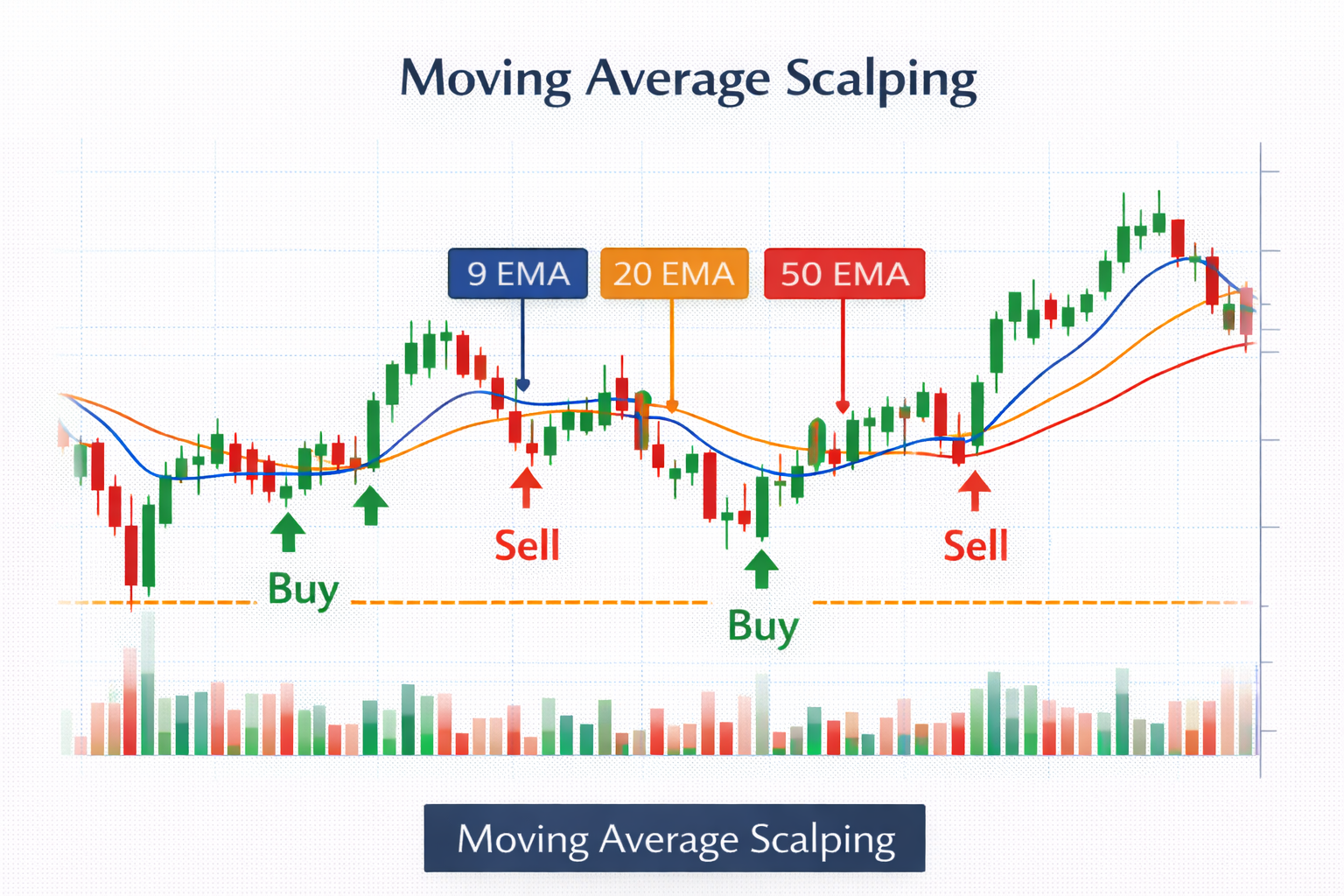
Moving averages enable traders to pinpoint short-term trends and momentum.
Common combinations include:
9-period moving average
20-period moving average
50-period moving average
When price crosses above or below these averages, scalpers may enter short trades to capture brief bursts of momentum.
Breakout scalping targets sharp price moves as markets break out of consolidation. Traders enter quickly after a breakout begins and exit shortly after momentum slows.
This strategy is often applied to liquid currency pairs such as EUR/USD and USD/JPY, where volatility can appear quickly during active trading sessions.
Range scalping is used when the market moves sideways without forming a clear trend.
In this environment, traders may repeatedly:
Buy near the lower boundary of the range.
Sell near the upper boundary of the range.
As the price oscillates between these levels, multiple short-term opportunities can appear.
News scalping involves profiting from rapid price movements following economic announcements.
Events that may trigger volatility include:
Inflation data releases
Employment reports
Central bank interest rate decisions
Prices can move rapidly within seconds during these announcements. However, this approach carries a higher risk because market reactions can be unpredictable.
Scalpers rely heavily on technical analysis tools to identify quick trading opportunities and precise entry points.
Common tools include:
Moving averages
Relative Strength Index (RSI)
Moving Average Convergence Divergence (MACD)
Support and resistance levels
Volume indicators
Because scalping demands split-second timing, traders often track 1-minute charts (which show each minute's price action), tick charts (which plot price changes after a certain number of trades), or other short-term intervals.
Scalping differs significantly from other trading approaches in terms of speed and trade frequency.
Among these styles, scalping is considered the fastest and most active form of trading.
Scalping strategies tend to work best in liquid markets with tight spreads and steady price activity.
Common markets include:
Major forex pairs
Large-cap stocks
Stock index futures
Highly traded exchange-traded funds
For scalping newcomers, discipline and preparation are vital. These practices help beginners navigate this fast-paced strategy effectively.
Start With Liquid Markets
Scalping works best in markets with high trading volume and tight spreads. Liquid instruments allow faster execution and lower transaction costs.
Use Clear Entry and Exit Rules
Effective scalpers follow predefined rules rather than make emotional decisions. Setting clear profit targets and stop loss levels helps maintain consistency.
Focus on Fewer Markets
Monitoring too many instruments can slow decision-making. Beginners often benefit from focusing on one or two markets.
Control Trading Costs
Because scalping involves many trades, spreads and commissions can significantly impact profitability.
Practice Before Using Real Capital
Many traders practice scalping strategies in demo accounts before trading with real money. This helps develop speed and confidence while reducing financial risk.
Understanding both sides is important because scalping amplifies both gains and risks due to the large number of trades involved.
A scalping strategy is a short-term trading approach that focuses on capturing small price movements by executing many trades within a short period. Positions are often held for seconds or minutes, and traders rely on fast execution and technical analysis to capture small gains repeatedly throughout a trading session.
Scalping can be challenging for beginners because it requires rapid decision-making, constant market monitoring, and strict risk-management discipline. Many new traders prefer slower trading styles first, such as swing trading, before attempting faster strategies like scalping.
Scalping usually works best in highly liquid markets with tight spreads and consistent price activity. Major currency pairs, large capitalisation stocks, index futures, and heavily traded exchange-traded funds are commonly preferred because traders can enter and exit positions quickly.
The number of trades varies depending on the trader's strategy and market conditions. Some scalpers may place 10 to 20 trades per day, while others who use very short timeframes or automated systems may execute dozens or even hundreds of trades in a single session.
A scalping strategy is a short-term trading method that focuses on capturing small price movements through frequent trades.
Traders rely on speed, liquidity, and precise timing to accumulate many small profits throughout a trading session. While the strategy can offer frequent opportunities, it also requires strong discipline, efficient execution, and careful risk management.
Disclaimer: This material is for general information purposes only and is not intended as (and should not be considered to be) financial, investment or other advice on which reliance should be placed. No opinion given in the material constitutes a recommendation by EBC or the author that any particular investment, security, transaction or investment strategy is suitable for any specific person.