Published on: 2026-04-15
Updated on: 2026-04-15
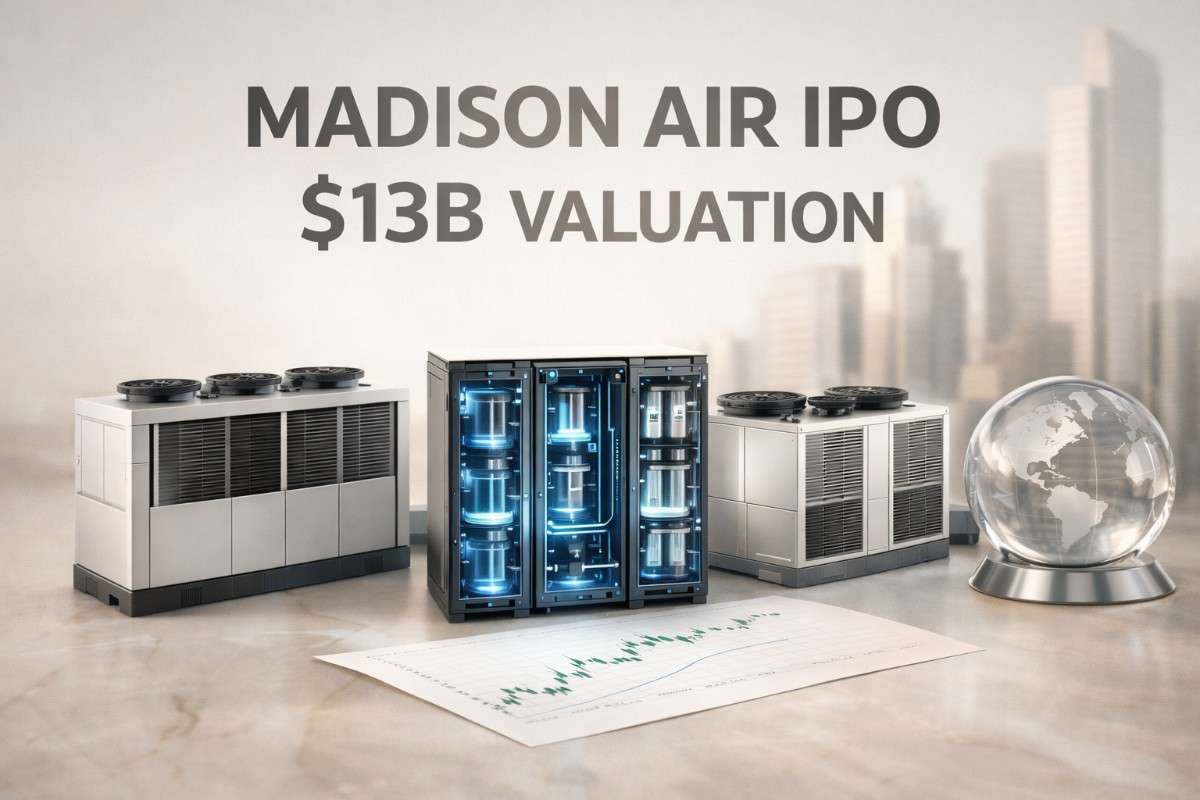
The Madison Air IPO is valued at up to $13.2 billion, with 82.7 million shares offered at $25 to $27 each. This makes it the largest U.S. IPO of 2026 to date and among the largest industrial debuts in decades.
In 2025, Madison Air reported $3.34 billion in revenue, up from $2.62 billion in 2024. However, net income declined to $124.3 million from $236 million.
On a pro forma basis including AprilAire, 2025 sales reached approximately $3.5 billion, with an adjusted EBITDA margin of 26.6%.
Data center electricity demand is expected to double to 945 TWh by 2030. Cooling systems may account for 7% to over 30% of a facility's electricity use, depending on efficiency.
Key risks include slower adoption of liquid cooling, integration challenges from acquisitions, founder control via supervoting shares, and the persistence of execution risk despite cornerstone demand.
The Madison Air IPO comes as AI infrastructure is increasingly valued based on power, heat, and uptime rather than chips alone. As of April 15, 2026, Madison Air is offering 82.7 million shares at $25 to $27 each, implying an equity valuation of up to $13.2 billion and potential gross proceeds of up to $2.23 billion.
This is one of the largest U.S. industrial offerings in decades and serves as a direct test of investor interest in the physical infrastructure supporting AI development.
| Metric | Value |
|---|---|
| IPO Shares Offered | 82.7M |
| Indicative Price Range | $25 to $27 |
| Implied Equity Value | $12.7B to $13.2B |
| 2025 Reported Net Sales | $3.34B |
| 2025 Pro Forma Net Sales | $3.5B |
| 2025 Pro Forma Adjusted EBITDA Margin | 26.6% |
| 2025 Organic Growth | 12.4% |
| 2025 Sales Mix | 66% Commercial / 34% Residential |
| Debt | ~$5.7B Pre-IPO / ~$3.5B Post-IPO |
| Indicated Cornerstone Interest | Up to $525M |
Madison Air demonstrates significant scale, strong margins, and a meaningful step toward deleveraging. However, it also features a conglomerate structure resulting from 13 acquisitions since 2017.
This structure provides resilience but requires investors to assess whether the platform merits a data center infrastructure premium or a traditional industrial valuation.
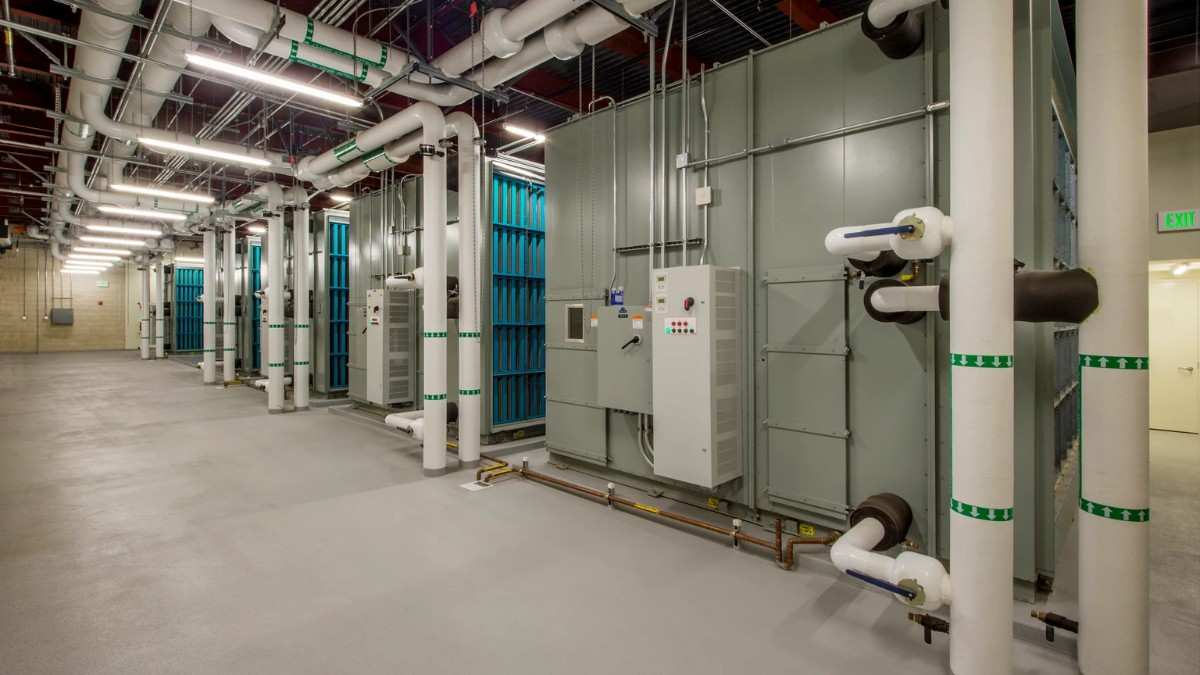
Madison Air offers a genuine AI-related advantage, though not in software. Its data center platform features AI-ready air, liquid, and hybrid cooling systems designed for operators managing higher compute densities, stricter thermal tolerances, and increased uptime requirements. As a result, thermal management becomes a core design consideration.
The hardware roadmap supports this transition. AI-driven data center demand is elevating cooling from a background utility to a performance-critical component. JLL's year-end 2025 data center report indicates vacancy near 1%, over 35 gigawatts under construction, and 92% precommitment.
In this environment, suppliers addressing airflow, heat rejection, and energy efficiency are positioned for stronger growth and pricing than standard HVAC manufacturers.
Investors should carefully consider the implications of the AI label in this context. Madison Air is not an AI platform but an industrial supplier that benefits from the growth of AI infrastructure. While the business model is strong, it does not warrant the full valuation premiums assigned to pure-play digital companies.
At the $26 midpoint, Madison Air's equity value is approximately $12.71 billion. Including about $3.5 billion in post-IPO debt and $208.4 million in cash, the enterprise value is roughly $16.0 billion. This equates to about 17.6 times adjusted EBITDA and 4.5 times pro forma sales.
Madison Air trades at higher multiples than Carrier but below Trane and well below Vertiv, the closest public company benefiting from AI infrastructure demand. The market positions Madison Air between a standard comfort-and-controls company and a full data center infrastructure provider.
This assessment appears reasonable. If management demonstrates continued growth in data center, semiconductor, and aftermarket segments while reducing leverage, the stock could be re-rated higher. Conversely, if it is viewed as a leveraged HVAC consolidator, the valuation multiple may decline rapidly.
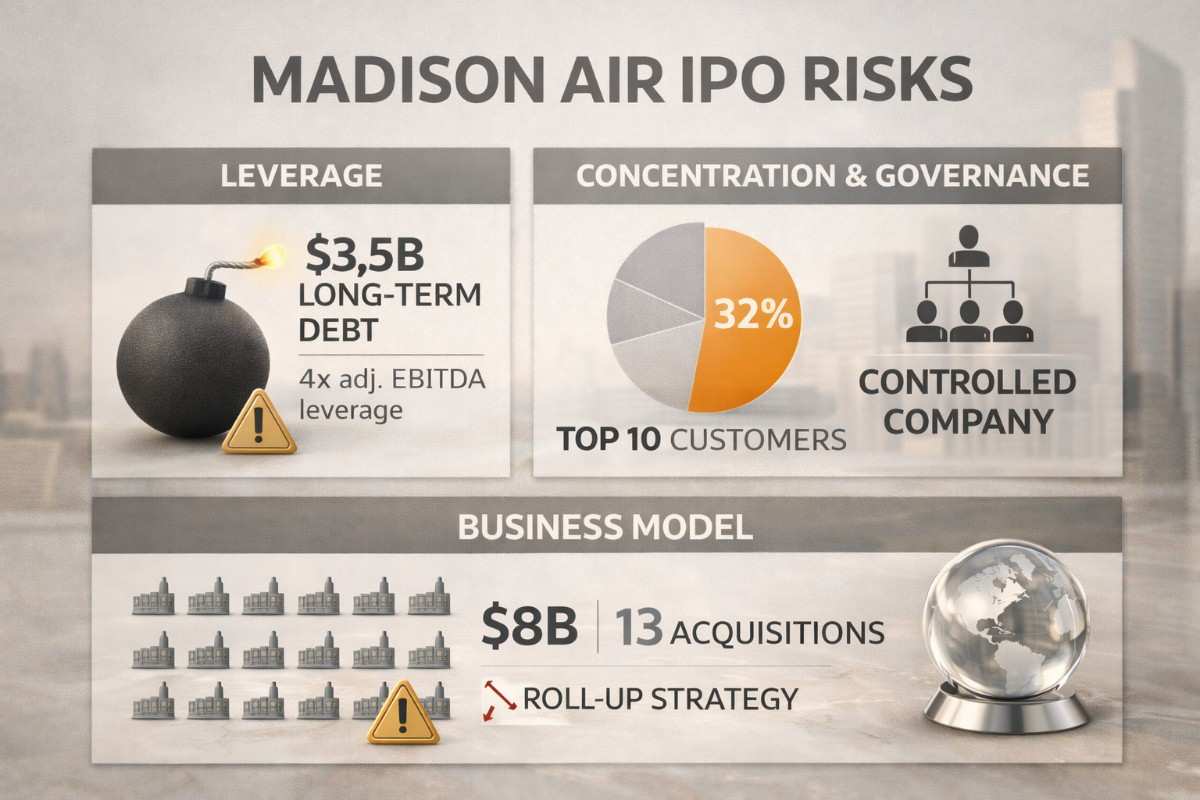
Following the IPO, Madison Air is expected to maintain approximately $3.5 billion in long-term debt. Based on the 2025 adjusted EBITDA margin and pro forma sales, leverage remains just under four times adjusted EBITDA.
This is an improvement over the pre-IPO structure, but it is not conservative for a company exposed to construction, industrial capital expenditures, and acquisition integration.
Approximately 32% of 2025 revenue was generated from the top 10 customers. Larry Gies will retain control through Class B supervoting shares, resulting in Madison Air remaining a controlled company after listing.
Investors will have access to financial performance data but will not have significant influence or control over company operations.
Since 2017, Madison Air has invested over $8 billion in 13 acquisitions. This strategy accelerated scale, but roll-ups are most attractive during periods of strong growth and accessible financing.
These strategies are challenged when growth slows, end markets weaken, or anticipated synergies are delayed.
Madison Air provides air, liquid, and hybrid cooling systems, along with engineering, commissioning, and lifecycle support. The company operates within the thermal management layer of data center deployment, not in chips or servers.
No. Madison Air has significant data center exposure but remains a diversified commercial and residential air management platform.
Currently, Madison Air is positioned between the two. It has a stronger AI infrastructure narrative than Carrier but does not yet match Vertiv's market position or valuation premium.
The Madison Air IPO stands out among 2026 industrial offerings as it seeks market support for a debt-funded consolidator transitioning to a more transparent public company and an airflow specialist gaining exposure to AI infrastructure.
The fundamentals warrant attention. Revenue scale, margin profile, and end-market mix exceed those of a typical HVAC offering. However, risks remain: leverage is still high, governance remains concentrated, and the transition from adjusted profitability to improved reported returns is not yet established.
Overall, Madison Air appears investable due to its tangible AI advantage and clear deleveraging strategy. However, the valuation does not sufficiently offset execution risk.
Disclaimer: This material is for general information purposes only and is not intended as (and should not be considered to be) financial, investment, or other advice on which reliance should be placed. No opinion given in the material constitutes a recommendation by EBC or the author that any particular investment, security, transaction, or investment strategy is suitable for any specific person.