Published on: 2026-06-03
Updated on: 2026-06-03
Data as of June 3, 2026, U.S. pre-market trading.
AVGO stock was indicated around $495 to $497 in early pre-market trading, leaving the $500 level less than 1% away before Broadcom has reported earnings. Broadcom guided Q2 revenue to approximately $22.0 billion, up 47% year-over-year, and Q2 AI semiconductor revenue to $10.7 billion; both figures are now public knowledge rather than fresh catalysts.
The question tonight is not simply whether Broadcom delivers. It is whether Broadcom delivers something the stock has not already priced.
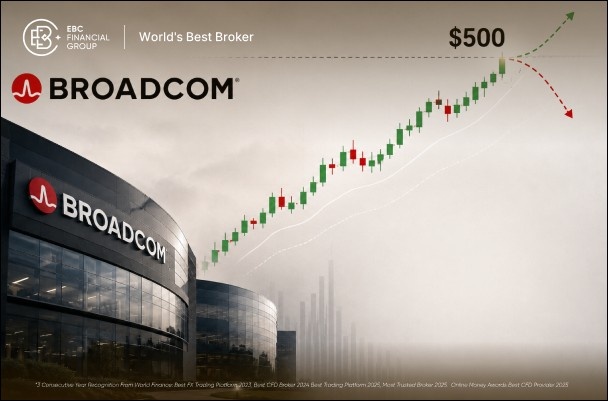
AVGO closed at $481.57 on June 2 and was indicated around $495 to $497 in early pre-market trading, leaving $500 less than 1% away before a single result has been released.
Broadcom guided Q2 revenue to approximately $22.0 billion, up 47% year-over-year, while Q2 AI semiconductor revenue guidance already stands at $10.7 billion; the surprise must come from guidance, AI run-rate visibility or margin quality, not the headline baseline.
Q1 AI revenue reached $8.4 billion, up 106% year-over-year and above the prior forecast. Whether Q3 guidance raises that run-rate further is the most important signal tonight.
Adjusted EBITDA guidance sits at approximately 68% of Q2 revenue. A slip below that line converts a revenue beat into a mixed result.
Broadcom's top five customers account for approximately 40% of revenue. Guidance on the timing of hyperscaler deployments carries more weight than the headline number at current revenue concentration levels.
The report should be read through five confirmation signals: Q3 guidance, AI semiconductor revenue, adjusted EBITDA margin, hyperscaler visibility and VMware software cash flow. Each one helps decide whether $500 becomes a breakout level or a sell-the-news trigger.
| Signal | Breakout Reading | Sell-the-News Reading |
|---|---|---|
| Q3 guidance | Raises the forward revenue path beyond the $22B Q2 benchmark | Confirms expectations without lifting the estimate path |
| AI semiconductor revenue | Beats the $10.7B Q2 guide or points to faster Q3 growth | Lands near guidance without a stronger runway |
| Adjusted EBITDA margin | Holds near the 68% guide despite AI hardware growth | Slips enough to question earnings quality |
| Hyperscaler visibility | Shows multi-quarter custom silicon demand | Suggests deployment timing risk or narrow customer dependence |
| VMware/software cash flow | Supports margin stability and deleveraging | Fails to offset hardware cyclicality |
The most important row is Q3 guidance. Q2 results confirm a quarter that is already complete. Q3 guidance is the clearest signal in tonight’s release because it can show whether the $500 move has another estimate upgrade behind it.
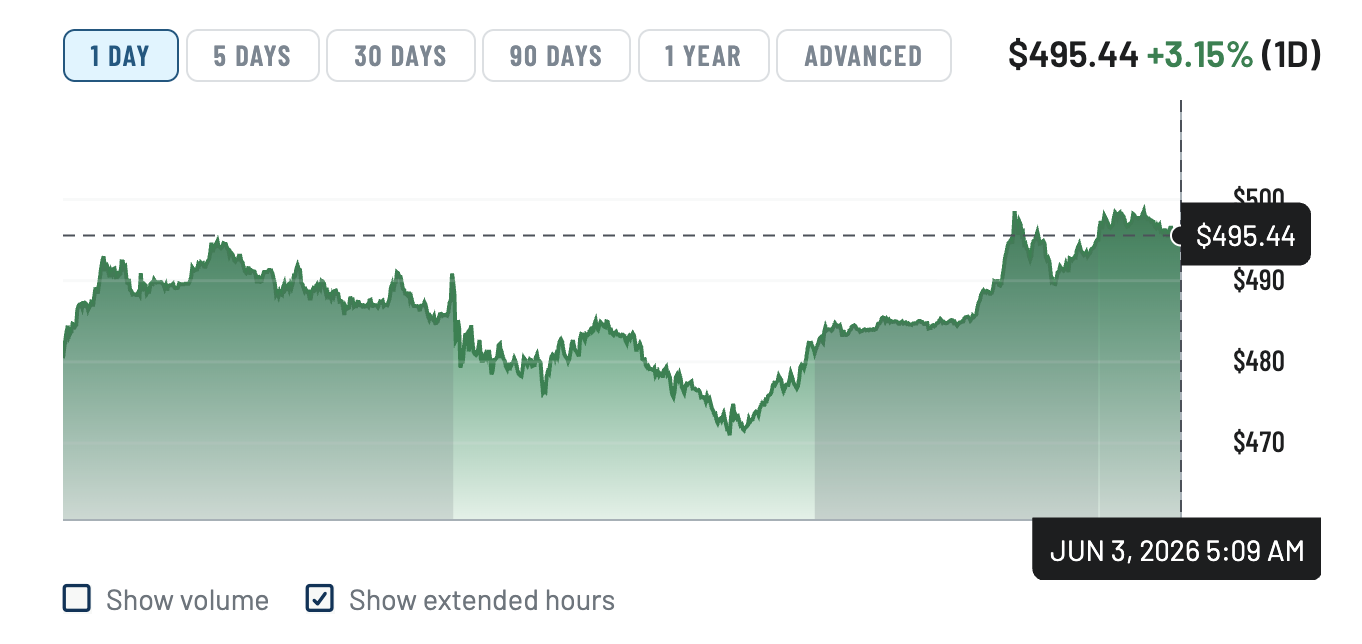
Image Source: Marketbeat
Crossing $500 during an earnings window would not be unusual for a stock already trading within 1% of the level. Normal earnings volatility covers that distance.
The distinction that matters is what happens next. A price tagged in after-hours trading with thin volume is not the same as a price that holds through the call, through analyst reactions, and into the following session. The first version of $500 is a print. The second version is a level. The earnings call determines which one AVGO gets.
Broadcom has not entered these results with low expectations. The Q2 revenue outlook of approximately $22.0 billion and the guided adjusted EBITDA margin of roughly 68% are already visible to the market and partly reflected in the pre-earnings move. A result that meets those figures validates the quarter. It does not upgrade the story.
That changes the standard for a meaningful beat. Growth that lands where the company said it would land is verification, not information. At a premium valuation, verification is not enough to move $500 from a target to a floor. The report needs to provide something existing guidance cannot.
Broadcom’s Q1 AI revenue reached $8.4 billion, up 106% year-over-year and above the company’s prior forecast. Management then guided Q2 AI semiconductor revenue to $10.7 billion, and that figure is tonight's reference point.
A Q2 result near $10.7 billion confirms execution. A result that meaningfully exceeds it, or guidance that shows Q3 moving materially higher, is what changes the calculus. The distinction is between a company performing as expected and a company outrunning its own estimates. Only the second gives a $500-plus stock new ground to stand on.
The strength of the breakout case depends less on the Q2 number than on what management says sits behind it. Meta described the partnership as critical to its broader AI infrastructure strategy, with Broadcom working across chip design, advanced packaging and networking.
That distinction matters. A customer buying AI capacity is transactional; a customer embedding Broadcom across multiple silicon generations, packaging layers and networking architecture is structural. The first supports a strong quarter. The second supports a design-win cycle.
A single strong quarter absorbed into a premium multiple does not expand that multiple. Evidence of multiple custom-silicon generations can, because it extends the revenue argument beyond one earnings print.
The sell-the-news scenario does not require disappointing numbers. It requires merely adequate guidance.
Broadcom’s annual report says its top five end customers accounted for approximately 40% of net revenue in both fiscal 2025 and fiscal 2024. It also says large orders or delayed orders from key semiconductor customers can cause quarterly revenue to fluctuate, especially in AI and wireless applications.
That asymmetry makes guidance the pressure point, not the reported quarter alone. When the forward story does not improve, a premium valuation has little room for error.
Broadcom's Q1 adjusted EBITDA reached $13.1 billion, equal to 68% of revenue, with Q2 guidance pointing to a similar level. That figure is the line between a clean beat and a complicated one.
AI hardware growth at scale can test margins because Broadcom’s margin profile depends heavily on product mix, including the balance between semiconductor solutions and infrastructure software. If Q2 AI revenue grows and margins hold near 68%, the market reads profitable scaling. If margins slip, the read changes: the business is growing faster but capturing less of each dollar.
A stock priced for compounding returns treats margin compression as a valuation event, not an operating footnote. The 68% line is where the quality verdict gets made, not just the revenue line.
The cleanest confirmation is not a brief after-hours move above $500. It is AVGO holding above that level after Q3 guidance and AI commentary are fully priced in.
If guidance lifts the forward revenue path and margins stay near Broadcom’s 68% EBITDA framework, $500 can become support. If the beat comes with cautious commentary, $500 becomes the level where momentum meets confirmation risk.
With early pre-market indications around $495 to $497, $500 is less than 1% away and within the normal earnings window range. Reaching the level does not require a strong report. Holding it does.
Q3 guidance, followed by AI semiconductor revenue. The Q2 AI revenue guide of $10.7 billion is already known. The more important signal is whether the Q3 run-rate moves above it. A quarter that validates the existing forecast without raising it confirms the business but gives the valuation nothing new to stand on.
Yes. A beat against Q2 estimates can still produce a sell-off if Q3 guidance is in line rather than higher, if margins come in below the 68% EBITDA guide, or if hyperscaler deployment language lacks specificity. The report's surface number and the stock's reaction can move in opposite directions at this valuation level.
The valuation is demanding, but the useful question is not whether the multiple is high. It is whether the AI growth cycle is expanding fast enough to grow into it. A custom-silicon pipeline with multiple design generations of hyperscaler work ahead is a different asset than one with single-quarter visibility, even at the same price. Management's language tonight defines which of those descriptions currently fits.
Broadcom's June 3 earnings call is the next test. If guidance expands the AI revenue runway beyond the $10.7 billion Q2 reference point, $500 can become more than a headline price. If guidance only confirms what the stock already reflects, the same level may mark where momentum meets valuation gravity.
For AVGO stock, $500 is not the destination now. It is the first verdict on whether the AI premium still has room to expand.