Published on: 2025-12-26
Updated on: 2026-07-13
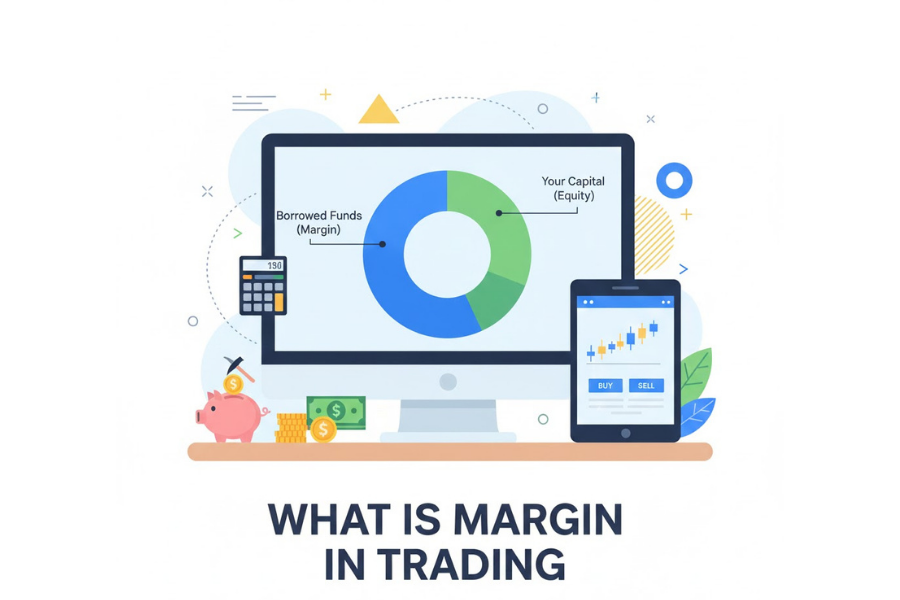
Margin in trading is the money you set aside from your account to open and hold a leveraged position. It is not a fee, and it is not money you pay to the broker. It is your own capital, held as a deposit for as long as the position stays open, and returned to your available balance when you close it.
That deposit lets you control a position worth far more than the margin itself. With EBC, opening one standard lot of a major currency pair (a position size of 100,000 units) at the maximum 1:500 leverage requires about 0.2% of the position value as margin. So a position worth roughly $108,500 can be opened with about $217 set aside. The margin is small next to the position, which is why both profits and losses are measured against the full position, not against the deposit.
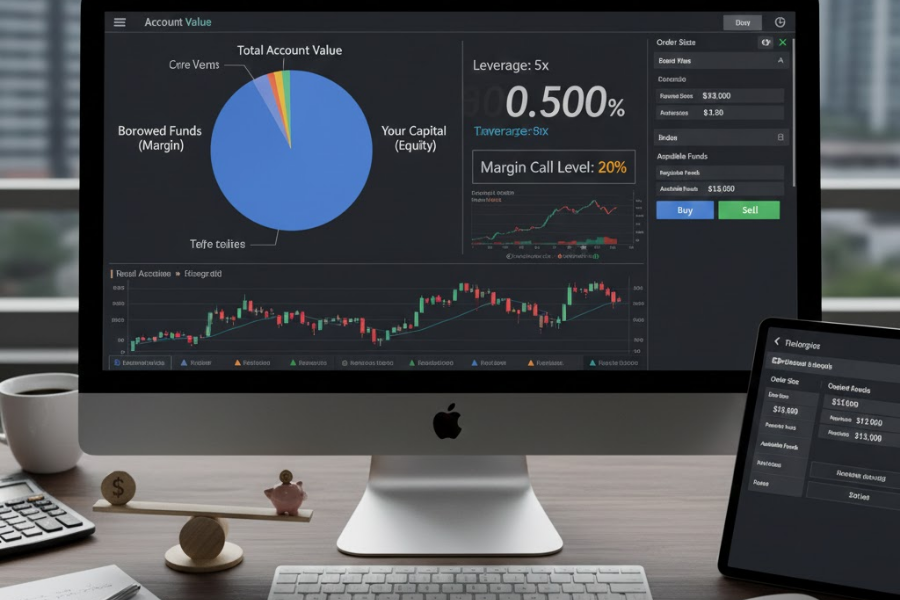
Margin is a returnable good-faith deposit, not a cost and not a loan.
Required margin depends on position size, price, and the leverage set for that instrument.
Margin and leverage are two ways of describing the same relationship: leverage is 1 divided by the margin percentage. A 0.2% margin equals 1:500 leverage.
Free margin is what remains available to open new positions or absorb losses after used margin is set aside.
If your equity falls too far against your used margin, the broker can issue a margin call and, at a lower level, automatically close positions.
This is where most explanations create confusion, because “margin” means two different things depending on the market.
In stock trading, a margin account is a brokerage account that allows you to borrow cash from a broker to buy shares. You pledge the shares as collateral and pay interest on the borrowed amount for as long as the loan is open. Under United States rules (Federal Reserve Regulation T), an investor can borrow up to 50% of the purchase price. Here, margin is debt.
In forex and CFD (contract for difference) trading, margin works differently. You do not borrow the margin, and you pay no interest on it. The margin is your own money, locked as a performance deposit while the trade runs. The leverage that gives you the larger position comes from the contract structure, not from a cash loan. You may still pay overnight financing (swap) on the position itself, but that is separate from the margin deposit.
The practical result: a stock margin trader carries an interest-bearing loan, while a forex or CFD trader posts a deposit that is released on closing. Reading a stock-margin guide and then opening a forex account is a common way traders get this wrong.
The core formula is straightforward:
Required margin = (Contract size × Lots × Opening price) ÷ Leverage
The result is stated in the instrument’s quote currency. If your account is held in a different currency, convert the figure using the exchange rate between the quote currency and your account currency.
Worked example, using EBC specifications for a major pair:
Instrument: EUR/USD
Contract size: 100,000
Lots: 1
Opening price: 1.0850
Maximum leverage: 1:500
Required margin = (100,000 × 1 × 1.0850) ÷ 500 = $217
That $217 controls a position worth $108,500. Because EUR/USD is quoted in US dollars, a US dollar account needs no conversion. For a pair quoted in another currency, for example EUR/GBP on a US dollar account, you would convert the GBP result into dollars at the current rate.
The same formula applies to other assets, using each instrument’s own contract size and leverage cap. Gold (XAU/USD) at EBC uses a contract size of 100 and up to 1:500 leverage. A US stock CFD uses a contract size of 1 and a maximum of 1:5 leverage, so the same position value requires far more margin than a currency pair does.
Margin and leverage describe one relationship from two directions. Margin is the fraction of the position you put up. Leverage is the multiple of exposure that fraction gives you.
Leverage = 1 ÷ margin percentage
The table below uses EBC’s own leverage caps to show how the two connect across asset classes:
| Margin Required | Maximum Leverage | EBC Instrument Examples |
|---|---|---|
| 0.2% | 1:500 | Major forex pairs, Gold (XAU/USD) |
| 1% | 1:100 | Stock index CFDs |
| 2% | 1:50 | USD/CNH, USD/HKD and similar forex pairs |
| 20% | 1:5 | US stock CFDs and ETF CFDs |
Higher leverage means a smaller margin deposit and a larger position for the same cash. It also means a smaller price move against you is enough to threaten the account. This is why the deposit alone does not tell you your risk. The position size does.
Four account figures move together once a position is open. Understanding them is what separates traders who manage risk from traders who are surprised by it.
Equity = account balance plus or minus the floating profit or loss on open positions.
Used margin = the total required margin locked across all open positions.
Free margin = equity minus used margin. This is what is available to open new positions or absorb further losses.
Margin level = (equity ÷ used margin) × 100, shown as a percentage.
A worked example. You deposit $2,000 and open one lot of EUR/USD at 1:500, using $217 of margin.
Used margin: $217
Free margin: $1,783
Margin level: (2,000 ÷ 217) × 100 = about 921%
Now the trade moves against you by $300. Your equity falls to $1,700.
Free margin: $1,483
Margin level: (1,700 ÷ 217) × 100 = about 783%
The margin level falls as losses grow. Watching that number, rather than the balance, tells you how much room the account has left.
A margin call is a warning. It means your equity has dropped low relative to your used margin, and the account no longer has a comfortable buffer. Some brokers notify you; some do not guarantee a warning.
A stop-out, also called a margin close-out, is the automatic step that follows. When equity falls to a set level relative to the used margin, the broker begins closing positions to prevent the account from incurring further losses. In jurisdictions covered by the European Securities and Markets Authority, the Financial Conduct Authority in the United Kingdom, and the Australian Securities and Investments Commission, this close-out is standardised at 50% of the initial margin required for open positions. The exact level for any account depends on the broker and the account type, so check it before you trade.
Two points matter here. Positions can be closed without advance notice. And in fast markets, prices can gap past the theoretical stop-out level, so the actual closing price may be worse than expected.
You can read how this plays out in practice on the EBC guide to margin calls.
Three related terms come up often, and they are not interchangeable.
Initial margin is the amount required to open a position. The $217 in the example above is initial margin.
The maintenance margin is the minimum equity required to keep the position open. Fall below it and a margin call or close-out follows.
Variation margin has a precise meaning in futures and cleared derivatives: the daily cash settlement of gains and losses between counterparties, marked to market. Some CFD providers use the term loosely to describe running losses, but in its exact sense it belongs to the institutional derivatives world, as defined by the Basel Committee, CPMI, and IOSCO in their 2022 review of margining practices.
Margin requirements track the risk and volatility of the underlying asset. A calm, deeply traded major currency pair can carry a small margin because large sudden moves are less common. A single stock or a commodity can move sharply on company news or supply shocks, so it carries a larger margin and lower leverage.
Regulation is the other driver. Retail leverage limits differ by country and determine how much margin a trader in that country must post.
In the European Union, the United Kingdom, and Australia, retail leverage is capped at 1:30 on major currency pairs, and at 1:2 on cryptocurrencies.
In the United States, retail forex leverage is capped at 1:50 on major pairs, and retail CFDs are not permitted.
In the United Arab Emirates, retail forex leverage is capped by the regulator, with negative balance protection and segregated client funds required.
In South Africa and Kenya, brokers are licensed by the national regulator, and available leverage is generally higher than in the EU or the UK.
In India, residents may trade forex only through authorised persons on recognised exchanges, and the range of permitted retail currency products is limited. In Pakistan, there is no domestic licensing regime for retail online forex or CFD trading, and the securities regulator has warned the public about unlicensed platforms.
Because the rules vary, the single most useful habit is to confirm which regulatory entity oversees any platform in your country before funding an account. Leverage caps are set for the broker’s regulated entity, not globally.
For the wider picture of how deposits, position sizing, and leverage fit together, see the forex fundamentals hub, and the guide to leverage in trading. To see margin applied to a specific asset class, the margin and leverage in indices trading guide works through index positions in detail. If you want to check the exact contract sizes and leverage caps EBC applies to each instrument, they are listed on the EBC trading conditions page.
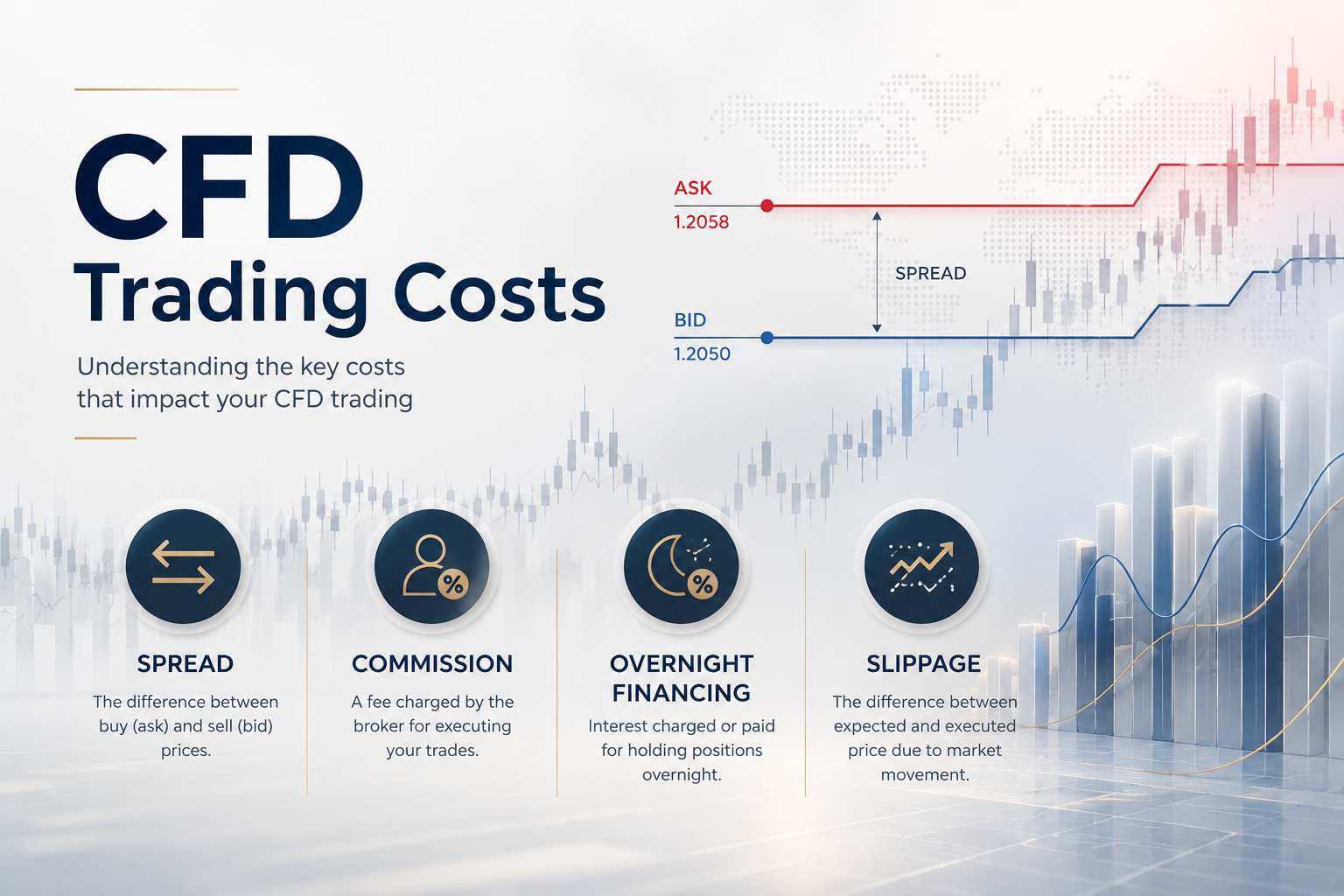
No. Margin is a deposit taken from your own funds and set aside while a position is open. It is returned to your available balance when the position closes. Trading costs such as spreads, commissions, and overnight swaps are separate.
No, but they are linked. Leverage is the multiple of exposure your deposit controls. Margin is the deposit itself, expressed as a percentage of the position. Leverage equals 1 divided by the margin percentage, so 0.2% margin is 1:500 leverage.
Use the formula: contract size times lots times price, divided by leverage. For one lot of EUR/USD at 1.0850 with 1:500 leverage, that is (100,000 × 1 × 1.0850) ÷ 500, or about $217.
As losses grow, free margin falls and your margin level drops. At a set level, the broker issues a margin call, and at a lower level it begins closing positions automatically to limit further loss. Positions can be closed without notice.
Initial margin is what you need to open a position. The maintenance margin is the minimum equity required to keep it open. Falling below maintenance margin triggers a call or close-out.
No. Retail leverage limits are set by each country’s regulator and vary widely. Some cap leverage tightly, some allow more, and a few restrict retail forex trading altogether. Always check the rules and the regulated entity that apply where you live.
The clearest way to hold the idea of margin is this: the deposit tells you what it costs to open a position, but the position size tells you what you stand to gain or lose. A $217 margin and a $108,500 position are the same trade seen from two ends.
That is why experienced traders watch their margin level rather than their balance. The balance can look healthy while the margin level quietly falls toward a close-out. Knowing the formula, knowing your instrument’s leverage cap, and knowing the level at which your account closes positions turns margin from a source of surprises into a number you control.
Disclaimer: This material is for general information purposes only and is not intended as (and should not be considered to be) financial, investment or other advice on which reliance should be placed. No opinion given in the material constitutes a recommendation by EBC or the author that any particular investment, security, transaction or investment strategy is suitable for any specific person.



World's Best Broker