Published on: 2026-06-03
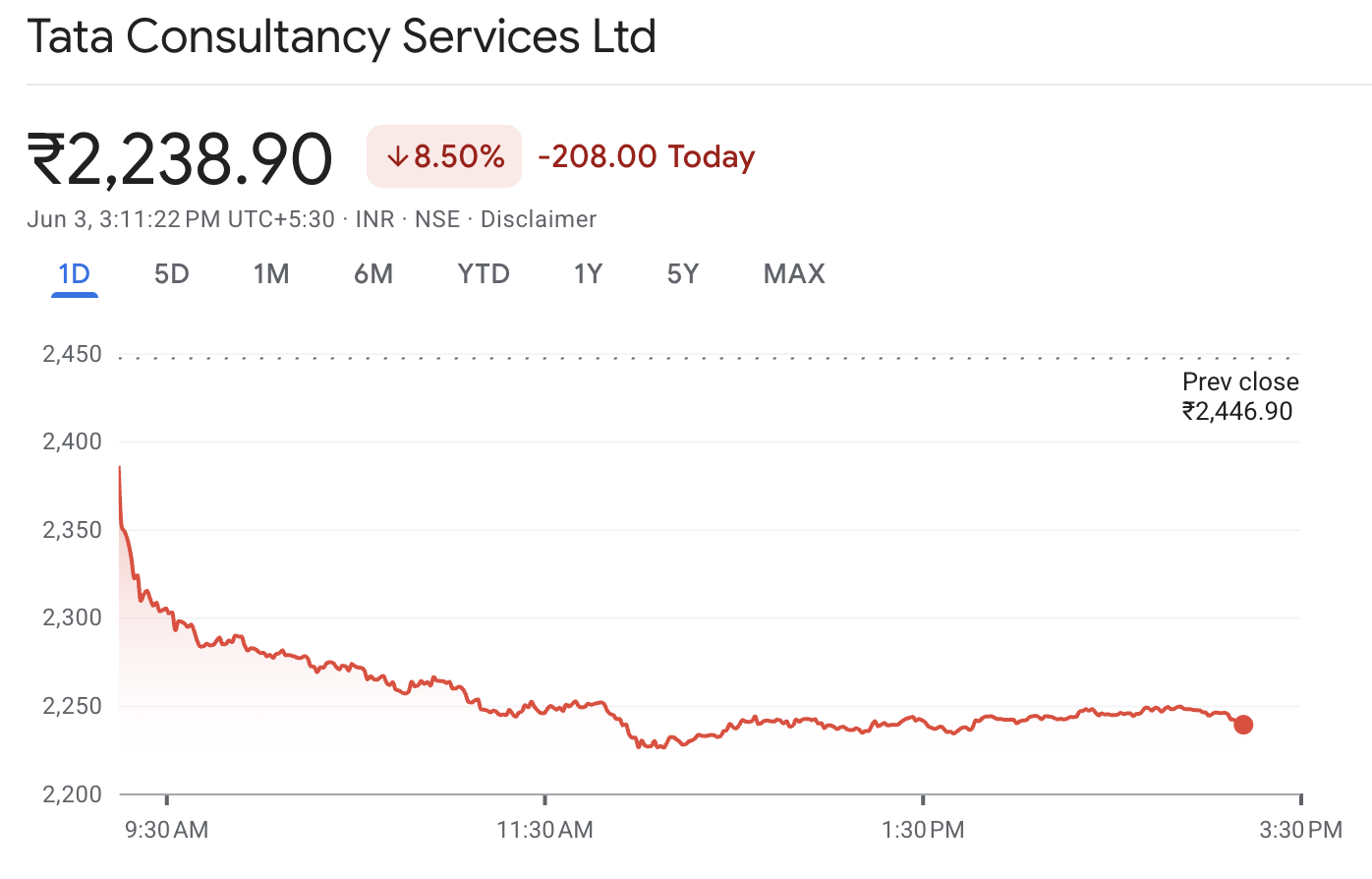
Shares of Tata Consultancy Services fell more than 9% intraday on June 3, 2026, leaving India’s largest IT services company on track for its worst single-day drop since the COVID-era crash. The turn was abrupt. Only days earlier the sector had been climbing, as investors picked back through beaten-down technology names looking for value.
What makes the selloff worth a second look is that TCS had just posted a respectable year: solid deal wins, stable margins, and annualised AI revenue north of $2.3 billion. None of that mattered much on the day. The market skipped past the results and fixed on a tougher question, which is whether India’s traditional IT services model can hold on to growth and pricing power as enterprises move faster on AI.
In other words, this was less a bout of profit-taking than a rethink of what a large IT services business is actually worth in a slower, AI-shaped technology cycle.
TCS shares fell more than 9% intraday, making the stock the single biggest drag on India’s large-cap IT space.
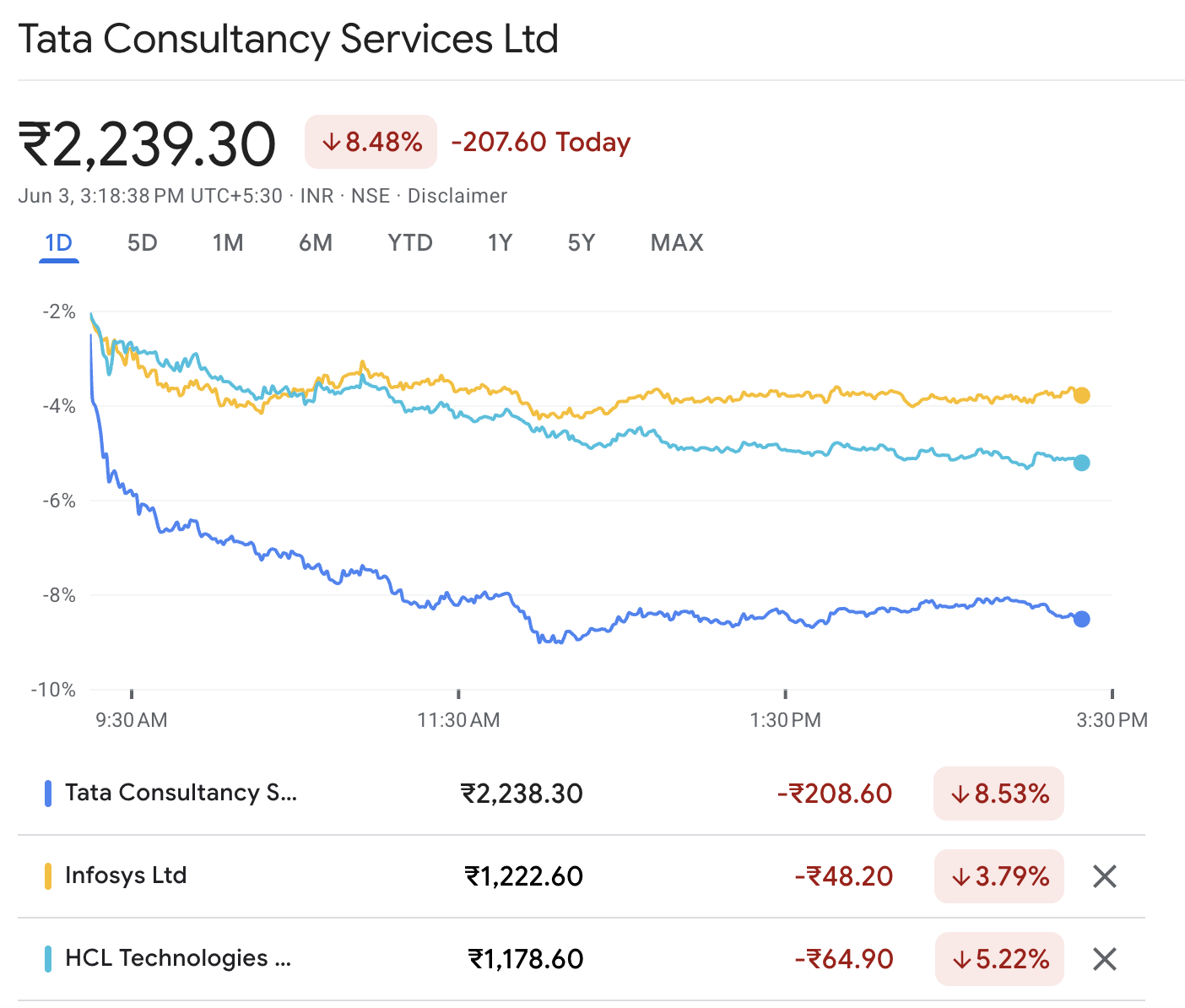
The drop anchored a wider IT selloff, with Infosys, HCL Tech, Wipro and Tech Mahindra all under pressure.
FY26 fundamentals held up, with revenue of $30.0 billion, an operating margin of 25.0% and total contract value of $40.7 billion.
AI cuts both ways, a genuine growth line for TCS at more than $2.3 billion annualised, but also a question mark over future delivery economics.
The technical setup has weakened, with the stock near its 52-week low and trading below its major moving averages.
The debate has moved on, from whether TCS makes money to whether it can grow faster again in a market AI is busy reshaping.
The spark was a broad reversal across Indian IT. The sector had run higher for three straight sessions on a mix of short covering and renewed appetite for large-cap tech, and that move unwound quickly once investors decided to bank the gains and take another look at valuations.
TCS led the way down for a simple reason: it is the stock the market reaches for first whenever sentiment toward Indian IT shifts. Its heavy index weight, deep institutional ownership and blue-chip global client base make it the cleanest proxy for the whole sector, which cuts both ways.
The wider market did not help. Indian equities softened on June 3 under the combined weight of firmer crude, a wobbly rupee, foreign outflows and rising bond yields. That backdrop sharpened the fall, but the selling inside IT had a logic of its own.
This was never about the balance sheet. The market is simply willing to pay less for a business whose growth is still sluggish and whose delivery model, pricing and staffing could all be reshaped by AI.
| Stock / Index | June 3 Signal | Fall Percentage | Market Interpretation |
|---|---|---|---|
| TCS | Down sharply intraday | More than 9% | Main drag on Sensex and Nifty |
| Infosys | Fell with the IT basket | About 4% | Profit-taking after the recent rebound |
| HCL Tech | Lower with the sector | About 3.5% | Large-cap IT sentiment weakened |
| Wipro | Under pressure | About 2% | Broad sector weakness |
| Tech Mahindra | Fell with peers | About 5% | Higher-beta IT names sold off |
| Nifty IT | Reversed after a recent rally | About 3% | Short-term recovery lost momentum |
The breadth of the move is the tell. This was not a governance scare or a balance-sheet problem at a single company. It was a sector-wide reassessment, and TCS took the hardest knock because it carries the sector on its back.
The puzzle with TCS right now is that the operating numbers look fine while the market keeps staring past them.
For FY26, the company reported revenue of $30.0 billion. The operating margin came in at 25.0%, up 70 basis points on the year and the best in four years, with net margin at 19.8%, also a four-year high.
Total contract value reached $40.7 billion for the year, $12.0 billion of it booked in the fourth quarter alone. That is not a company in trouble.
The catch is growth. In reported dollar terms, FY26 revenue actually slipped 0.5%, and in constant currency it fell 2.4%. Read together, the message is that TCS is defending its profitability more successfully than it is rebuilding its top line.
| TCS Metric | FY26 / Q4 FY26 Data | Market Meaning |
|---|---|---|
| FY26 revenue | $30.0 billion | Scale remains intact |
| FY26 revenue growth | -0.5% YoY, -2.4% constant currency | Growth remains soft |
| Q4 FY26 revenue | $7.62 billion | Sequential momentum improved |
| FY26 operating margin | 25.0% | Cost discipline remains strong |
| FY26 net margin | 19.8% | Earnings quality remains resilient |
| FY26 TCV | $40.7 billion | Demand pipeline remains visible |
| Annualised AI revenue | Above $2.3 billion | AI revenue is growing, but still being tested |
So the market is not arguing with this year’s earnings. It is haggling over the multiple, asking how much those earnings are really worth if AI starts to shrink delivery effort, reset client pricing and cap the headcount-led growth that powered the old model.
TCS has a credible answer on AI, and it is worth taking seriously. Big enterprises still need someone to modernise their data, wire AI tools into ageing systems, lock down security and stand up the governance around it all. That is exactly the kind of complex, relationship-heavy work where TCS has scale and decades of client trust. On that reading, AI is a tailwind.
The worry is that the same technology chips away at how the business has always made money. Automate enough of the delivery work and clients will push for lower prices. Shorten development cycles and the labour-heavy billing model starts to look dated.
Add in global firms that are trimming discretionary tech budgets while they experiment with AI in-house, and near-term growth can stay stuck.
That is the tension in a single stock. TCS can show real, growing AI revenue and still get sold, because what investors are really trying to price is whether AI grows the business faster than it erodes the economics of the one already there.
The chart is not doing TCS any favours. The stock is hovering near its 52-week low and sitting below both its 50-day and 200-day moving averages, the kind of structure that says downtrend rather than one-off dip.
| TCS Technical Level | Signal |
|---|---|
| ₹2,206 | 52-week low and immediate downside reference |
| ₹2,245 | Latest intraday zone on June 3 |
| ₹2,415 | 50-day moving average resistance |
| ₹2,879 | 200-day moving average resistance |
| ₹2,500 | Psychological recovery zone |
| Below ₹2,200 | Fresh breakdown risk |
A close beneath the 52-week low would confirm there is more downside in play. Reclaiming the 50-day average, on the other hand, would be the first real evidence that buyers are prepared to step in and defend the name. Short of that, treat any bounce as a relief rally rather than a turn.
A 9% day does not unmake a franchise. TCS is still India’s largest IT services company, with fat margins, sticky client relationships, a full order book and a real AI business underneath all the noise.
What the selloff does say is that the market has lost its appetite for paying premium prices for slow-growing IT services until the shape of the AI transition is clearer.
For anyone holding the stock for years rather than days, three questions matter more than the next print: can AI revenue grow faster than legacy work fades, do the big deal wins finally translate into stronger sales, and can margins survive once clients start asking for their share of AI-driven savings?
For traders, it comes down to one thing: does TCS hold its 52-week low, or does this leg of selling crack it open?
TCS is falling because the market has stopped treating Indian IT as an easy recovery trade. The brief rebound ran straight into the harder question hanging over the sector, which is how much of the old outsourcing model makes it through the AI transition, and at what price.
The fundamentals are not the problem. Margins are high, the pipeline is visible and AI revenue is already material. But share prices look forward, and right now the market is pricing the risk that growth stays soft while AI quietly rewrites the economics of delivery.
That is what makes June 3 more than a bad session. It is a stress test for India’s IT bellwether. TCS has already shown that AI can be an opportunity. The thing left to prove is that it can be a growth engine without hollowing out the margins and the premium valuation that made the stock an institutional favourite in the first place.