Published on: 2026-04-14
Updated on: 2026-04-14
Direct Market Access (DMA) is a trading method that allows investors to place buy and sell orders directly into an exchange’s order book, bypassing traditional manual broker handling.
In today’s fast-moving, electronically driven markets, execution speed and precision can significantly impact trading outcomes, making DMA an important concept for active participants.

Direct Market Access (DMA) is a trading method that enables investors to place orders directly into an exchange’s order book without manual broker intervention.
DMA provides faster trade execution and lower latency, which are critical in volatile, high-frequency trading environments.
Traders using DMA benefit from greater price transparency and control, as they interact directly with real-time market liquidity.
DMA is primarily used by institutional investors, hedge funds, and active traders, rather than long-term or passive investors.
While DMA can improve execution quality, it also requires advanced trading knowledge, risk management, and reliable technology infrastructure.
Direct Market Access refers to a trading setup where orders are transmitted electronically to an exchange with minimal manual intervention. Instead of relying on a broker to process or manage the order, the trader’s instruction is routed straight to the market, where it interacts with real-time buy and sell orders.
This means traders using DMA can:
Place orders at specific price levels
See and react to live market depth (Level 2 data)
Adjust or cancel orders instantly based on market conditions.
DMA is widely supported across major financial markets, including equities, futures, and foreign exchange, through regulated broker infrastructure.
Financial markets in 2026 are shaped by high-speed execution, algorithmic trading, and rapid information flow. Prices can change within milliseconds, especially during macroeconomic events such as inflation releases, central bank decisions, or corporate earnings announcements.
In this environment:
Execution speed directly affects profitability, particularly for short-term strategies.
Liquidity can shift quickly, requiring precise order placement.
Algorithmic and quantitative strategies rely on low-latency access.
DMA helps address these challenges by allowing traders to interact directly with market liquidity, rather than relying on slower, multi-step execution processes.
The DMA process is designed to minimise delays and improve execution efficiency.
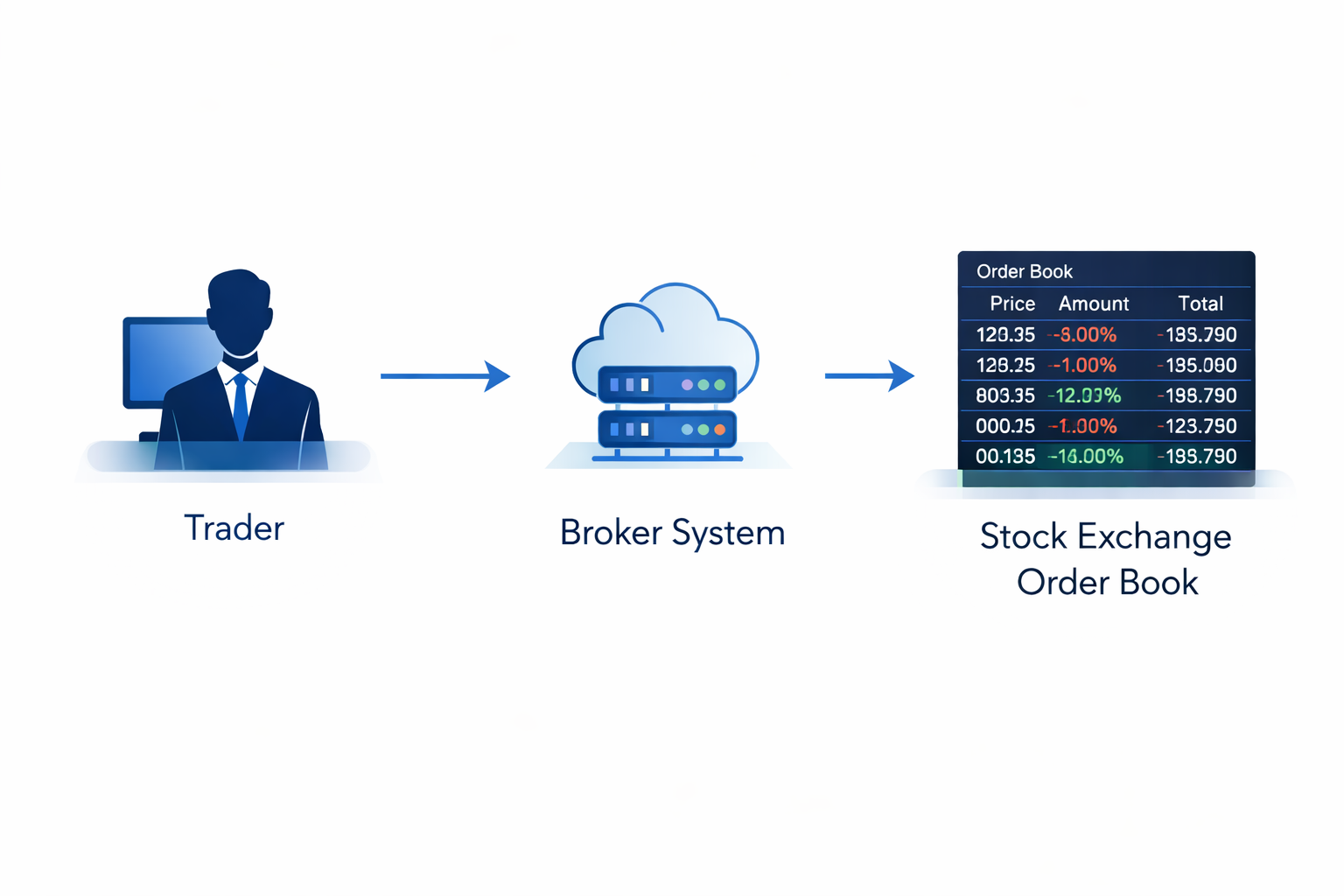
A trader places an order using a DMA-enabled platform.
The order is electronically transmitted to the broker’s system.
The broker performs automated risk checks.
The order is sent directly to the exchange.
The order is matched against available market liquidity.
Execution confirmation is returned in real time.
Although the order goes directly to the exchange, regulated brokers still apply pre-trade risk controls to ensure market stability.
Many retail traders do not use true DMA. Instead, their orders are handled by a broker or market maker.
Understanding this distinction helps traders recognise why execution quality may differ between platforms.
Consider a trader buying shares of Apple Inc. (AAPL) during an earnings announcement.
During such events:
Bid-ask spreads may widen.
Prices can change rapidly within seconds.
With DMA:
The trader can place a limit order within the spread.
Adjust or cancel the order instantly as conditions change.
Potentially achieve a more precise entry price.
Without DMA:
The order may be routed through intermediaries.
Execution may occur at a less favourable price due to delays.
This difference becomes more significant in volatile or high-volume market conditions.
DMA is not necessary for every investor. Its benefits depend on trading style and objectives.
Active traders and short-term strategists
Scalpers and day traders
Algorithmic or quantitative traders
Institutional investors
Long-term investors
Passive ETF investors
Beginners with limited market experience
For many investors, execution precision is less important than overall investment strategy.
DMA provides several advantages for traders who require speed and control:
Faster execution in rapidly changing markets
Greater control over order placement and pricing
Improved transparency through direct order book access
Potential reduction in slippage, particularly in liquid markets
Despite its advantages, DMA also introduces additional complexity and responsibility.
Execution risk: Poorly placed orders can be filled unfavourably
Market impact: Large orders may influence prices
Technology dependency: Requires stable and fast trading systems
Operational complexity: Not beginner-friendly
Regulatory controls: Orders are still subject to broker risk filters
Traders using DMA must have a clear understanding of order types, liquidity, and market conditions.
DMA stands for Direct Market Access. It refers to a trading method where orders are placed directly into an exchange’s order book, allowing traders to interact with real market liquidity without manual broker intervention or dealing desk involvement.
No, DMA does not remove the broker entirely. Brokers still provide trading infrastructure, connectivity, and risk controls. However, they do not manually handle, intervene, or alter the order before it is routed directly to the exchange for execution.
Some advanced brokers offer DMA features to experienced retail traders, typically through specialised platforms or accounts. However, many retail platforms still operate using market maker models, meaning client orders may not be sent directly to the underlying exchange.
DMA does not guarantee better pricing or execution outcomes. However, it provides greater transparency and control over order placement. This allows traders to optimise timing, pricing, and order types, thereby improving execution quality in fast-moving or volatile market conditions.
Active traders depend on speed, precision, and control. DMA enables faster order routing, real-time adjustments, and direct interaction with market liquidity. These advantages are crucial for strategies like scalping, intraday trading, and algorithmic trading in competitive market environments.
Direct Market Access (DMA) is a trading approach that enables investors to place orders directly into an exchange’s order book, offering greater speed, transparency, and control. It is particularly valuable in modern, high-speed markets where execution quality can influence performance. While DMA provides clear advantages for active and professional traders, it also requires a higher level of expertise and technical capability.
Disclaimer: This material is for general information purposes only and is not intended as (and should not be considered to be) financial, investment or other advice on which reliance should be placed. No opinion given in the material constitutes a recommendation by EBC or the author that any particular investment, security, transaction or investment strategy is suitable for any specific person.