Published on: 2025-12-10
Updated on: 2025-12-10
Wall Street is heading into today's Fed decision with nerves showing but no panic. The S&P 500 slipped just 0.1% to 6,840 overnight as traders chose to wait rather than make big bets, while the 10-year Treasury yield has crept up to around 4.18% and the US dollar index (DXY) is holding near 99.2.
Futures markets say this should be the third 25 bp cut of 2025, taking the funds rate from 3.75–4.00% down to 3.50–3.75%, with odds around 85–90% depending on the source.
But this meeting is not about the cut itself. It's about how divided the Fed looks, how hawkish the guidance sounds, and what that means for 2026 cuts and risk assets.
The Fed has already moved twice this year:
September 17, 2025: First cut since December 2024, -25 bp to a 4.00–4.25% target range. New Governor Stephen Miran dissented, wanting a -50 bp move.
October 29, 2025: Second cut, -25 bp to 3.75–4.00%. The Fed also announced it would end balance sheet runoff on December 1. The vote was 10–2, with Miran voting for a bigger cut and Kansas City Fed President Jeff Schmid voting for no cut at all.
So heading into today's meeting:
The current fed funds range is 3.75–4.00%, down 50 bp from mid-September.
The FOMC has already signalled at least one more cut in the 2025 dot plot, with many officials pencilling in a year-end range of 3.50–3.75%.
That's exactly what markets now expect to see delivered today. Additionally, the Fed's September Summary of Economic Projections (SEP) pencilled in three cuts for 2025 and only one for 2026.
With two cuts already delivered, today's move would complete that 75 bp path for 2025, which is why many on the Street are calling this the "final" cut of the year.
The macro backdrop is messy rather than catastrophic:
The Fed's preferred PCE inflation is running around 2.8% year-on-year, above target but not accelerating.
Unemployment has drifted up to about 4.4%, a four-year high, and job growth has cooled.
A long federal government shutdown delayed key data for October and November, including jobs and CPI, leaving the Fed "flying somewhat blind" into this meeting.
So you have inflation still a bit sticky, but a cooling labour market and patchy data visibility. That's the tension driving both the cuts and the internal fight about whether to go further.
Across Fed-watchers, the call is aligned:
Fed funds futures (CME FedWatch) put the odds of a 25 bp cut today at 85–90%.
A strong majority of economists expect a cut to 3.50–3.75%, but few expect a unanimous vote.
Business press coverage repeats the same message: the cut is largely priced; the guidance isn't.
Where things get interesting is after today:
Fed funds markets estimate only a 20–25% chance of an additional cut in January, and 30–40% for March.
Strategists at several banks (e.g. BofA, Morgan Stanley) now expect a shallow 2026 easing path, with just two 25 bp cuts on some forecasts, and they explicitly tie that view to the likely change in Fed leadership next year.
In other words, today's cut is "done" in market terms. What moves assets is whether Powell leans toward "this really is the last for a while" or "we're likely to cut again if data softens."
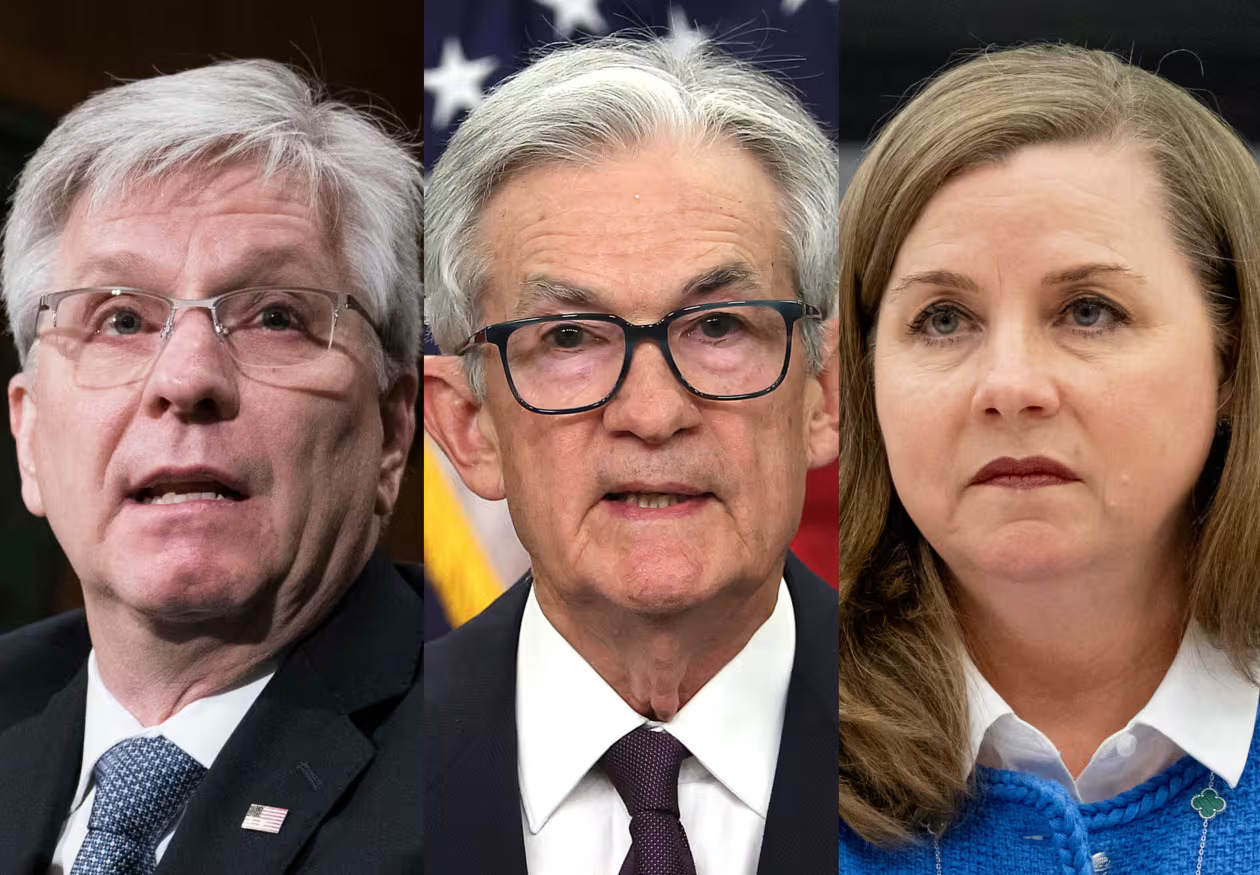
The October meeting already showed the split three ways: a majority for a 25 bp cut, Stephen Miran arguing for 50, and Jeff Schmid wanting no move. Minutes described "strongly differing views" on the December decision.
Since then:
Minutes and subsequent speeches suggest that "many" officials leaned against another cut, even as "most" still saw some further easing as likely in general.
Data flag expectations of two to three dissents, potentially the highest dissent count since the early 1990s. Likely dissenters include Schmid, on the hawkish side, and Miran, who is expected to argue for a larger cut.
It is one of the most divided Feds in recent years, especially with Powell's term ending in May 2026 and political pressure mounting over his successor.
So the market isn't just watching the rate line in the statement. It's also watching how many "no" votes show up and from which camp.
For example:
More hawkish dissents = higher bar for further cuts in 2026.
A lone dovish dissent for a bigger cut = a warning flare about growth, and about how much economic weakness is sitting under the surface.
A very tight vote (7–5) would indicate that this cut is controversial and could be the last unless the data worsens sharply.
That's why we call this a "hawkish cut" meeting: a cut delivered by a divided committee that almost dares markets to price in too much easing.
Put together the strongest threads from mainstream previews:
A widely expected -25 bp cut to 3.50–3.75%.
A new dot plot that:
Keeps 2026 year-end rates higher than markets would like
Signals few, if any, cuts in the first half of 2026.
A larger-than-usual cluster of hawkish "no cut" votes, plus Miran again voting for a bigger move.
That's the textbook hawkish cut: "You get your 25 bp today, but don't assume another one is coming any time soon."
In that setup, the first-order market reaction tends to be:
Equities: Knee-jerk bounce on the cut, then a sell-off as algos read the dots and dissent.
Front-end yields: Higher, as the path for 2026 cuts is marked down.
Dollar: Firmer, as rate differentials stay attractive.
Gold: Vulnerable to a pullback from the $4,200 area if real yields edge up.
The crucial factor is whether this action is interpreted as merely a "sell the news" shake-out or the beginning of a true risk-off period.
| Asset / market | Latest level* | Short-term trend | Key levels in play |
|---|---|---|---|
| Fed funds (target) | 3.75–4.00% | Easing since Sept | Cut to 3.50–3.75% ~90% priced |
| S&P 500 (SPX) | ~6,840 | Slight pullback near highs | Support 6,750 (50-day), deeper 6,600; resistance 6,900+ |
| US 2-year yield | ~3.6% | Drifting higher this week | Support 3.4%; resistance 3.8–3.9% |
| US 10-year yield | ~4.18% | Rising 4th day | Support 4.0%; resistance 4.3–4.4% |
| DXY (US dollar index) | ~99.2 | Firm but range-bound | Support 98.8; resistance 99.8–100 |
| Gold spot | ≈$4,200/oz | Just off record highs | Support around $4,120; resistance $4,250–4,300 |
*Levels rounded from late New York close on December 9, 2025.
None of these markets is positioned for an extreme surprise. They are sized for a cut plus cautious, data-dependent language. Anything that meaningfully deviates from that script will show up fast in 2-year yields, DXY, and growth stocks.
The FOMC wraps up its December 9–10 meeting with a statement scheduled for 2:00 p.m. ET, followed by Powell's press conference around 2:30 p.m. ET in Washington.
Everything points to a 25 bp cut, taking the target range from 3.75–4.00% to 3.50–3.75%.
A "hawkish cut" means rates go down today, but the messaging and projections warn against many more cuts.
A "plain vanilla" 25 bp cut with cautious guidance probably keeps the S&P 500 in its current range, with sector rotation more important than the index move.
Today's Fed decision isn't about whether rates end the day at 3.75% or 3.5%. That part is almost locked in. The real story is whether Jay Powell can deliver what markets want (a final 2025 cut), without giving away more easing than his divided committee is willing to promise.
For traders, that means the focus has to be on three things: the vote count, the 2026 dots, and Powell's language on how much more pain he is willing to tolerate in the labour market to keep inflation in check.
Anything meaningfully more hawkish, or unexpectedly dovish, could reset the path for yields, the dollar, and the late-year equity tape in a hurry.
Disclaimer: This material is for general information purposes only and is not intended as (and should not be considered to be) financial, investment or other advice on which reliance should be placed. No opinion given in the material constitutes a recommendation by EBC or the author that any particular investment, security, transaction or investment strategy is suitable for any specific person.