Published on: 2026-03-11
Updated on: 2026-03-11
For small-account scalpers, the choice between gold vs silver CFDs is not merely a matter of preference.
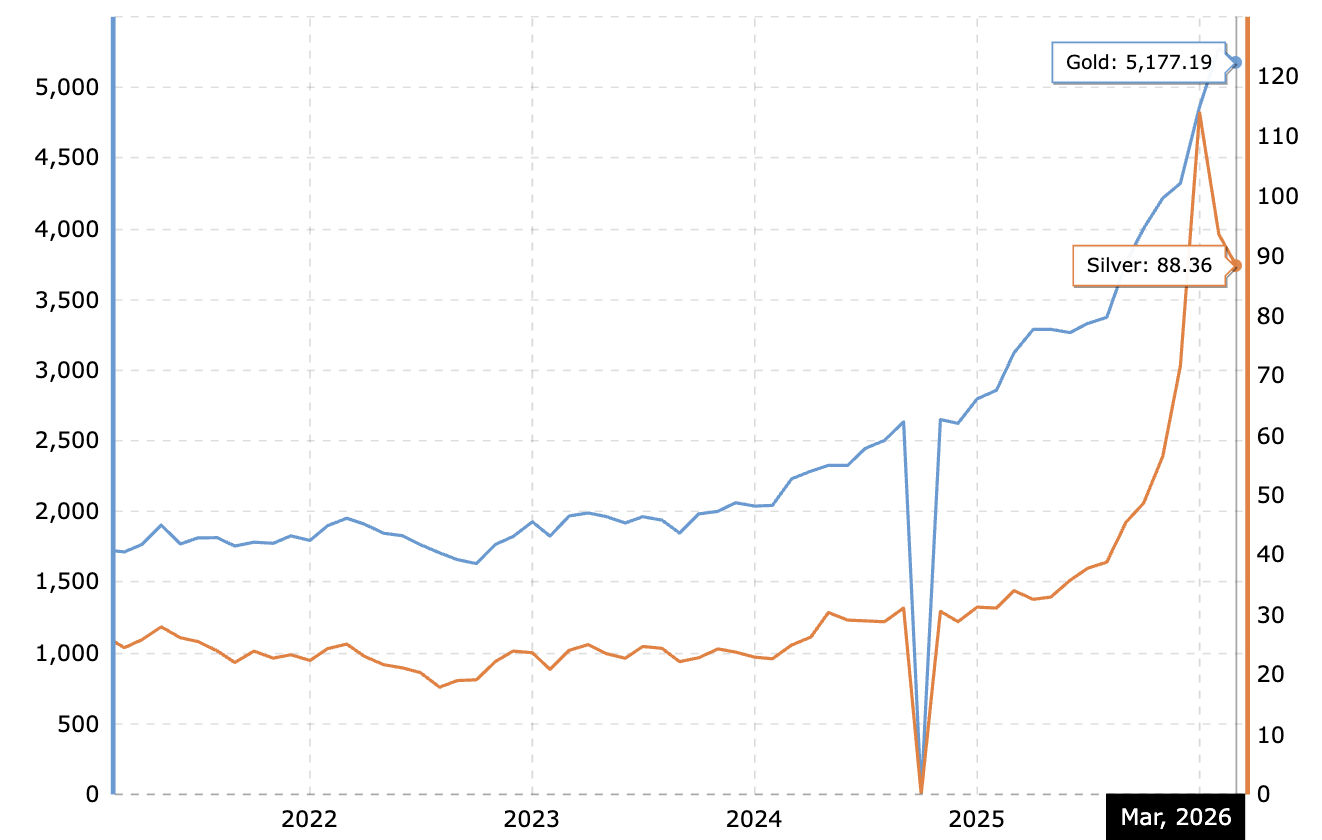
Right now, gold is trading around $5,205 an ounce and silver around $88.22, but the more important number is volatility: CME’s 30-day implied volatility gauge is roughly 32.2 for gold and 80.7 for silver.
Many scalpers treat gold CFDs as a safer instrument for scalping. While silver CFDs can generate larger percentage moves and faster returns, they also result in more frequent stop-outs, greater emotional volatility, and a significantly higher risk of exceeding daily loss limits.

If the primary objective is to remain active in the market long enough to develop trading skills, gold typically warrants priority consideration.
A contract for difference (CFD) enables traders to speculate on the price movement of gold or silver without owning the physical metal. For scalpers, the relevant question is not which metal is inherently “better,” but rather which offers more favorable trading conditions.
The question is which market offers cleaner intraday movement after accounting for spreads, slippage, leverage, and stop placement.
Silver’s lower nominal price can mislead less experienced traders. Although silver appears less expensive per ounce, a lower price does not equate to a safer trade.
Safety is determined by the magnitude of price movements, the frequency of price gaps beyond stop-loss levels, and the amount of leeway required to avoid being stopped out by normal market fluctuations.
Based on these criteria, gold generally exhibits more stable behavior for small accounts due to its lower volatility.
The current macro backdrop is not neutral. The Federal Reserve’s target range is 3.50% to 3.75% as of its latest published update, and the latest fully released U.S. CPI report showed inflation running at 2.4% year over year in January, with core CPI at 2.5%.
Consequently, precious metals continue to trade in an environment influenced by real interest rate sensitivity, inflation expectations, and headline risk, rather than in a low-volatility setting.
Gold also has unusually strong institutional support right now. The World Gold Council said global physically backed gold ETFs recorded a ninth straight month of inflows in February 2026, adding US$5.3 billion, with holdings rising to a record 4,171 tonnes.
The same group reported that central banks bought 863.3 tonnes of gold in 2025, still far above the 2010 to 2021 annual average despite record prices. That matters because official and ETF demand tends to give gold a deeper, more stable macro bid than silver gets.
The first reason is simple: gold is less volatile. CME’s implied volatility measures show the market pricing much larger short-term swings in silver than in gold.
For small-account scalpers, this difference is highly consequential. It directly influences stop-loss placement, position sizing, and the number of losing trades an account can withstand before incurring significant losses.
The second reason is that gold is driven by a cleaner macro framework. Gold mainly trades as a reserve asset, an inflation hedge, a safe-haven vehicle, and a rate-sensitive macro instrument.
Silver shares some of that too, but it also trades as an industrial metal. As a result, silver prices are often influenced by both investment and industrial demand, leading to more complex price dynamics.
Gold CFDs are also usually safer due to path risk. Silver’s 2026 price action has already shown how violent it can be. The Silver Institute noted that silver broke above $100 in January, then fell back below $80 before stabilizing.
If you are scalping, four differences matter more than almost anything else.
Silver normally needs more breathing room. If you place the same relative stop on silver that you use on gold, you are far more likely to get clipped by normal noise.
Due to silver’s greater percentage price movements, position sizes must be reduced more significantly than many traders anticipate. Small-account traders frequently overlook this requirement, focusing instead on silver’s lower nominal price.
Broker spreads vary, but the right way to judge them is not by the raw number alone. Judge them against your average stop and your average target. On a very short scalp, a slightly worse cost structure can turn a decent setup into a negative-expectancy trade.
Silver forces faster decisions. That sounds exciting, but on a small account, it often leads to overstaying losers, cutting winners too fast, and revenge trading after sharp reversals.
Therefore, the safer option is typically not the metal with the largest potential price swings, but rather the one that allows for consistent execution of trading strategies without frequent changes in risk exposure.
There are cases where silver deserves the trade.
If your strategy is built for momentum expansion, silver can outperform gold on days when precious metals are being repriced quickly.
The 2026 backdrop still supports that possibility because silver’s market remains physically tight, investment demand is expected to recover strongly, and its price remains highly sensitive to geopolitical and policy shocks.
Silver can also be useful when you want more movement from the same amount of market exposure. But that only helps if you are disciplined enough to shrink in size properly. Most traders do not get hurt in silver because silver is “bad.” They get hurt because they trade it like gold.
So the real rule is this: silver is better only when the trader is better. If your execution, sizing, and emotional control are not already solid, silver magnifies your weaknesses faster than it rewards your edge.
Gold has a calmer volatility profile, stronger institutional demand structure, and a more stable macro narrative. In the current market, it is also being supported by persistent ETF inflows and durable central bank buying.

Those are not guarantees of profits, but they do help explain why gold often trades in a more orderly way than silver.
Silver is a more volatile instrument and can generate larger intraday percentage moves. In strong trends, it may appear to be the more advantageous trade.
However, for small accounts, increased volatility typically translates to reduced tolerance for errors, which is an unfavorable trade-off when capital is limited.
A good operating framework is straightforward:
Start with gold if your account is small and your edge is still developing.
Use silver only when volatility expansion is part of your plan, not just a hope.
Cut silver size well below gold size.
Compare your broker’s average spread and execution quality in both metals before deciding what is “better.”
Avoid trading either metal like a casino around major data releases unless news volatility is part of your tested setup.
The market does not reward small scalpers for taking excessive risks. Instead, consistent survival and the development of precise trading skills are more likely to yield long-term success.
Usually yes. Gold CFDs tend to have steadier price action and lower volatility, making risk control easier for small-account scalpers.
Silver CFDs are usually more volatile. They can deliver faster moves, but they also increase stop-out risk and account drawdown.
Yes. Gold CFDs are generally easier for beginners because price swings are more manageable and position sizing is less punishing.
Yes, but it is riskier. Silver can move sharply in a short time, so small accounts are more vulnerable to fast losses.
Gold is usually the better choice. It offers a better balance of liquidity, volatility, and control for smaller trading capital.
The best time is when liquidity is strongest and spreads are tighter, usually during major market sessions and key economic releases.
For a small account scalper, the safer choice is gold CFDs.
Silver CFDs are the higher-octane instrument, and there are sessions when that extra speed is exactly what a skilled momentum trader wants.
However, if the objective is to protect capital, minimize variance, and establish repeatable execution strategies in the current 2026 market, gold represents the more prudent choice.
Disclaimer: This material is for general information purposes only and is not intended as (and should not be considered to be) financial, investment or other advice on which reliance should be placed. No opinion given in the material constitutes a recommendation by EBC or the author that any particular investment, security, transaction or investment strategy is suitable for any specific person.