Published on: 2026-06-03
Eurozone inflation is back above the ECB’s comfort zone, but this is not a clean euro-positive rate story. The May inflation rebound has been driven largely by energy, while EUR/USD is trapped between a more hawkish European Central Bank and a dollar that still benefits from yield advantage and defensive demand.
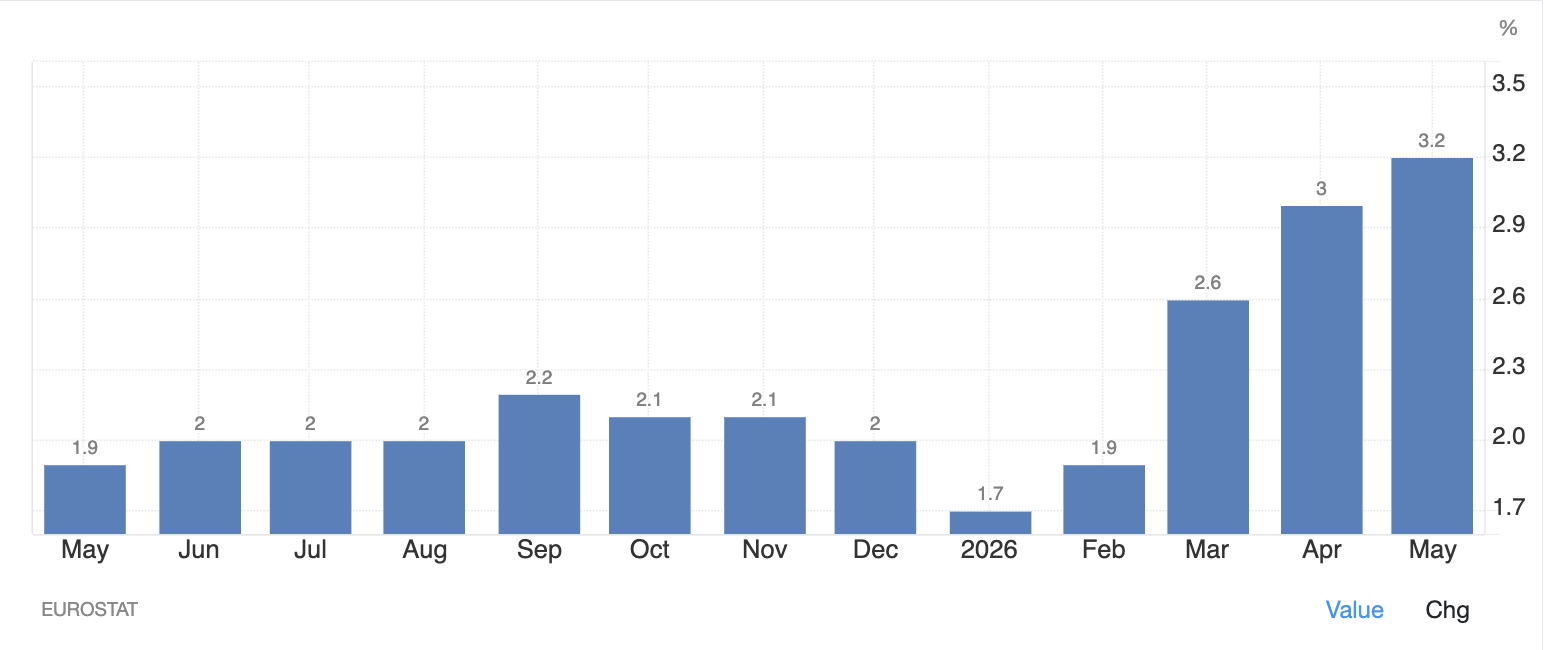
Euro area annual inflation rose to 3.2% in May 2026, up from 3.0% in April, according to Eurostat’s flash estimate. That marked the highest reading since September 2023 and kept inflation well above the ECB’s 2% target just days before the June 11 policy meeting.

The composition matters more than the headline. Energy prices rose 10.9% year on year, while core inflation increased to 2.5% and services inflation reached 3.5%. That mix gives the ECB a difficult problem: the initial shock is external, but the risk of persistence sits inside domestic wages, services and expectations.
Eurozone inflation rose to 3.2% in May, extending a sharp rebound after inflation had moved close to target earlier in the year.
Energy is the main source of the overshoot, with prices up 10.9% year on year and oil and gas costs feeding directly into headline inflation.
Services inflation is the signal to watch, rising to 3.5% in May and raising the risk that an external price shock becomes domestically embedded.
The ECB is under pressure to hike, after holding the deposit rate at 2.00%, the main refinancing rate at 2.15% and the marginal lending rate at 2.40% in April.
EUR/USD has not rallied cleanly, because higher inflation is lifting rate expectations but also weakening the eurozone’s growth and terms-of-trade outlook.
The euro’s best bullish case is not simply an ECB hike. It is energy prices stabilising while the ECB remains cautious about declaring inflation under control.
The speed of the move is important. Eurozone inflation was near target at the start of the year, then moved higher through spring. By May, the annual rate had reached 3.2%, reversing the disinflation narrative that dominated much of 2024 and 2025.
This is not yet a broad-based demand surge. Food inflation has been contained, non-energy goods inflation remains subdued and core inflation is far below the levels seen during the 2021 to 2022 shock. The problem is that energy is powerful enough to lift the headline rate quickly, and services are sticky enough to make the ECB uncomfortable.
| Eurozone Inflation Component | May 2026 Reading | Market Interpretation |
|---|---|---|
| Headline HICP | 3.2% | Back above target and rising |
| Energy | 10.9% | Main source of the shock |
| Core inflation | 2.5% | Firmer, but not yet broad inflation stress |
| Services | 3.5% | Key second-round risk |
| Food, alcohol and tobacco | 2.0% | Contained relative to headline |
| Non-energy industrial goods | 0.9% | Still subdued |
That is the central distinction for markets. If inflation remains mostly energy-led, the ECB can argue that part of the overshoot should fade. If higher energy costs feed into wages, services and inflation expectations, the central bank loses that flexibility.
Central banks usually avoid overreacting to commodity shocks. Monetary policy cannot create energy supply, lower shipping costs or reverse external supply disruptions. A rate hike does not reduce oil demand in a precise or immediate way.
The ECB’s problem is credibility. After the inflation surge of 2021 and 2022, policymakers have less room to tolerate another overshoot, even if the source is outside domestic demand. Inflation expectations shape wage bargaining, corporate pricing and household behaviour. Once they drift, the cost of restoring credibility rises.
The ECB kept policy rates unchanged on April 30. The deposit facility rate remained at 2.00%, the main refinancing rate at 2.15% and the marginal lending facility at 2.40%. But May’s inflation print makes a June hike harder to avoid, with markets now pricing a very high probability of a 25-basis-point increase.
The rate decision itself may not be the most important event. The ECB’s updated staff projections will matter more. In March, the ECB’s forecast showed inflation averaging 2.6% in 2026, then returning to 2.0% in 2027 and 2.1% in 2028. If the new forecasts push 2027 inflation above target, traders will treat a June hike as the start of a tightening phase rather than a one-off adjustment.
In a normal cycle, higher inflation can support a currency. It raises expected interest rates, lifts front-end yields and attracts capital.
This episode is different.
The eurozone is a large net energy importer. Higher oil and gas prices weaken its terms of trade, raise input costs for firms and reduce household purchasing power. That means inflation is rising while growth remains fragile. Eurostat’s preliminary flash estimate showed euro area GDP grew only 0.1% in the first quarter of 2026, after 0.2% growth in the fourth quarter of 2025.
That is why EUR/USD has not responded as a simple rate-hike trade. The market is not seeing this as a healthy demand-led tightening cycle. It is seeing the ECB pushed toward tighter policy by a supply-side inflation shock.
The dollar also retains support from rate differentials. Even if the ECB lifts the deposit rate to 2.25%, the Federal Reserve’s policy range remains higher, keeping carry tilted toward the dollar. Defensive flows during periods of energy stress also tend to favour the dollar over the euro.
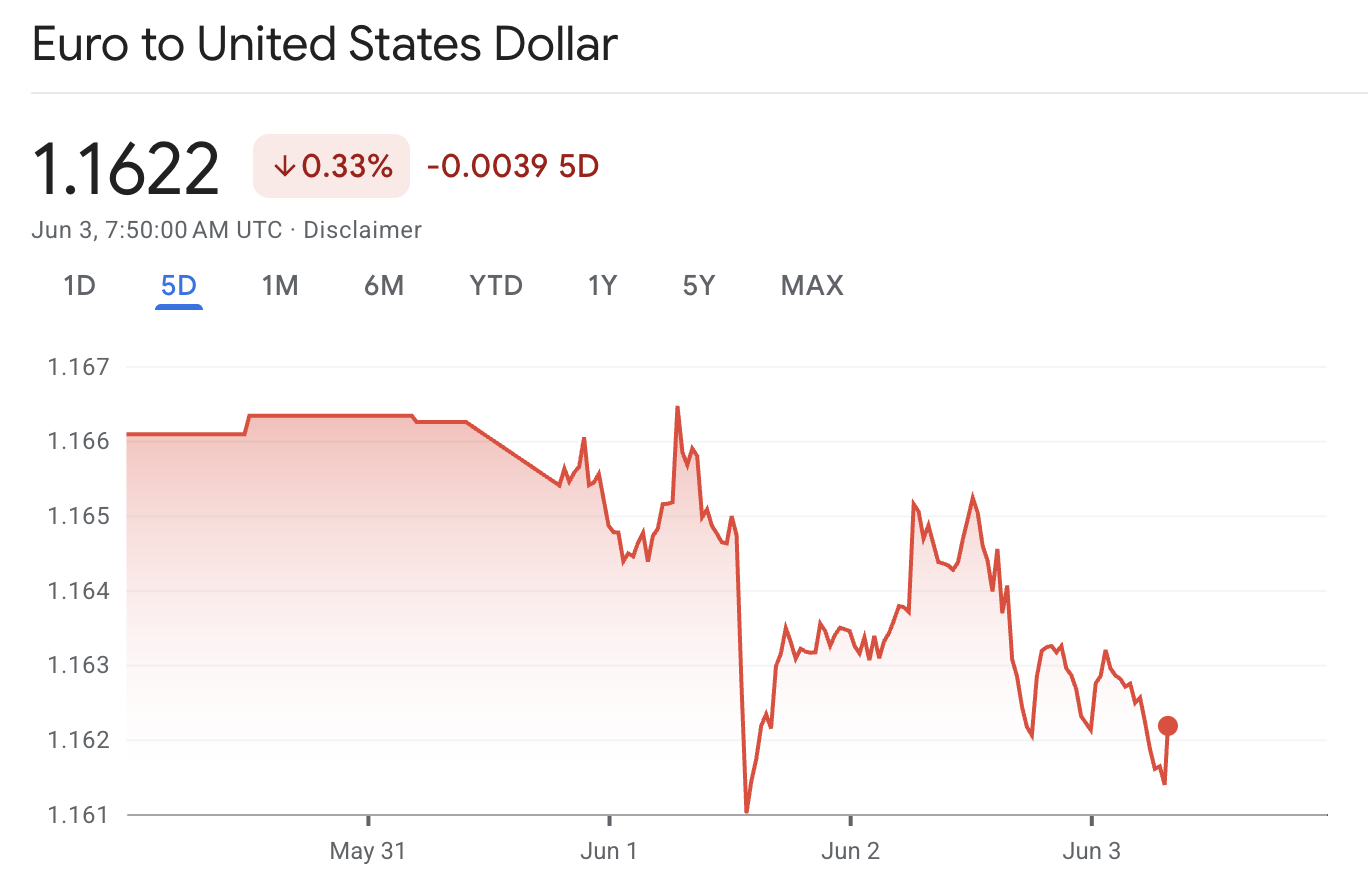
EUR/USD was fixed at 1.1649 on June 2, according to the ECB reference rate. The pair remains well below its January 2026 high near 1.1974, even as ECB tightening expectations have risen.
The disconnect is logical. The ECB may be turning more hawkish, but it is doing so for the wrong macro reason.
| Scenario | Inflation Driver | ECB Signal | Likely EUR/USD Impact |
|---|---|---|---|
| Energy prices stabilise | External shock fades | Hawkish bias remains | Euro-positive |
| Services inflation stays above 3.5% | Domestic persistence | More hikes priced | Short-term euro-positive, but growth risk rises |
| Oil rises further | Terms-of-trade shock deepens | ECB forced tighter | Euro-negative despite higher rates |
| Fed stays hawkish | U.S. yield advantage remains | ECB impact diluted | EUR/USD capped |
| Energy supply risks ease | Dollar defensive bid fades | ECB remains cautious | Best bullish euro setup |
The strongest bullish case for the euro is not simply a June rate hike. It is a combination of stabilising energy prices, reduced defensive demand for the dollar and an ECB that remains unwilling to declare victory on inflation.
The bearish case is the opposite. If energy prices rise further, EUR/USD could weaken even as eurozone inflation moves higher. That would be a classic stagflationary currency response: higher prices, weaker growth and a weaker currency.
EUR/USD is sitting in a policy-sensitive range. The 1.1600 to 1.1700 zone has become the near-term battleground between ECB repricing and dollar resilience.
A sustained break above 1.1700 would suggest traders are treating a June ECB hike as more than defensive insurance. It would point to rising confidence that European yields can support the euro.
A break below 1.1600 would send a different message. It would imply the market sees the inflation shock as more damaging to growth than supportive for rates.
| EUR/USD Level | Market Meaning |
|---|---|
| Above 1.1800 | Broad euro recovery gains traction |
| Above 1.1700 | ECB repricing starts to support spot |
| 1.1600 to 1.1700 | Policy consolidation zone |
| Below 1.1600 | Dollar and stagflation risks dominate |
| Below 1.1500 | Euro weakness becomes more structural |
The near-term bias is conditional. EUR/USD can rise if the ECB sounds hawkish and energy markets stabilise. It remains vulnerable if oil rises, U.S. yields stay firm or the ECB frames a June hike as a temporary adjustment rather than the start of a cycle.
Services is the bridge between an external energy shock and persistent inflation. If services inflation stays at 3.5% or rises further, the ECB will have a stronger case for additional tightening.
The June inflation forecast matters more than the rate decision itself. A 2027 projection above 2% would be the clearest signal that policymakers see the shock as more durable.
Energy is now the euro’s macro pressure point. Lower oil and gas prices would reduce stagflation risk and help the euro. Another rise would likely support the dollar more than the euro.
EUR/USD remains a two-central-bank trade. If the Fed keeps its policy stance firm, one ECB hike will not be enough to materially change the rate differential.
Eurozone inflation is back, but this is not the kind of inflation that gives the euro an easy tailwind.
The May print strengthens the case for an ECB hike, but it also exposes the weakness of Europe’s position. The eurozone is absorbing an energy shock while growth is barely positive. That makes the coming rate hike defensive, not celebratory.
For EUR/USD, the policy signal is mixed. Higher ECB rates can support the euro at the margin, but energy-led inflation damages the growth outlook and keeps the dollar supported through carry and defensive demand.
The cleanest market read is this: the euro does not need inflation to rise further. It needs the inflation shock to stop behaving like a drag on growth.
Until that happens, EUR/USD is less a pure ECB trade than a test of whether Europe can absorb higher energy prices without losing economic momentum.