Published on: 2026-05-28
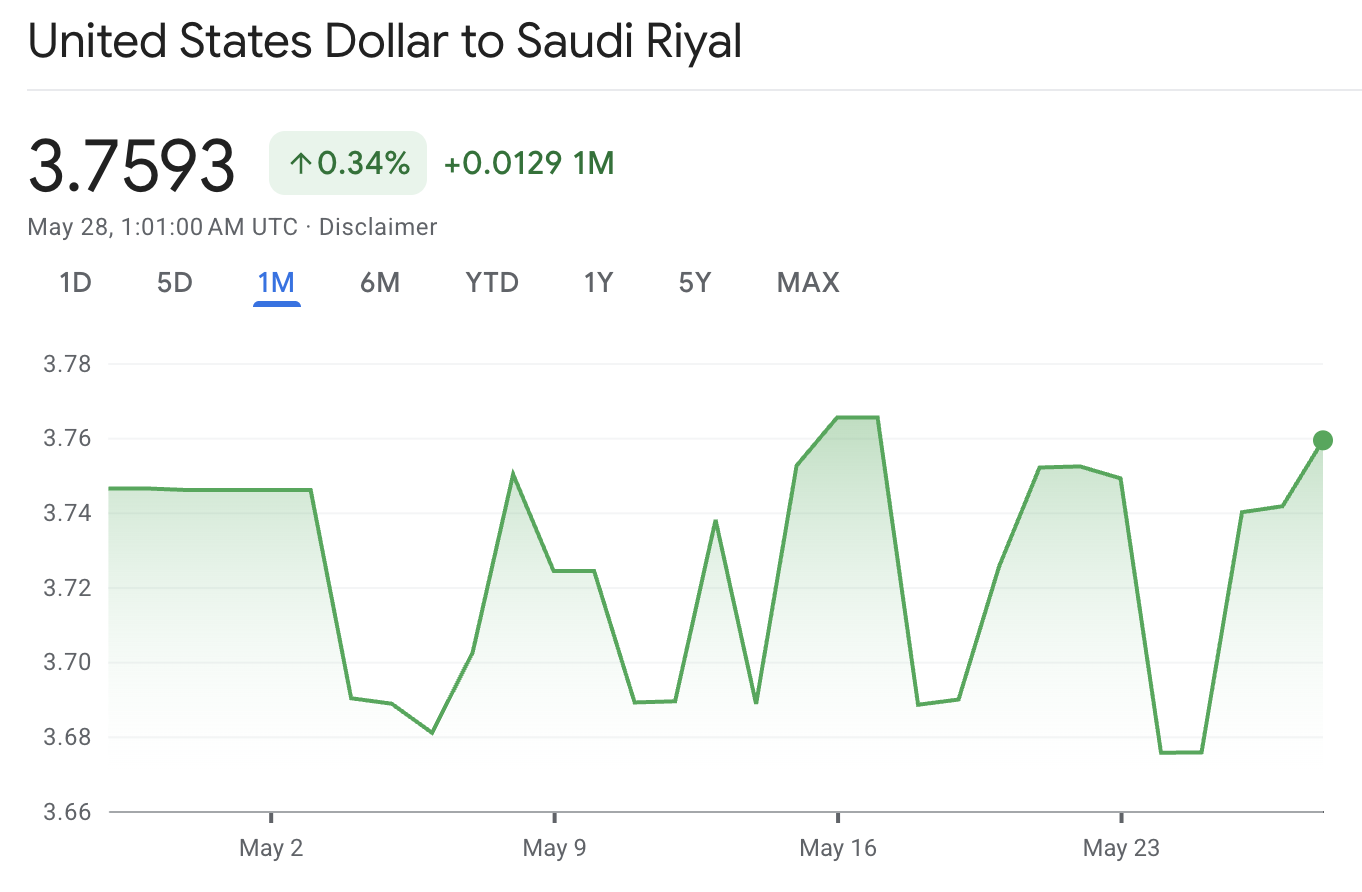
USD/SAR is one of the quietest major currency pairs on the screen. The Saudi riyal has been pegged to the US dollar near 3.75 for four decades, the chart barely moves, and conventional technical analysis finds almost nothing to work with.

But here is the thing: stability by design is not the same as irrelevance. The real signal in USD/SAR does not come from daily price movement. It comes from the conditions that make the peg credible in the first place, namely foreign reserves, oil revenue, US interest rates and domestic liquidity.
USD/SAR is stable because the Saudi riyal is pegged to the US dollar at SAR 3.75.
The pair’s main signal is not volatility. It is confidence in the peg.
SAMA reserve assets, oil revenue and domestic liquidity matter more than short-term chart movement.
The peg imports US monetary policy into Saudi Arabia because local rates must stay broadly aligned with dollar conditions.
USD/SAR becomes worth watching most during stress periods, when oil prices, reserves or funding conditions come under simultaneous pressure.
The Saudi riyal is not a free-floating currency. The Saudi Central Bank, SAMA, maintains the riyal’s fixed exchange rate against the dollar, and has done so at SAR 3.75 per USD since 1986. That is not a soft target or a managed float. It is a hard peg, backed by an institutional commitment that has held through oil price crashes, geopolitical shocks and multiple global financial crises.
For anyone approaching USD/SAR expecting the kind of volatility that defines pairs like EUR/USD or USD/JPY, the experience is disorienting. The spot rate does not deliver the usual information. That does not mean the pair has nothing to say. It means the information is being transmitted through different channels.
Because USD/SAR barely moves, traders and macro analysts have to look elsewhere for the signals that matter. The table below captures what those signals are and what each one is actually measuring.
| Signal | What it shows |
|---|---|
| Foreign reserves | The balance-sheet strength behind the peg |
| Oil revenue | The main external income source supporting dollar liquidity |
| US interest rates | The policy anchor Saudi rates must broadly follow |
| Domestic liquidity | Whether the banking system is under funding pressure |
| Forward points | Whether markets are pricing stress or confidence in the peg |
| Fiscal spending | Whether external income is sufficient to support investment plans |
Reading USD/SAR through this lens changes the question entirely. Instead of asking why the spot rate moved, a more useful question is whether the conditions that underpin the peg are becoming stronger or weaker. A stable exchange rate with reserves rising and oil revenue healthy reads very differently from a stable exchange rate with reserves falling and a fiscal deficit widening. The spot price looks identical in both scenarios. The underlying signal does not.
Foreign reserves are the buffer that lets a central bank defend a fixed exchange rate. If the riyal ever came under selling pressure, SAMA could use its dollar reserves to buy riyals and hold the peg near 3.75. The credibility of that commitment depends directly on the size and direction of those reserves.
Saudi Arabia’s foreign reserve assets stood at around SAR 1.855 trillion in April 2026, based on the latest reported monthly data. In US dollar terms, that is roughly USD 495 billion at the peg rate. Saudi Arabia’s reserve position remains large by international comparison, with import-cover estimates around 22 months, well above the global average often cited near six months.
That is a meaningful buffer. It does not make the peg invulnerable, but it makes a credible speculative attack against it difficult to sustain under current conditions. The stronger signal from reserves is not the absolute level alone, but the direction of travel. A stable USD/SAR spot rate with rising or steady reserves sends a different message from a stable rate with reserves in persistent decline.
One of the most important things the peg does is disconnect oil price volatility from the spot exchange rate. Brent crude can swing sharply in a quarter and USD/SAR may barely move. That can give a misleading impression that oil is irrelevant to the currency picture. It is not.
Oil revenue flows through the Saudi economy in ways that directly affect the peg’s durability. Stronger oil income improves the current account, adds to dollar inflows, supports reserve accumulation and allows the government to fund long-term investment plans without drawing down external buffers. Weaker oil income runs those dynamics in reverse, tightening domestic liquidity, slowing reserve growth and increasing fiscal pressure.
USD/SAR may not move every time oil moves. But oil revenue shapes the conditions that make the peg credible, and those conditions are continuously evolving beneath the surface of a chart that appears to show very little.
This is the part of the USD/SAR story that macro readers tend to underestimate. Because the riyal is pegged to the dollar, Saudi monetary policy cannot fully decouple from the Federal Reserve. SAMA does not set interest rates to manage domestic inflation or growth in isolation. It manages them in reference to dollar conditions, because diverging too far can create pressure through capital flows and funding markets.
SAMA cut its repo rate by 25 basis points to 4.25% and its reverse repo rate by 25 basis points to 3.75% in December 2025. The move followed global monetary developments and preserved the policy alignment required under the dollar peg.
The practical implication is significant. When the Fed held rates high through 2023 and much of 2024, Saudi funding conditions stayed tighter than the domestic economy might otherwise have required. When the global rate cycle turned lower, SAMA gained room to ease as well.
That transmission is largely unavoidable under a fixed exchange-rate regime. It means US monetary policy is not just a global backdrop for Saudi Arabia. It is an active input into domestic financial conditions, regardless of where oil sits.
The peg is a robust institutional arrangement and it has survived serious stress tests. But robust is not the same as unconditional. USD/SAR becomes worth monitoring most closely when several pressure points arrive together rather than in isolation.
The relevant stress indicators are: a sustained drop in oil prices that compresses dollar inflows; a persistent decline in reserve assets rather than the accumulation trend seen recently; signs of tightening domestic liquidity in the banking system; forward markets starting to price risk rather than confidence; US rates staying elevated while the Saudi economy needs easier conditions; and fiscal spending accelerating faster than external income can support.
None of those conditions points to imminent peg risk under the current environment. Reserve assets remain substantial, the rate-cut cycle has created some room for easier funding conditions, and Saudi Arabia’s diversification agenda continues to reduce the economy’s single-channel dependence on oil over time.
But the framework above is what informed analysts are tracking beneath the surface of a spot price that, by design, does not move much.
For most traders, USD/SAR is not a volatility trade. The peg makes sure of that. What it offers instead is a confidence gauge for one of the world’s most strategically important economies.
The spot rate near 3.75 tells readers the regime is intact. What surrounds it tells them whether that stability is becoming easier or harder to maintain. Rising reserves, healthy oil revenue and a rate cycle that gives SAMA room to ease all reinforce the peg. Falling reserves, oil price weakness and a prolonged high-rate environment in the US tighten the conditions under which that commitment is held.
For investors with exposure to Saudi equities, real estate, infrastructure or Gulf fixed income, those underlying signals matter directly. USD/SAR is not the trade. It is the frame through which the macro picture becomes legible.
USD/SAR teaches an important FX lesson: a quiet exchange rate does not mean an empty signal. In a fixed exchange-rate system, the most useful information often sits outside the chart entirely, in reserves, oil revenue, interest rates and liquidity conditions.
The Saudi riyal’s peg to the dollar at 3.75 has held since 1986 and remains backed by a substantial reserve position. The signal is not where the pair is trading. The signal is everything that determines whether it can stay there.