Published on: 2026-03-27
Updated on: 2026-03-27
Week 14 arrives with an unusual setup: the most important US macro release of the month lands on Good Friday. That means March payrolls will hit at 8:30 a.m. ET on April 3, while the NYSE is closed. For traders, this is not just a data week. It is a liquidity week, a rates-repricing week, and potentially a gap-risk week into Monday's reopen.
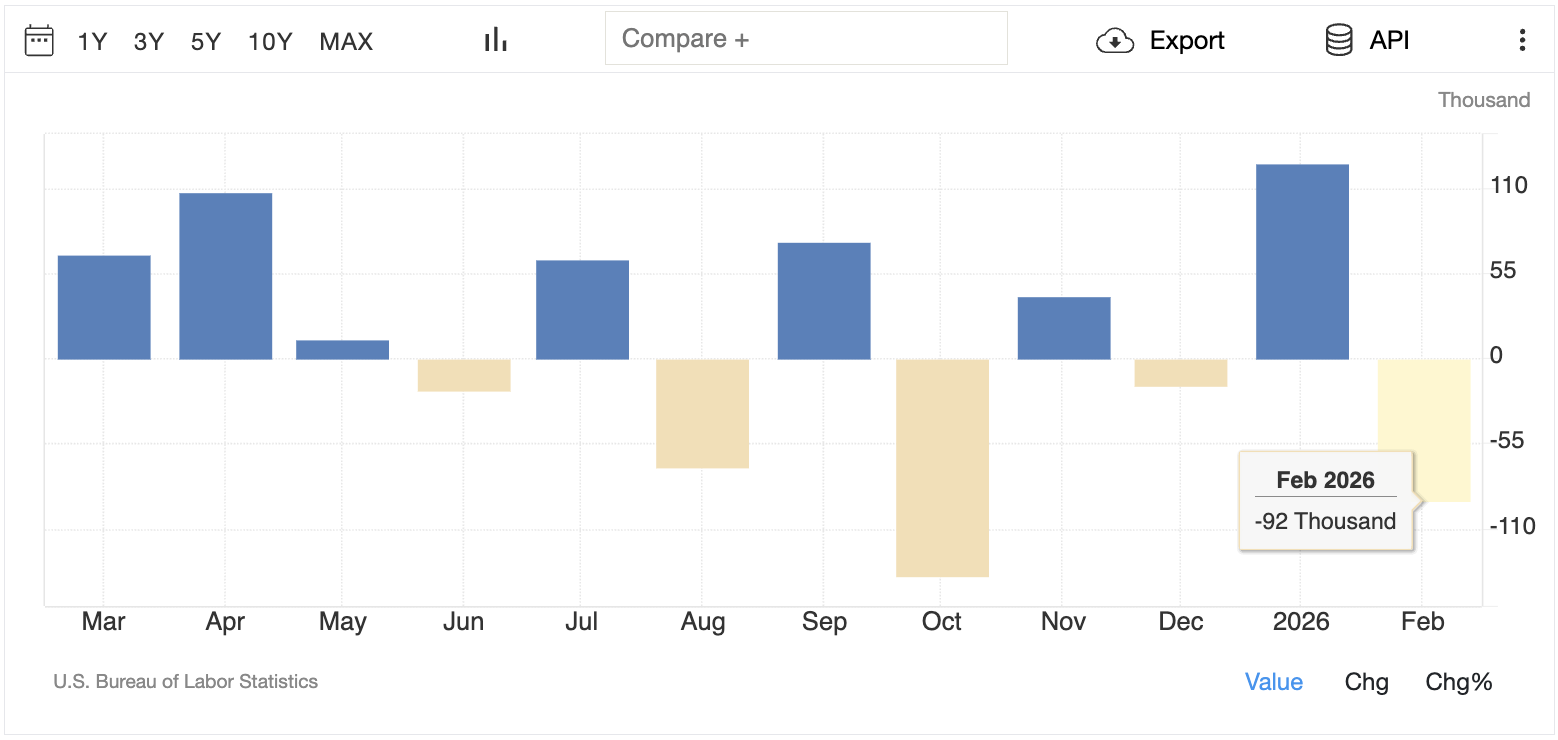
The backdrop is already tense. The Federal Reserve maintained interest rates at 3.5 to 3.75 percent on March 18 and still projects the year-end policy rate at 3.4 percent. However, February payrolls decreased by 92,000, while unemployment remained steady at 4.4 percent.
At the same time, oil has surged back above $100, the S&P 500 has logged five straight weekly losses, and the Nasdaq has slipped into correction territory. Therefore, week 14's data will be judged less on whether growth is slowing and more on whether the slowdown is becoming policy-relevant.
| Day | Catalyst |
|---|---|
| Monday, March 30 | Quarter-end and month-end positioning |
| Tuesday, March 31 | JOLTS, 10:00 a.m. ET |
| Wednesday, April 1 | ADP, 8:15 a.m. ET; ISM Manufacturing, 10:00 a.m. ET |
| Thursday, April 2 | US trade, 8:30 a.m. ET; weekly claims, 8:30 a.m. ET |
| Friday, April 3 | Employment Situation, 8:30 a.m. ET; ISM Services, 10:00 a.m. ET; Good Friday |
The Fed's latest projections still describe a sturdy economy, with 2026 GDP growth at 2.4 percent, unemployment at 4.4 percent, and PCE inflation at 2.7 percent. That is not a recession template.
However, it is also not a clean disinflation story, particularly with Powell flagging higher near-term inflation pressure from energy and February core PCE running at an estimated 3.0 percent.
That puts Week 14 at the center of the policy debate. February already delivered one labor shock, with payrolls down 92,000. JOLTS job openings were 6.946 million in January, quits were 2.0 percent, and the latest ADP pulse suggested private hiring had slowed to single-digit thousands per week by late February and early March.
If week 14 reports confirm softer labor demand while ISM price gauges stay firm, markets will have to price a more uncomfortable mix: weaker growth, sticky inflation, and less clarity on the Fed reaction function.

The market no longer needs a soft jobs narrative. It already has one. What it needs now is confirmation. February payrolls fell by 92,000, unemployment held at 4.4 percent, and Powell acknowledged that job gains have remained low and labor demand has softened.
A second weak payroll print would shift the debate from "slower hiring" to "broadening labor slack."
ISM is crucial because it can move both sides of the market simultaneously. Manufacturing PMI stood at 52.4 in February, but the prices index jumped to 70.5. Services PMI was even stronger at 56.1, with prices still elevated at 63.0.
If March repeats that pattern, traders may get softer labor data without the bond rally they expect, because inflation-sensitive components remain uncomfortably firm.
This is the structural risk of the week. The NYSE is closed on Friday, April 3, the day the employment situation is released.
In practice, this increases the likelihood of significant movements in interest rates and foreign exchange futures, weaker price discovery across assets, and a postponed reaction in cash equity markets until Monday. That last point is an inference based on the holiday calendars.
| Asset / Market | What to watch | Likely reaction |
|---|---|---|
| US front-end rates | Payrolls and ISM | Softer data would likely push the two-year yield lower; stronger jobs and hotter ISM prices could drive a sharp selloff in the front end |
| US Dollar / USDJPY | US rate repricing | USD/JPY should remain highly sensitive to changes in US rate expectations; broader dollar strength would also fit a more hawkish inflation view |
| Equities | Growth and risk sentiment | Stocks look more fragile than usual, with the Nasdaq already in correction territory and the S&P 500 coming off five straight weekly losses |
| Gold | Growth fear vs. real rates | Gold can benefit from growth concerns and geopolitical demand, but rising real-rate expectations could limit the upside |
| Crude / Brent | Inflation sensitivity | Brent above $100 keeps inflation pressure elevated and continues to affect pricing across other asset classes |
Payrolls rebound modestly from February's contraction, unemployment stays near 4.4 percent, and both ISM reports remain in expansion territory.
That would keep the Fed's broad message intact: growth is still positive, labor is cooling but not breaking, and inflation is easing too slowly for aggressive easing.
Payrolls undershoot again, unemployment rises, and ISM employment or new orders components soften materially.
That mix would likely pull front-end yields lower, weaken the dollar, and give beaten-down growth equities room for a relief rebound, particularly if oil stabilizes.
Payrolls have recovered strongly, wages have surprised on the high side, and ISM prices remain elevated, while oil prices remain high.
In that scenario, the market could reprice away from cuts and toward a longer hold, with higher Treasury yields, firmer dollar performance, and renewed pressure on rate-sensitive equities.
The headline payroll number matters, but the broader market signal will be more important. Revisions, unemployment, hours worked, and wage growth will shape the rates move far more cleanly than payrolls alone. The same is true for ISM.
The top-line PMI attracts attention, but prices paid, employment, and new orders will determine whether the report is seen as a disinflationary slowdown or inflationary resilience.
Execution matters as much as macro next week. Friday's holiday setup means traders should think about venue, not just direction. Thin liquidity, wider spreads, and incomplete cross-asset confirmation can still undermine a clean macro view. That is the real Week 14 hazard.
In conclusion, Week 14 revolves around a central question: Is the US economy soft enough to influence the rate discussion, or simply soft enough to disturb markets without providing relief?
Payrolls and ISM will answer that question, but Good Friday may distort how the answer is priced.
Disclaimer: This material is for general information purposes only and is not intended as (and should not be considered to be) financial, investment or other advice on which reliance should be placed. No opinion given in the material constitutes a recommendation by EBC or the author that any particular investment, security, transaction or investment strategy is suitable for any specific person.