Published on: 2026-03-25
Updated on: 2026-07-20
A double top is a bearish reversal pattern that forms after an uptrend and looks like the letter M. A double bottom is a bullish reversal pattern that forms after a downtrend and looks like the letter W.
Both signal that a trend may be running out of strength, but they point in opposite directions. The double top warns that buyers are losing control. The double bottom shows that sellers are losing control.
A double top (M shape) forms after an uptrend and signals a possible move down. A double bottom (W-shaped) forms after a downtrend and signals a possible move higher.
Neither pattern is confirmed until price closes beyond the neckline. Acting early is the most common and most costly mistake.
The measured target is the height of the pattern projected from the neckline. Treat it as a probability, not a promise.
These patterns fail a meaningful share of the time. In tested data, even the classic double top reaches its target only about 43% of the time.
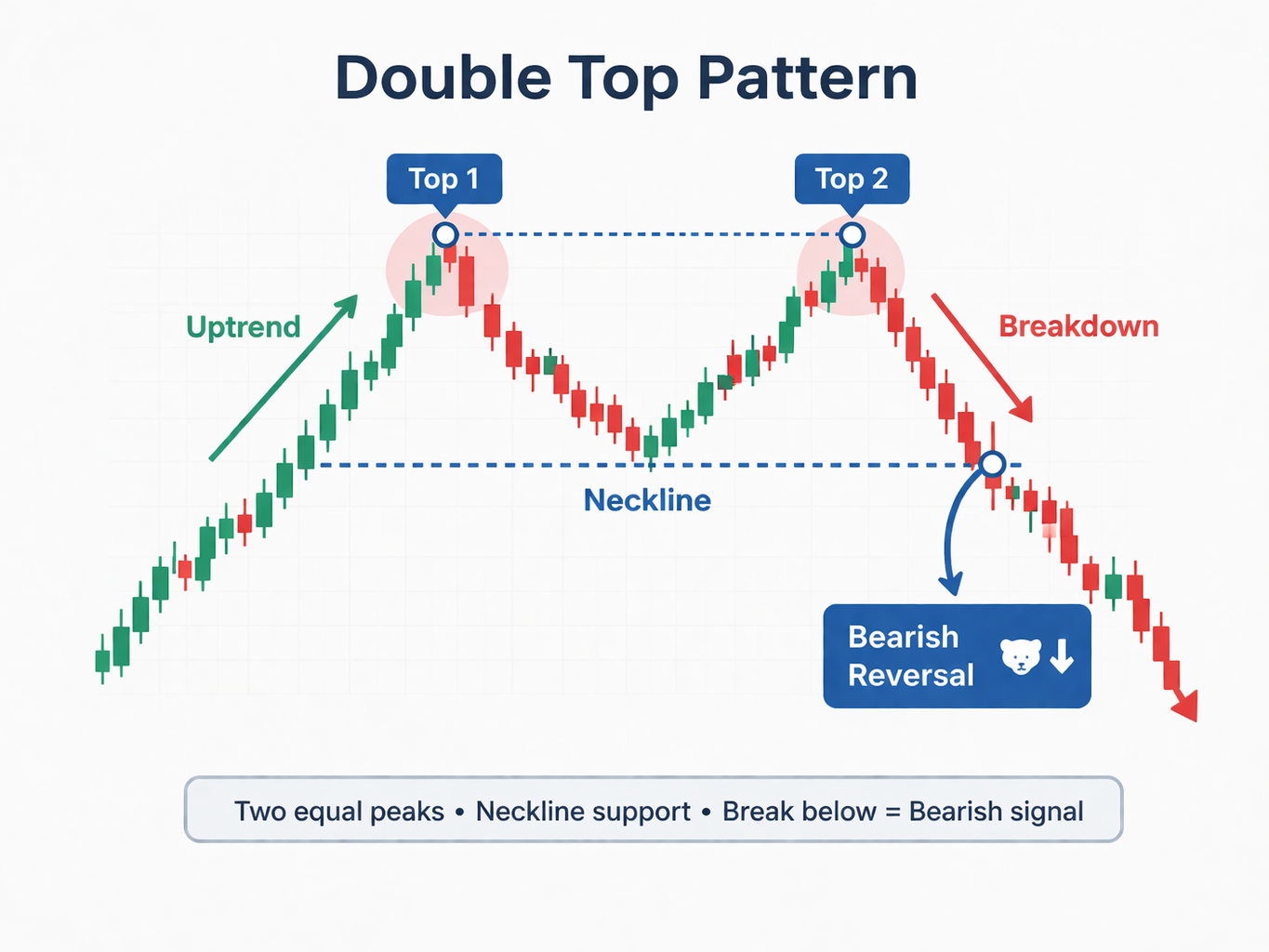
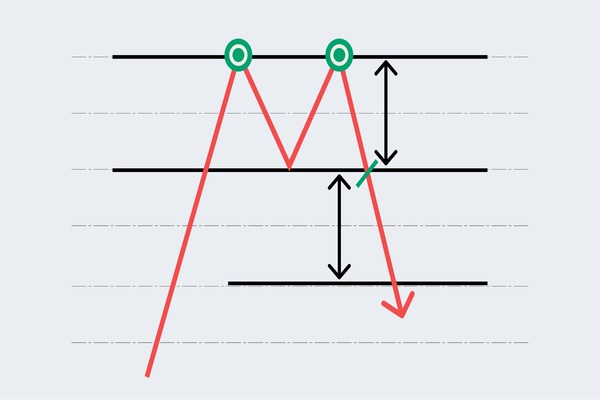
A double top forms at the end of an uptrend. Price rises to a high, pulls back, rises again to roughly the same high, then falls. The two peaks sit at about the same level. The low between them is called the valley or trough.
The line drawn across that low is the neckline. For a double top, the neckline acts as support. As long as price holds above it, the pattern is only forming, not confirmed.
The two peaks should be close in price. As a working guide, the difference between them is usually small, often under about 3%. The peaks are typically a few weeks apart on a daily chart, giving the market time to test the same level twice and fail both times.
The pattern is bearish because it shows a level that buyers could not break. Price reached the first peak; sellers pushed it back; buyers tried again; and sellers won a second time. When price then falls through the neckline, it shows that sellers have taken control.
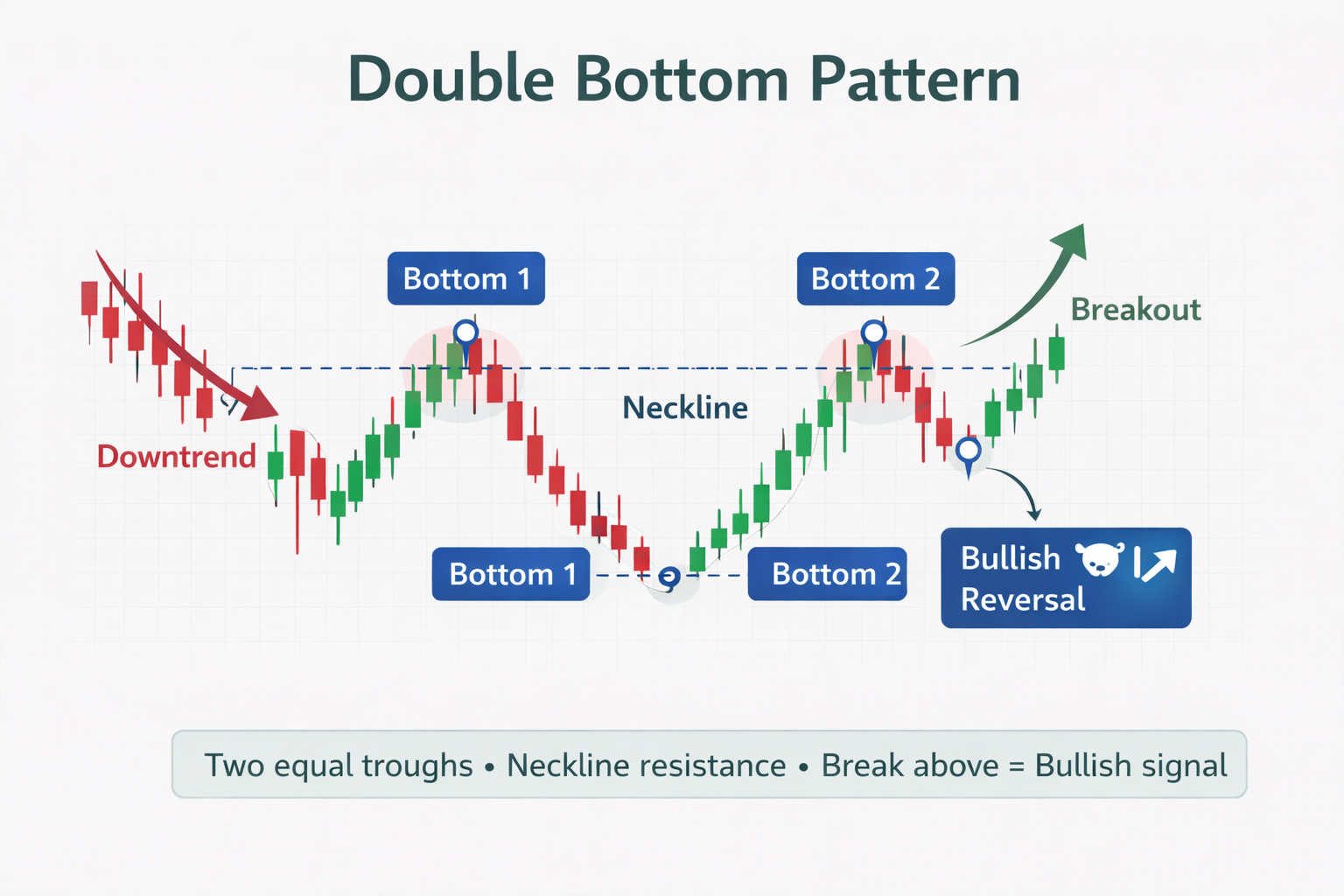
A double bottom is the mirror image. It forms at the end of a downtrend. Price falls to a low, bounces, falls again to roughly the same low, then rises. The two troughs sit at about the same level. The high between them is the peak.
The neckline for a double bottom is drawn across that middle peak. Here the neckline acts as resistance. The pattern is confirmed only when price closes above it.
As with the double top, the two lows should be close in price. In tested data on the classic form, the variation between the two bottoms is usually between 0% and 6%. The twin lows are most often two to seven weeks apart on a daily chart.
The pattern is bullish because it shows a level that sellers could not break. Buyers defended the same price twice. When price then rises above the neckline, it shows that buyers have taken control.
Feature |
Double top |
Double bottom |
Shape |
M |
W |
Forms after |
An uptrend |
A downtrend |
Signal |
Bearish reversal |
Bullish reversal |
Two extremes |
Two peaks (highs) |
Two troughs (lows) |
Neckline drawn at |
The low between the peaks |
The high between the troughs |
Neckline acts as |
Support |
Resistance |
Confirmed when price |
Closes below the neckline |
Closes above the neckline |
Target direction |
Down |
Up |
A double top only means something if there was an uptrend to reverse. A double bottom only means something if there was a downtrend to reverse. This is the point most beginners miss.
If price is moving sideways in a range, it will touch the same high twice and the same low twice as a matter of course. That is normal range behaviour, not a reversal pattern. Two touches of resistance inside a range is just resistance holding, not a double top.
Before you label a pattern, check the trend that came before it. No prior trend, no valid reversal.
The single most important rule is this: the pattern is not valid until price closes beyond the neckline. A close below the neckline confirms a double top. A close above the neckline confirms a double bottom. An intraday spike that reverses does not count. Wait for the candle to close.
Here is why waiting matters, backed by data. Trader and author Thomas Bulkowski, who has catalogued tens of thousands of chart patterns, found that when you see two peaks at a similar level, price fails to close below the valley between them about 60% of the time.
In other words, a twin-peak shape that has not yet broken the neckline continues higher, not lower, most of the time. For twin bottoms, there is about a 48% chance the price continues lower rather than confirming the pattern.
Read that again. An unconfirmed double top is more likely to keep rising than to break down. The shape alone tells you very little. The neckline break is what gives it meaning. Traders who short the second peak before confirmation are betting against the odds.
The standard method is the measured move. Measure the height of the pattern, then project that distance from the neckline toward the breakout.
For a double top, measure from the peaks down to the neckline. Subtract that distance from the neckline break point to get the target below.
For a double bottom, measure from the troughs up to the neckline. Add that distance to the neckline break point to get the target above.
A worked example in forex. Say EUR/USD forms a double bottom with both troughs near 1.0800 and the neckline at 1.1000. The height is 200 pips. Add 200 pips to the breakout at 1.1000 and the measured target is about 1.1200.
Treat this target as a minimum objective and a probability, not a guarantee. The data is clear on this. In Bulkowski’s figures for the classic double top, price reaches the full measured target only about 43% of the time.
For the classic double bottom, it reaches the target about 65% of the time. Many trades stall before the target or reverse. A sensible plan takes partial profit along the way rather than waiting for the full projection every time.
The invalidation level is the second extreme of the pattern. For a double top trade, a stop is conventionally placed just above the higher of the two peaks. If price returns above that level, the reversal has failed.
For a double bottom trade, a stop is conventionally placed just below the lower of the two troughs. If price falls back under that level, the pattern has broken down.
Compare the distance to your stop against the distance to your target to judge the risk and reward before entering. If the stop is far and the target is near, the trade may not be worth taking. You can read more on this in our guide to the risk-reward ratio.
In stocks, volume adds useful confirmation. Volume is often lower at the second peak of a double top or the second trough of a double bottom, indicating fading conviction. Volume then tends to expand on the neckline break, which shows the move has force behind it.
Forex traders face a catch here. The spot forex market is decentralised. There is no central exchange, so there is no single, true record of how much was traded. What your platform shows is tick volume, which counts price changes rather than actual contracts. Tick volume is a useful proxy for activity, but it is not the same as the actual volume reported by a stock exchange.
For forex, treat volume as a relative and directional clue, not an exact figure. Rising tick volume on a neckline break is a reasonable sign of participation. Do not read precise meaning into the numbers themselves.
This is the section most guides leave out. Every chart pattern fails at some point, and honest numbers help you properly size up risk.
The most cited data comes from Thomas Bulkowski’s Encyclopedia of Chart Patterns (3rd edition, 2021). He measures each pattern by variant and reports results on clean historical examples in rising markets. His figures for the classic forms are below.
Metric |
Double top (Eve & Eve) |
Double bottom (Eve & Eve) |
Break-even failure rate |
20% |
12% |
Average move after breakout |
16% decline |
50% rise |
Reaches measured target |
43% |
65% |
Throwback or pullback rate |
65% |
65% |
Source: Thomas Bulkowski, thepatternsite.com, figures updated August 2025.
Two cautions on these numbers. First, they come from US stocks in bull markets, measured on clean examples. They are the best public benchmark available, but they do not transfer one-for-one to forex or to falling markets.
Second, patterns fail more often now than they used to. Bulkowski’s study of nearly 14,000 patterns found that chart patterns fail several times more often in recent decades than in earlier ones, as more traders watch the same setups. Use the patterns, but do not expect the textbook outcome every time.
There is academic support for the claim that these shapes carry real information. A peer-reviewed study by Lo, Mamaysky and Wang, published in the Journal of Finance in 2000, applied statistical methods to decades of US stock data and found that several technical patterns, including the double bottom, do provide some added information.
A double top fails, or “busts,” when price breaks below the neckline as expected, then turns around and closes back above it. The expected decline never comes, and price often runs higher instead. A double bottom busts in the same way in reverse: price breaks above the neckline, then falls back below and keeps dropping.
This is why the stop-loss placement above the second peak or below the second trough matters. A busted pattern can move fast in the wrong direction. The retest, covered next, helps you tell a healthy breakout from a failing one.
After a breakout, price often returns to the neckline before continuing. This is called a throwback in a double top and a pullback in a double bottom. In the tested data, this retest happens about 65% of the time for both patterns.
A retest is normal. Many traders use it as a second, lower-risk entry: they wait for price to break the neckline, come back to test it, hold, and then move on again. The key difference between a healthy retest and a busted pattern is whether price holds beyond the neckline or closes back through it.
Two more shapes get confused with these patterns.
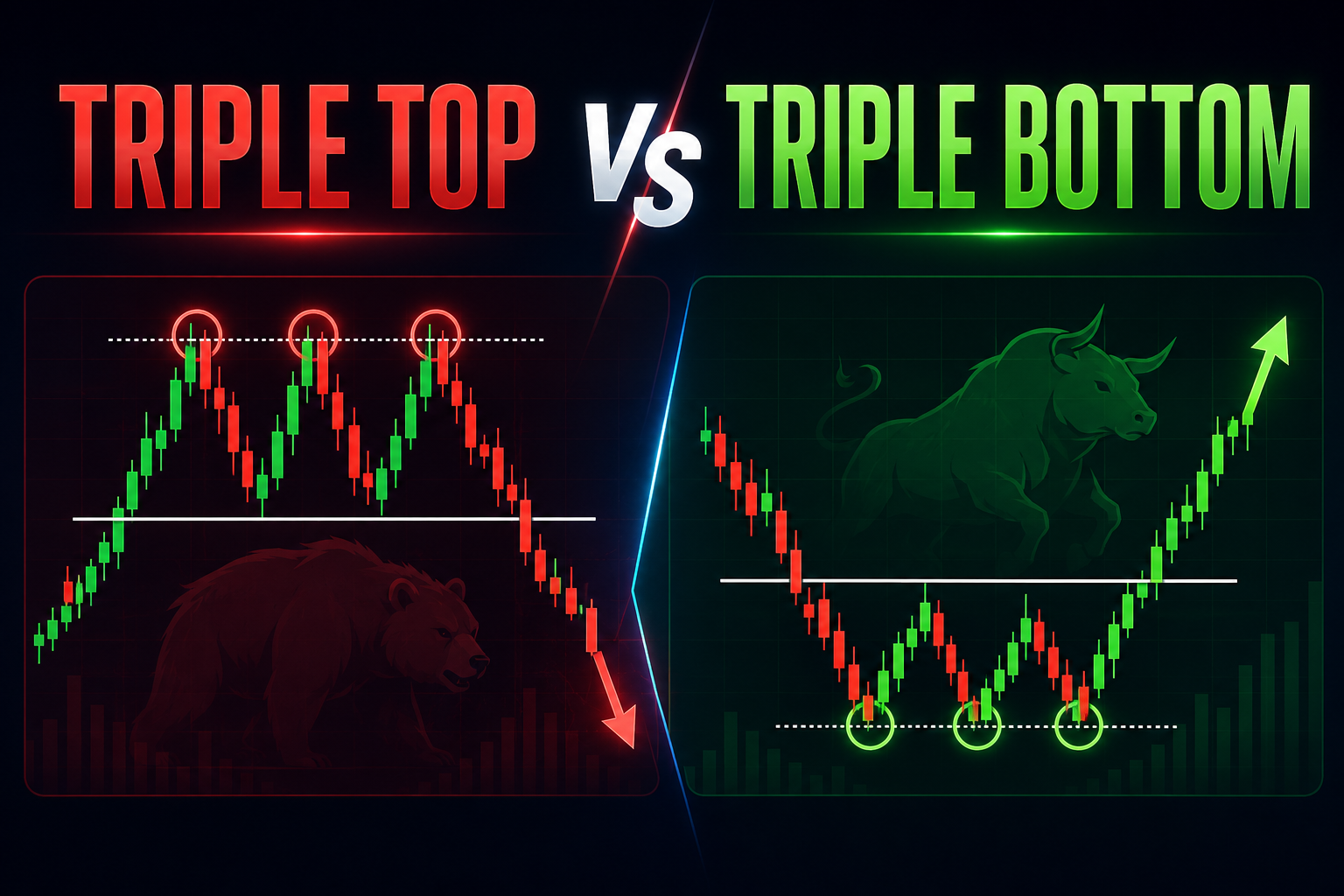
A triple top or triple bottom is the same idea, with three tests of the level rather than two. It carries similar meaning but takes longer to form.
A trading range is the bigger trap. In a range, price bounces between the same high and low repeatedly with no prior trend to reverse. Two touches of the top of a range is not a double top. The presence of a clear prior trend is what makes the pattern a reversal signal rather than ordinary range noise.
For more on related shapes, see the chart patterns hub and our guide to triple tops and bottoms.
Higher timeframes give more reliable patterns. A double bottom on a daily or weekly chart reflects the decisions of many traders over weeks. A double bottom on a one-minute chart reflects short-term noise and tends to fail more often.
Context also matters. A double bottom that forms against a strong longer-term downtrend faces more resistance than one that forms as a market is already turning. Read the pattern inside the bigger picture, not in isolation.
Entering before the neckline close. The most frequent error, and the data shows the shape alone favors the opposite direction most of the time.
Ignoring the prior trend. Without a trend to reverse, the pattern is not valid.
Expecting the full target every time. The measured move is a probability, not a promise.
Placing the stop too tight. The second extreme is the true invalidation level. A stop inside the pattern gets hit by normal noise.
Reading forex tick volume as exact volume. It is a proxy, not a true count.
A double bottom is bullish. It forms after a downtrend and signals that price may move up, but only once it closes above the neckline. A double top is bearish. It forms after an uptrend and signals that price may move down, but only once it closes below the neckline.
A double top looks like an M, forms after an uptrend, and is bearish. A double bottom looks like a W, forms after a downtrend, and is bullish. They are opposites in shape and direction.
It works some of the time, not always. In Bulkowski’s data on the classic form, price reaches the measured target about 43% of the time, and the pattern has a 20% break-even failure rate. Confirmation and a stop-loss are essential.
Wait for a candle to close beyond the neckline. A close below confirms a double top. A close above confirms a double bottom. An intraday spike alone is not confirmation.
The double top and double bottom are among the clearest reversal patterns to learn, which is exactly why they are so often misused. The shape is easy to see. The discipline is harder: wait for the neckline close, measure the target as a probability, place the stop at the true invalidation level, and accept that a real share of these patterns will fail.
The traders who get the most from these patterns are the ones who treat the failure rate as information rather than a flaw. Know that an unconfirmed double top usually keeps rising, that even a textbook pattern hits its full target less than half the time in the case of the double top, and that a retest of the neckline is normal.
Read the pattern inside the trend and the timeframe around it, and it becomes one useful tool among several, not a crystal ball.
To build on this, work through the chart patterns hub, then study the individual reversal and continuation shapes that often appear alongside these two.
Disclaimer: This material is for general information purposes only and is not intended as (and should not be considered to be) financial, investment or other advice on which reliance should be placed. No opinion given in the material constitutes a recommendation by EBC or the author that any particular investment, security, transaction or investment strategy is suitable for any specific person.